The chapter, as DCAA serves it
- Document
- DCAAM 7640.1, Chapter 7
- Title
- Fraud
- Revision
- September 3, 2026
- Length
- 13 pages, 17 numbered paragraphs
The short version
- 1Chapter 7 is now called Fraud, and it is short. It runs to 17 numbered paragraphs on referring suspected fraud, improper gifts, the contractor disclosure program and obstruction of audit. The cost guidance that used to live there is now a separate 75-chapter guidebook.
- 2Suspicion is the threshold, and you will not be told. An auditor does not have to prove fraud or intent to file a referral, and management may not talk them out of it. The referral is kept out of the audit report, out of the working papers, and away from the contracting officer, your employees and your attorney.
- 3A disclosure under FAR 52.203-13 starts a clock you do not control. It is high audit risk by default, the branch answers within 30 days and issues its disposition memorandum within 60, and a contractor who does not cooperate can have that treated as a denial of access to records.
- 4The office behind it reports real money. DCAA's Annual Report to Congress FY 2025 credits its Office of Investigative Support with contributing to recoveries of $689.9 million and 485 months of sentencing in that year, including a $428 million settlement over a weapon systems pricing scheme.
- 5The audits that feed all this are getting better tools. DCAA reports one team testing 100 percent of a contractor's indirect expenses with data analytics and another running incurred cost audits on generative AI, and its manual already tells auditors to use data analytics to reveal concealed charges. Under a chapter that asks for suspicion rather than proof, more anomalies found means more occasions to refer.
01What Chapter 7 was, and what it is now
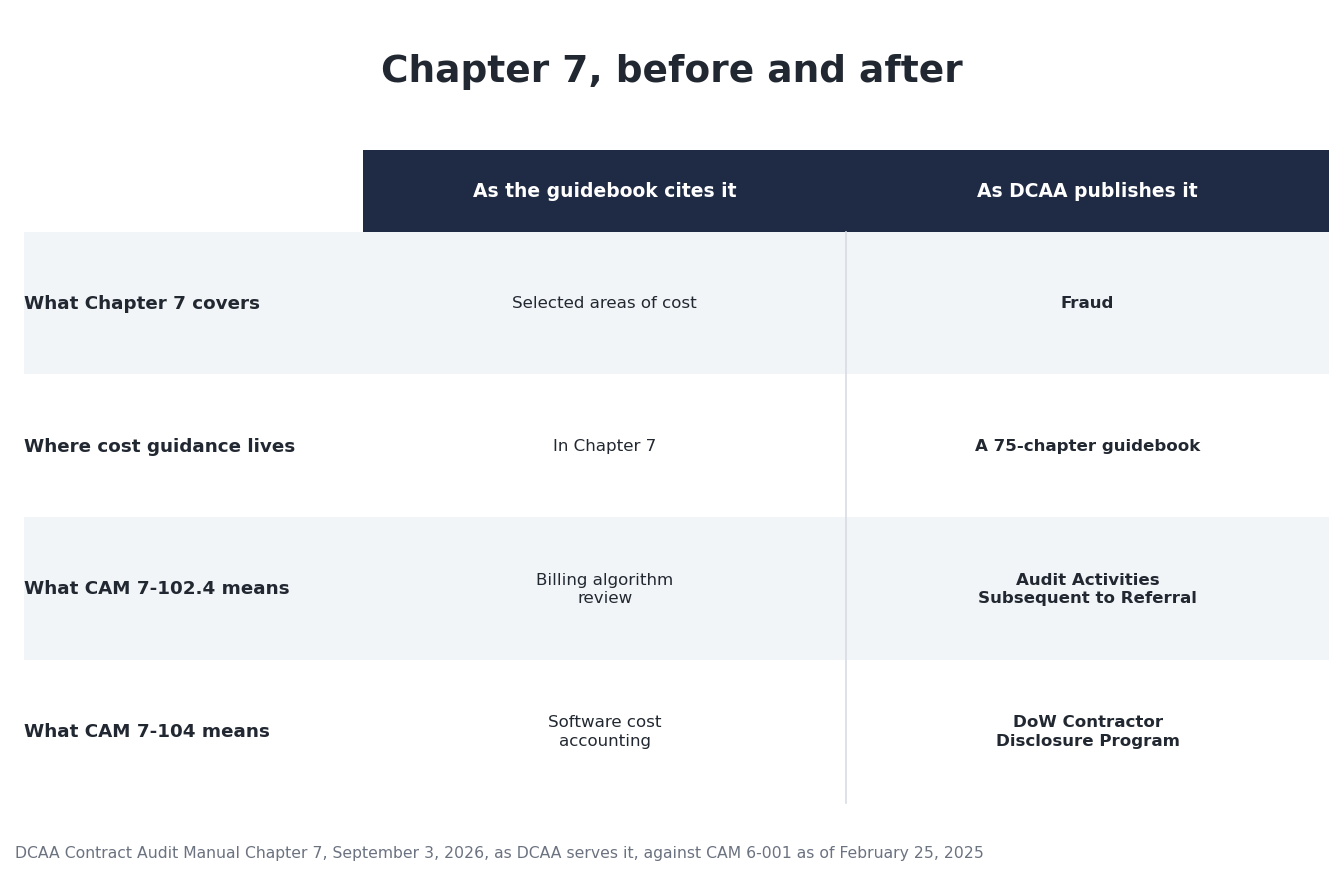
One term first. A selected area of cost is one line of the cost principles taken on its own: advertising, pensions, travel, legal fees. For most of the manual's life, Chapter 7 was where an auditor went for that. The manual said so in the neighboring chapter, in a revision DCAA no longer publishes and this platform still holds.
This chapter presents general guidance on auditing costs incurred under the broad types of contracts and functional areas of cost incurrence. Chapter 5 provides guidance on systems and internal control structure audits; Chapter 7 provides more specific guidance on auditing selected areas of cost; and Chapter 8 covers specific requirements of the Cost Accounting Standard Board rules, regulations and standards.
DCAA rewrote that chapter on August 19, 2026. Its scope paragraph is now one sentence long, and a search of the whole current chapter for the words "Chapter 7" returns zero hits. The cost guidance moved into guidebooks, and the one on selected areas of cost runs to 75 chapters of its own.
What replaced it is short. Chapter 7 is now titled Fraud, the one word DCAA's own index gives it, and it defines its subject broadly. For this chapter, fraud is "any willful or conscious wrongdoing, including, but not limited to, acts of cheating or dishonesty which contribute to a loss or injury to the Government".
Keep one thing in mind throughout. The manual is guidance to DCAA's own people, not a rule for you, and its front matter tells auditors not to cite it in audit reports or in correspondence outside the agency (CAM 0-002). You are not meant to see it quoted, which is a good reason to read it.
02The referral, step by step
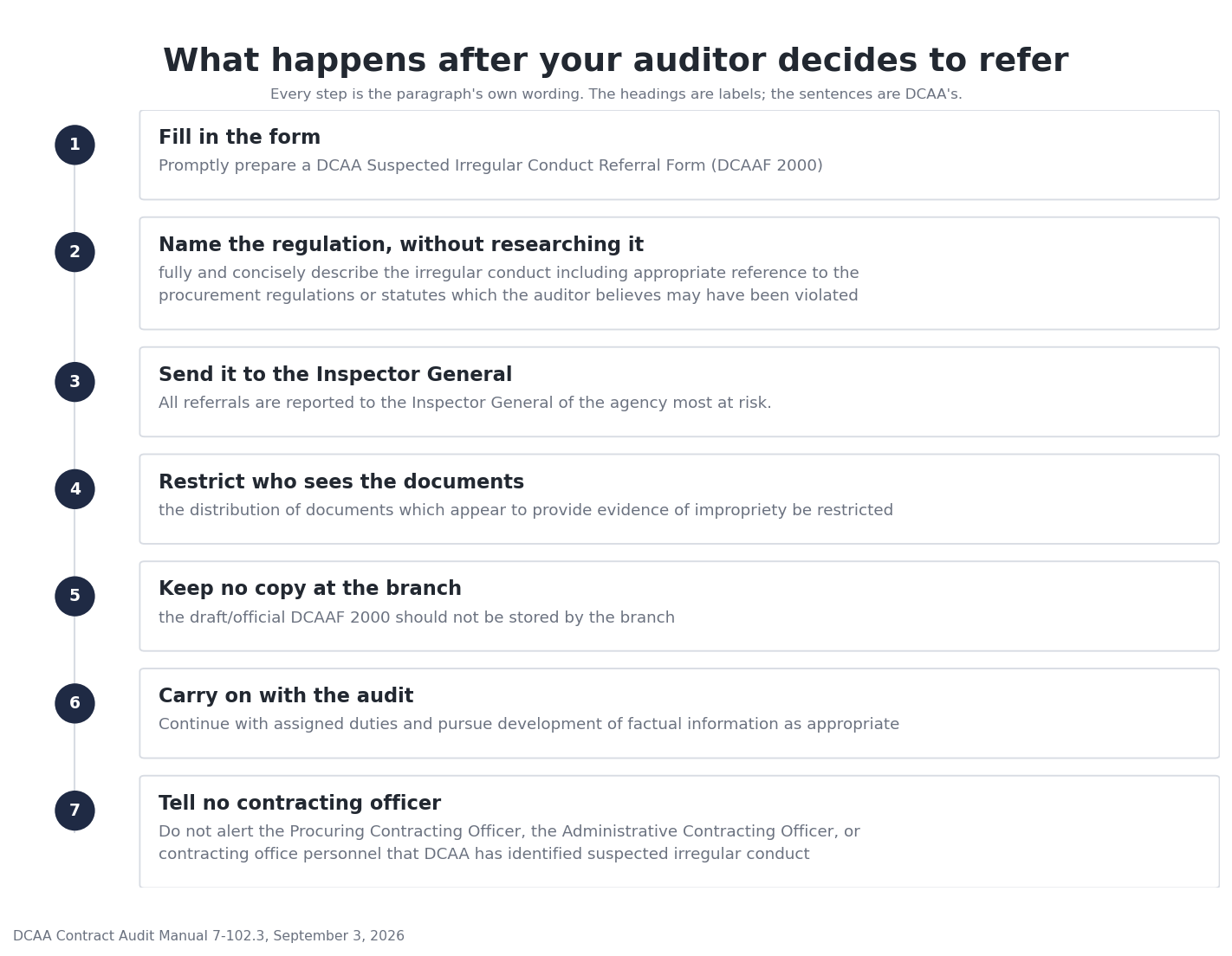
The instrument is a DCAA Form 2000, the Suspected Irregular Conduct Referral Form, and CAM 7-102.3 walks an auditor through seven steps for filing one. The first thing to understand about it is the threshold.
there is no requirement for the auditor to prove the existence or intent of fraud to submit a referral
A reasonable suspicion is enough. The auditor is told not to run down legal citations, since general references will do, and the form is open to any DCAA employee, not only the auditor in your conference room. And the auditor's supervisor is not allowed to talk them out of it.
Management review of the DCAAF 2000 prior to formal submission to OIS is not required, and should be limited to what is necessary to ensure clarity and completeness. Management should not dissuade an auditor from completing and submitting a DCAAF 2000.
You can read it yourself. This link opens on CAM 7-102.3 in the manual reader on this site, which is free with an account. It is the whole chapter, word for word, at the revision DCAA publishes.
03What your auditor will not tell you
This is the part that changes how you should read an audit. A referral is designed to be invisible from where you sit, and the chapter says so in four places.
Where a referral does not appear
Not in the working papers
auditors should not reference the DCAAF 2000 in the working papers
CAM 7-102.3
Not in the audit report
Do not make reference in the audit report to suspected irregular conduct or a referral for investigation.
CAM 7-102.4
Not to you or your counsel
Information relating to a matter referred for investigation will be protected and not released or disclosed to a contractor, or a contractor's employee, representative, or attorney.
CAM 7-102.4
Not ever, by anyone at DCAA
No DCAA employee should inform a contractor that it is under investigation.
CAM 7-102.5
The contracting officer is kept out of it too, until the investigative office says otherwise. So is the branch itself. Once the form is filed the work passes to a separate office, and the chapter is blunt about it: "Branch auditors should not support fraud related investigations."
One consequence is worth sitting with. If an audit goes quiet, or a report does not arrive, that is not by itself evidence of anything. The chapter's default is that the work carries on: "Audit activities outside the area of investigative interest will continue unless the investigative organization requests in writing" that they be deferred or suspended. But a pause is possible, and nobody would tell you the reason for it.
04Disclosure, and the clock it starts
The other half of the chapter is the contractor disclosure program, which runs on FAR 52.203-13, the Contractor Code of Business Ethics and Conduct. The clause requires timely written disclosure of credible evidence of certain criminal violations or of a violation of the civil False Claims Act. It reaches contracts and subcontracts expected to exceed $5 million with a period of performance of 120 days or more, and the Department implements it at DFARS 203.1004.
Failing to disclose is separately a cause for debarment and for suspension, at FAR 9.406-2 and FAR 9.407-2.
A disclosure does not go to DCAA. It goes to the Inspector General, who routes it, and the first thing the chapter tells a DCAA office is what it may not take: "Under no circumstances are DCAA personnel to accept refund checks."
From there the clock is the agency's, not yours. The branch answers within 30 days; the disposition analysis and the memorandum to the contracting officer are expected within 60. The work is opened under its own assignment code, 17920, so the program stays visible.
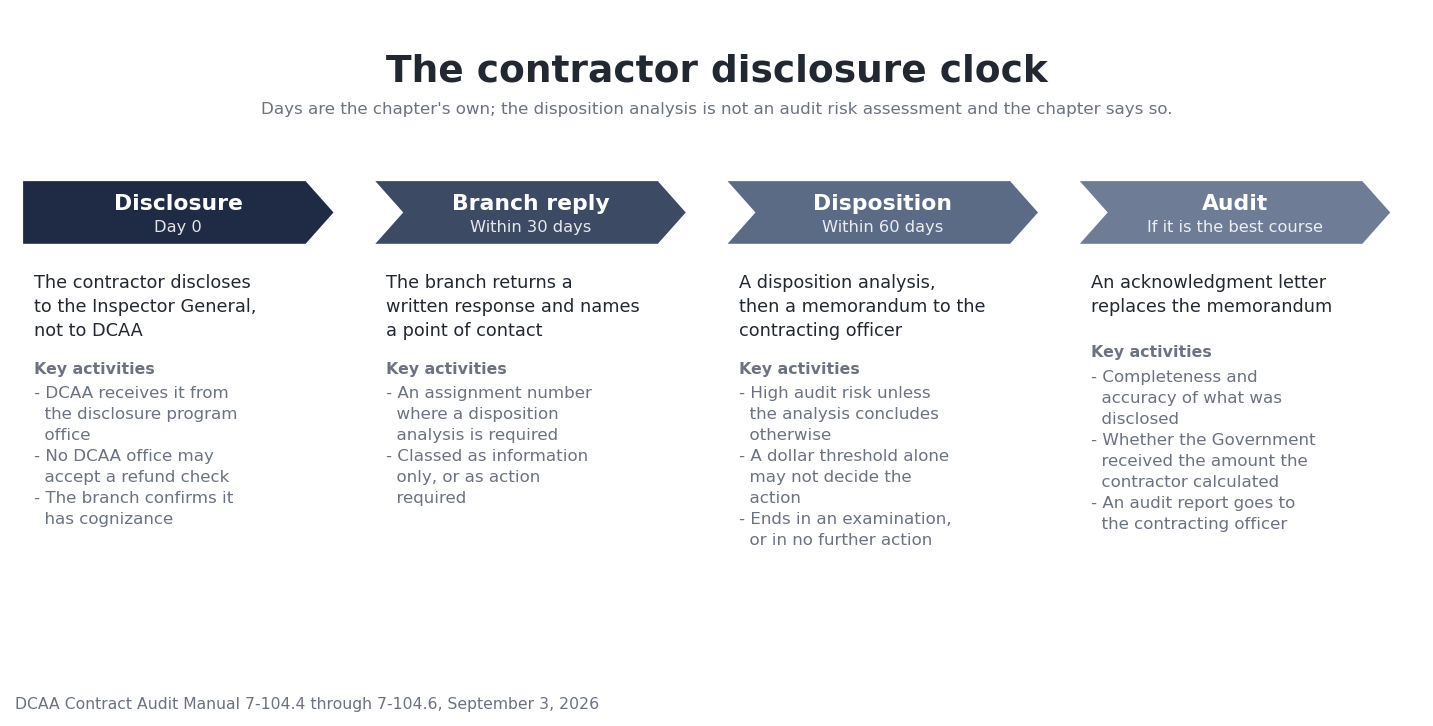
Two sentences matter most if you are the one disclosing. The first is the default posture: a disclosure "should be considered as high audit risk due to the contractor's disclosure of credible evidence of fraud and its potential damage to the Government", and an auditor may conclude otherwise only after doing the analysis. The second is about cooperation. Go slow on the supporting records and the branch manager is told to "consider the contractor's lack of cooperation in supporting their disclosure as a denial of access to contractor records".
05Obstruction, and what it looks like charged
The chapter closes on Title 18 U.S.C. section 1516, which makes it a crime to obstruct a federal auditor with intent to deceive or defraud the Government. The paragraph is more protective of contractors than its heading suggests.
The provision does not make it a crime to deny an auditor access to records unless the purpose of the denial is to prevent such discovery.
Withholding records is not the offense. Withholding them to stop an auditor finding fraud is. The chapter says it again a paragraph later: "The mere denial of access to records; however, is not by itself a reasonable basis to suspect fraud." An access dispute is handled under its own instruction, and it is worth knowing that DCAA's own manual draws that line.
What the statute does reach is visible in a live matter. On December 10, 2025 the Department of Justice announced an indictment of a former senior manager at a government contractor that includes two counts of obstructing a federal audit. The conduct alleged is not a refusal to hand over records.
allegedly sought to influence and obstruct third-party assessors during required audits in 2020 and 2021 by concealing deficiencies and instructing others to hide the true state of the system during testing and demonstrations
The auditors there were third-party assessors under a cloud security program, not DCAA auditors, which is the point: the statute protects a federal audit, whoever is conducting it.
Charged, not proven
Senior Manager for Government Contractor Charged in Cybersecurity Fraud Scheme
- Announced
- December 10, 2025
- Obstruction counts
- 2
- Maximum, each count
- 5 years
What is alleged. The Department describes "a multi-year scheme to mislead federal agencies about the security of a cloud-based platform used by the U.S. Army and other government customers", running from approximately March 2020 through at least November 2021. The indictment alleges the defendant falsely represented that security controls were implemented at the FedRAMP High baseline and at Department of Defense Impact Levels 4 and 5, despite repeated warnings that the system lacked required access controls, logging, monitoring, and other security capabilities.
The charges. The indictment brings two counts of wire fraud, one count of major government fraud and two counts of obstruction of a federal audit.
Who is investigating. The GSA-OIG, Defense Criminal Investigative Service, Naval Criminal Investigative Service and The Department of the Army Criminal Investigation Division are investigating the case. These are the kind of investigative organizations Chapter 7 tells DCAA to support.
An indictment is merely an allegation. All defendants are presumed innocent until proven guilty beyond a reasonable doubt in a court of law.
Department of Justice, release 25-1162
06The office behind it, and where a referral ends up
The chapter describes an office rather than a person: Operations Investigative Support, which receives the forms, supports the investigators and tells the branch when to stop. You can check that the office is real, and staffed, without taking DCAA's word for it, because the federal government advertises the jobs. Of 2,497 DCAA announcements published since February 2, 2017, 68 are for this function.
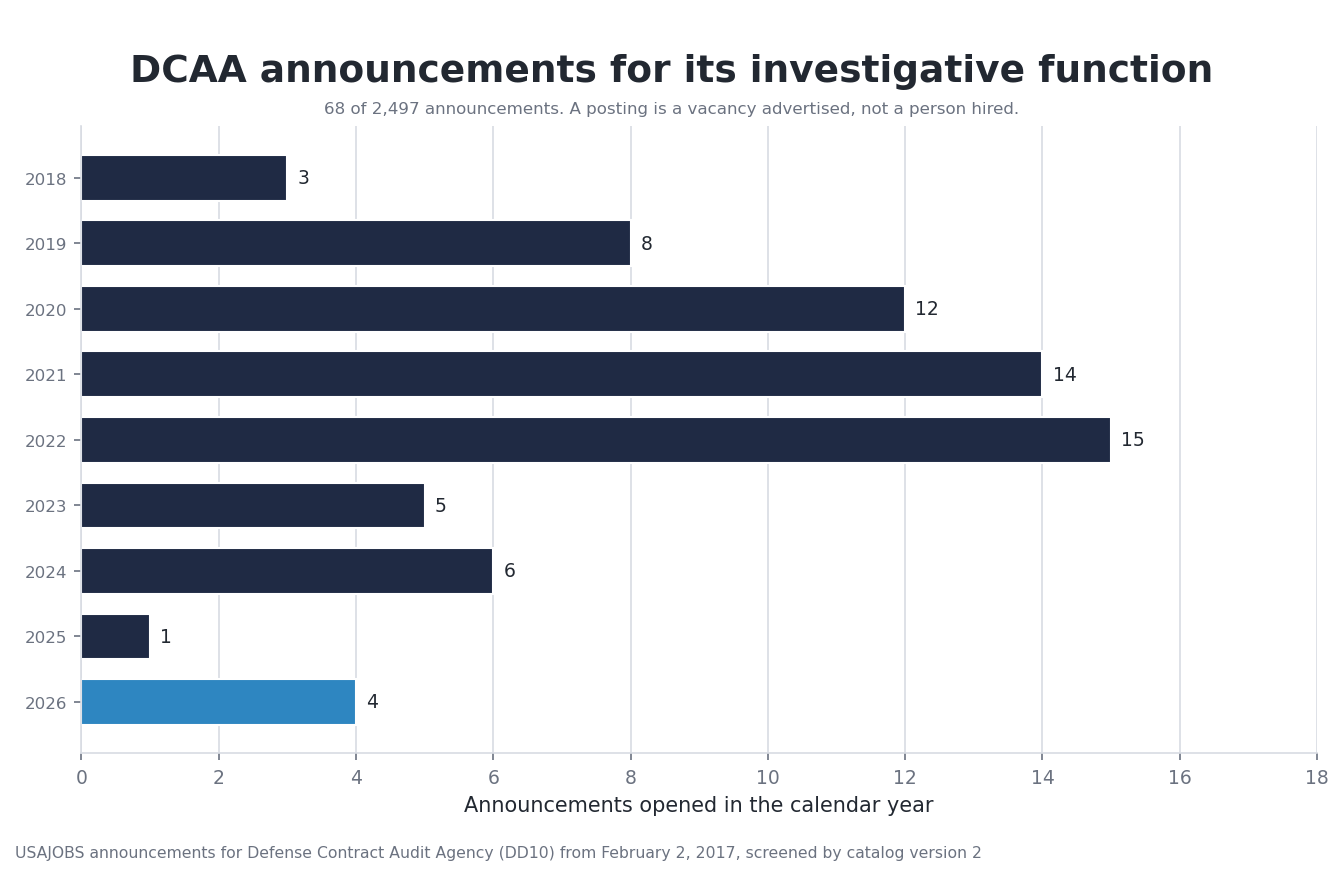
Read the chart honestly: this is a standing capability, not a new one. The busiest year was 2022, with 15 announcements, and the years since have been quieter.
Most of those postings are for one job. 43 of the 68 carry the title "Auditor (Investigative Support)", and the most recent, opened April 10, 2024, is a GS-12 position in the headquarters division the chapter sends every referral to. This is not the auditor in your conference room. It is the auditor who picks the file up after that one has filed the form, and the announcement says what they do with it: "Plans and conducts analyses of defense contractor's records where Suspected Irregular Conduct (SIC) or potential fraud has been identified."
What they test is the ordinary paper of a cost-type contract: "Provides advisory services by performing tests and analyses of contractor's cost representations, billings, invoices, time cards, labor charges, internal controls, policies, practices pertinent to the specific SIC case or grand jury investigation." Then the findings leave DCAA: "Develops draft advisory memorandum of findings, conclusions and recommendations for cognizant Defense Criminal Investigative Organizations (DCIOs), Military Investigative Organizations (MCIOs) and Department of Defense Inspector General (DoDIG)."
And the work may not end with a memorandum.
May serve as a witness before judicial, quasi-judicial or administrative bodies and/or may provide a variety of technical litigation support to U.S. attorneys, preparing evidence for the grand jury or for trial.
On June 16, 2026, 11 weeks before this chapter was published, DCAA advertised for the person who runs that office. The title is Supervisory Auditor (Division Chief, Operations Investigative Support), and it is a title the chapter uses: every contractor disclosure reaches DCAA through this one desk (CAM 7-104.4). The first duty the announcement lists is advisory, and it says who the office answers to: "Serves as the principal technical advisor and consultant to the General Counsel on highly complex, controversial, and sensitive technical matters related to investigative services for procurement fraud activities."
The second is running the investigative function and its fraud programs. The third names who the office deals with, and they are the ones a referral is handed to: "Represents the Operations investigative services function on complex audit and financial issues with external organizations such as the Department of Justice (DoJ), Department of Defense Inspector General (DoDIG), and other investigative bodies."
The chief also runs the agency's technical training for the investigative function and supervises its staff. It is a GS-15 post, advertised at $169,279 to $197,200.
None of that is a claim about output. For output, DCAA reports to Congress, and its Annual Report to Congress FY 2025 gives the office a section of its own. Note what it claims: that the office's support contributed to these outcomes, not that it produced them, which is the right claim for an office that supplies analysis to investigators and prosecutors.
What the office reports for FY 2025
$689.9 million
recovered through investigations and prosecutions its support contributed to
485
months of sentencing, alongside other sanctions
- $428 milliona weapon systems pricing scheme
- $86 millionthe TRICARE military healthcare program
- $62 millionfalse cost and pricing data submissions
DCAA Annual Report to Congress FY 2025, 18 pages
Two of the three cases the report names are pricing cases, which is to say they began in the kind of cost and pricing data a contractor files routinely.
The Department of Justice publishes the other end. This platform holds 944 DoJ press releases announcing False Claims Act matters in federal procurement, from January 6, 2009 to September 15, 2026. The Defense Criminal Investigative Service, one of the investigative organizations the chapter tells DCAA to support, is named in 384 of them, and DCAA itself in 153.
The Department's own statistics separate the two ways a matter opens. A qui tam action is filed by a whistleblower. Everything else is a referral or an investigation, which is the lane a DCAA Form 2000 feeds.
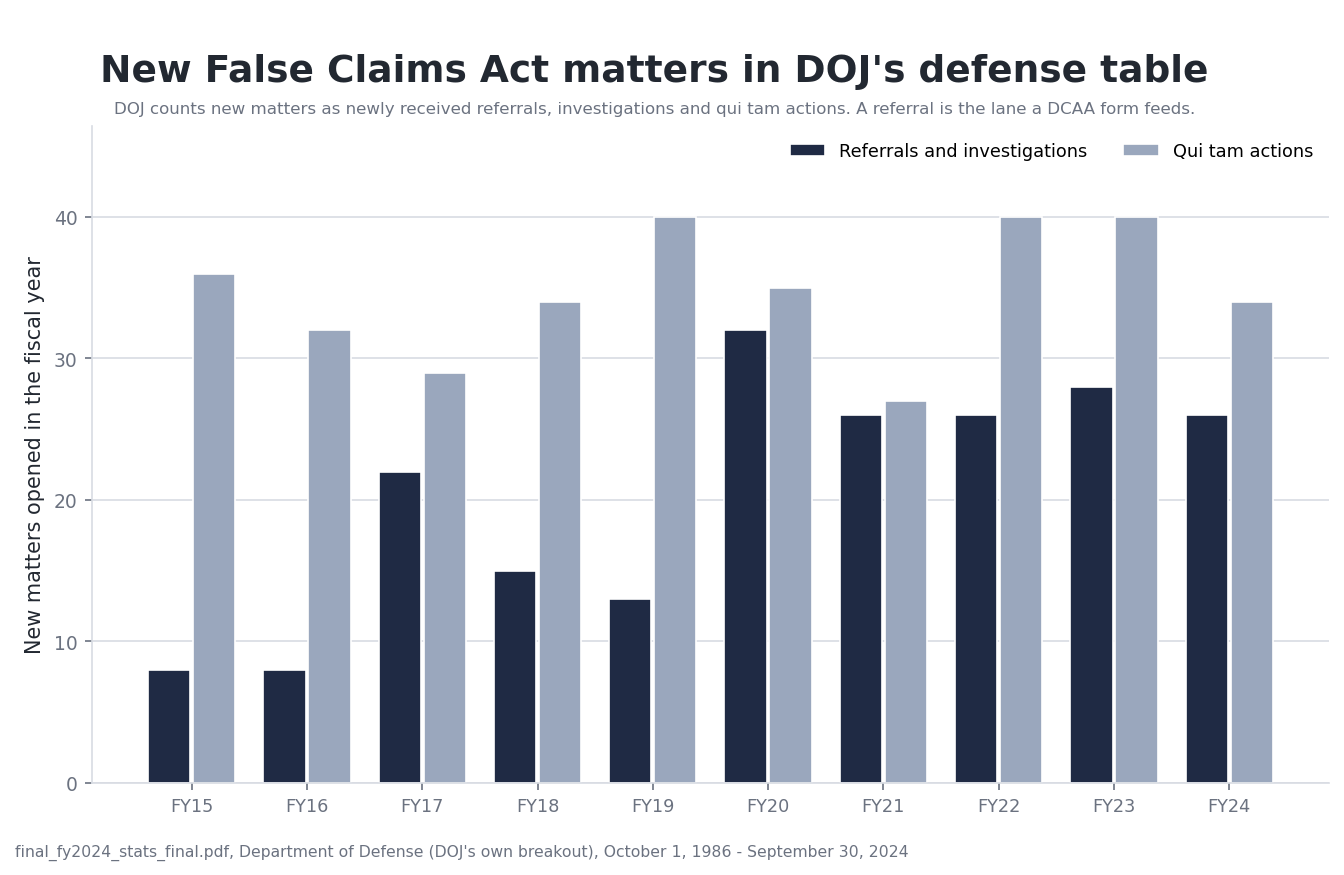
Two things follow for a contractor. The first is scale: the referral lane has run between 8 and 32 new defense matters a year across that span, not a wave, and most of them will never touch you. The second is that this is the lane you get no notice of. A whistleblower complaint surfaces eventually. A referral may simply be a quiet audit.
07What generative AI changes
Everything above describes a pipeline fed by what an auditor happens to notice. That is the part now changing, and DCAA says so itself. On September 15, 2026 its newsroom described a New York branch team that audited a major contractor's incurred costs and forward pricing rates using AI and data analytics. One sentence of that account matters more than the rest.
They leveraged data analytics to test 100 percent of indirect expenses across numerous accounts, which allowed the team to focus on higher-risk areas and identify multiple instances of expressly unallowable costs.
Testing 100 percent of the expenses in an account is not a sample. And what it found was expressly unallowable cost, the category the manual says carries penalties (CAM 6-107). The team pointed AI at the rules as well: "The auditors also utilized AI for deep regulatory research, significantly reducing the time needed to identify material CAS noncompliances."
It was not a one-off. A week earlier the same newsroom described a Nashville branch running two incurred cost audits, over $282 million in proposed costs, on generative AI. It says where the tools were pointed: "the team used custom data analytic software to target higher-risk accounts without sacrificing accuracy and excellence".
The tools behind those results are not improvised. GenAI.mil, the Department's AI platform, launched on December 9, 2025 with a promise: "Additional world-class AI models will be available to all civilians, contractors, and military personnel, delivering on the White House's AI Action Plan announced earlier this year." On August 31, 2026 it added OpenAI's ChatGPT Mil.
And the models keep moving. On September 17, 2026 OpenAI introduced Astra for Law, built on its latest and most powerful model and tuned for legal research: it searches U.S. case law, statutes, regulations, court rules and administrative decisions across more than 230 million URLs. It is offered first to selected law firms, and the announcement does not mention the Department or GenAI.mil, so do not read it as a tool your auditor has today. It shows where these tools are going. The New York team above already used AI to research the rules, and a model built to search regulations and administrative decisions does that same job faster.
DCAA talks about its own work the same way: "In FY 2025, DCAA leveraged cutting-edge technology and strategic collaboration to deliver unprecedented financial returns for the DoW." And it has the people to match. DCAA has top data analytics auditors, AI specialists and data scientists, and it is training its auditors in data analytics and AI. The Department adds training of its own: "The Department is providing no-cost training for GenAI.mil to all DoW employees."
None of this is a new idea at DCAA. Its manual already told incurred cost auditors what concealment looks like in a ledger, and what to use against it.
A common method used to make improper charges to flexibly priced contracts is to change the account number to which a vendor invoice is charged. Accordingly, be alert for accounting miscommunication intended to conceal the true purpose of an expenditure. Also, consider applying data analytics techniques to reveal these types of inconsistencies.
The investigative side is tooling up the same way. The newest posting for the office that takes over a referral, a GS-12 Investigative Support Auditor opened August 19, 2026, writes the method into the duties: "Uses statistical sampling, improvement curves, and quantitative software to gather and analyze complex accounting data." Across the agency, DCAA has posted 12 announcements for data analytics, data science and AI roles since February 2, 2017.
Now set all of that beside Chapter 7. The chapter says "auditors need to assess fraud risk, develop procedures to mitigate risk", and it sets the bar for a referral at reasonable suspicion. An auditor working a sample sees a handful of oddities a year. An audit that tests every expense sees all of them, including every vendor invoice recoded to a different account, which is the exact pattern the manual names above. Each one is an occasion for suspicion under a chapter that does not ask for proof.
That last step is our reading, not a claim DCAA has made. Neither newsroom account uses the word fraud: both are about unallowable costs and audits finished early. DCAA's report to Congress credits AI with savings and credits the investigative office with recoveries, and it never names the two in the same sentence.
What you can do about it has nothing to do with AI. An anomaly is not fraud. Under this chapter it does not have to be to start a referral you will never see. The reclassification with a memo behind it, and the journal entry whose reason was written down when it was made, are what turn a flagged transaction back into an ordinary one, and the time to find them is before your auditor does. We read everything DCAA has published on its use of AI in a separate piece.
GovConDash.ai
Your auditor has world-class AI. Look at your own ledger first.
DCAA reports testing every indirect expense on an audit. Accounting Tools in GovConDash lets you go through your own books first: Ledger Scan runs a general ledger against 351 terms, 211 of them tied to a FAR 31.205 cost principle, and shows you what it flags while there is still time to document it. Uploading a ledger is free with an account, and so is the manual reader; the AI analysis needs a paid plan.
08Reading the manual in GovConDash
Every quotation from the manual above came out of a reader we built for exactly this problem. DCAA publishes the manual as a set of chapter PDFs and replaces them in place, so the revision that said what Chapter 7 was for is no longer downloadable anywhere. The Contract Audit Manual sub-tab keeps them: 18 chapters across 26 revisions, 1,892 numbered paragraphs, with eight chapters held at more than one revision.
Audit Readiness / Contract Audit Manual
The manual, by paragraph
The whole manual, chapter by chapter, including the older revisions DCAA has since replaced. Every paragraph shows the date of the revision it comes from, so you always know which version you are reading.
Accounting Tools / Ledger Scan
Test every expense before they do
The same idea, pointed at your own books. Upload a general ledger and a deterministic keyword screen runs every transaction against 351 terms: 211 tied to a FAR 31.205 cost principle and 140 red-flag words worth a second look. A match is an item to review, not a compliance determination. Uploading and previewing is free; the AI analysis needs a paid plan.
Audit Readiness / Selected Areas of Cost
The guidebook that took over
All 75 chapters of the cost guidebook, beside the manual rather than buried behind it. It is where your auditor now goes for a question about a cost.
False Claims Act
Where the referrals surface
Every Department of Justice procurement matter in the corpus above, 944 of them, browsable and charted, with the Department's own fraud statistics behind the figures rather than a count of press releases.
Audit Readiness / Research Agent
Ask it a question
The research agent answers out of the same stored paragraphs and cites the ones it read, so you can open each citation and check it. It needs a paid plan; the reader does not.
A link into the reader opens on the paragraph rather than on page one of a PDF. Try CAM 7-104.6, the high-risk default, or CAM 7-105, the obstruction paragraph. Both are free with an account. No paid plan is needed to read the manual.
Documents and data used in this piece
Every quotation above was checked against a stored copy of its source before this page was written, 112 checks in all, and the chapter itself was also checked against the PDF on DCAA's own site on September 20, 2026. Counts were computed from the data, not typed. Each link below opens the publisher's own site or document.
The chapter
- DCAA Contract Audit Manual, Chapter 7: Fraud (September 3, 2026)
The chapter this piece reads, as DCAA publishes it.
- DCAA's own Contract Audit Manual index
The page DCAA publishes every chapter of the manual on.
The regulation
- FAR 52.203-13, Contractor Code of Business Ethics and Conduct
The regulation itself, on the eCFR.
- FAR 9.406-2, Causes for debarment
The regulation itself, on the eCFR.
- FAR 9.407-2, Causes for suspension
The regulation itself, on the eCFR.
- DFARS 203.1004, Contract clauses
The regulation itself, on the eCFR.
Who DCAA pays to do this
- USAJOBS: Auditor (Investigative Support), opened April 10, 2024
The announcement DCAA posted for the role that does this work.
- USAJOBS: Supervisory Auditor (Division Chief, Operations Investigative Support), opened June 16, 2026
The announcement DCAA posted for the person who runs that office.
- DCAA Annual Report to Congress FY 2025
DCAA's own account to Congress of what its investigative office produced.
Generative AI and data analytics
- Department of War Launches OpenAI's ChatGPT Mil on GenAI.mil (Department of War, August 31, 2026)
The Department's announcement that OpenAI's ChatGPT Mil is on its AI platform.
- The War Department Unleashes AI on New GenAI.mil Platform (Department of War, December 9, 2025)
The Department's launch of GenAI.mil, the AI platform on every desktop.
- Introducing Astra for Law (OpenAI, September 17, 2026)
OpenAI's announcement of its model for legal research, offered first to law firms.
- New York Branch Office Delivers High-Impact Results Ahead of Schedule (DCAA, September 15, 2026)
DCAA's own account of a team that tested every indirect expense with data analytics.
- DCAA Nashville Team Leverages Technology to Deliver Rapid, High-Impact Audits for Department of Energy (DCAA, September 8, 2026)
DCAA's own account of two incurred cost audits run on generative AI.
- USAJOBS: Investigative Support Auditor, opened August 19, 2026
The investigative office's newest posting, which lists quantitative software among its methods.
Where a referral ends up
- Senior Manager for Government Contractor Charged in Cybersecurity Fraud Scheme (Department of Justice, December 10, 2025)
The Department's announcement of the indictment. An indictment is an allegation, not a conviction.
- Fraud Statistics, Overview, October 1, 1986 - September 30, 2024
The Civil Division's own record of what it recovers under the False Claims Act each year.
- The Department of Justice's own False Claims Act page
The Department's False Claims Act page, where those statistics are published.
This piece is commentary on published audit guidance and on regulations as the eCFR carries them. It is not legal advice, and it is not a determination about any contractor, any contract, any audit or any disclosure. The Contract Audit Manual is guidance to DCAA personnel and does not itself create obligations for a contractor. If you believe you may have a disclosure obligation, talk to counsel before you talk to anyone else.

Keep reading
The Pentagon Put AI on Every Computer. Your DCAA Auditor Is on It Too.The other half of what DCAA is doing to its own practice: the agency's published account of running incurred cost audits on generative AI, quoted rather than characterized.