
The short version
- 1Cost-type work is now the exception, and it has to be written down. The order says any contract that is not fixed-price "must be justified in writing by the contracting officer to the agency head". Above the agency's line, the agency head approves it in writing.
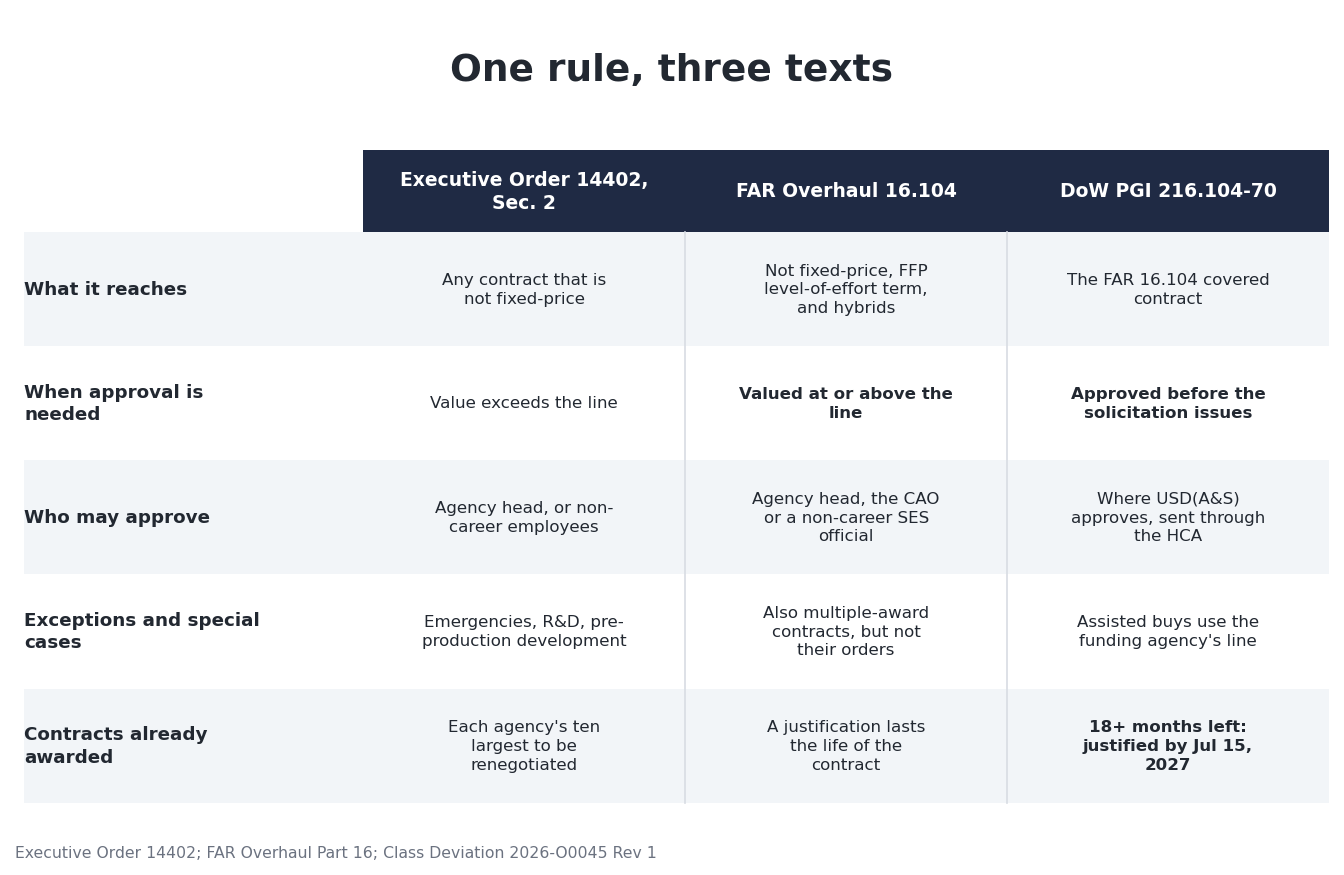
- 2The FAR text that carries it is not the order word for word. It applies at or above the line rather than above it, adds firm-fixed-price level-of-effort term contracts, and narrows who may approve. Multiple-award contracts are excepted, but the orders under them are not.
- 3At the Department of War, the clock is already running. Since July 15, 2026, covered solicitations need an approved justification before they issue. Existing covered contracts with 18 or more months left need one by July 15, 2027.
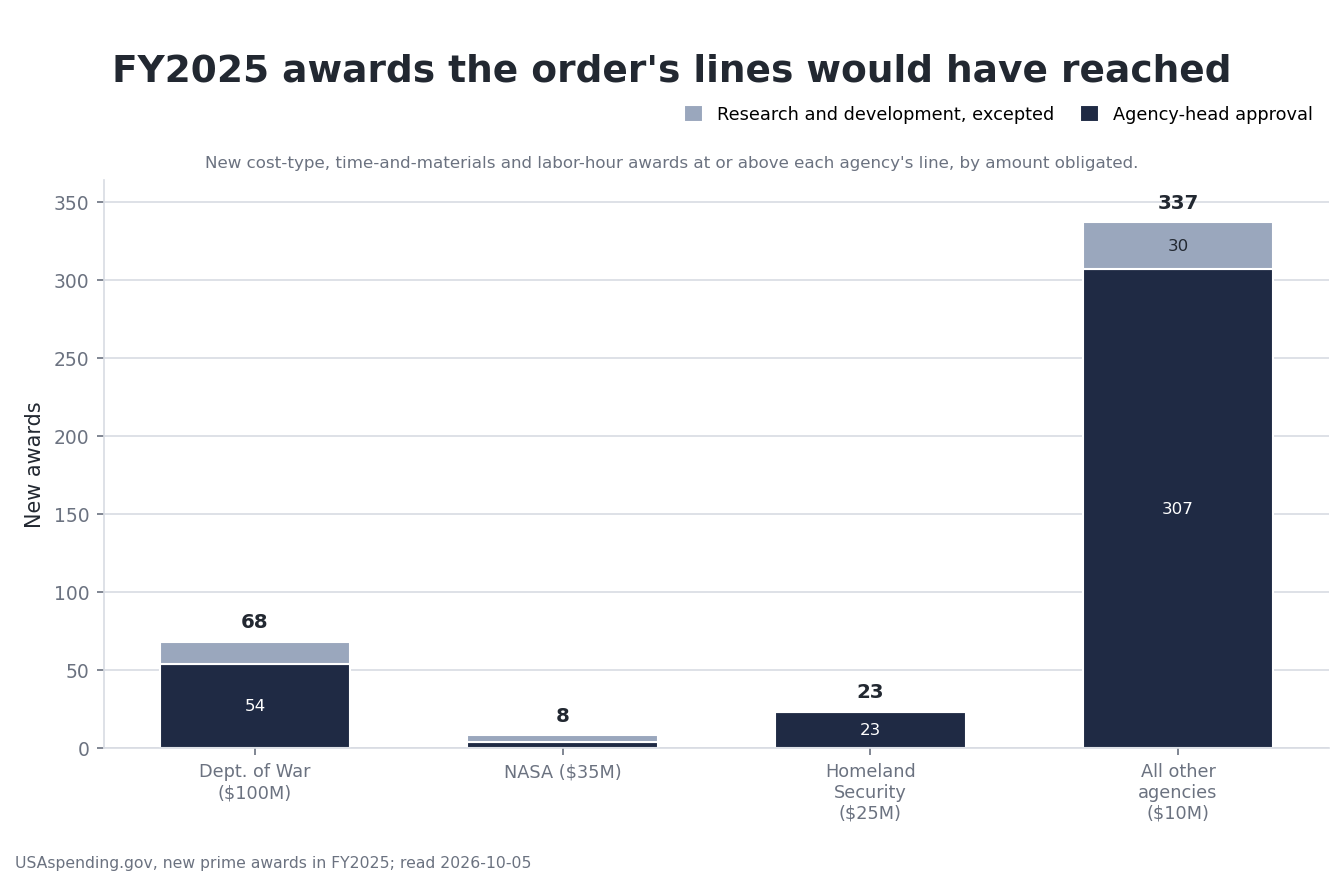
- 4Most of the awards the lines reach are at civilian agencies. In FY2025, 436 new awards that were not fixed-price would have crossed a line, 337 of them under the $10 million line that covers every agency but the three the order names.
- 5The preference is not new. The signature is. A presidential memorandum preferred fixed-price contracts in 2009, Better Buying Power pushed fixed-price incentive contracts from 2010, and the FAR has limited cost-reimbursement contracts since 2012. The agency head's approval and the dates are what the order adds.
One term before the details
- Covered contract
- The FAR Overhaul's name for what needs the justification: a contract or order that is other than fixed-price, a firm-fixed-price level-of-effort term contract, or a hybrid that includes either. Fixed-price means the fixed-price types in FAR Part 16, so a fixed-price incentive contract counts as fixed-price. Time-and-materials and labor-hour contracts do not.
01What Section 2 of the order requires
The order states its policy plainly: "fixed-price contracts with performance-based considerations should serve as the default and preferred method of procurement". Of cost-reimbursement contracting it says: "it should be the exception, granted only in limited circumstances and with appropriate senior-level accountability at the agency".
It puts a figure on the stakes from its own review of Fiscal Year 2024: "approximately $120 billion obligated on cost-reimbursement consulting contracts alone". Section 2 then turns the policy into a rule. It opens:
"To the maximum extent consistent with law, and except as provided in subsection (b) of this section, executive branch departments and agencies (agencies) shall, in procurement, utilize fixed-price contracts"
For the order's purposes, the same paragraph also counts as fixed-price "contracts that tie profit to performance-based metrics when appropriate". Everything else is a non-fixed-price contract: cost-reimbursement, time-and-materials, labor-hour, or any other type under Part 16 that is not fixed-price. For a hybrid, the order measures only the portion that is not fixed-price.
The rule has two tiers. Every non-fixed-price contract needs the contracting officer's written justification to the agency head. When the value is over the agency's line, the agency head must also approve the contract in writing.
The line, by agency
New FY2025 awards at or above it
Department of War
$100 million
68 awards reached it, 14 of them research and development
NASA
$35 million
8 awards reached it, 4 of them research and development
Homeland Security
$25 million
23 awards reached it, 0 of them research and development
Every other agency
$10 million
337 awards reached it, 30 of them research and development
"Agency heads may delegate approval under subsection (b)(ii) of this section to appropriate non-career employees within the agency". The second tier does not apply to contracts for an emergency, a major disaster or a contingency operation, or to research and development and pre-production development for a major system. Those exceptions lift the agency head's approval only. They do not lift the written justification.
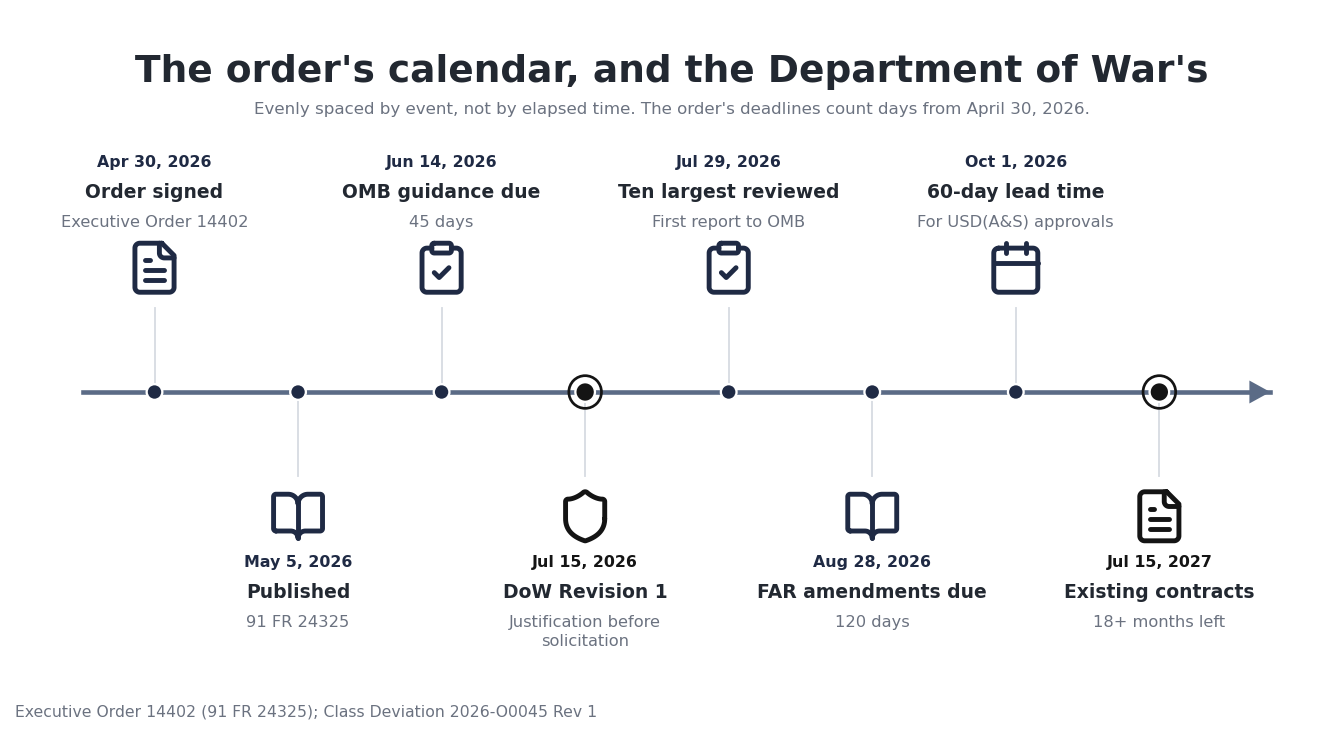
The order also looks back at contracts already awarded. Within 90 days, which ran out on July 29, 2026, each agency head was told to "seek to modify, restructure, or renegotiate its 10 largest non-fixed-price contracts by dollar value", with the same research and emergency exceptions. The first report to the Office of Management and Budget was due the same day, and reports follow every six months, with the number, value and written justification of every approval. The rules apply when one agency buys for another, and until the FAR itself is amended the order says "agencies shall utilize applicable deviations from provisions of the Federal Acquisition Regulation, to the maximum extent practicable".
What it means for you. If you hold one of an agency's ten largest contracts that are not fixed-price, the agency was told to try to move it toward fixed prices and performance incentives, so expect that ask at the next modification or option. The order also says it creates no right anyone can enforce against the government. In practice its requirements reach a contract through the FAR text and the class deviations that carry it, which parts 3 and 4 read.
If you are asked to convert, two cautions from the client alert by Blank Rome LLP on the order are worth taking: price the work again from the ground up rather than turning the old cost estimate into a fixed price, and read any waiver or release language offered with the change before you sign it. And the case for staying cost-type is still in the FAR. FAR 16.301-2 allows a cost-reimbursement contract on this ground: "Uncertainties involved in contract performance do not permit costs to be estimated with sufficient accuracy to use any type of fixed-price contract". The FAR Overhaul keeps that test word for word.
02Fixed-price first has been the policy before
The order is the newest statement of a preference the government has made for nearly two decades. On March 4, 2009, a presidential memorandum noted that dollars obligated under cost-reimbursement contracts had nearly doubled, from $71 billion in 2000 to $135 billion in 2008, and set the policy: "there shall be a preference for fixed-price type contracts". Its next sentence, allowing cost-reimbursement only when an agency cannot define its requirements well enough for a fixed price, is now FAR 16.301-2(a)(1) almost word for word. It got there through a FAR rule effective April 2, 2012 (77 FR 12925), which carried out section 864 of the defense authorization act for fiscal year 2009.
At the Department, the first Better Buying Power memorandum, signed by Ashton B. Carter on September 14, 2010, made the fixed-price incentive firm target contract the point of departure, with a 50/50 share line and a 120 percent ceiling. It also asked for the thing the order now asks of every agency, a written case for the contract type: "I will require a justification of contract type for each proposed contract settlement be made to the relevant acquisition executive before negotiations are concluded".
The same memorandum warned against overcorrecting: "At one time, the Department attempted to impose fixed-price contracts on efforts where significant invention (and thus unknowable costs) could be anticipated".
The warning was needed. Better Buying Power 2.0 was introduced by a memorandum of November 13, 2012, and the more detailed implementation directive that followed in 2013 said "The guidance included in BBP 1.0 suggested to some that Fixed Price Incentive contract types should be used much more broadly and to the exclusion of other contract types", and that "the emphasis on FPIF contracts was largely intended to prevent the premature use of Firm-Fixed-Price (FFP) contracts too early in the acquisition process". It kept one push in place: more fixed-price incentive contracts in low-rate initial production.
Better Buying Power 3.0, issued April 9, 2015, reported that the use of cost-plus-incentive-fee and fixed-price-incentive-fee contracts "was highly correlated with better cost and schedule performance", and added: "We are not directing a wholesale conversion to these types of contracts". The guidance that followed, the Defense Procurement and Acquisition Policy memorandum of April 1, 2016, "Guidance on Using Incentive and Other Contract Types", is still the document the Department of War's PGI 216.102 sends contracting officers to.
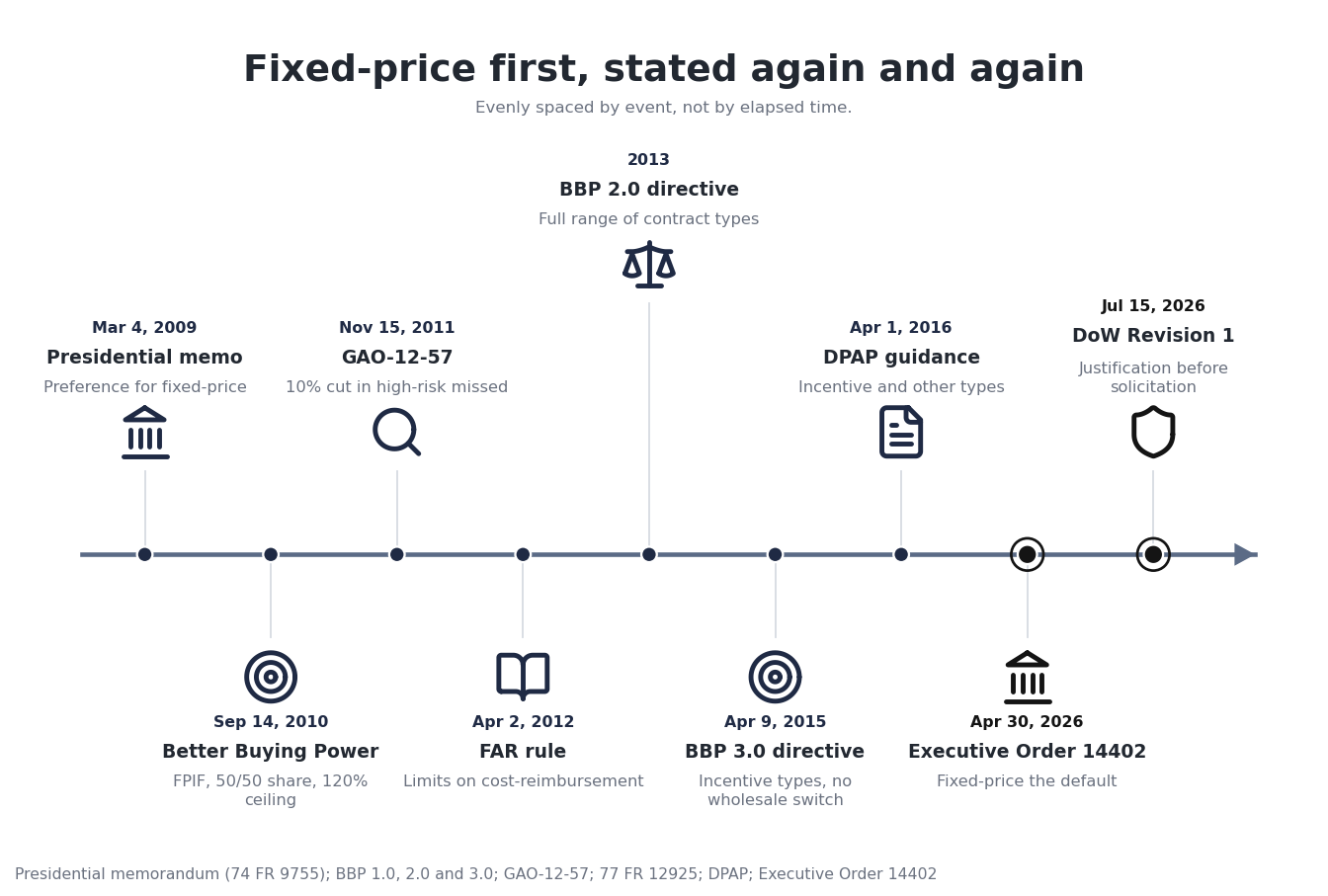
Did any of it work? Not by the government's own count. Months after the memorandum, the Office of Management and Budget told agencies to cut the share of dollars in new high-risk contracts by 10 percent in the following fiscal year. Its report to Congress, dated July 8, 2011, found new time-and-materials and labor-hour dollars down 19 percent, but "the relative share of dollars awarded in new cost-reimbursement contracts during this same period increased by 2 percent". GAO, auditing the same initiative in a report released November 15, 2011, put that rise at 9.4 percent, and found that, taking new high-risk contracts together, "agencies decreased use of those contracts, as a share of base spending, by less than 1 percent".
The two counts differ because OMB and GAO divided the old "combination" contracts among contract types in different ways. OMB's letter also gave a reason the share moved the wrong way: "Some increase in spending through cost-reimbursement contracting was expected as agencies moved away from T&M/LH contracting". Those are the contracts, it said, "which have long been recognized in government-wide policy as the least favored contract type". Our reading of the two counts: pushing work off time-and-materials moved some of it to cost-reimbursement, not to a fixed price, and Section 2 now reaches both.
For the Department's later move toward fixed-price incentive contracts, the Blank Rome LLP alert, citing a later GAO report, says "DoD has never formally assessed whether that shift actually improved cost and schedule performance outcomes".
What it means for you. Each earlier wave left text that still governs a contract: the conditions in FAR 16.301-2, the fixed-price incentive point of departure, the incentive guidance. The order does not replace that text. It adds an approval, a reviewer at the top of the agency and a calendar, so the reasons that justified a cost-type contract before still apply, and now have to be written down early enough to meet the dates.
03How the FAR Overhaul wrote it into Part 16
The FAR Council's model text for Part 16, the FAR Overhaul Part 16, now opens its policy on contract type with one sentence: "Fixed-price contract types are the default and preferred contract types." If fixed-price does not fit the whole contract, the contracting officer is to consider whether a portion can be fixed-price.
Its new 16.104 is where Section 2 lands. Watch the number: in the codified FAR, FAR 16.104 is titled "Factors in selecting contract types", a different section, and none of the 66 codified Part 16 sections names the order, as the eCFR stood on September 10, 2026. The Overhaul's 16.104 states the rule this way:
"The head of the agency must approve a written justification described in paragraph (d) of this section prior to using a covered contract or order."
The lines are the order's, but the text around them differs in ways a contractor will feel. It applies to contracts valued at or above the line, where the order says over it. It reaches firm-fixed-price level-of-effort term contracts, which the order does not name, and a single-award indefinite-delivery contract when its forecast covered orders meet the line. Multiple-award contracts are excepted, with a catch: "However, the justification requirement does apply to task orders, delivery orders, and BPAs under those contracts". And the agency head "may only delegate the justification approval to the chief acquisition officer of the agency or another non-career official in the Senior Executive Service within the agency", which is narrower than the order's non-career employees. Once approved, a justification lasts for the life of the contract or order.
Below the line, the written analysis still applies. The Overhaul's 16.103 asks for it in the acquisition plan, or in the contract file when no written plan is required. For any contract that is not fixed-price, that analysis must weigh the adequacy of the contractor's accounting system and discuss "planned actions to minimize the use of other than fixed-price contracts on future acquisitions for the same requirement and to transition to fixed-price contracts to the maximum extent practicable".
What it means for you. Your proposal for cost-type work now feeds a document the government has to defend. Expect questions about your accounting system, which the codified FAR already makes a condition of a cost-reimbursement contract in FAR 16.301-3: "The contractor's accounting system is adequate for determining costs applicable to the contract or order". The Overhaul's own 16.301-3 keeps that condition and adds the agency head's justification to the list. Expect questions, too, about how the work could move to fixed prices next time. If part of the work can be priced firm, offer it.
04What the Department of War did with it
On July 15, 2026, the Department issued Class Deviation 2026-O0045, Revision 1. It replaced the memo of February 20, 2026, which predates the order, and lists Section 2 among the things it implements. It tells contracting officers to use the FAR Overhaul Part 16 in place of the codified text, and its guidance, PGI 216.104-70, sets the Department's own dates:
"Solicitations issued on or after July 15, 2026, require an approved justification prior to solicitation issuance"
Justifications that need approval from the Under Secretary of Defense for Acquisition and Sustainment go through the head of the contracting activity. For a solicitation expected on or after October 1, 2026, they are due at least 60 days before it issues. A solicitation already out before July 15, 2026, with an award planned after that date, needs its justification before award, and no later than July 15, 2027. For a purchase one agency makes for another, the line is the funding agency's.
Contracts already awarded are not left alone either: "If an existing covered contract has at least 18 months remaining in the period of performance (including all options) as of July 15, 2026, an approved justification is required by July 15, 2027".
What it means for you. If you are capturing a Department of War cost-type opportunity, the justification is now on the schedule, and a late one moves the solicitation. Ask the program office whether it has been submitted. If you hold a covered contract that had 18 or more months to run on July 15, 2026, options included, a justification has to be approved for it by July 15, 2027. Be ready to answer what could be priced firm.
05How many awards the lines would have reached
To size the rule, this piece counted new prime awards on USAspending.gov from October 1, 2024 through September 30, 2025, the last full fiscal year before the order, priced cost-reimbursement, time-and-materials or labor-hour. USAspending still lists the Department of War as the Department of Defense.
Of 18,755 such awards, 436 were at or above their agency's line. The largest group by far fell under the $10 million line: 337. The Department of War had 68, Homeland Security 23 and NASA 8. Research and development, which the order excepts from the approval, accounts for 48, which leaves 388 that would have needed the agency head.
Where the line sits decides who signs. Take the new awards of $10 million or more that were not fixed-price. The Department of War had 900, and only 68 reached its $100 million line. The other 832 needed the contracting officer's written justification but not the agency head. At every agency outside the three the order names, the line is $10 million, so all 337 needed the agency head.
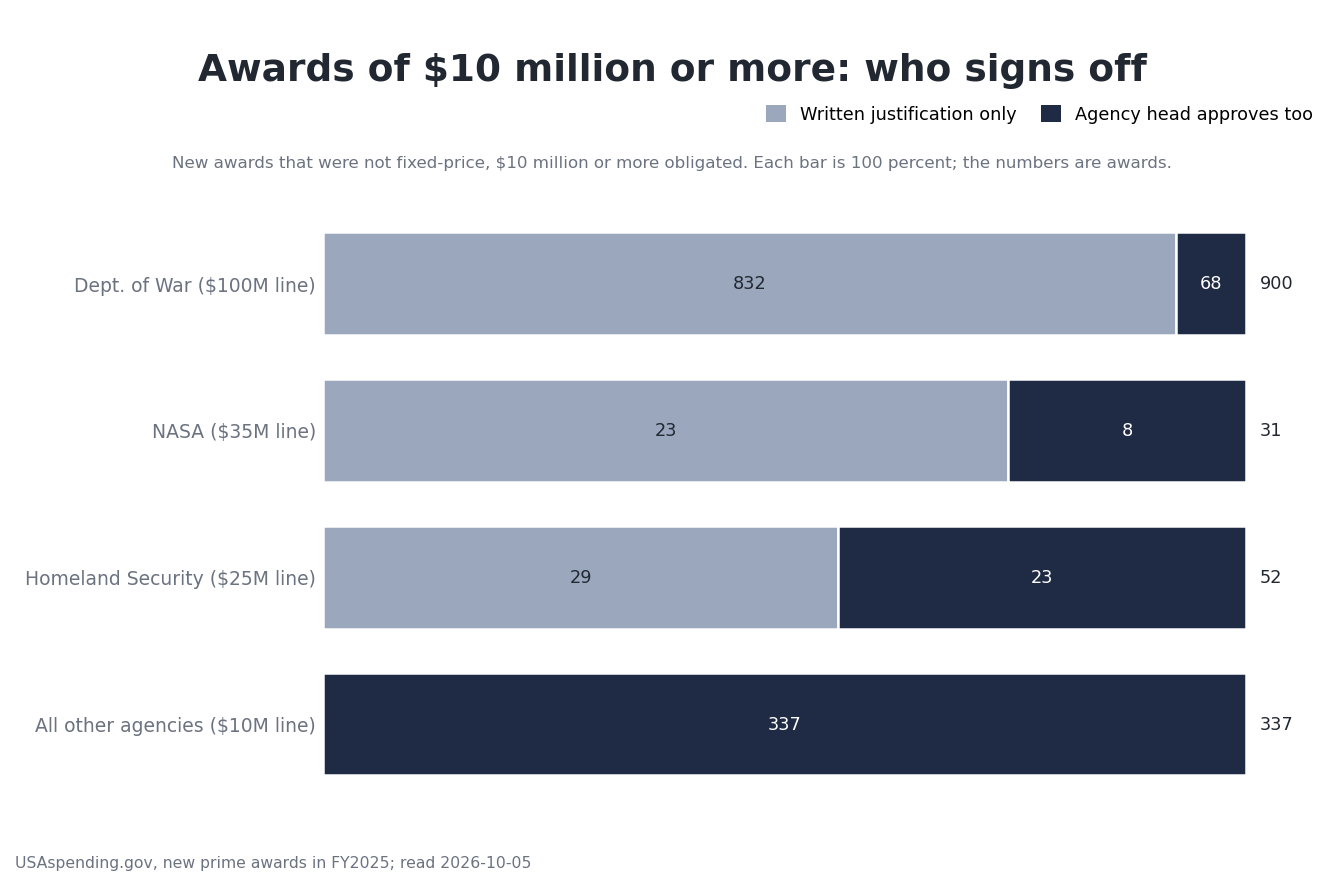
Read the counts as a floor. They use the amount obligated, while the FAR text measures value, which includes options and forecast orders. They leave out fixed-price level-of-effort awards, which the FAR text reaches in their term form (five were at or above a line), and hybrids. And they cannot see an emergency purchase.
What it means for you. If you hold or bid on cost-type or time-and-materials contracts with civilian agencies in awards of $10 million or more, the rule reaches you most often. At the Department of War, most cost-type awards sit under the line and need the written justification but not the agency head. Knowing which of your awards sit where is the first step.
GovConDash.ai
See how much of your own work is not fixed-price
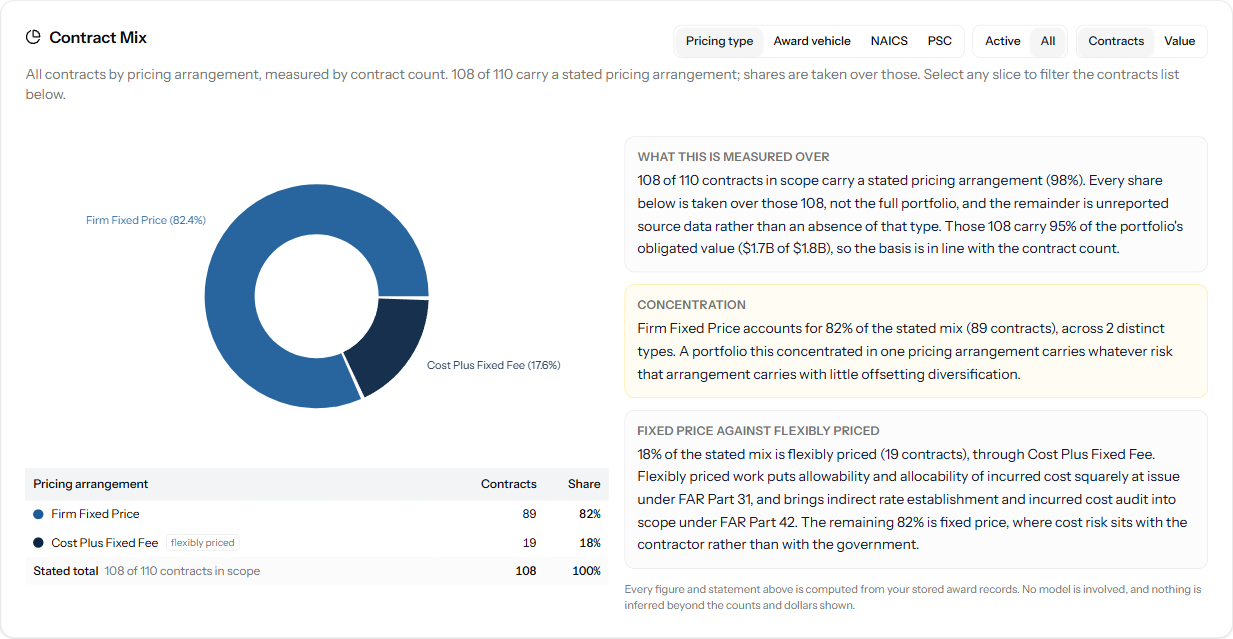
Create a free account and add your company. On the Contracts tab, the Contract Mix card set to Pricing type shows your awards by how they are priced, by count or by value, and All adds the awards that have ended. It is the quickest way to see whether the order reaches your book of business.
06Where GovConDash fits
Reading an executive order is the easy part. The work is knowing which rule carries it into your contracts, and which of your contracts it reaches. GovConDash puts both in one place, free with an account.
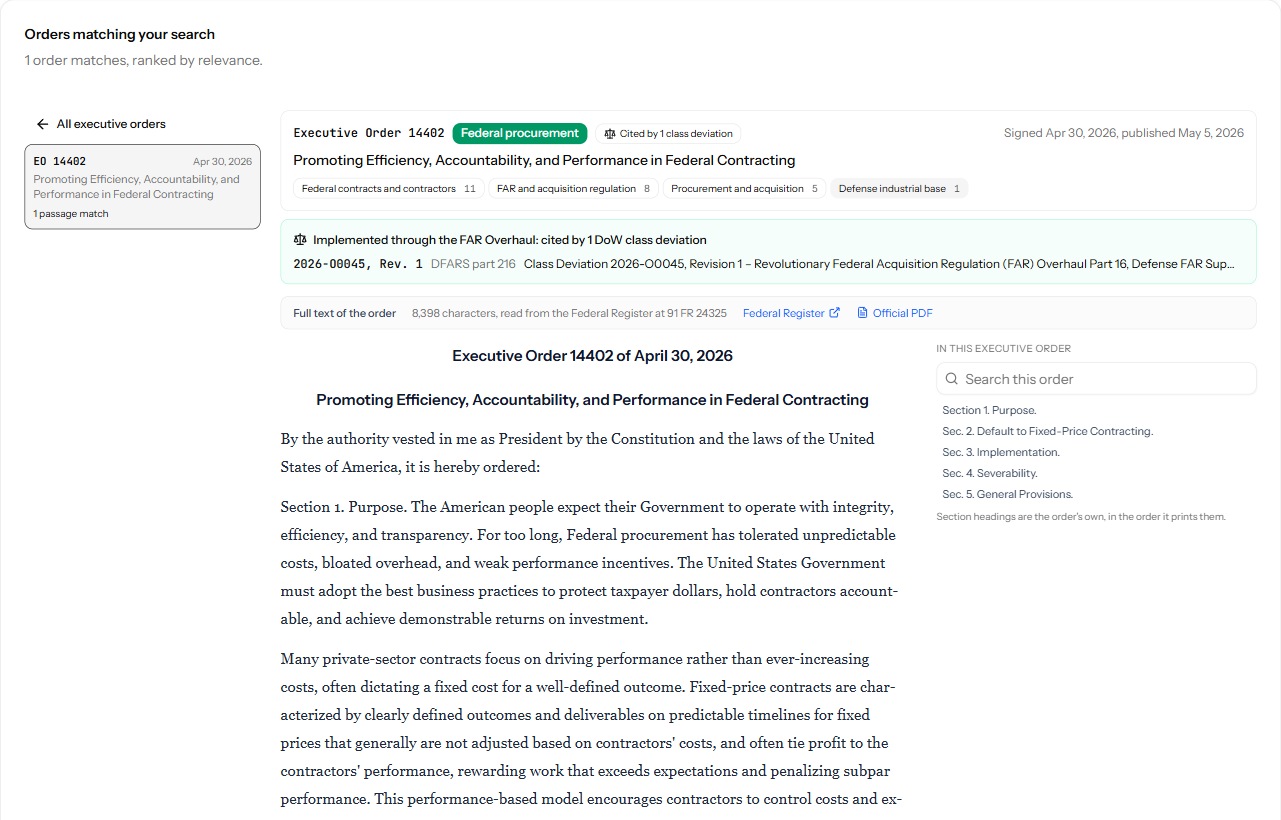
Start in Regulations & Policy. The Executive Orders sub-tab holds Executive Order 14402 in full and searchable, and it names the Department of War class deviation that carries it. Of the 53 deviation memos on file, one cites the order: Class Deviation 2026-O0045, the one read above, whose full text opens from the same screen.
Then turn to your own book. On the Contracts tab, the Contract Mix card sorts your awards by how they are priced, by count or by value, so you can see which of them Section 2 reaches before a contracting officer asks.
Regulations & Policy / Executive Orders
The order and what carries it
The order in full, marked "Implemented through the FAR Overhaul: cited by 1 DoW class deviation", with that deviation's text a click away. Free with an account.
Contracts / Contract Mix
How your work is priced
Your awards by pricing type, by count or by value, active or all. Free with an account.
Documents and data used in this piece
The order
- Executive Order 14402, Promoting Efficiency, Accountability, and Performance in Federal Contracting (91 FR 24325)
Federal Register. Signed April 30, 2026 and published May 5, 2026.
The history
- Presidential Memorandum of March 4, 2009, Government Contracting (74 FR 9755)
Federal Register. The memorandum that set a preference for fixed-price type contracts.
- Better Buying Power: Guidance for Obtaining Greater Efficiency and Productivity in Defense Spending
Under Secretary of Defense (Acquisition, Technology and Logistics). Issued September 14, 2010. A scan of the signed memorandum.
- Federal Acquisition Regulation; Proper Use and Management of Cost-Reimbursement Contracts (77 FR 12925)
Federal Register. The final rule, effective April 2, 2012, behind today's FAR 16.301.
- Report to Congress on cost-reimbursement contracting by executive agencies, fiscal years 2009 and 2010
Office of Management and Budget, Office of Federal Procurement Policy. Dated July 8, 2011. OMB's own count of how the 2009 initiative did.
- GAO-12-57, Federal Contracting: OMB's Acquisition Savings Initiative Had Results, but Improvements Needed
Government Accountability Office. Released November 15, 2011. GAO's audit of the same initiative, with its own count.
- Better Buying Power 2.0: Continuing the Pursuit for Greater Efficiency and Productivity in Defense Spending
Under Secretary of Defense (Acquisition, Technology and Logistics). Dated November 13, 2012. The memorandum that introduced BBP 2.0, a scanned image.
- Better Buying Power 2.0 implementation directive
Under Secretary of Defense (Acquisition, Technology and Logistics). The more detailed directive that followed in 2013, and the copy quoted here.
- Implementation Directive for Better Buying Power 3.0
Under Secretary of Defense (Acquisition, Technology and Logistics). Issued April 9, 2015.
Commentary
- Is This the End of Cost-Type Contracting? (May 4, 2026)
Blank Rome LLP, on JD Supra. A law firm's client alert on the order. It is commentary, and the page attributes what it takes from it.
How the rules carry it
- FAR Overhaul, Part 16, Types of Contracts
Acquisition.gov. The FAR Council's model text for contract types, including the new 16.104.
- Class Deviation 2026-O0045, Revision 1, FAR Overhaul Part 16 and DFARS Part 216
Defense Pricing, Contracting, and Acquisition Policy. The Department of War memorandum that puts the revised Part 16 in place, with its own dates for justifications.
- DFARS Revolutionary FAR Overhaul class deviations
Defense Pricing, Contracting, and Acquisition Policy. The Department's list of its class deviations, with the revision in effect for each part.
- FAR 16.104, Factors in selecting contract types
Electronic Code of Federal Regulations. The codified section as the eCFR prints it today.
- FAR 16.301-2, Application
Electronic Code of Federal Regulations. The codified section as the eCFR prints it today.
- FAR 16.301-3, Limitations
Electronic Code of Federal Regulations. The codified section as the eCFR prints it today.
The count
- USAspending.gov award search
U.S. Department of the Treasury. Prime award counts by pricing type, agency and amount, read October 5, 2026.
Disclaimer. This piece is commentary on a published executive order, the FAR Overhaul text and a class deviation. It is not legal advice, and it is not a determination about any contractor, solicitation or contract. Confirm what applies to a contract action with the contracting officer, counsel or a government contracts professional.

Keep reading
Your DFARS Deviation May Already Be SupersededThe Department's class deviations are revised often, and a saved memo can be out of date. How to check which revision is in effect.