
SBA award file
219,587 awards
Every SBIR and STTR award from 1983 through 2026, loaded September 2, 2026
Flexibly priced awards
11,952 awards
Department of War awards to small businesses with activity in FY2025 to FY2026, from USAspending
The Department's BAA
50 pages
The 2026 SBIR preface, Amendment 2 (July 15, 2026), with Navy and DARPA instructions
DCAA audit programs
17740, 15500 and 10100
The pre-award accounting system survey, provisional billing rates and the incurred cost audit, with DCAA's adequacy checklist
One term before the numbers. A flexibly priced contract is one whose final price depends on the cost the contractor incurs, so the government audits that cost. The record read here covers seven pricing types: fixed price incentive, cost plus award fee, cost no fee, cost sharing, cost plus fixed fee, cost plus incentive fee and time and materials. When this piece says cost-type, it means that group.
The short version
- 1Who buys a Phase II decides whether it is a cost-type contract. In FY2025 to FY2026, 321 of 333 Navy Phase II awards and 76 of 78 at the Missile Defense Agency were flexibly priced. At the Air Force it was 31 of 671, and at the Army 4 of 202. The component's own instructions tell you which you are walking into.
- 2When Phase III is written as cost-type work, it is written as cost-plus-fixed-fee. Of the 123 flexibly priced Phase III actions measured here, 121 carry that pricing, $900.01 million obligated in all, at a median of $2.79 million, 1.9 times the median flexibly priced Phase II.
- 3A cost-type award starts clocks that outlast the research. A pre-award survey against the SF 1408 criteria, provisional billing rates, and an adequate final indirect cost rate proposal within six months after the end of every fiscal year the contract incurs cost.
- 4Phase III is funded from outside the program, and it has to follow an award inside it. The Department's contract reporting instructions under the FAR Overhaul say so in one sentence: “SBIR and STTR Phase III awards require that a previous SBIR or STTR award exists.”
- 5Phase III arrives late. The median action began 11.7 years after the company's first Department of War Phase II, and 1.6 years after its most recent one.
01The three phases, in the Department's own words
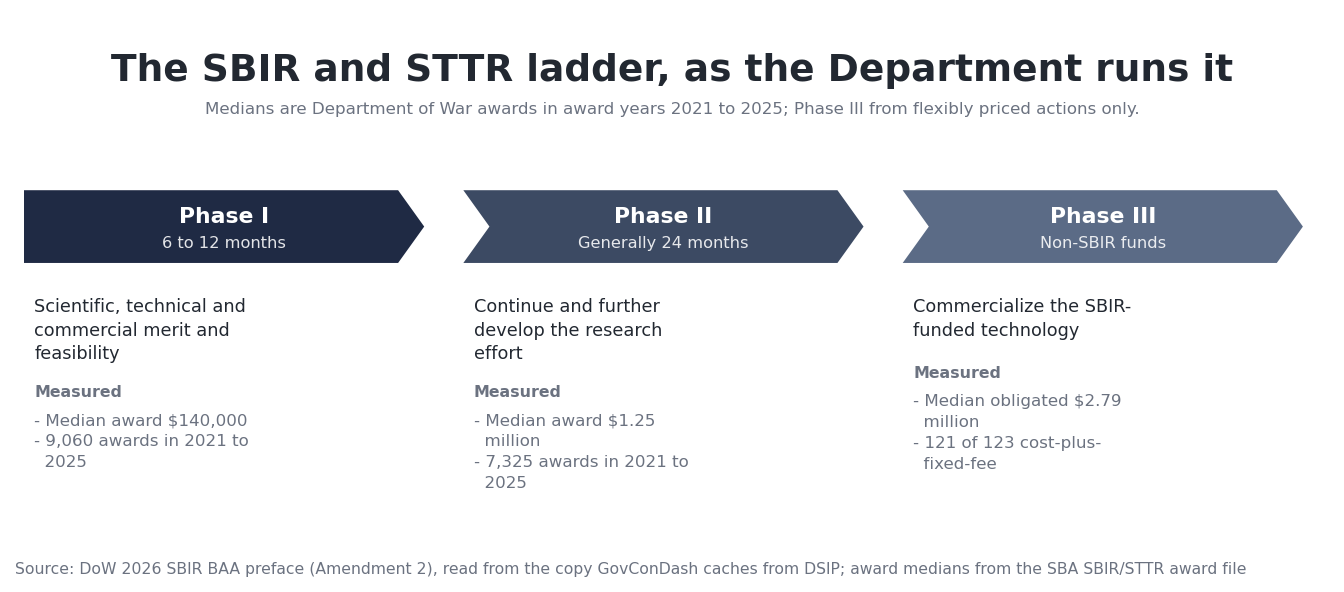
The Department of War publishes its 2026 SBIR topics through the DSIP portal, in numbered releases under a Broad Agency Announcement whose preface, now at Amendment 2 (July 15, 2026), sets out the ladder in its own words.
- Phase I is feasibility.
- “Phase I determines, to the extent possible, an idea's scientific, technical, and commercial merit and feasibility within the SBIR program.” “The Phase I period of performance is generally between six to twelve months.”
- Phase II is the build.
- “The period of performance is generally 24 months. The objective of Phase II is to continue and further develop the R/R&D effort from the completed Phase I award.”
- The gate between them is one sentence.
- “Only Phase I awardees may submit Phase II proposals.” The exception is a topic that accepts a Direct to Phase II proposal, which substitutes demonstrated feasibility for the Phase I award.
Phase III is different in kind, not just in size. It is the first rung the program does not pay for.
Phase III refers to work that derives from, extends, or completes an effort made under prior SBIR funding agreements, but is funded by sources other than the SBIR Program.
The same page says what the company is expected to do with it: “Under Phase III, the SBC should focus on commercializing previously SBIR-funded technology and is required to obtain funding from either the private sector, a non-SBIR federal source, or both, to develop the prototype into a viable product or non-R&D service for sale in military or private sector markets.” The Navy's instructions for the same release read the definition broadly, reaching awards made through a competitive process, not only follow-on awards.
This covers any contract, grant, or agreement issued as a follow-on Phase III award or any contract, grant, or agreement award issued as a result of a competitive process where the awardee was an SBIR/STTR firm that developed the technology as a result of a Phase I or Phase II award.
And the Navy states the consequence plainly: “The DON will give Phase III status to any award that falls within the above-mentioned description.” The one hard condition sits in the Department's contract reporting guidance, issued with the FAR Overhaul class deviation 2026-O0043 effective February 17, 2026: a Phase III needs a prior SBIR or STTR award to attach to. For a company, that means Phase III is never bid cold. An earlier award is what makes you eligible for it, which is why this piece reads the award file first.
02The program, measured
The SBA publishes every SBIR and STTR award in one file on SBIR.gov, and this platform loads it monthly. The copy read here, loaded September 2, 2026, holds 219,587 awards worth $82.3 billion, from 1983 through 2026, across 13 agencies. The Department of War accounts for 105,819 of those awards, 48 percent, and $41.4 billion of the dollars, 50 percent. The file does not record Phase III at all; every row is Phase I or Phase II.
Inside the Department, Phase II awards totaled $907.31 million in award year 2015 and $2.5 billion in 2025. Phase I totaled $174.93 million and $243.69 million in the same two years. Over 2021 to 2025 the Department made 16,385 awards worth $12.1 billion to 4,282 distinct companies, and the Air Force alone awarded $5.6 billion of it.
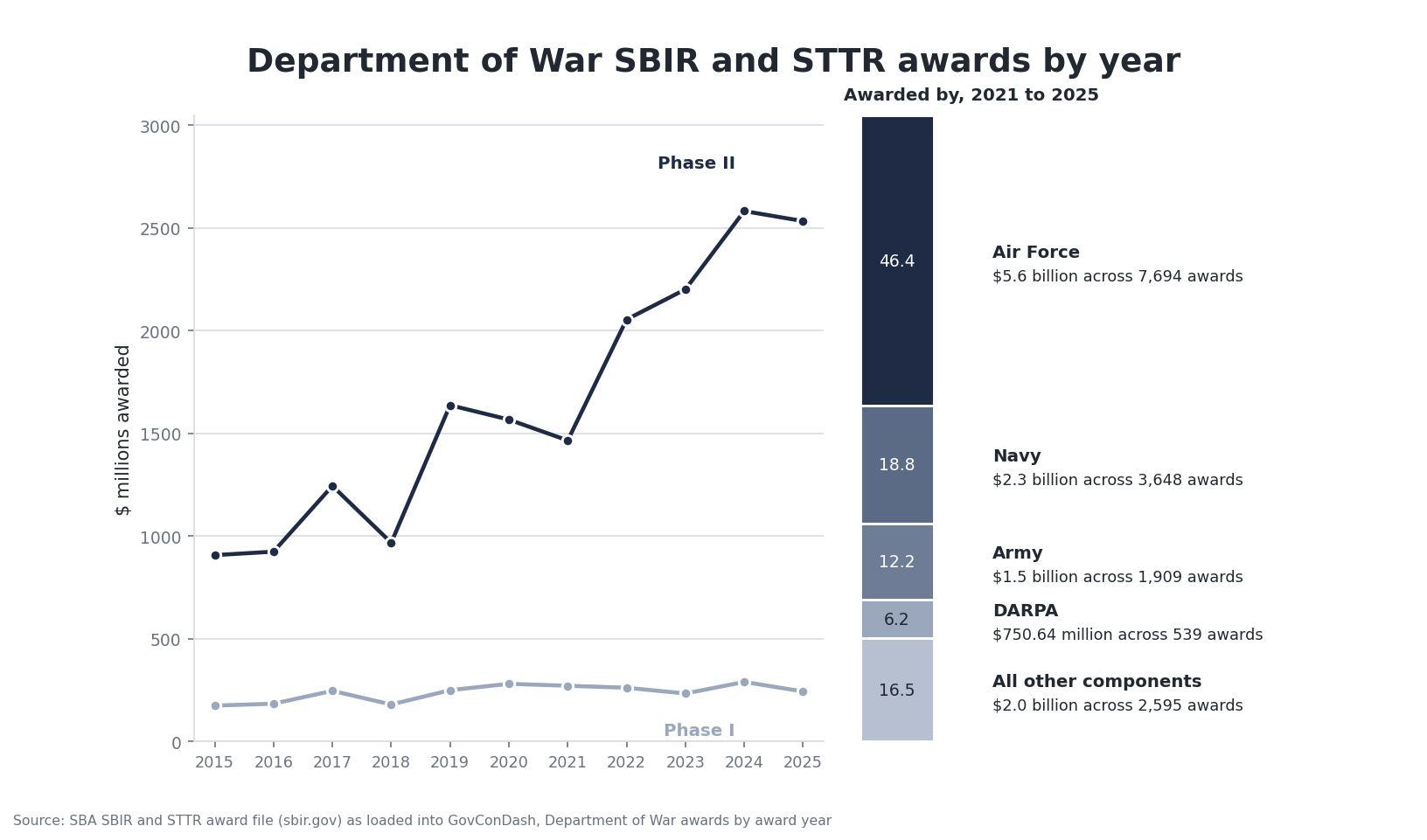
The awards themselves sit in narrow bands. Over 2021 to 2025 the median Department of War Phase I was $140,000, with the middle half between $75,000 and $180,000. The median Phase II was $1.25 million, and the middle half ran to $1.70 million. Those bands are what a program-funded award looks like. Part 5 shows what happens when the funding comes from somewhere else.
Getting from the first rung to the second is close to a coin flip. Of the 8,068 Department of War Phase I awards made in award years 2015 through 2019 that carry a company identifier and a topic code, 3,889, or 48 percent, were followed by a Phase II to the same company on the same topic. That is a floor: a Phase II recorded under a different topic code is not counted, and the cohort is old enough that the rest have had years to arrive.
03Who wins it, by industry
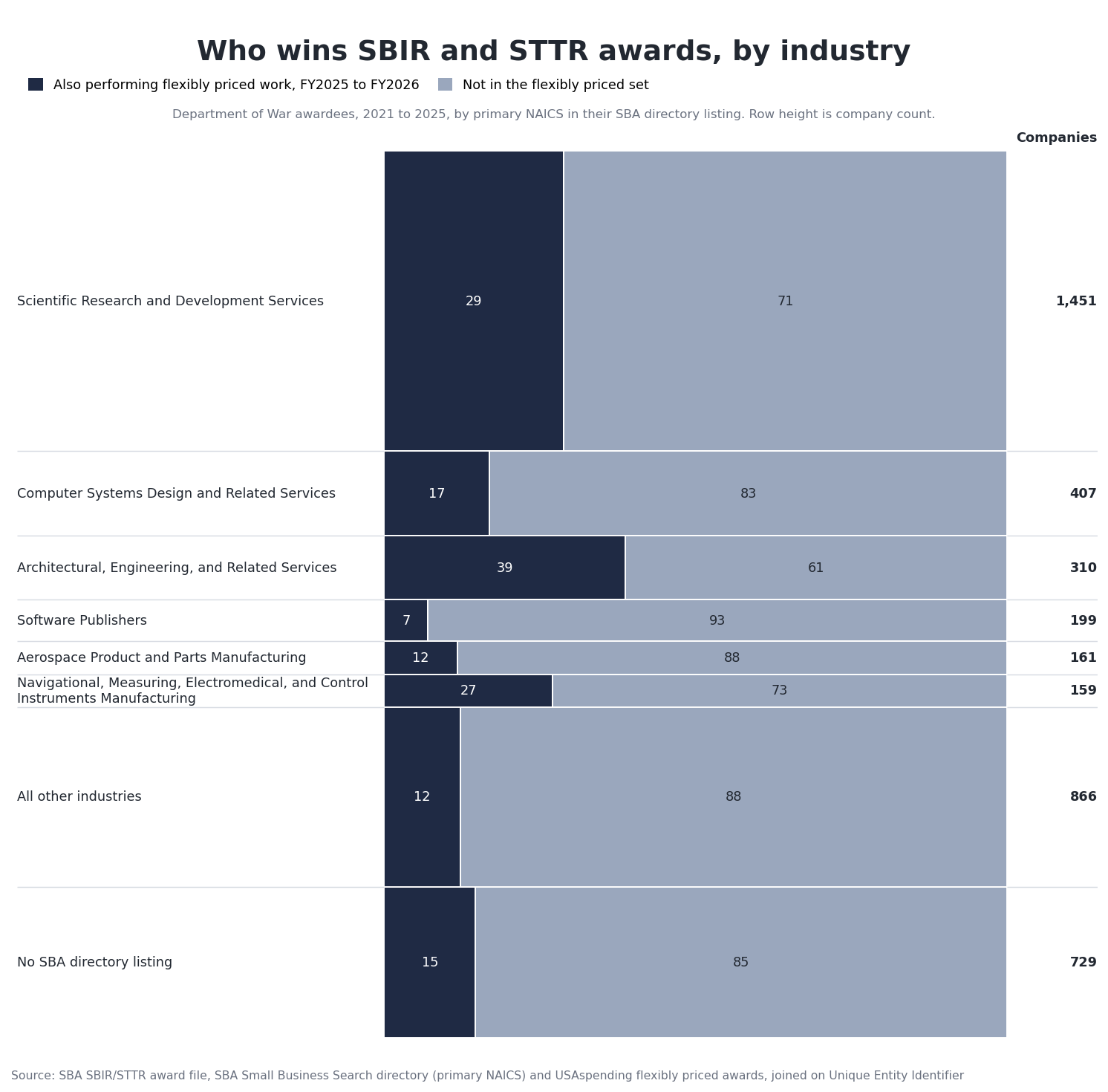
The award file carries no industry code. The SBA's own Small Business Search directory does, and it shares the file's company identifier. Of the 4,282 companies holding a Department of War award in 2021 to 2025, 3,553 (83 percent) have a directory listing with a primary NAICS code, spread across 113 industry groups. The largest is Scientific Research and Development Services, with 1,451 of them.
The more useful cut is which of those companies have already crossed into cost-type work. Of the 4,282, 897 (21 percent) also perform flexibly priced Department of War work in FY2025 to FY2026. The share depends on the industry: 39 percent of the architectural, engineering, and related services firms, against 7 percent of the software publishers.
The award file carries no product service code either, but the flexibly priced contract record does, and a research and development code names its own stage. Of the 1,766 Phase II awards found there, 75 percent are coded applied research. Part 5 sets that against Phase III.
04When the Phase II arrives as a cost-type contract
The BAA does not decide the instrument. It leaves the choice to the contracting officer and lists what is on the table.
RFO-based contract types, including, Firm-Fixed-Price, Firm-Fixed-Price Level of Effort, Labor Hour, Time & Material, or Cost-Plus-Fixed-Fee type contracts may be negotiated at the discretion of the Component Contracting Officer.
The components then narrow it. The Navy's release instructions name four: “The DON will consider the following for award: Cost Plus Fixed Fee (CPFF), Firm Fixed Price (FFP), Basic Ordering Agreement (BOA), or Prototype Other Transaction (OT).” The DARPA instructions ask for proof of an approved accounting system before a cost-type award.
If requesting a FAR based Cost-Plus Reimbursement type contract, proposers shall include their Defense Contract Management Agency (DCMA) Final Determination Letter showing approval of the company's Accounting System.
For a fixed price, DARPA adds: “No additional action is required to be taken by proposers requesting a FAR based Firm-Fixed Price type contract.” Its instructions also ask proposers to complete the DARPA SBIR/STTR pre-award checklist before they are selected for award. At DARPA, in other words, the accounting system question is asked with the proposal, not after the award.
The regulation explains why research lands on cost-type terms so often. FAR 35.006 says “Because the absence of precise specifications and difficulties in estimating costs with accuracy (resulting in a lack of confidence in cost estimates) normally precludes using fixed-price contracting for R&D, the use of cost-reimbursement contracts is usually appropriate”.
So we measured what the buyers actually did. The flexibly priced award record, read from USAspending, covers Department of War awards to small businesses with activity from October 1, 2024 through September 30, 2026, and in that window the SBA file records 1,518 Department of War Phase II awards. Of those, 437, or 29 percent, appear among the flexibly priced awards by contract number, and 434 of those are cost-plus-fixed-fee. The Phase I awards barely register: 2 of 1,581. The cost-type decision arrives with Phase II, and it depends almost entirely on who is buying.
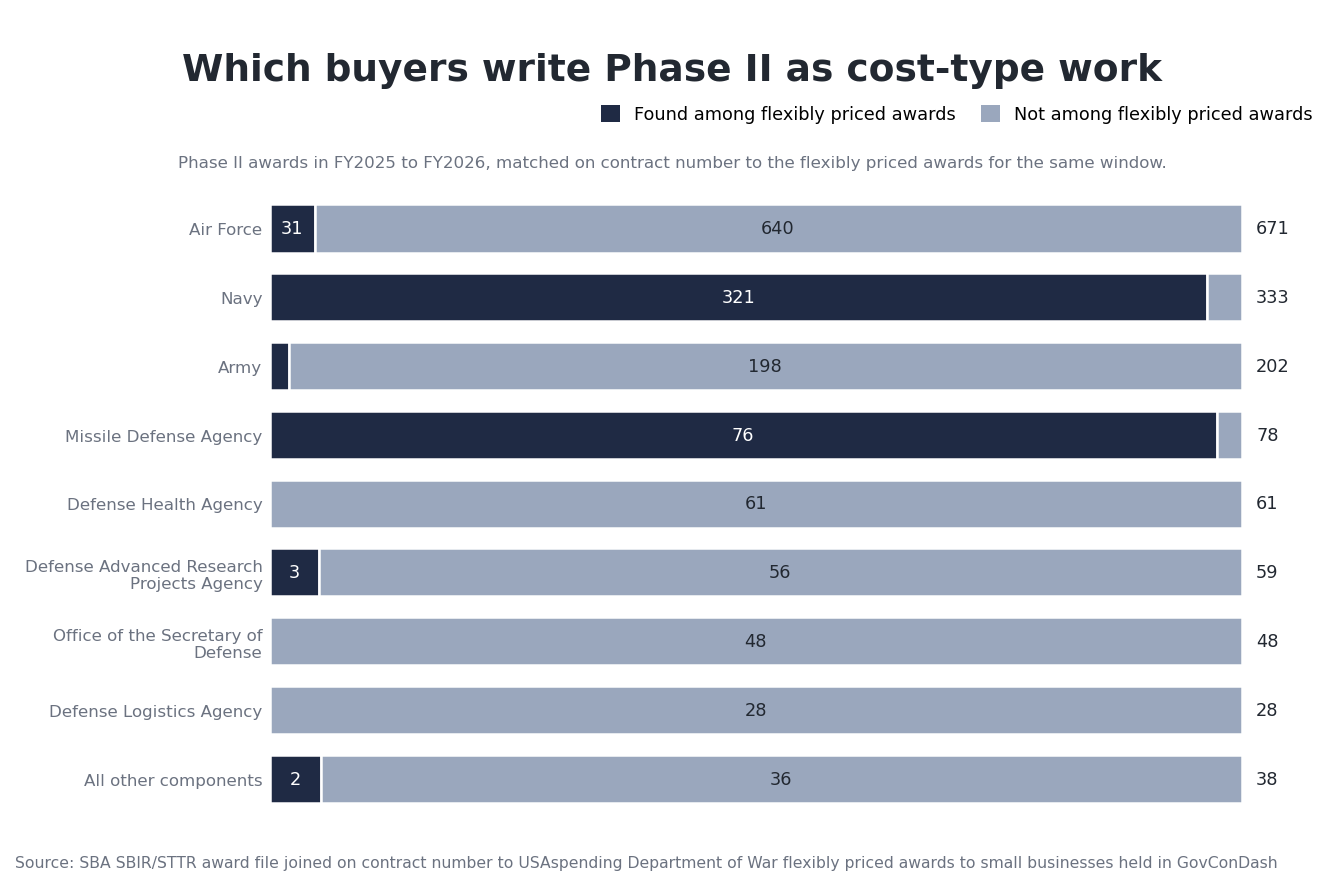
The Navy and Missile Defense Agency wrote at least nine in ten of their Phase II awards as flexibly priced contracts. The Air Force, Army, Defense Health Agency, Defense Advanced Research Projects Agency, Office of the Secretary of Defense and Defense Logistics Agency each wrote one in ten or fewer. The same program, the same phase and the same statute produce a cost-plus-fixed-fee contract at one buyer and something else entirely at another, so the first document to read after a Phase I is not the Phase II topic. It is the component's own instructions.
1,171 of 2,557
small businesses performing flexibly priced Department of War work in FY2025 to FY2026 hold at least one Department of War SBIR or STTR award in the SBA file, 46 percent of them. Among the ones holding cost-plus-fixed-fee work it is 1,130 of 2,189. A large share of the small companies that owe the Department an incurred cost submission have been through SBIR or STTR.
05Phase III, measured
The SBA file stops at Phase II, and the USAspending award search this record is built from returns no phase field. So we read the contracts' own descriptions. A flexibly priced Department of War award counts here when its description names both SBIR or STTR and Phase III. One naming Phase III alone is excluded, because that also catches construction and network work with its own phases.
In all, 123 actions pass, held by 87 companies: $900.01 million obligated, a median of $2.79 million and a largest of $164.27 million. Of those, 66 are definitive contracts and 57 are delivery orders, the shape of a Phase III set up as a vehicle and ordered against.
Of the 123, 121 are cost-plus-fixed-fee, and the rest are one priced cost no fee and one priced time and materials. This record holds only flexibly priced work, so a firm-fixed-price Phase III is invisible to it, and the count is a floor for cost-type Phase III rather than a census of Phase III. But it answers the question this piece is about: when the top rung is cost-type work, it is overwhelmingly one kind.
It is also late work. Of the actions, 111 belong to 78 companies with an earlier Department of War Phase II in the SBA file. The median action began 11.7 years after that company's first Phase II, with the middle half between 7.3 years and 17.7 years, and the median action went to a company holding eleven earlier Department of War Phase II awards. The most recent of those came a median 1.6 years before. The Phase III record belongs to companies with long runs of Phase II work.
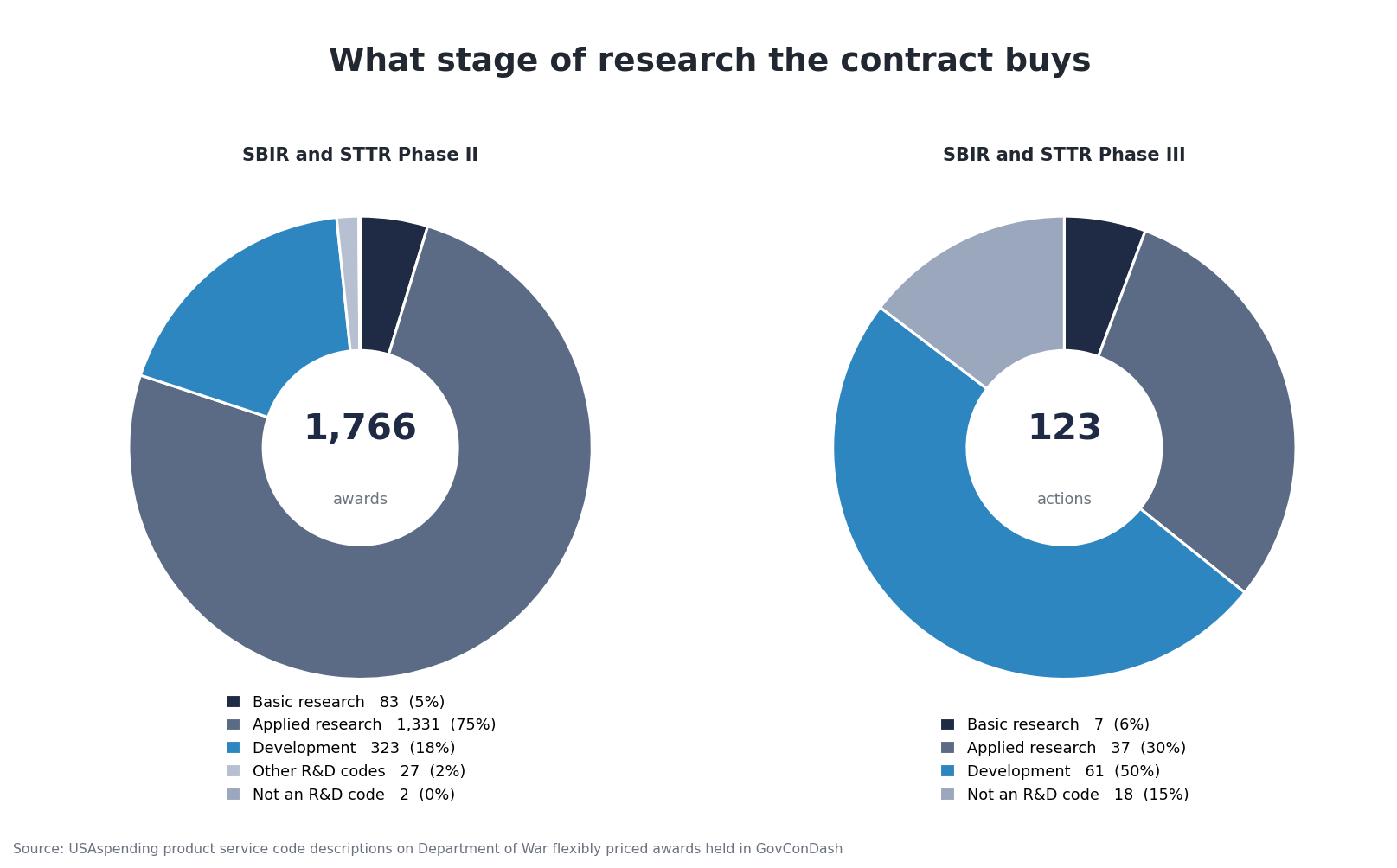
The work moves down the research ladder with the phase. Development accounts for 18 percent of the Phase II awards and 50 percent of the Phase III actions. What does not change is who owns the data. DFARS 227.7104-1 carries SBIR data rights into Phase III, and the Department's Part 227 deviation 2026-O0036 keeps the same sentence.
SBIR/STTR data rights apply to SBIR/STTR data that are delivered, developed, or generated in the performance of a contract or agreement that is covered by SBIR/STTR policies, including contracts and subcontracts that include phase III work.
The clause that carries those rights into a Department of War contract is DFARS 252.227-7018, and outside the Department it is FAR 52.227-20. The Department's clause is blunt about what happens to data that arrives without its legend.
Technical data, computer software, or computer software documentation delivered or otherwise provided under this contract without restrictive markings shall be presumed to have been delivered with unlimited rights.
06What a cost-type contract asks of the books
This is where DCAA comes to the door, and it comes before the award, not after it, because that is where the regulation puts the condition. FAR 16.301-3 allows a cost-reimbursement contract only when, among other things,
The contractor's accounting system is adequate for determining costs applicable to the contract or order
FAR 16.104 tells the contracting officer to check before choosing the type at all: “Before agreeing on a contract type other than firm-fixed-price, the contracting officer shall ensure that the contractor's accounting system will permit timely development of all necessary cost data in the form required by the proposed contract type.” On the Department's side, DFARS 242.7502 makes the system a standing obligation rather than a one-time test: “Contractors receiving cost-reimbursement, incentive type, time-and-materials, or labor-hour contracts, or contracts which provide for progress payments based on costs or on a percentage or stage of completion, shall maintain an accounting system.”
The Department's BAA turns that into advice aimed squarely at the companies reading it, in its own section on the Phase II accounting system.
To reduce the small business's risk and avoid potential contracting delays, companies interested in pursuing Phase II SBIR contracts and other contracts of similar size with the DoW, may require an adequate accounting system in place per General Accepted Accounting Principles, Generally Accepted Government Auditing Standards, Revolutionary FAR Overhaul (RFO) and Cost Accounting Standards. The Defense Contract Audit Agency (DCAA) will audit the accounting system.
The audit that answers the question is a pre-award survey, and FAR 9.106-1 limits when one is requested: “A preaward survey is normally required only when the information on hand or readily available to the contracting officer, including information from commercial sources, is not sufficient to make a determination regarding responsibility.” A company with no cost-type history has little on hand for a contracting officer to rely on. DCAA runs the survey under audit program 17740, and two sentences in that program matter more than the rest: “This audit only evaluates the design effectiveness, not the operating effectiveness, of the accounting system.” “The contractor's accounting system must be either in operation, or set up, but not in operation.” A company can pass before it has booked a single cost-type dollar, provided the design exists and a walkthrough can show it.
The design is tested against the SF 1408, criterion by criterion. There are 14 of them in the program. One reaches past the ledger into contract administration: limitation of costs, which checks that the system can support the notices a clause like FAR 52.232-20 requires.
SF 1408, as DCAA audit program 17740 tests it
Version 9.3, Jun 2025
- 1Generally Accepted Accounting PrinciplesII.1
- 2Proper segregation of costsII.2a
- 3Direct costs by contractII.2b
- 4Allocation of indirect costsII.2c
- 5Accumulation of costs under general ledger controlII.2d
- 6Timekeeping systemII.2e
- 7Labor distributionII.2f
- 8Interim determination of costsII.2g
- 9Exclusion of UnallowablesII.2h
- 10Costs by Contract Line ItemII.2i
- 11Preproduction CostsII.2j
- 12Limitation of CostsII.3a
- 13BillingsII.3b
- 14Adequate, Reliable DataII.4
07Billing rates, and the submission every year after
Once the contract is signed, the costs get billed on public vouchers at indirect rates nobody has audited yet. Those are provisional billing rates, and FAR 42.704 says whoever sets them should ensure “the billing rates are as close as possible to the final indirect cost rates anticipated for the contractor's fiscal period, as adjusted for any unallowable costs”. DCAA's own program for provisional billing rates reads the same way from the auditor's side: “Provisional billing rates are an estimate and should be approximately equal to the expected final indirect cost rates adjusted for anticipated unallowable costs and new contract awards.” And it does not wait on the company: “Provisional billing rates should be established timely and FAOs should not wait for the contractor to submit provisional billing rates to establish provisional billing rates for the new fiscal year.”
- 1
Pre-award accounting system survey
FAR 9.106-1Before award, when the contracting officer lacks enough on hand to find the company responsible. DCAA tests the design of the system against the SF 1408 criteria.
- 2
Provisional billing rates
FAR 42.704Indirect rates set for interim billing on public vouchers, as close as possible to the final rates the year is expected to produce.
- 3
Cost vouchers under the payment clause
FAR 52.216-7Allowable cost billed as it is incurred, subject to audit and later adjustment to final rates.
- 4
Incurred cost submission
FAR 52.216-7An adequate final indirect cost rate proposal within six months after the end of every fiscal year the flexibly priced work incurs cost.
- 5
Adequacy review
FAR 52.216-7DCAA reads the submission against its adequacy checklist before any audit begins; an inadequate one comes back with a written description of what is missing.
- 6
Incurred cost audit
FAR 42.705-1Run under DCAA audit program 10100, published in a Small and a Large version, starting from the completed adequacy checklist.
- 7
Final indirect cost rates
FAR 42.705-1Settled by the contracting officer or through audit, then applied to the flexibly priced contracts that carried cost in that year.
The obligation that outlives everything else is in the payment clause itself, FAR 52.216-7.
The Contractor shall submit an adequate final indirect cost rate proposal to the Contracting Officer (or cognizant Federal agency official) and auditor within the 6-month period following the expiration of each of its fiscal years.
The same paragraph lists 15 things an adequate proposal must contain, including a summary of claimed indirect rates and a reconciliation of payroll to labor cost distribution. For a company whose fiscal year ends December 31, 2026, the proposal is due June 30, 2027, and the final rates it supports are then settled under FAR 42.705-1 and applied to the flexibly priced contracts that carried cost in that year. A two-year Phase II touches at least two of those submissions. A Phase III issued as delivery orders can touch many more.
DCAA reads a submission against those items before it audits a dollar of it. Its adequacy checklist, version 3.4, dated December 2021, puts 47 questions to the same 15 schedules the clause lists, A through O, and says what the review is for.
Adequacy assessments of contractor incurred cost proposals include an assessment for completeness and accuracy of the submission, so the audit team can determine if the submission is auditable.
The adequacy checklist, by schedule
Version 3.4, dated December 2021
- ASummary of All Claimed Indirect Expense Rates, Including Pool, Base, and Calculated Indirect Rate6 questions
- BGeneral & Administrative (G&A) Expenses (Final Indirect Cost Pool)4 questions
- COverhead Expenses (Final Indirect Cost Pool)3 questions
- DOccupancy Expenses (Intermediate Indirect Cost Pool(s))3 questions
- EClaimed Allocation Bases by Element of Cost, Used to Distribute Indirect Costs2 questions
- FFacilities Capital Cost of Money Factors Computation2 questions
- GReconciliation of Books of Account and Claimed Direct Costs by Major Costs Element2 questions
- HSchedule of Direct Costs by Contract and Subcontract and Indirect Expense Applied at Claimed Rates as well as a Subsidiary Schedule of Government Participation Percentages in Each of the Allocation Base Amounts6 questions
- ISchedule of Cumulative Direct and Indirect Costs Claimed and Billed by Contract and Subcontract5 questions
- JSubcontract Information2 questions
- KSummary of Each Time-and-Materials and / Labor Hour Contracts Information, Including Labor Categories, Labor Rates, Hours, and Amounts; Direct Materials; Other Direct Costs; and, Indirect Expense Applied at Claimed Rates5 questions
- LReconciliation of Total Payroll per IRS Form 941 to Total Labor Costs Distribution3 questions
- MList of Decisions, Agreements, Approvals, and Description of Accounting/Organizational Changes (e.g., Advance Agreement for Blended Rates)1 question
- NCertificate of Final Indirect Costs1 question
- OContract Closing Information for Contracts Physically Completed in this Fiscal Year2 questions
The checklist is just as direct about a submission that falls short: “If it is determined that the submission is inadequate, the auditor must provide a written description of any inadequacies to the contractor and contracting officer in accordance with FAR 42.705-1(b)(1)(iii).” The six-month requirement in the payment clause is a requirement to submit an adequate proposal, not merely a proposal.
The audit itself runs from an audit program DCAA publishes in two versions, Small (version 6.5, Jan 2026) and Large (version 12.5, Jan 2026). The small version starts where the adequacy review stopped: its first planning step tells the auditor to review the checklist “completed during the adequacy review of the incurred cost proposal and note any areas requiring further consideration”. Among its first reconciliations is the one Schedule G is built for: “Verify the Direct and Indirect costs reconcile to the contractor's general ledger or other accounting system records that will aid in the evaluation of the subject matter.” That is the same general ledger control the SF 1408 survey tested in design, now tested against a year of real costs.
One note on the citations. The regulation sections linked on this page are the codified FAR and DFARS in the eCFR, as refreshed September 10, 2026. The Department now contracts under the FAR Overhaul, and its own BAA says so: “General references to FAR and DFARS are now RFO and R-DFARS, respectively.” Its Part 242 class deviation, 2026-O0050 (listed with the rest on the DARS index), has directed contracting officers since March 16, 2026 to use the revised FAR Part 42 in lieu of the codified text, and it administers the accounting system through a deviation clause numbered 252.242-7999. Numbers and wording move under the deviations, so read the clauses your own award carries rather than the numbers linked here.
08Where GovConDash fits
Every figure above comes from data this platform already reads for its users, and four of its surfaces follow the same ladder this piece has walked: finding the topic, writing the proposal, getting the accounting system through the pre-award survey, and keeping the books a cost-type award asks for once it arrives.
Opportunities
DoW SBIR/STTR
Workflows
SBIR/STTR Proposal Package
Compliance
Pre-Award Survey
Accounting
ICP Dashboard
The Pre-Award Survey, up close
The survey in part 6 is the first audit a cost-type award brings, and the Pre-Award Survey tab is built around the program DCAA runs it under, audit program 17740. The tab runs on the Pro and Max plans. It walks DCAA's checklist in seven steps: Company Information, Prerequisites, DCAA Audit History, CAS, Accounting System, Cost-Type Contracts and Review & Download. After two prerequisite acknowledgments come the checklist's 28 questions, and every SF 1408 criterion the program tests has its own. Surveys are saved to the account, versioned and resumed. The screens below show a fictitious company, XYZ, Inc., not a real contractor.
- 1
Start from the company, not a blank form
The first step is the company block DCAA's form opens with. Prefill fills the empty fields from the company's SAM.gov registration, the cognizant DCAA office from DCAA's own Branch Locator, and the principal and accounting system from the last survey completed. It never fills in the point of contact, which the company enters for each submission.
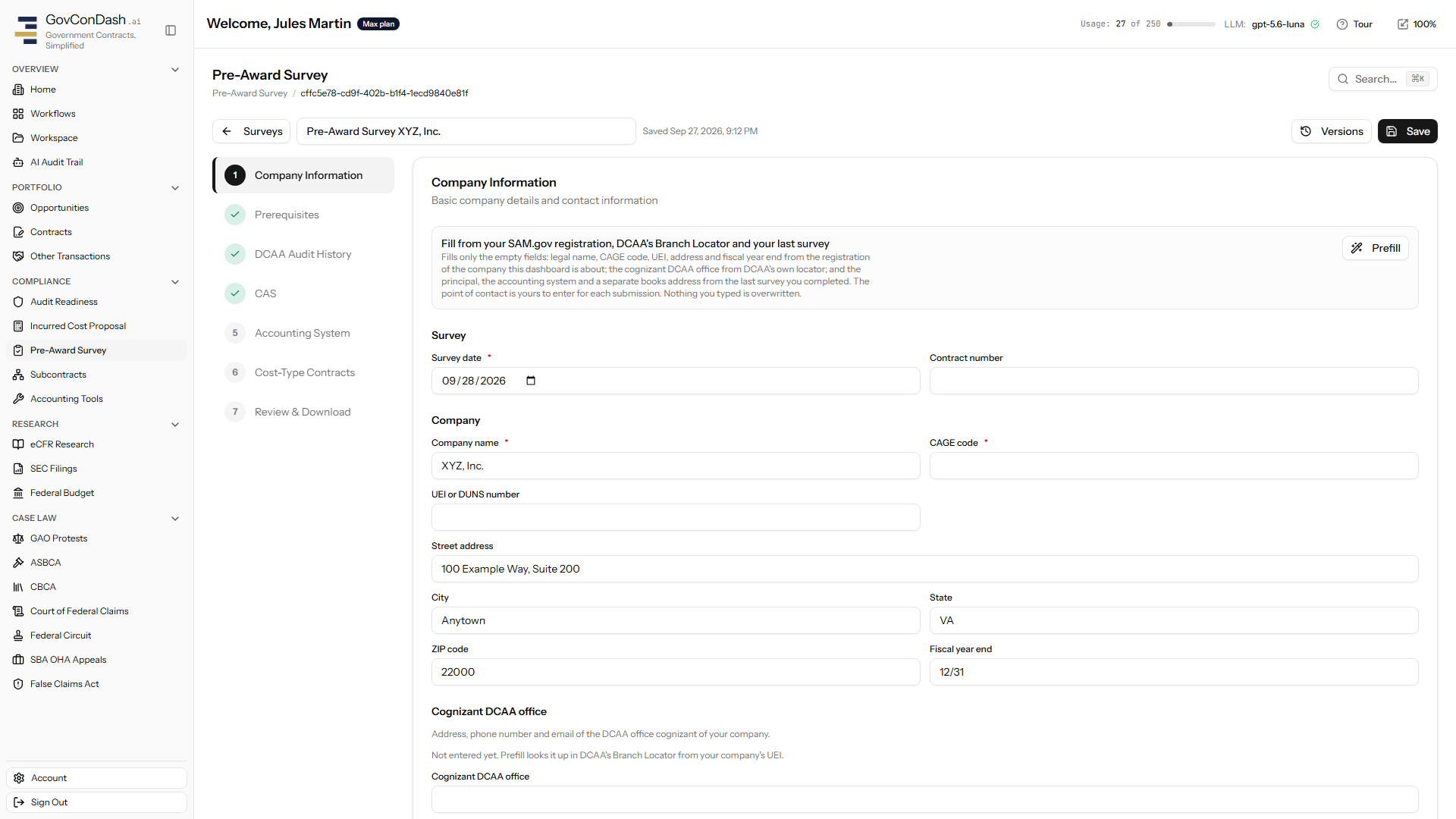
Company Information, the first of the survey's steps. The company, its people and its address are invented for this piece. - 2
Ask what the auditor will look for, from 17740 itself
A question that tests an SF 1408 criterion is tagged with it, and most carry DCAA's own contractor guidance beside the answer. Explain this question retrieves the steps of audit program 17740 that bear on it from this platform's DCAA corpus before it writes a word, and cites them. Here the company has answered that its system is not yet in full operation, the case part 6 described: DCAA evaluates the design, so a system set up but not yet running can pass if the narrative says which parts are which. A second button drafts that narrative.
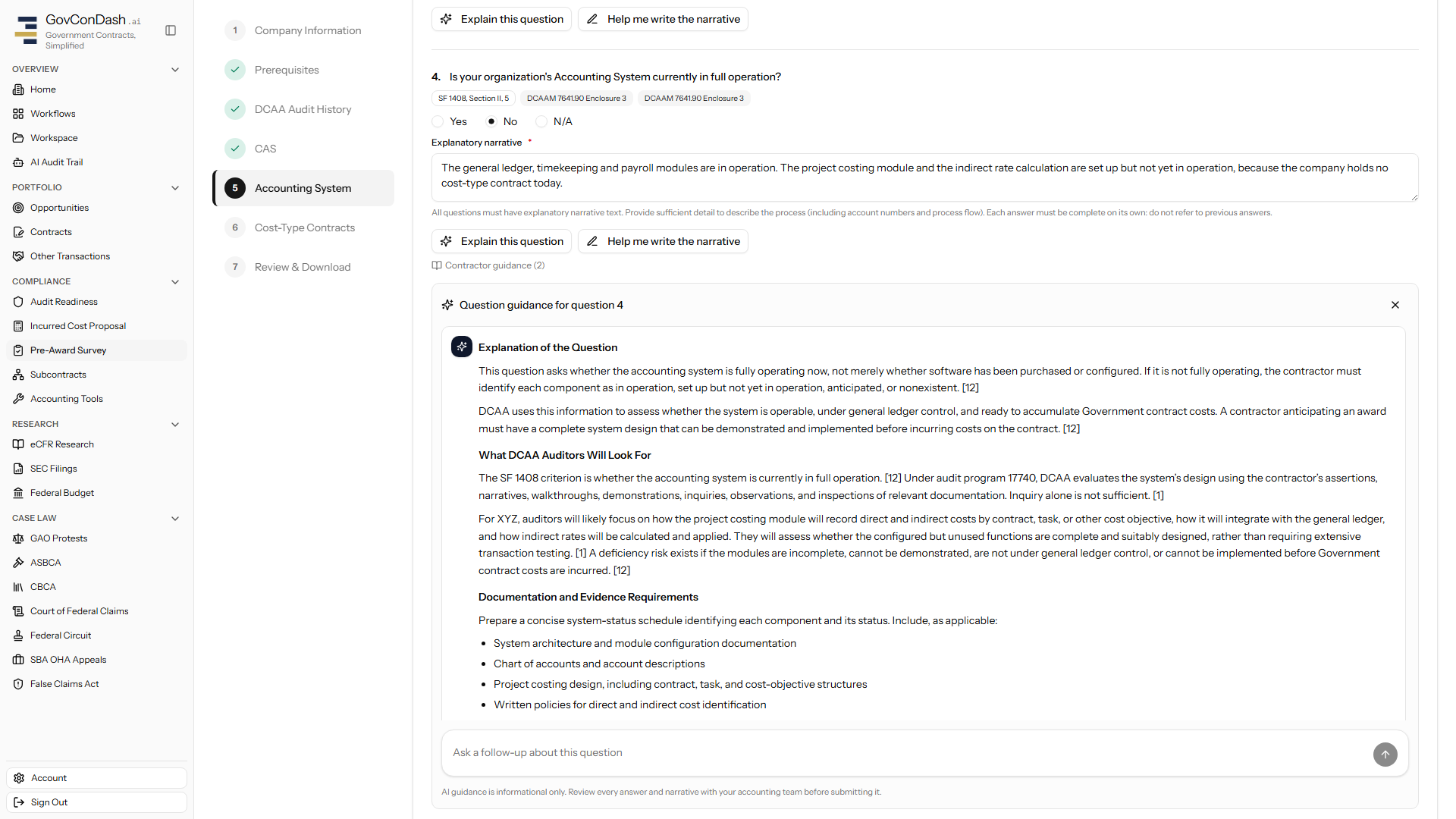
The Accounting System step: the question behind SF 1408 criterion II.5, with its guidance open. The explanation is generated for this company's answer and cites the program steps it read. - 3
Score the survey before DCAA reads it
The last step scores the survey and lists what is still missing: an answer DCAA would read as a possible deficiency, two answers that contradict each other, a question left blank, a narrative the checklist requires and the survey lacks. The score and every finding are computed by rule from the answers, not written by a model, and each one links back to the question it concerns.
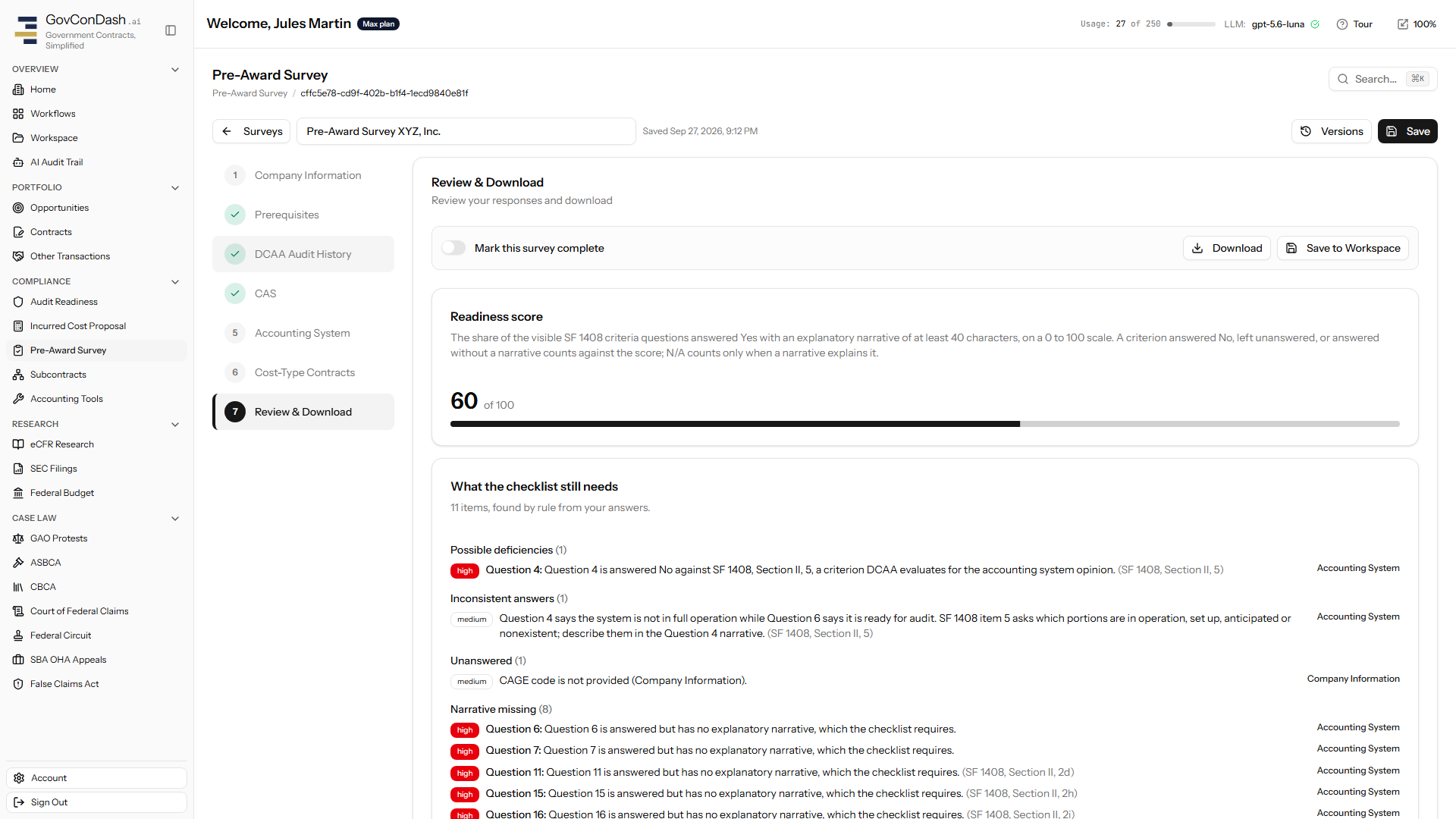
Review & Download: the readiness score and what the checklist still needs, each finding tagged with the SF 1408 section it concerns. - 4
Hand DCAA its own form, filled in
The checklist downloads as DCAA's own PDF form with its fields filled in, not a lookalike. Beside it come the narrative responses as a Word document ending in a references section, a transmittal letter, and a submission package that numbers every file as the enclosure the letter names.
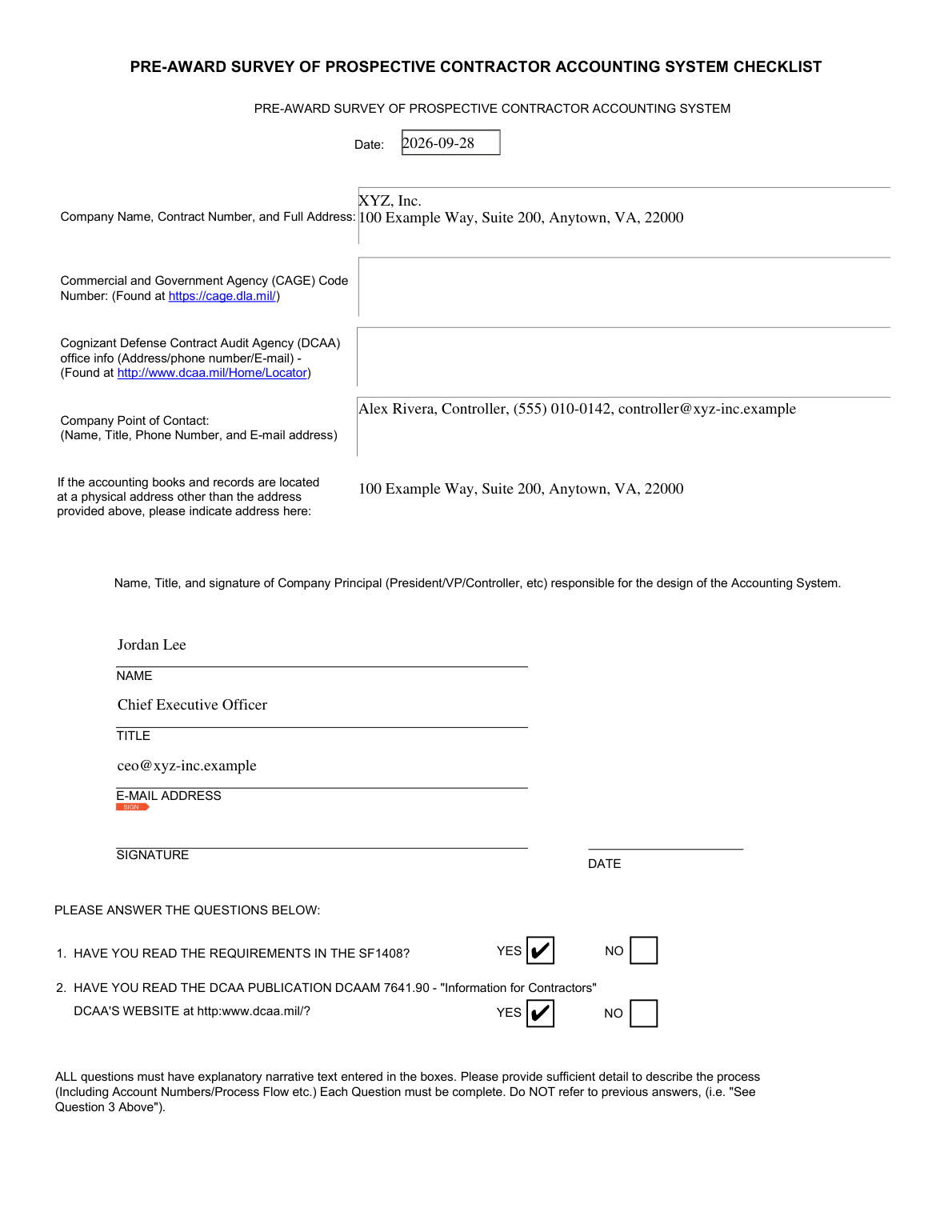
The first page of the checklist PDF the survey downloads, filled in for XYZ, Inc..
The ICP Dashboard, up close
The Incurred Cost Proposal tab has three parts. Overview is free for every account: it shows the next proposal due date from the fiscal year end on your SAM.gov registration, lists the flexibly priced contracts that make a proposal due, and exports Schedule H. Prepare and Research Agent run on the Pro and Max plans. Prepare is where a proposal gets built, and it takes the same path this piece has: the books, the schedules, the reconciliation, DCAA's adequacy checklist, the package that goes to DCAA, and the rates. The screens below show its built-in demo company, not a real contractor.
- 1
Enter the books once
Data entry runs in seven steps: Setup, Chart of Accounts, General Ledger, Job Cost Ledger, Contracts & Cost Data, IRS 941 Data and Certification. The manual's promise is literal: “Enter data once and all schedules are generated automatically.” What comes out is Schedules A through O, the same letters the payment clause and DCAA's checklist use.
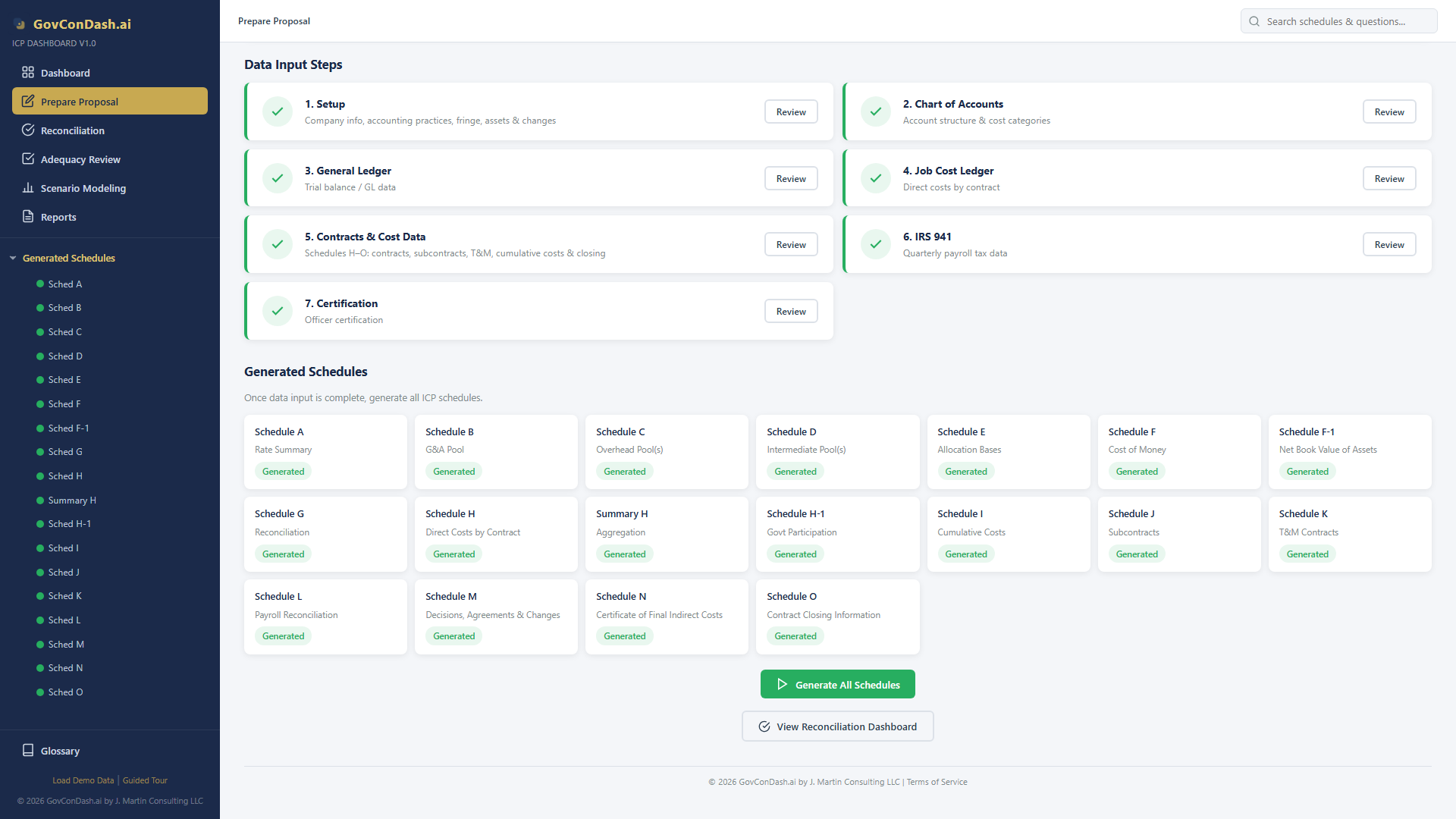
Prepare Proposal: the data input steps, each marked complete, and the schedules they generate. Demo company data. - 2
Reconcile the books the way the auditor will
“This schedule verifies that the total costs in the ICP (direct + indirect) agree with the contractor's financial records. Any differences must be explained and resolved before submission.” It is the reconciliation DCAA's small incurred cost audit program performs among its first steps, and each adjustment here carries the cost principle that required it.
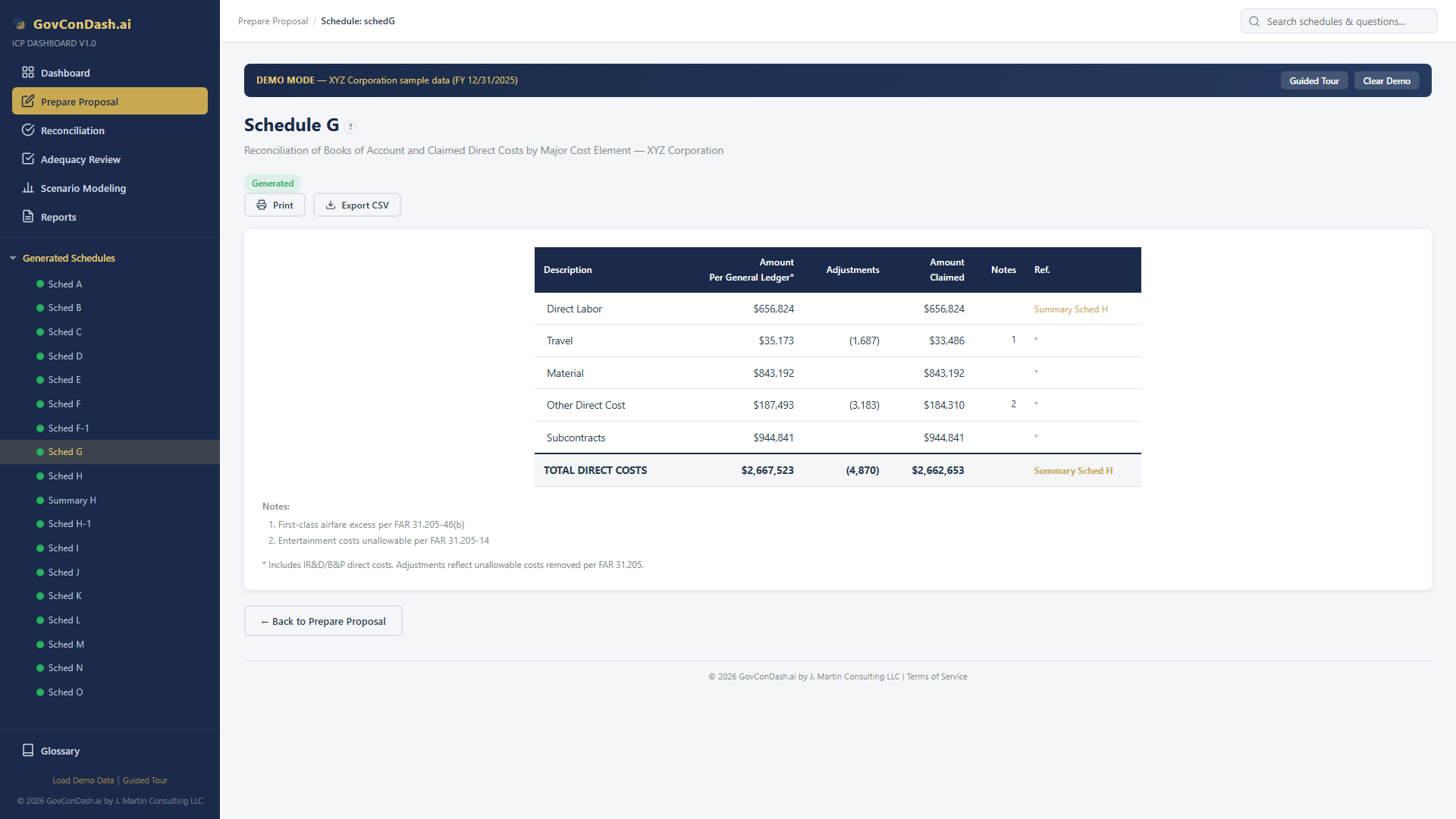
Schedule G, the reconciliation of books of account to claimed direct costs, with each adjustment footnoted to its cost principle. Demo company data. - 3
Find the unallowable costs before DCAA does
The Reconciliation page runs the dashboard's validation engine every time the schedules are generated. “The engine scans all account names in your Chart of Accounts against 21 FAR 31.205 keyword patterns, including entertainment, lobbying, alcoholic beverages, fines, penalties, donations, and other expressly unallowable cost categories.” The same page fills in the adequacy questions the generated schedules already answer.
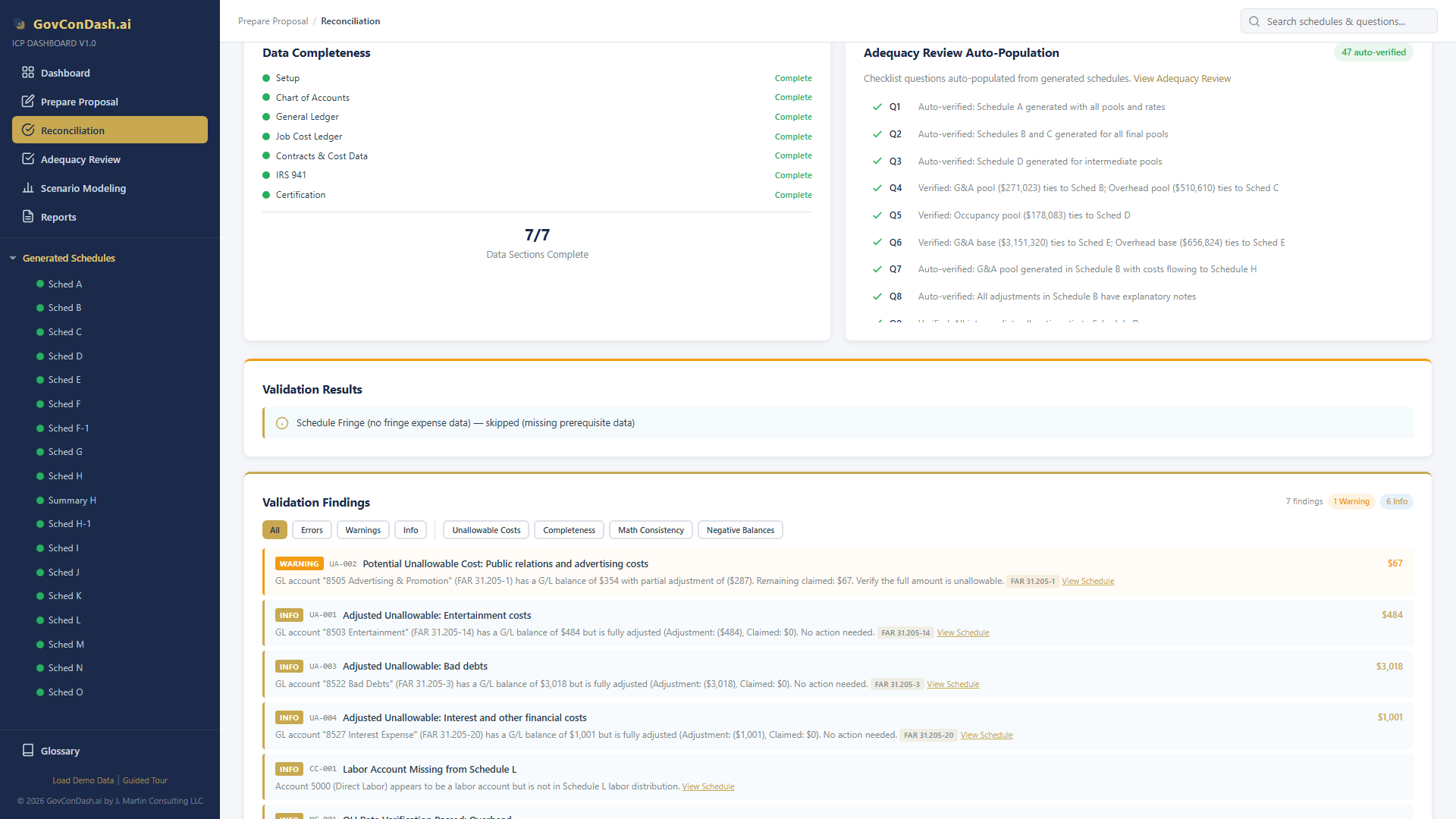
Reconciliation: data completeness, checklist questions answered from the generated schedules, and validation findings by FAR 31.205 cost principle. Demo company data. - 4
Run DCAA's checklist on yourself
Adequacy Review carries all 47 questions of DCAA's checklist, version 3.4, dated December 2021, grouped by schedule, so a company can put its proposal through the questions DCAA's auditor will ask before it is ever submitted.
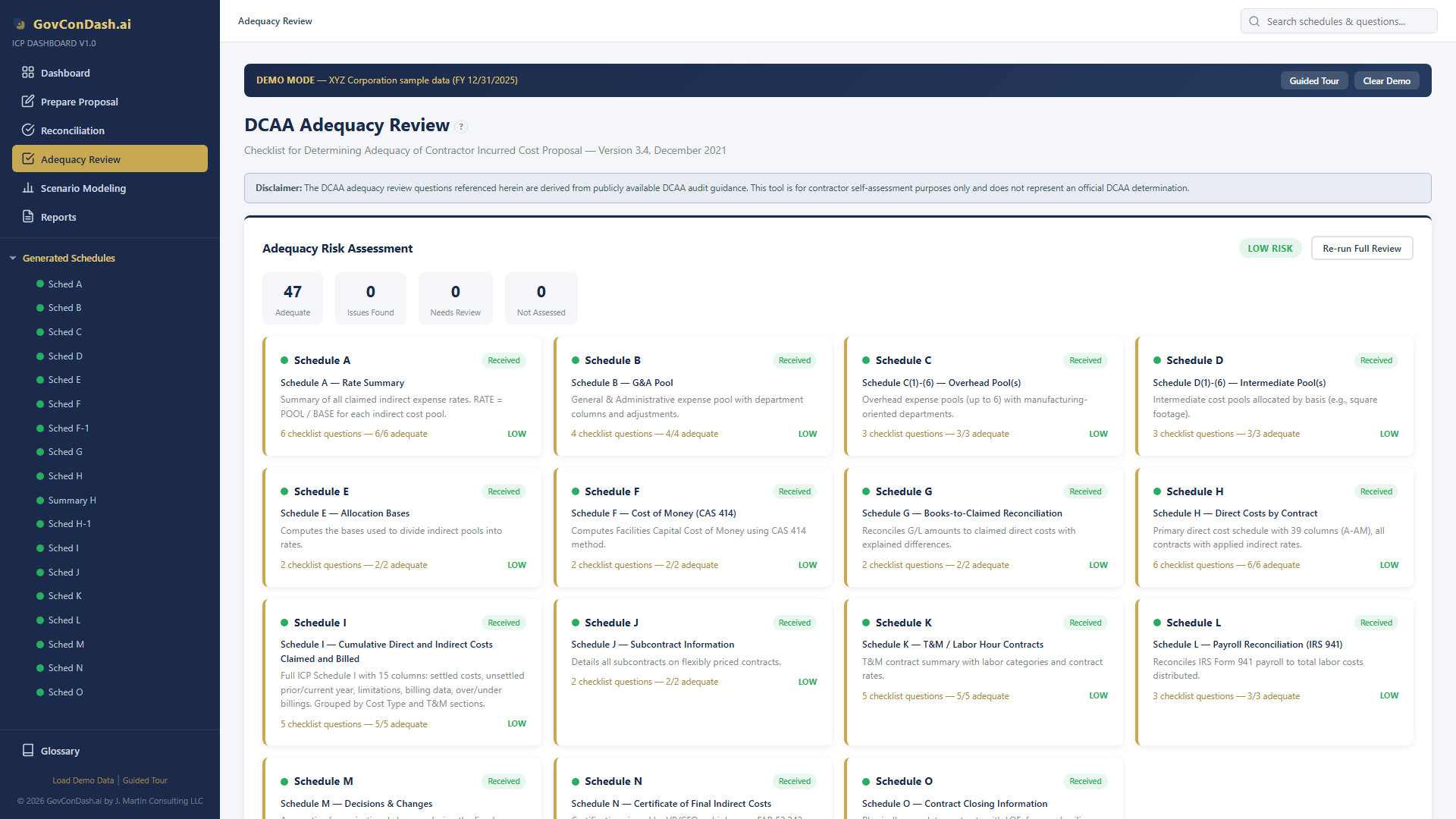
Adequacy Review: DCAA's checklist by schedule, with a risk assessment across all of it. Demo company data. - 5
Send DCAA a package, not a spreadsheet
The Reports page turns the finished work into what gets sent. The schedules export as a formatted Excel workbook, or as DCAA's own ICE workbook filled from your data. The submission package bundles Schedules A through O, the adequacy self-assessment, the signed Certificate of Final Indirect Costs and a transmittal letter, and scores the whole for readiness before it goes out. A separate audit package holds a workbook for each data input step, for the questions that come after submission.
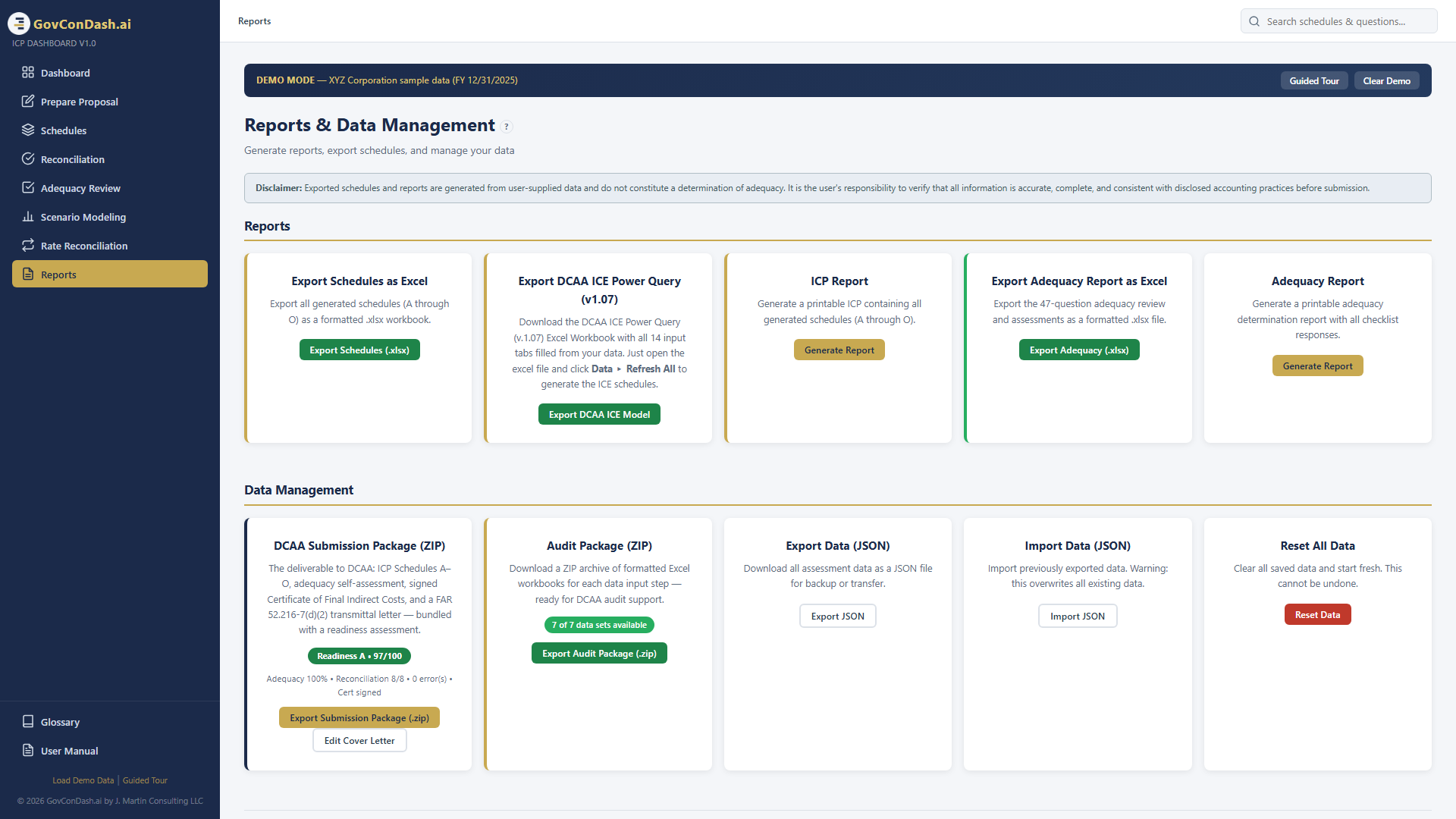
Reports and Data Management: the schedule and adequacy exports, the DCAA submission package with its readiness score, and the audit package. Demo company data. - 6
Model the rates before you bill them
“Contractors can model alternative indirect cost structures, evaluate different G&A allocation bases, and compare scenarios side-by-side to make informed decisions about cost allocation practices.” It is the arithmetic behind a provisional billing rate meant to land close to the final rate, which is what the billing rate rule aims at.
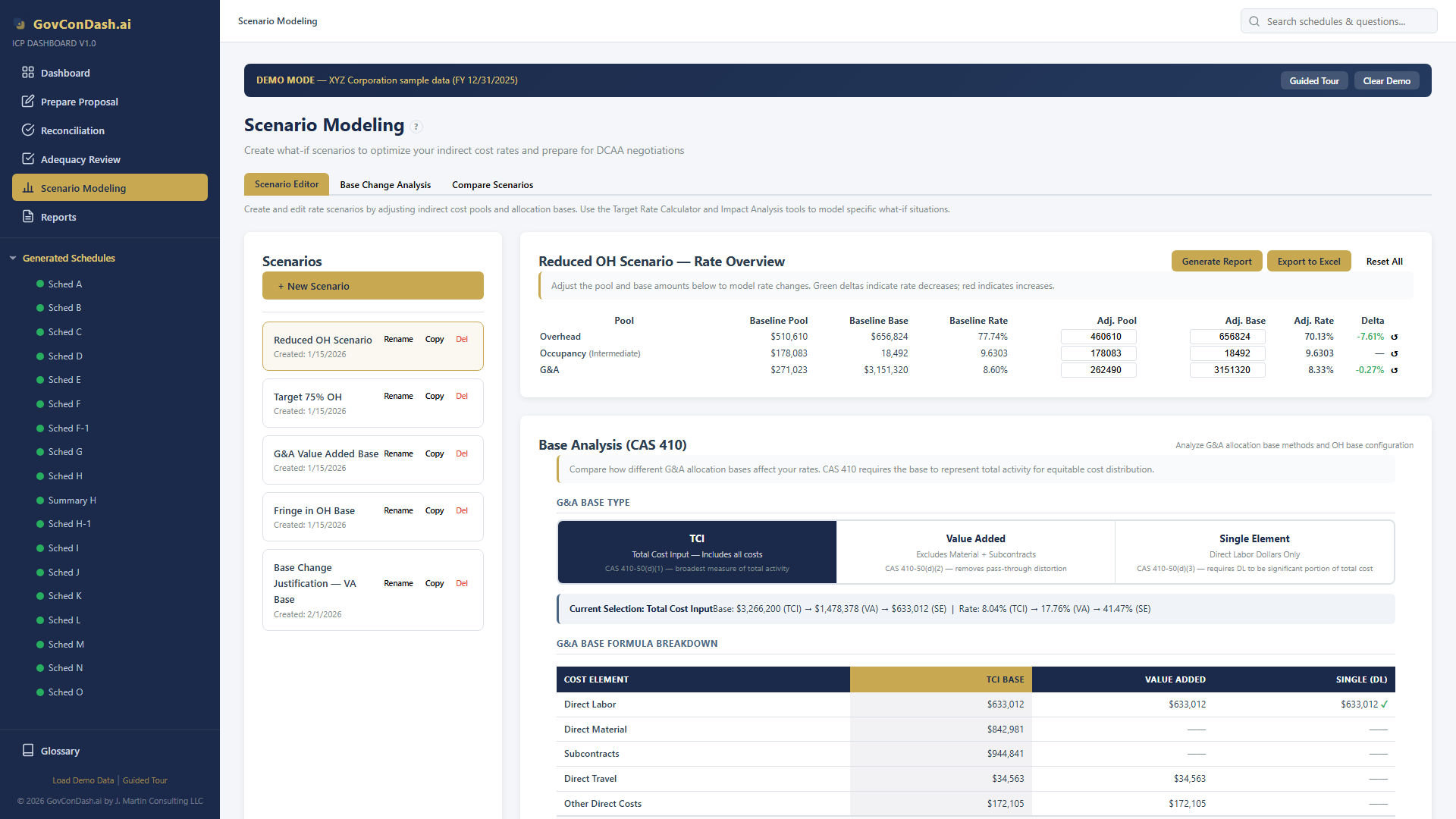
Scenario Modeling: adjusted pools and bases against the baseline rates, and the G&A allocation base analyzed under CAS 410. Demo company data.
The third part, Research Agent, answers incurred cost questions from DCAA's audit programs, the regulation, and the boards' and courts' decisions, and cites what it used.
Documents and data used in this piece
Every quotation above was checked against the copy of its document this platform holds, and every figure was counted from the data below. Each link opens the publisher's own site or document.
The Department's SBIR and STTR documents
- 2026 SBIR Broad Agency Announcement, preface
Department of War, through DSIP
Amendment 2 (July 15, 2026), 50 pages. The phase definitions, the contract types a contracting officer may use, and the section on a Phase II accounting system.
- Navy SBIR Release 5 Direct to Phase II instructions
Department of the Navy, through DSIP
27 pages. The contract types the Navy considers for award and its Phase III guidelines.
- DARPA SBIR Release 5 instructions
Defense Advanced Research Projects Agency, through DSIP
38 pages. The DCMA accounting system letter a cost-plus request must include.
- Defense SBIR/STTR funding opportunities
Department of War SBIR/STTR program
Where the Department posts each BAA cycle and its amendments; the Navy instructions point readers here.
- DSIP topics
DoW SBIR/STTR Innovation Portal
The live topic list the GovConDash DoW SBIR/STTR tab reads, with each topic's instructions and published questions.
- SBIR.gov open topics
U.S. Small Business Administration
Every agency's open SBIR and STTR topics.
- DARPA SBIR/STTR overview and pre-award checklist
Defense Advanced Research Projects Agency
The small business page where DARPA posts the pre-award checklist its instructions ask proposers to complete.
Award and company data
- SBIR.gov
U.S. Small Business Administration
The SBA's SBIR and STTR program site, which publishes the award file below and a page for each award.
- SBIR and STTR award file, without abstracts
U.S. Small Business Administration
A CSV download of 91 MB; 219,587 awards as loaded September 2, 2026.
- SBA Small Business Search
U.S. Small Business Administration
The directory whose primary NAICS code places each awardee in an industry group.
- North American Industry Classification System
U.S. Census Bureau
The industry group titles the codes roll up to.
- USAspending.gov
USAspending.gov
Department of War flexibly priced awards to small businesses, read through its award search API (https://api.usaspending.gov/api/v2/search/spending_by_award/).
DCAA audit programs and forms
- Audit program 17740, Preaward Survey of Prospective Contractor Accounting System
Defense Contract Audit Agency
Version 9.3, Jun 2025. The SF 1408 criteria, step by step.
- Audit program 15500, Provisional Billing Rates
Defense Contract Audit Agency
Effective Jul 2020. How DCAA sets provisional billing rates.
- Checklist for Determining Adequacy of Contractor Incurred Cost Proposal
Defense Contract Audit Agency
Version 3.4, dated December 2021, 10 pages, 47 questions across schedules A through O. The same checklist the ICP Dashboard's adequacy review runs.
- Audit program 10100, Post Year End Incurred Cost Audit - Small
Defense Contract Audit Agency
Version 6.5, Jan 2026. Its first planning step reviews the completed adequacy checklist.
- Audit program 10100, Post Year End Incurred Cost Audit - Large
Defense Contract Audit Agency
Version 12.5, Jan 2026. The same audit, in its Large version.
- Standard Form 1408, Preaward Survey of Prospective Contractor Accounting System
U.S. General Services Administration
The form audit program 17740 completes; the program links its latest version here.
FAR Overhaul class deviations
- DFARS FAR Overhaul class deviations
Defense Acquisition Regulations System (DARS)
The index every class deviation cited here is listed on, with its current revision.
- Class deviation 2026-O0043, DFARS Part 204
Department of War
Effective February 17, 2026.
- Class deviation 2026-O0036, DFARS Part 227
Department of War
Effective February 1, 2026.
- Class deviation 2026-O0050, DFARS Part 242
Department of War
Effective March 16, 2026.
- Revised FAR Part 42, Contract Administration and Audit Services
Acquisition.gov
The FAR Overhaul text the Part 242 deviation directs contracting officers to use in lieu of the codified FAR Part 42.
Regulations cited, as codified in the eCFR
This piece is commentary on published solicitation documents, regulations, DCAA audit programs and public award data. It is not legal advice, and it is not a determination about any contractor, any solicitation, any contract type or any audit.

GovConDash.ai
From the topic to the incurred cost submission
GovConDash scores the Department of War's live SBIR and STTR topics against your own award history, drafts the proposal package from the BAA and the component instructions themselves, prepares the pre-award accounting survey DCAA runs before a cost-type award, and tracks the incurred cost proposal the award starts. Every answer cites the record it came from. Your next incurred cost proposal due date is free on every account.
Keep reading
DCAA Rewrote Seven Chapters of Its Contract Audit Manual in SeptemberWhat DCAA's September reissue of its Contract Audit Manual cut from the passages courts and boards quote, what the decisions citing the manual did with them, and how to cite it now.