
The short version
- 1Seven chapters, most of them much shorter. DCAA reissued Chapters 1, 4, 7, 8, 9, 10 and 12 between September 3 and September 21. The six that had an earlier revision went from 700 numbered paragraphs to 277. Chapter 7 has a new subject: Fraud.
- 2Tribunals cite the manual. On this platform, 24 decisions do, from 2011 to 2026: 14 at the ASBCA, five at the CBCA, three at GAO and two at the Court of Federal Claims.
- 3It is not law, and it says so. The manual calls itself instructive and tells auditors not to cite it outside DCAA. The Court of Federal Claims and GAO have both said as much.
- 4It can still be read against the government. In six decisions a board or court held DCAA's own guidance against the government's position. That is the most useful thing the manual does for you.
- 5Cite it by revision date. Of nine passages tribunals quoted, six are no longer in the manual DCAA publishes and two have new numbers.
01What DCAA reissued this month
DCAA publishes the manual as one PDF per chapter and replaces each file when it reissues the chapter. Its index lists 19 files today, and seven of them carry a September 2026 date.
Reissued in September 2026, as DCAA's index lists them
- September 18Chapter 1, Introduction to Contract Audit39 to 40 paragraphs
- September 18Chapter 4, General Audit Requirements119 to 56 paragraphs
- September 3Chapter 7, Fraudnew subject, 17 paragraphs
- September 17Chapter 8, Cost Accounting Standards130 to 10 paragraphs
- September 21Chapter 9, Cost Estimates and Price Proposals233 to 70 paragraphs
- September 3Chapter 10, Report Writing68 to 33 paragraphs
- September 18Chapter 12, Contract Terminations Delay/Disruption and Other Requests for Equitable Adjustment or Claims111 to 68 paragraphs
Most of these chapters are shorter, and some by a lot. Chapter 8, Cost Accounting Standards, now runs to six pages. Chapter 9, Cost Estimates and Price Proposals, went from 233 numbered paragraphs to 70, and it is the newest revision on the list, dated September 21, 2026. Chapter 12, on terminations, delay and requests for equitable adjustment, went from 111 to 68.
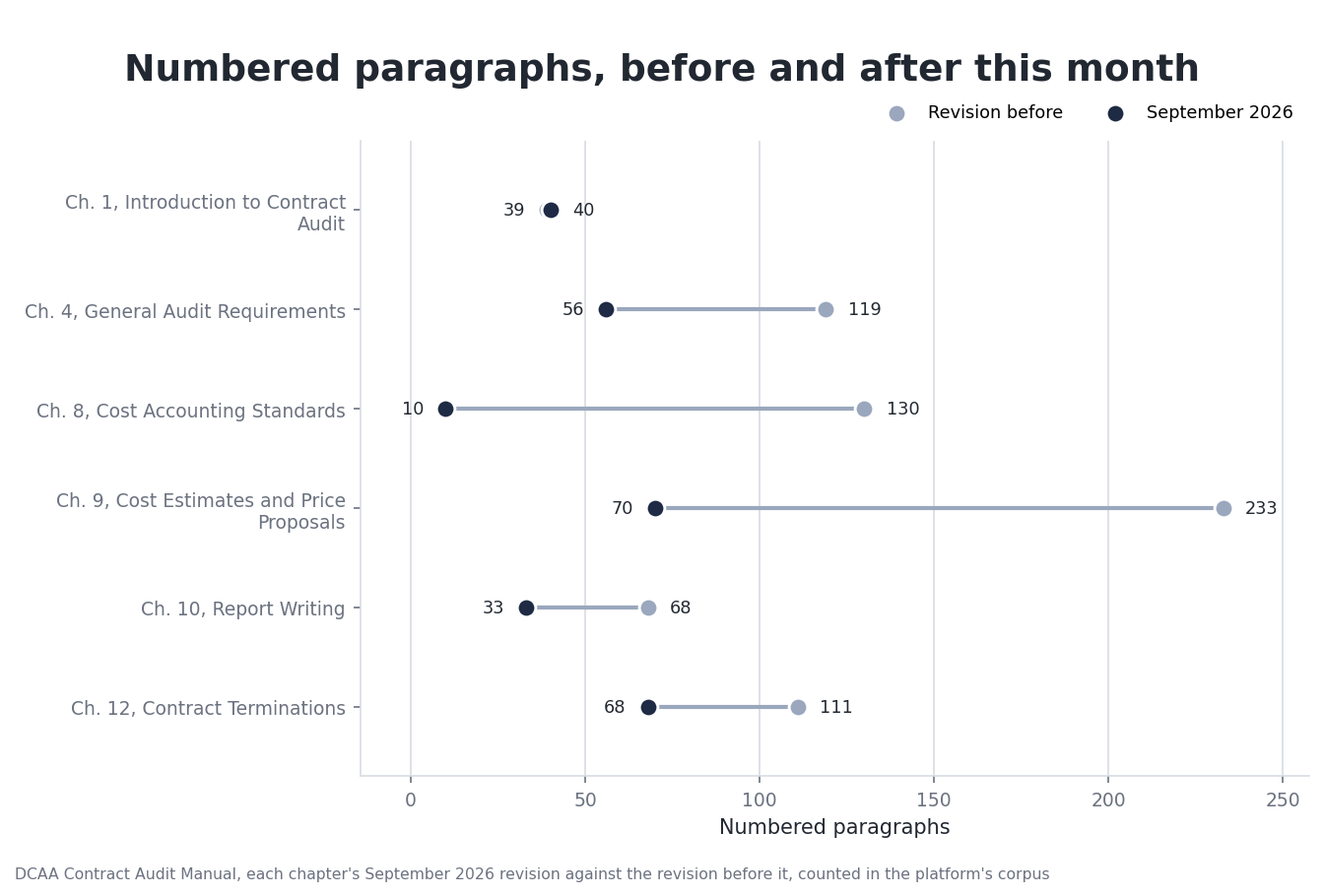
A shorter chapter is not necessarily a looser one, and what the cuts mean for audit practice is DCAA's to say. What they change for certain is citation. Paragraph numbers are how people cite the manual, and in a chapter that goes from 130 numbered paragraphs to 10, most of the old numbers no longer exist.
Chapter 7 is the one change of subject. DCAA's index now titles it Fraud. We read that chapter closely in a separate piece.
02The manual is not law, and it says so
Start with what the manual is. It is DCAA's guidance to its own auditors, and its Foreword is plain about how it expects to be used.
The material in this manual is instructive. Reference to this manual should not be made in audit reports or correspondence addressed to offices other than those of DCAA.
Tribunals have taken the manual at its word. In Advanced Powder Solutions, Inc. v. United States, the Court of Federal Claims noted that "the DCAM itself specifically instructs auditors to avoid citing the DCAM" in audit reports or correspondence outside the agency. In a protest by Battelle Memorial Institute, GAO said the manual "is for use by DCAA personnel, and is not a mandatory or binding regulation for procuring agencies".
In IAP Worldwide Services, Inc., the ASBCA said the same about the cost guidebook that grew out of the manual: "the guidebook is not binding on us".
Not binding does not mean irrelevant. In an attorney fee dispute, J.F. Taylor argued that DCAA's executive compensation method rested on "a manual that is not published and does not have the force of regulation". In its October 2013 decision the Board kept its finding that the government's position was substantially justified, partly because the method had been in the manual for years. The manual shows what DCAA told its auditors to do, and that is often exactly what a dispute is about.
03How courts and boards use it
We searched the full text of every decision this platform holds at six tribunals for the manual by name, then read each hit. The Armed Services Board accounts for 14 of the 24. The Federal Circuit (360 opinions on file) and the SBA Office of Hearings and Appeals (1,194 decisions) do not cite it at all.
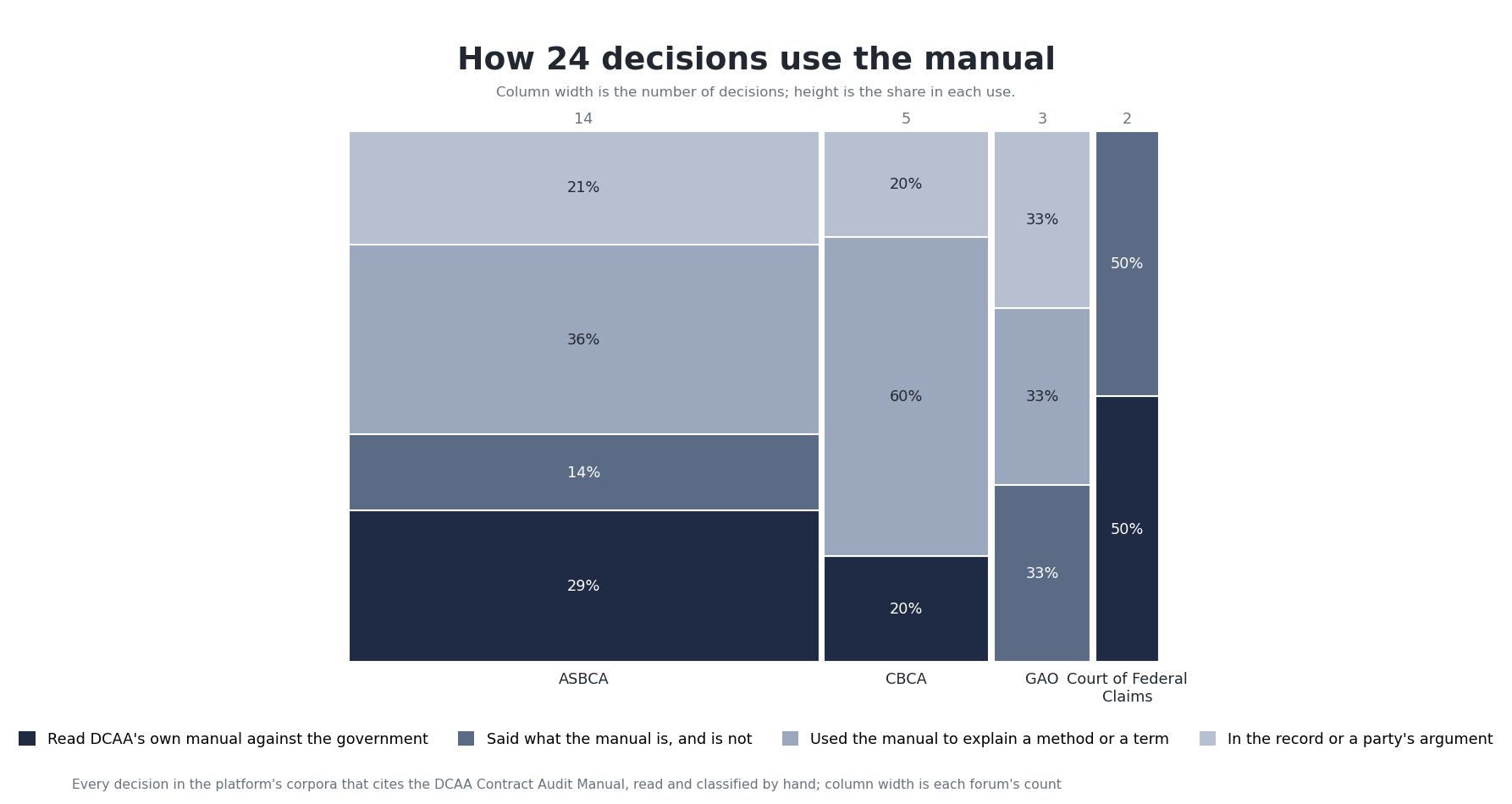
The largest group, nine decisions, uses the manual to explain how something is done: the Eichleay formula, the range of reasonableness for executive pay, disposal credits in a termination settlement, provisional billing rates. In five more it sits in the record without deciding anything. The four that said what the manual is are the ones part 02 quoted. Each decision below opens on its own page on this site.
Used the manual to explain a method or a term: 9
J.F. Taylor, Inc. (ASBCA, January 18, 2012)
Executive compensation. The Board recorded that DCAA's survey method is set out in the manual and auditors must follow it.
Metron, Inc. (ASBCA, June 4, 2012)
Executive compensation. The manual's ten percent range of reasonableness.
J.F. Taylor, Inc. (ASBCA, April 22, 2013)
Executive compensation. A survey method in use since the mid-1980s and set out in the manual.
Environmental Safety Consultants, Inc. (ASBCA, March 2, 2015)
Termination settlement. The manual's description of disposal credits.
Tyonek Global Services, LLC; Depot Aviation Solutions, LLC (GAO, October 4, 2019)
Provisional billing rates are for interim billing, per the manual.
Advanced Technologies Group, Inc. (ASBCA, November 18, 2020)
Incurred cost. DCAA rated a proposal low risk under the manual's sampling paragraph and skipped audit procedures.
Active Construction, Inc. (CBCA, March 9, 2022)
Field office overhead may be charged directly or indirectly, so long as the charging is consistent.
HPM Corporation (CBCA, July 12, 2023)
Audit scope is a matter of audit judgment, and auditors and contracting officers share information.
Venergy Group, LLC (CBCA, August 18, 2026)
Unabsorbed overhead. What total billings means in the Eichleay formula, quoted from the February 2026 chapter.
In the record or a party's argument: 5
Helionix Systems, Inc. (GAO, May 26, 2011)
The protester said a solicitation instruction violated the manual. GAO disagreed that the solicitation dictated the offeror's cost accounting.
Lockheed Martin Integrated Systems, Inc. (ASBCA, December 20, 2016)
The contractor argued nothing in the manual makes subcontractors send incurred cost proposals to the prime.
Vistas Construction of Illinois, Inc. (ASBCA, January 12, 2016)
DCAA supervisors cited the manual to an auditor in an internal dispute over the auditor's own report.
Sparton DeLeon Springs, LLC (ASBCA, May 18, 2017)
A manual excerpt the government attached to a reconsideration motion was not newly discovered evidence.
NVS Technologies, Inc. (CBCA, June 19, 2018)
A party's expert relied on the manual's auditing and investigative guidance.
Said what the manual is, and is not: 4
J.F. Taylor, Inc. (ASBCA, October 23, 2013)
Attorney fees, on reconsideration. The contractor argued the manual is not published and lacks the force of regulation; the Board kept its finding that the government's position was substantially justified.
Battelle Memorial Institute (GAO, January 23, 2020)
The manual is for DCAA personnel and does not bind a procuring agency's cost realism analysis.
Advanced Powder Solutions, Inc. v. United States (Court of Federal Claims, July 13, 2022)
The court noted that the manual tells auditors not to cite it outside DCAA.
IAP Worldwide Services, Inc. (ASBCA, May 6, 2026)
Joint venture legal costs. DCAA's cost guidebook, which expands on the manual, is not binding on the Board.
04When the manual is read against the government
This is the use that matters most to a contractor. When DCAA's own guidance says an auditor should do something and the auditor did not, a board will notice. In Voxtel, Inc., the government rejected indirect costs after a nomenclature review, a read of account names. The manual says "a nomenclature review alone is not a sufficient basis to reject a category of indirect expenses", and the Board added:
Ironically, the same criticism could be leveled at the government
The same move works on narrower points. In Technology Systems, Inc., the Board quoted DCAA's own guidance that the auditor "should not insist on a work product if other evidence provided is sufficient to determine the nature and scope of the actual work performed". In Turner Construction Company, the Civilian Board held that a voucher paragraph the agency relied on "does not apply to T&M contracts or to changes under a fixed-price contract".
In Sikorsky Aircraft Corp. v. United States, the Court of Federal Claims read the manual's instructions on when CAS noncompliance should be caught. The government had contracted on the very practices it later called noncompliant, and the court concluded that "this instruction is enough to allow Sikorsky to state a plausible claim" that its own rights were affected. And in the Boeing and Raytheon offset appeals, the Board noted that DCAA's own manuals had allowed the offsetting at issue.
Read DCAA's own manual against the government: 6
The Boeing Company (ASBCA, September 6, 2013)
Cost Accounting Standards offsets. The statement allowing combined changes to be offset appeared in the manual year after year.
Raytheon Company, Space & Airborne Systems (ASBCA, May 7, 2015)
Cost Accounting Standards offsets. DCAA's own manuals had expressly allowed the offsetting.
Technology Systems, Inc. (ASBCA, January 12, 2017)
Consultant costs. DCAA's own guidance says the auditor should not insist on a work product.
Turner Construction Company (CBCA, May 5, 2017)
The agency relied on a voucher paragraph; the Board held it does not reach time-and-materials work.
Sikorsky Aircraft Corp. v. United States (Court of Federal Claims, August 19, 2022)
Cost Accounting Standards. The manual's own audit instructions helped the contractor's claim survive a motion to dismiss.
Voxtel, Inc. (ASBCA, March 9, 2023)
Indirect costs. The manual says a nomenclature review alone cannot reject a cost, and the government never tested transactions.
The practical point for a rebuttal: when an audit finding departs from the procedure the manual sets out, quote the manual, at the revision in effect when the audit was done.
05The passages they quoted, and where they are now
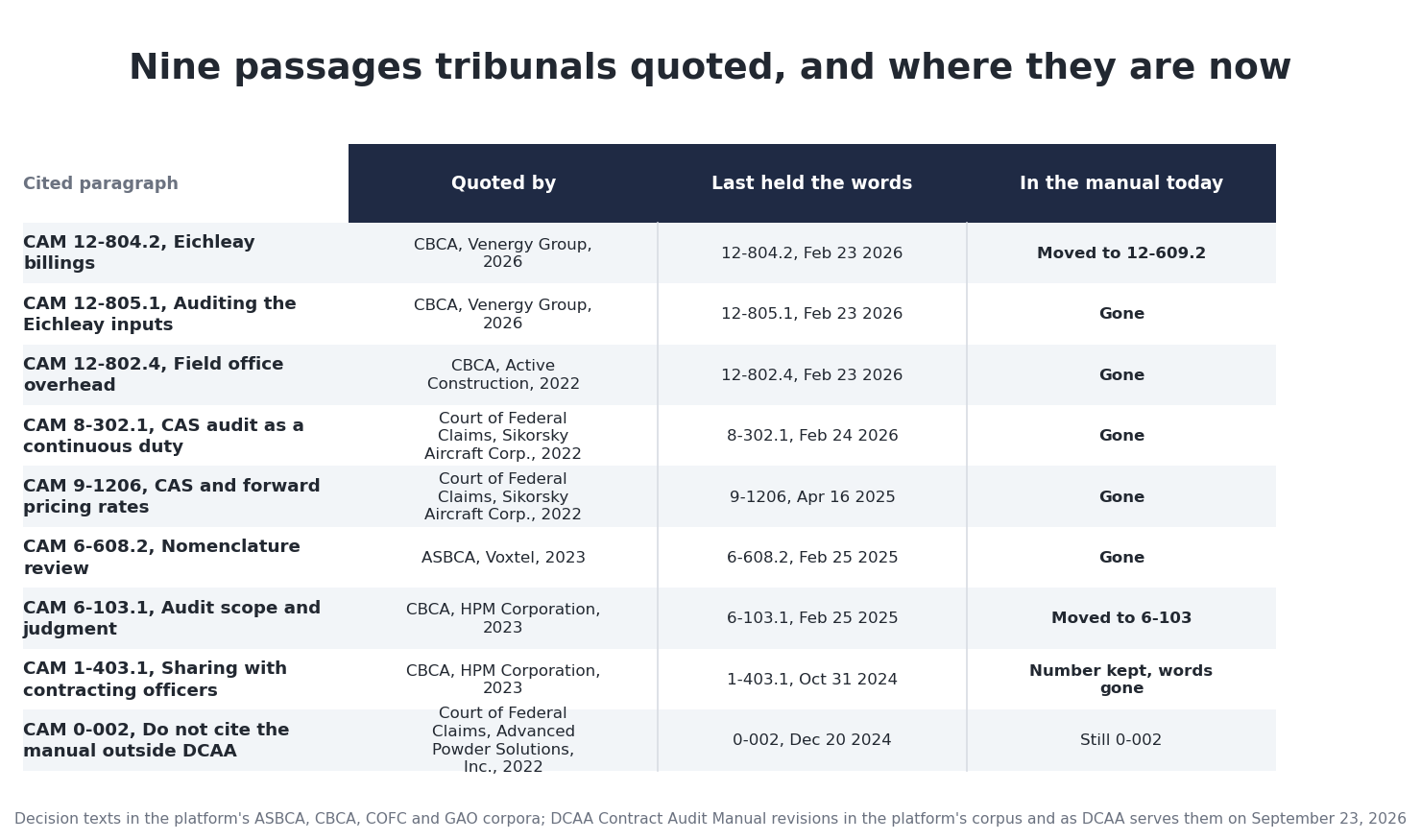
A manual citation is only as good as the revision behind it, and this month proved it. We took every passage a tribunal quoted word for word and looked for the same words in the manual DCAA publishes today.
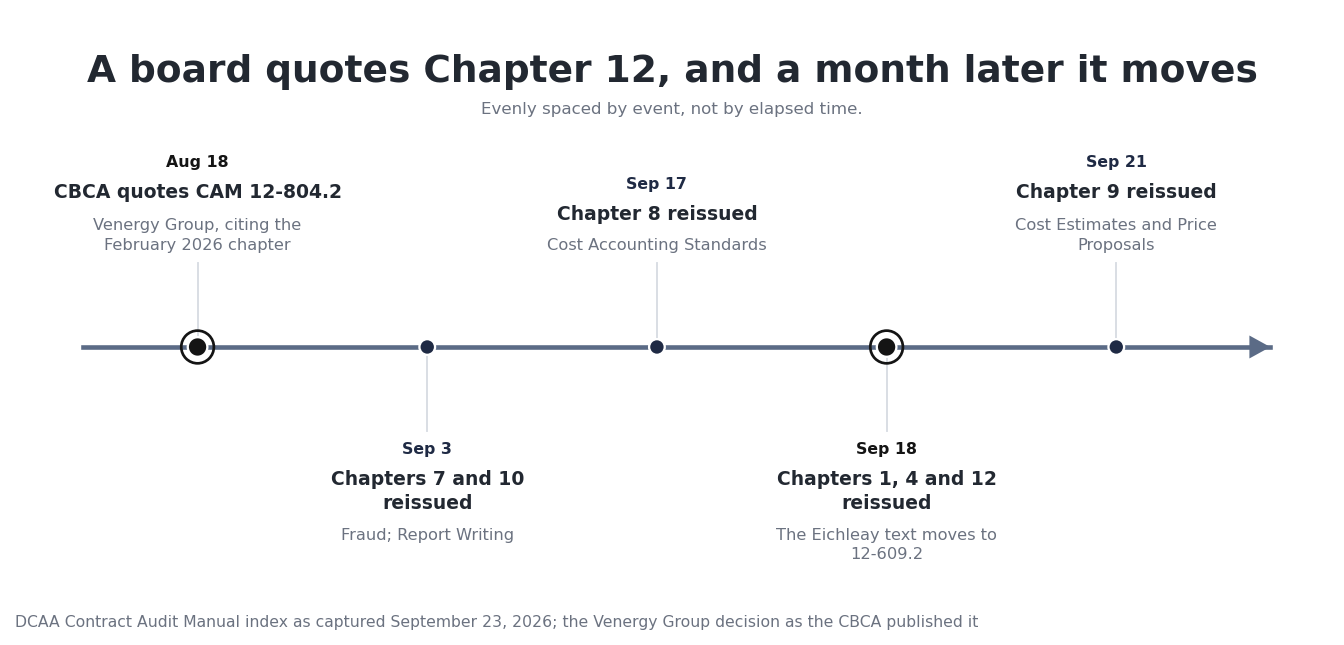
The Eichleay sentence survived word for word. In Venergy Group, LLC, the Board quoted that total billings are "revenues for all contracts (including Government and commercial) recognized for the period of actual contract performance including the delay/suspension and extended performance periods". The revision of September 18, 2026 carries the same words at 12-609.2, and Chapter 12 no longer has a paragraph 12-804.2. The other paragraph the Board cited that day, CAM 12-805.1, is not in the new chapter at all.
Six of the nine passages are gone. The Court of Federal Claims built part of its reasoning in Sikorsky on CAM 8-302.1, which called CAS audit responsibility a "continuous requirement". The September 17, 2026 Chapter 8 carries neither the paragraph nor the phrase. The Chapter 9 paragraph the court cited beside it, 9-1206, did not survive the revision of September 21, 2026. The nomenclature passage the Board relied on in Voxtel is not in the Chapter 6 revision of August 19, 2026.
Not everything went this month. In 2023 the Civilian Board quoted CAM 1-403.1 on auditors and contracting officers sharing information. That sentence was dropped in the revision of July 16, 2026; the paragraph number is still there, with different words under it. And the Foreword's rule about not citing the manual outside DCAA, the one the Court of Federal Claims relied on, is still 0-002, unchanged.
What this means for you is simple. A citation to the manual without a revision date now points at a paragraph that may not exist. Cite the chapter's date the way the Board did in Venergy, and keep the PDF you relied on. Before you quote an older decision's manual citation back to an auditor, check whether the words are still there.
GovConDash.ai
Check a citation before you rely on it
The Contract Audit Manual reader keeps the revisions DCAA has replaced beside the ones it publishes. Open a paragraph number and it lands on the revision that holds it; if DCAA has since reissued the chapter without that number, the reader says so. Try CAM 12-804.2, the paragraph the Board quoted in August. It is free with an account.
06Researching the manual and the case law in GovConDash
Everything in this piece came out of two parts of the platform: the Audit Readiness tab, which holds DCAA's guidance, and the decision tabs, which hold the case law. They are built to be used together.
Audit Readiness / Contract Audit Manual
The manual, paragraph by paragraph
Every chapter, including revisions DCAA has replaced, with each paragraph dated by the revision it comes from. A paragraph number opens on the revision that holds it, and the reader tells you when a newer revision dropped it. Free with an account.
Audit Readiness / Selected Areas of Cost
The cost guidebook
All 75 chapters of DCAA's Selected Areas of Cost Guidebook, where the cost guidance that used to live in the manual now sits.
Audit Readiness / Audit Program Explorer
What the auditor will test
DCAA's audit programs, step by step, so you can see the procedures behind a finding before you answer it.
Audit Readiness / Research Agent
Ask a question across all of it
The research agent answers out of the same stored paragraphs and cites the ones it read, so each one can be opened and checked. It needs a paid plan.
ASBCA / CBCA / GAO Protests / Court of Federal Claims
The case law, in full text
The decisions this piece read, searchable in their own tabs: the ASBCA, the Civilian Board, the Court of Federal Claims and GAO. Every decision linked above opens on its own public page on this site.
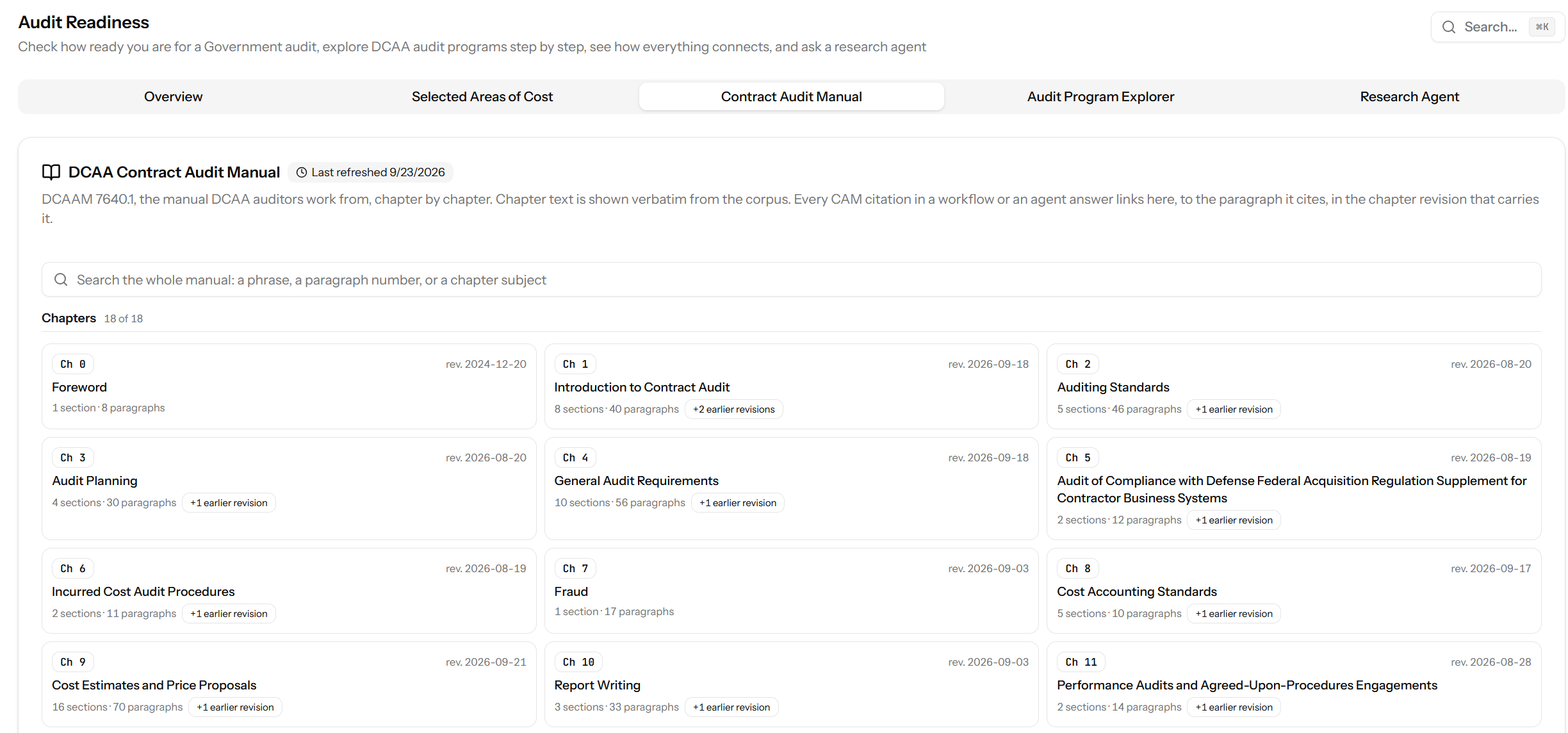
To do what this piece did for your own issue, take the manual paragraph an auditor cited. Search the decision tabs for it, read how the boards treated it, then open it in the reader to see whether it still says the same thing. Try CAM 6-608.2, the nomenclature passage from Voxtel, or CAM 12-609.2, where the Eichleay text sits now.
Documents and data used in this piece
Every quotation above was checked against a stored copy of its source before this page was written, 63 checks in all. Each passage from the current manual was also found in the PDF on DCAA's own site on September 23, 2026. Counts were computed from the data, not typed. The decisions were found by searching for the manual by name and read one by one. Each link below opens the publisher's own site or document.
The manual, as DCAA publishes it
- DCAA Contract Audit Manual, DCAA's chapter index
Every chapter DCAA publishes, each file stamped with its revision date.
- DCAA Contract Audit Manual, Foreword
As DCAA publishes it, revised December 20, 2024.
- DCAA Contract Audit Manual, Chapter 1: Introduction to Contract Audit
As DCAA publishes it, revised September 18, 2026.
- DCAA Contract Audit Manual, Chapter 4: General Audit Requirements
As DCAA publishes it, revised September 18, 2026.
- DCAA Contract Audit Manual, Chapter 6: Incurred Costs Audit Procedures
As DCAA publishes it, revised August 19, 2026.
- DCAA Contract Audit Manual, Chapter 7: Fraud
As DCAA publishes it, revised September 3, 2026.
- DCAA Contract Audit Manual, Chapter 8: Cost Accounting Standards
As DCAA publishes it, revised September 17, 2026.
- DCAA Contract Audit Manual, Chapter 9: Cost Estimates and Price Proposals
As DCAA publishes it, revised September 21, 2026.
- DCAA Contract Audit Manual, Chapter 10: Report Writing
As DCAA publishes it, revised September 3, 2026.
- DCAA Contract Audit Manual, Chapter 12: Contract Terminations Delay/Disruption and Other Requests for Equitable Adjustment or Claims
As DCAA publishes it, revised September 18, 2026.
The decisions quoted most
- Venergy Group, LLC, CBCA 7915, 8303 (CBCA, August 18, 2026)
The tribunal's own copy of the decision.
- Sikorsky Aircraft Corp. v. United States, No. 21-2327 (Court of Federal Claims, August 19, 2022)
The tribunal's own copy of the decision.
- Voxtel, Inc., ASBCA No. 60129 (ASBCA, March 9, 2023)
The tribunal's own copy of the decision.
- Battelle Memorial Institute, B-416263.5 (GAO, January 23, 2020)
The tribunal's own copy of the decision.
- Advanced Powder Solutions, Inc. v. United States, No. 20-137 (Court of Federal Claims, July 13, 2022)
The tribunal's own copy of the decision.
This piece is commentary on published audit guidance and on published decisions. It is not legal advice, and it is not a determination about any contractor, contract or audit. The Contract Audit Manual is guidance to DCAA personnel and does not itself create obligations for a contractor. The grouping of decisions by use is our reading; the words each decision is described by are its own.

Keep reading
DCAA Replaced Its Cost Chapter With a Fraud ChapterThe one chapter DCAA gave a new subject this month: what the fraud chapter tells your auditor to do, what it tells them not to tell you, and where a referral ends up.