
The document this piece reads
- Document
- 91 FR 59476
- Case
- FAR Case 2026-006
- Stage
- Proposed rule, published September 18, 2026
- Comments close
- October 19, 2026
One term first. An incurred cost proposal is a yearly submission. A contractor with cost-reimbursement or time-and-materials work files it to propose final indirect cost rates for a fiscal year that has closed. FAR 52.216-7 requires it, and paragraph (d)(2)(iii) lists what it must contain. DCAA calls those items schedules and names them by the clause's own letters, so this piece does too.
The short version
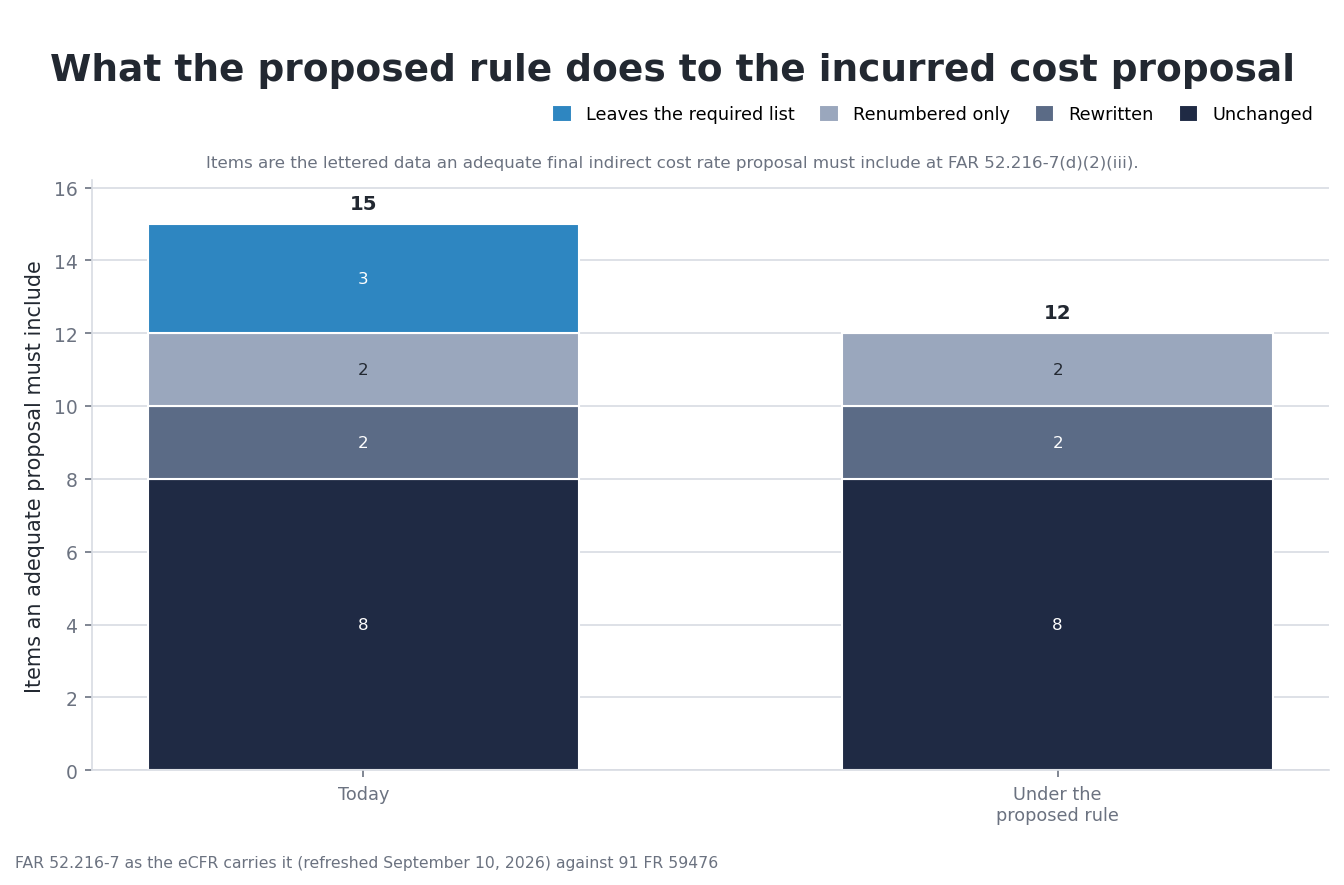
- 1The required list drops from 15 items to 12. The time-and-materials detail (K), the IRS Form 941 payroll reconciliation (L) and the contract closing schedule (O) stop being required items.
- 2Only the payroll reconciliation is truly deleted. The summaries from (K) and (O) move into schedule (H). Contract fee computations are dropped.
- 3The subcontract listing shrinks to large subcontracts. Schedule (J) would list only subcontracts above the certified cost or pricing data threshold, $2,500,000 today.
- 4Fixed-price incentive contractors get pulled in. Hold one and no cost-reimbursement or time-and-materials work? The rule would have you file an incurred cost proposal to establish final rates. Jump to that part.
- 5Nothing changes yet. This is a proposed rule. The clause in your contract governs until a final rule is adopted and reaches a new award.
01What leaves the list
Why cut the list at all? The FAR Council's answer is less work on both sides: less to prepare, and less time spent on information that adds little to the adequacy check. It expects contractors to save about 10 percent of their preparation time, a figure it takes from industry's own statements rather than from measurement. Here it is in the rule's words.
The proposed changes are expected to decrease the overall burden related to the preparation and submission of incurred costs proposals and streamline the initial determination adequacy. Contractors will spend less time preparing the submission and estimate 10 percent based on the statements from Industry in their response to OIRA's Request for Information (RFI) for burden reduction suggestion. In addition, contractors and Government will spend less time reviewing and discussing information that provide little value to the initial adequacy determination. These changes will promote efficiency in the setting of final indirect cost rates.
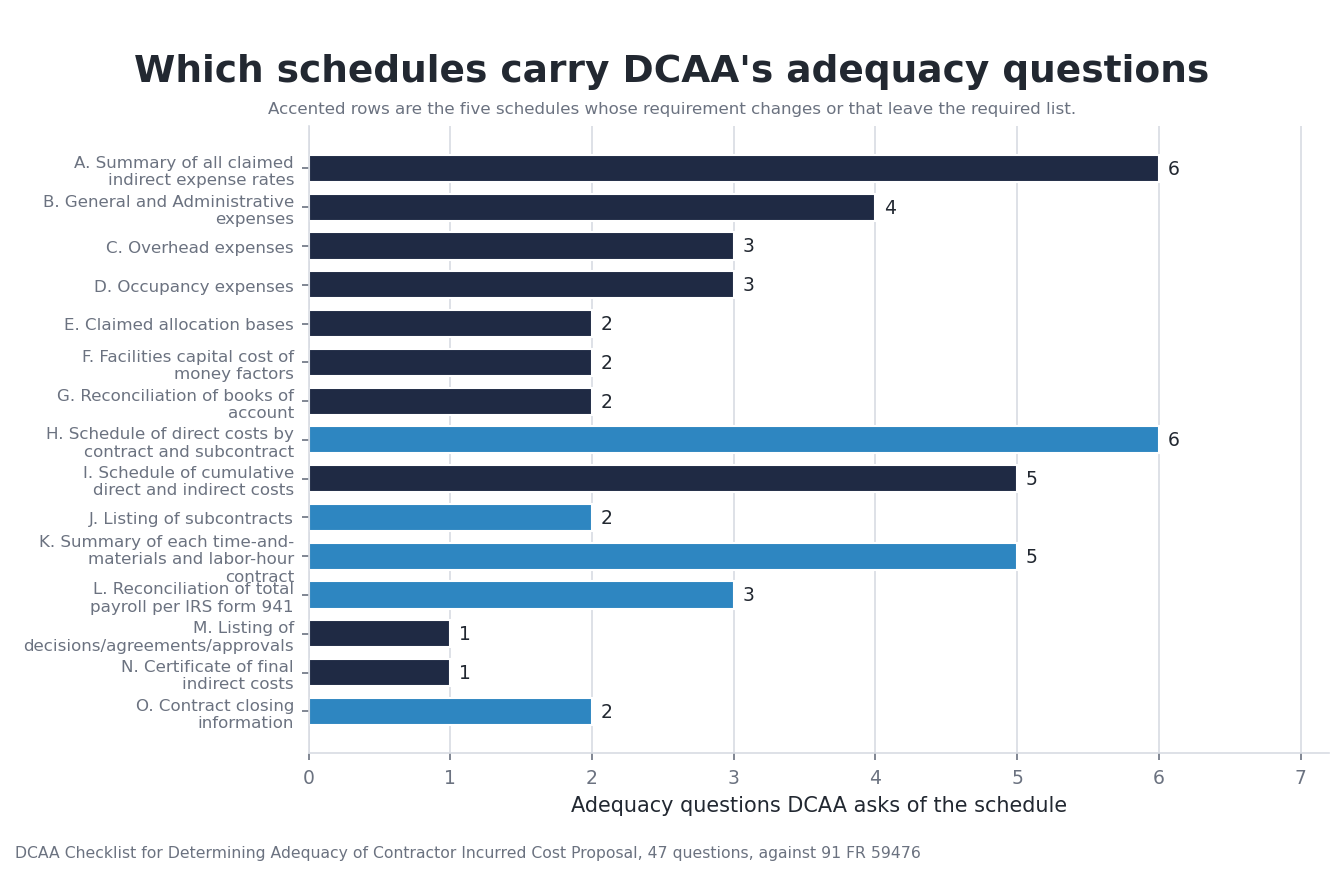
Today the clause lists 15 items, (A) through (O). DCAA's adequacy checklist is organized by the same letters and asks 47 questions across them, so counting questions shows how much of the adequacy review each change touches.
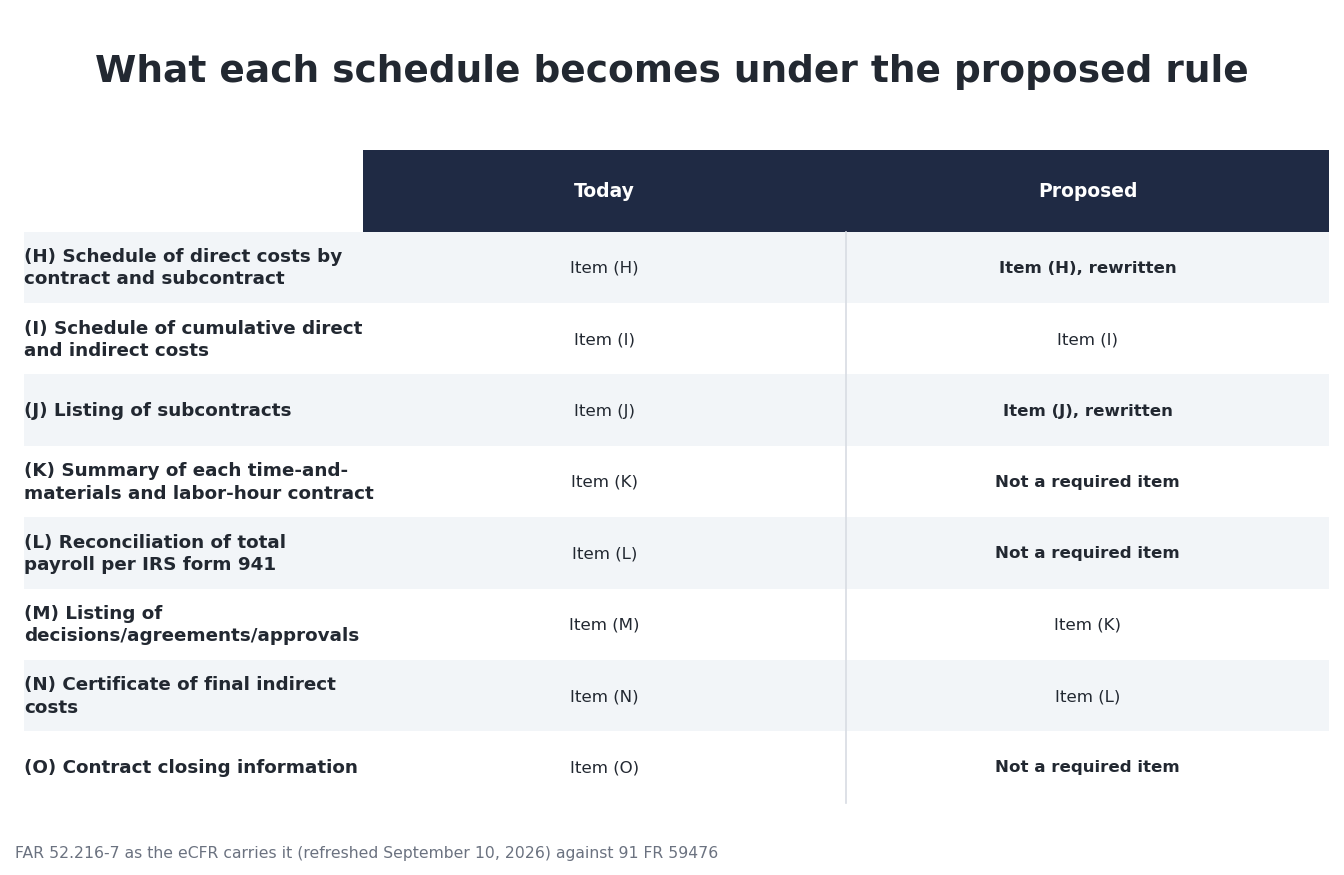
Three items stop being required. They are not equal losses.
Today: Summary of each time-and-materials and labor-hour contract information, including labor categories, labor rates, hours, and amounts; direct materials; other direct costs; and, indirect expense applied at claimed rates.
Proposed: The detail goes and the summary moves. Labor rates, labor hours and other detailed cost elements are removed; the summary level information relocates to schedule (H).
Today: Reconciliation of total payroll per IRS form 941 to total labor costs distribution.
Proposed: Gone. It is the only one the rule says would be removed in its entirety, with nothing relocated.
Today: Contract closing information for contracts physically completed in this fiscal year (include contract number, period of performance, contract ceiling amounts, contract fee computations, level of effort, and indicate if the contract is ready to close).
Proposed: Relocated to schedule (H) and trimmed to level-of-effort information, the contract ceiling amount and whether the contract is ready to close. Contract fee computations are no longer required.
One caution on the payroll reconciliation. The rule changes what makes a submission adequate, the check DCAA runs before an audit starts. It does not say what an auditor may request once the audit is under way. The clause already keeps the two apart: paragraph (d)(2)(iv) lists information that is not required for adequacy but may be required during the audit. If the reconciliation catches your own errors today, the rule is no reason to stop preparing it.
02Two schedules stay but change: (H) and (J)
Schedule (H), direct costs by contract and subcontract, absorbs what survives from the two relocated schedules. The proposed text adds a summary of total labor and nonlabor billed on time-and-materials and labor-hour contracts, and then this for closeout:
For contracts physically completed during the fiscal year, the schedule must include the contract number, level-of-effort information, the contract ceiling amount, and confirmation of whether the contract is ready to close.
What you would stop preparing is the detail: the labor categories, rates and hours behind each time-and-materials contract, and fee computations at closeout. The reconciliation of your books to claimed costs in schedule (G) is untouched.
Schedule (J) changes more. Today it lists every subcontract you awarded as a prime or upper-tier contractor, with no dollar floor.
Paragraph (j), Subcontract Information, would be limited to only those subcontracts with a value exceeding the threshold for requiring certified cost or pricing data as prescribed in FAR 15.403-3.
That threshold is $2,500,000 today, raised from $2,000,000 effective Oct 1, 2025. A company with dozens of small subcontracts lists every one now, with names, addresses and points of contact. Under the proposed text only those above the threshold would appear. One note for anyone checking the citation: the rule cites FAR 15.403-3, the overhaul's new home for the threshold. In today's FAR it sits at FAR 15.403-4.
03Who newly files one
Everything above narrows an existing obligation. This part widens who has it. A fixed-price incentive contract settles at a price that depends on your actual cost, indirect cost included. Yet the two incentive price revision clauses, FAR 52.216-16 and FAR 52.216-17, never mention the allowable cost and payment clause today.
Does an incentive price revision clause send you to FAR 52.216-7?
Today
Zero mentions
Neither Incentive Price Revision-Firm Target nor Incentive Price Revision-Successive Targets names the allowable cost and payment clause anywhere in its text.
Proposed
Both, by name
Each clause gains the same sentence routing a contractor with no other rate-setting contract into paragraph (d) of the allowable cost and payment clause.
The proposed text adds the same sentence to both clauses.
If the Contractor does not have another Federal contract which requires the establishment of final indirect cost rates for the relevant fiscal year, the contractor must submit the data required by, and the parties must follow the procedures identified in, paragraph (d) of 52.216-7, Allowable Cost and Payment, to establish final indirect cost rates.
The condition matters. If you already hold cost-reimbursement work, you file an incurred cost proposal anyway and nothing changes. If a fixed-price incentive contract is the only one you hold that needs final rates, you would follow paragraph (d) of the allowable cost and payment clause. That means an adequate proposal within six months of your fiscal year end, closing with the certificate of final indirect costs at FAR 52.242-4.
Two details. First, the proposed clauses leave one exit: rates need not be settled first if the quick-closeout procedure is used (FAR 42.708 in today's FAR). Second, the clause's prescription, today at FAR 16.307, would be rewritten to name cost-type incentive contracts. If that burden is not what the rule assumes for a company like yours, the comment period is the place to say so.
04What happens next
This is a proposed rule. The clause in your contract governs until a final rule is adopted, and the rates for a closed fiscal year are set under the clause that contract carries.
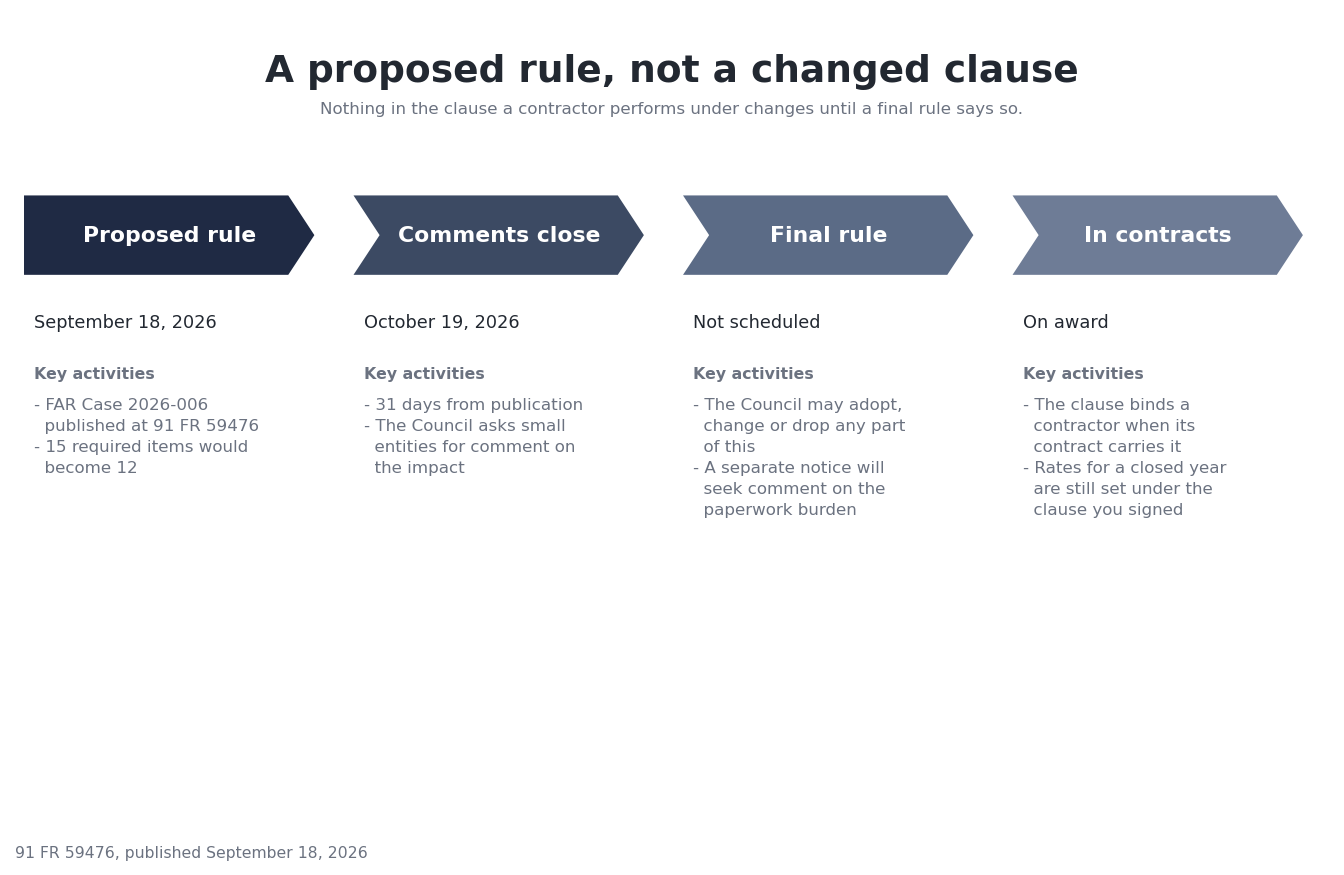
The rule also sizes the work involved: 6,265 respondents and 1,353,807 burden hours a year across the five clauses in its information collection, about 216 hours each.
Comments close October 19, 2026. The rule asks for them through the Federal eRulemaking portal, citing FAR Case 2026-006.
05Preparing an adequate proposal in GovConDash
Each item on that list is a schedule someone on your team has to build every year. The Incurred Cost Proposal tab in GovConDash builds them from your accounting data, and its user manual shows how, step by step.
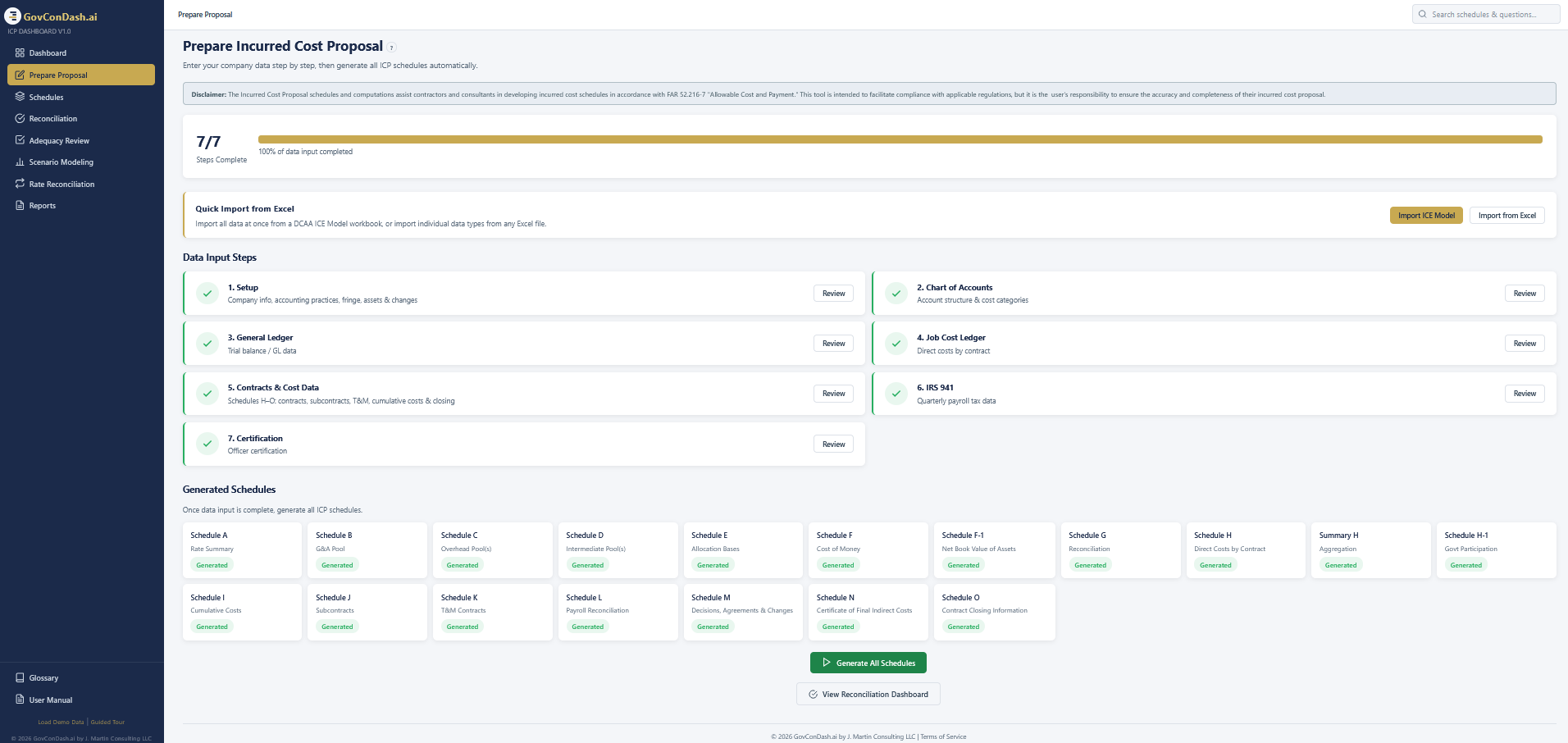
Dashboard / Incurred Cost Proposal / Prepare
From your books to the schedules
- What you enter
- The Prepare Proposal page provides a 7-step wizard for entering all data needed to generate ICP schedules.
- What it builds
- Once that data is in, the dashboard automatically computes all ICP schedules (A through O) without manual formula management.
- How it checks adequacy
- The complete 47-question DCAA Adequacy Checklist (v3.4) is integrated directly into the dashboard, with progress tracking, auto-population from generated data, and exportable assessment reports.
- Why that matters here
- That is the same checklist whose 47 questions this piece counted. If the rule is adopted, 10 of them sit on schedules that stop being required.
The dashboard already works the way this rule is heading. Three of the schedules the rule changes, (J), (K) and (L), already appear in it only when they apply to your company, based on your setup. The Form 941 step can be skipped too, under the waiver DCAA typically grants when a labor reconciliation is not meaningful for a contractor's cost structure. The rule would, in effect, extend that waiver to everyone.
Already keep DCAA's ICE Model in Excel? You do not start over. The dashboard imports an existing ICE Model workbook and exports a multi-sheet Excel workbook with number formatting and cross-sheet formulas. Prepare needs a paid plan.
Reading the regulation does not. The eCFR Research Agent is the one AI surface a free account includes. Ask it what FAR 52.216-7 requires of an adequate proposal. It answers from the regulation and names the section it read, so you can check it against the eCFR yourself.
Documents and data used in this piece
Both versions of the clause list were read from their sources rather than typed: today's from the eCFR, the proposed one from the Federal Register. Every quotation and figure above was checked against a stored copy of its source before this page was written, 58 checks in all. Each link opens the publisher's own site or document.
The rule
- Federal Acquisition Regulation: Revolutionary Federal Acquisition Regulation Overhaul Parts 16, 17, and 35 (91 FR 59476)
Captured September 18, 2026 from the publisher's own text service, 429,938 bytes, sha256 c1cfd32b19274ddb.
- Where to comment: the Federal eRulemaking portal
The address the rule's own ADDRESSES section prints for comments on FAR Case 2026-006.
- The rule's text as this post read it
The exact bytes hashed above and stored at reports/allowable-cost-rule/sources/2026-19160.txt.
The regulation as it stands today
- FAR 52.216-7, Allowable Cost and Payment
The eCFR address the seeded row carries, refreshed September 10, 2026.
- FAR 52.216-16, Incentive Price Revision-Firm Target
The eCFR address the seeded row carries, refreshed September 10, 2026.
- FAR 52.216-17, Incentive Price Revision-Successive Targets
The eCFR address the seeded row carries, refreshed September 10, 2026.
- FAR 52.242-4, Certification of Final Indirect Costs
The eCFR address the seeded row carries, refreshed September 10, 2026.
- FAR 16.307, Contract clauses
The eCFR address the seeded row carries, refreshed September 10, 2026.
- FAR 15.403-3, Requiring data other than certified cost or pricing data
The eCFR address the seeded row carries, refreshed September 10, 2026.
- FAR 15.403-4, Requiring certified cost or pricing data (10 U.S.C. chapter 271 and 41 U.S.C. chapter 35)
The eCFR address the seeded row carries, refreshed September 10, 2026.
- FAR 42.708, Quick-closeout procedure
The eCFR address the seeded row carries, refreshed September 10, 2026.
What an auditor asks
- DCAA Checklist for Determining Adequacy of Contractor Incurred Cost Proposal (47 questions)
The address serves bytes hashing to 71c4482e4dc98bce, the sha256 the tracked module records.
- FAR threshold changes, as acquisition.gov publishes them
The address the tracked threshold table records as its own source.
The product this piece points at
- The Incurred Cost Proposal Dashboard's own site
The origin of the guide download addresses the tracked ICP reference module carries.
- ICP Dashboard User Manual, version 1.0 (69 pages)
The address the tracked ICP reference module carries; it serves bytes hashing to 6125018d6ec5a69d, the sha256 the tracked guides module was built from.
This piece is commentary on a published proposed rule and on regulations as the eCFR carries them. It is not legal advice, and it is not a determination about any contractor, any contract, any submission or any audit. A proposed rule is not law, and the FAR Council may adopt, change or drop any part of it.

GovConDash.ai
Read the clause you are actually performing under
Ask the eCFR Research Agent what the allowable cost and payment clause requires of an adequate proposal, and it answers from the seeded Federal Acquisition Regulation with the section it read. It is free on every account, including the free one.
Keep reading
CAS Is Shrinking. Your Accounting Rules Are Not.The other rulemaking reshaping contract cost accounting, read rule by rule against every decision in this platform's Court of Federal Claims and ASBCA corpora that names a standard.