


































01Where the two rulebooks actually collide
Start with how rarely the question comes up, because that is the first surprise. This platform holds 2,322 Court of Federal Claims opinions and 4,570 ASBCA decisions with their verbatim text. Search all 6,892 of them and 117 name a Cost Accounting Standard, 45 name generally accepted accounting principles, and 18 name both.
That last number is the one that matters. A decision naming only CAS is a decision about a government rule. A decision naming only GAAP is usually about something else entirely, a financial statement or an audit. A decision naming both is a decision where somebody argued that one rulebook should decide what the other one means, and a tribunal had to say whether that was right.

02The ASBCA said no. The Court of Federal Claims said yes.
Inside that overlap sit two decisions that put the question as cleanly as it can be put: when the text of a Cost Accounting Standard runs out, does GAAP fill the gap?
In Exelis, Inc., the Defense Contract Management Agency asserted a $3,821,534 claim on the theory that the contractor had misclassified a building lease as an operating lease rather than a capital lease, and that the misclassification broke CAS 404. The agency's argument was fundamentally an appeal to GAAP: the lease was a capital lease under FAS 13, so the contractor's capitalization practice was noncompliant. The Armed Services Board of Contract Appeals disagreed, twice, and the second time it explained why in a sentence that should be on the wall of every cost accounting group.
Armed Services Board of Contract Appeals
Does GAAP fill a gap in CAS 404?
No.
The Board denied reconsideration and held that the government cannot state a CAS 404 claim over a lease the contractor did not treat as a purchase, whatever GAAP would have called it.
At stake: $3,821,534
Read the decisionUnited States Court of Federal Claims
Does GAAP decide allowability under CAS 406?
Yes.
The court held that the deferred costs are allowable only if the practice that produced them complied with GAAP, and sent that question toward trial.
At stake: $271,152,672
Read the opinion“The government seeks to use GAAP, the lowest level of the hierarchy, to interpret the top level of the hierarchy because of a purported gap.”
The Board's reasoning rested on drafting history rather than on accounting theory. When CAS 404 was written, the Board noted, the CAS Board had proposed language that would have pulled the accounting principles of the day into the standard, and then removed that language before the final rule. Twenty years later the reconstituted CAS Board readopted the standard unchanged, declining a second opportunity to import the newer lease treatment. Two deliberate omissions, two decades apart, are what defeated a multimillion dollar claim.
Now put United Launch Services, LLC beside it. There the government was the one arguing that GAAP controlled, and it won. The court read FAR 31.201-2(a), CAS 406 and FAR 31.205-23 together and concluded that whether the contractor could recover $271,152,672 in deferred support costs depended on whether the deferral practice behind them complied with GAAP, a question of fact requiring expert testimony. We read that opinion in full in a separate piece.
The two are reconcilable, and the reconciliation is the practical lesson. GAAP does not override a standard that speaks for itself, and it does not get to redefine terms the CAS Board deliberately left alone. But where the FAR routes allowability through GAAP by its own terms, or where a standard requires an “appropriate” practice without defining one, GAAP supplies the content. Which rulebook wins depends on which provision you are standing in.
A cost is allowable only when it complies with standards promulgated by the CAS Board, if applicable, or otherwise, generally accepted accounting principles and practices appropriate to the circumstances.
03The standards being fixed are not the standards being fought over
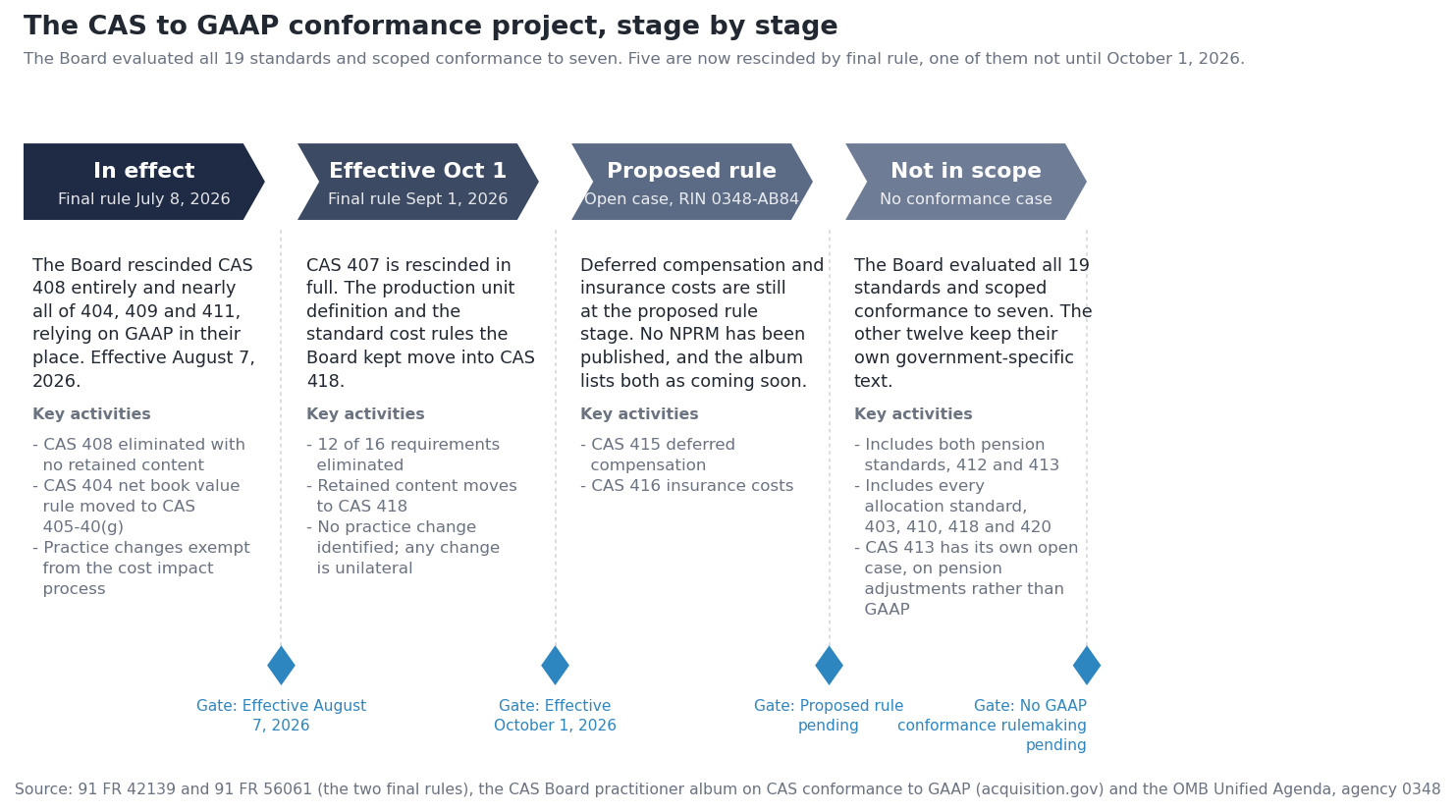
The CAS Board's answer to this tension is systematic: work through the standards one at a time and, where GAAP already says the same thing, rescind the government version. The project is real and it is moving. On July 8, 2026 the Board issued 91 FR 42139, a final rule rescinding CAS 408 entirely and nearly all of CAS 404, 409 and 411, effective August 7, 2026. By the Board's own count that eliminated 68 of the 72 individual requirements in the four standards and removed over 10,000 words of regulatory text. CAS 404, the very standard the Board and DCMA spent two rounds of briefing on in Exelis, Inc., is now almost entirely gone, with one provision preserved and moved into CAS 405 because GAAP has no equivalent protection against paying twice for the same asset after an acquisition.
Then on September 1, 2026 the Board finished CAS 407, the standard on standard costs for direct material and direct labor. 91 FR 56061 rescinds it effective October 1, 2026. 12 of its 16 requirements go, almost 2,000 words with them, and what the Board kept, the production unit definition and the rules on setting a labor-rate standard and disposing of variances, moves into CAS 418, which is where a reader will find them from October. The Board identified no practice change in the rescission, which cuts both ways: a contractor changes nothing on the effective date, and any change it later makes to its standard costing is unilateral, with the price adjustment that implies.
The codified text agrees, which is worth checking rather than assuming. This platform reseeds the eCFR weekly, and as of 2026-09-13 chapter 99 carried 8 sections for CAS 406 and not one for CAS 404, CAS 408, CAS 409 or CAS 411. It still carried 7 sections for CAS 407, which the September 1, 2026 rule removes on October 1, 2026. The four rescinded standards are gone from the Code of Federal Regulations itself, which is the same fact the Board's album reports, confirmed from a source that is not the Board.
So the tension gets resolved, eventually, by deleting the text that caused it. That is a defensible way to run a conformance program. It is worth being precise, though, about what it will and will not do for your exposure.
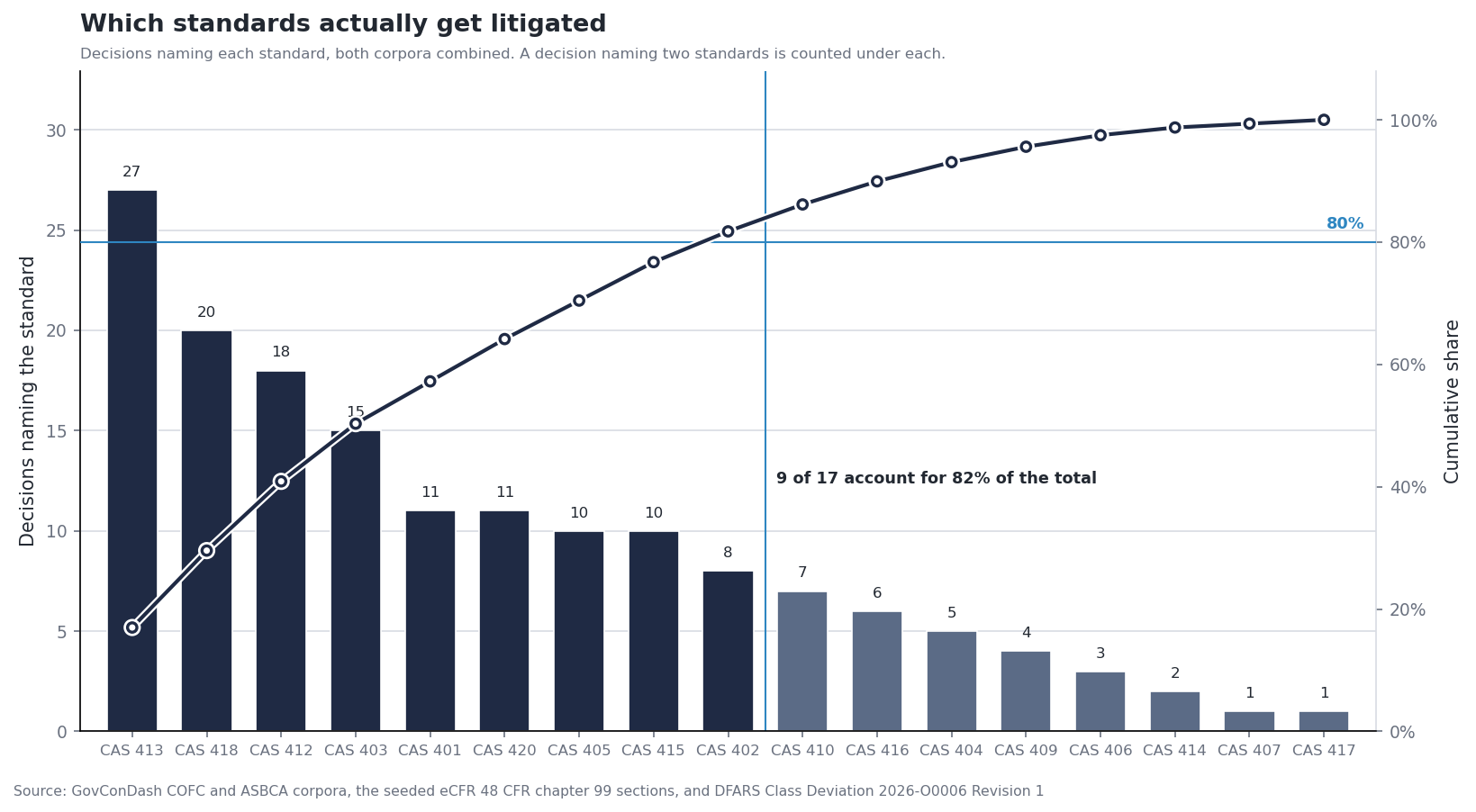
Set the conformance project against that ranking and the mismatch is stark. The 7 standards in scope account for 26 of the 159 standard mentions across both corpora. The 12 standards outside it account for the other 84 percent. Of the 82 decisions that name a numbered standard at all, only 9 stay inside the project's 7.
The standards the Board has rescinded outright are the clearest illustration. CAS 408 and CAS 411 appear in no decision in either corpus, and CAS 407 appears in one. Meanwhile CAS 413 and CAS 412, the two pension standards, together appear in 45 decisions, and CAS 418 on allocating direct and indirect costs appears in 20. None of those three is in the conformance project.
This is not a criticism of the Board's sequencing. Its own stated method was to scope by opportunity for conformance, meaning the places where GAAP already covers the same ground, not by how much litigation a standard generates. Those are different questions and the Board answered the one it asked. But a contractor reading the headlines should draw the correct inference: the conformance project reduces your compliance surface in areas that were rarely contested. It does not reduce your litigation exposure, because the standards that generate disputes are not in it.
04Meanwhile, who is covered changed twice
The second track is not about what the standards say. It is about how many contractors have to read them, and it moved in three steps. Congress went first. Section 1806 of the FY2026 National Defense Authorization Act rewrote the statute, decoupling the CAS applicability threshold from the certified cost or pricing data threshold and stating it as a dollar figure. That was the Board's own legislative proposal, and the thresholds rule says so: section 1806 “fully codified the OMB legislative proposal.”
The Department of War moved second. DFARS Class Deviation 2026-O0006, Revision 1 (30 July 2026) directs contracting officers to use the revised FAR part 30 published on the Revolutionary FAR Overhaul page and an attached DFARS part 230 in place of the codified text, and in the memorandum's own words “changes the applicability of cost accounting standards, increases the threshold for disclosure of cost accounting practices, and increases the cost accounting standards waiver threshold.” For a business unit with only Department of War work it set the full coverage and Disclosure Statement triggers at $100 million. A unit with mixed federal work stayed on FAR 30.201(b) and the codified $50 million.
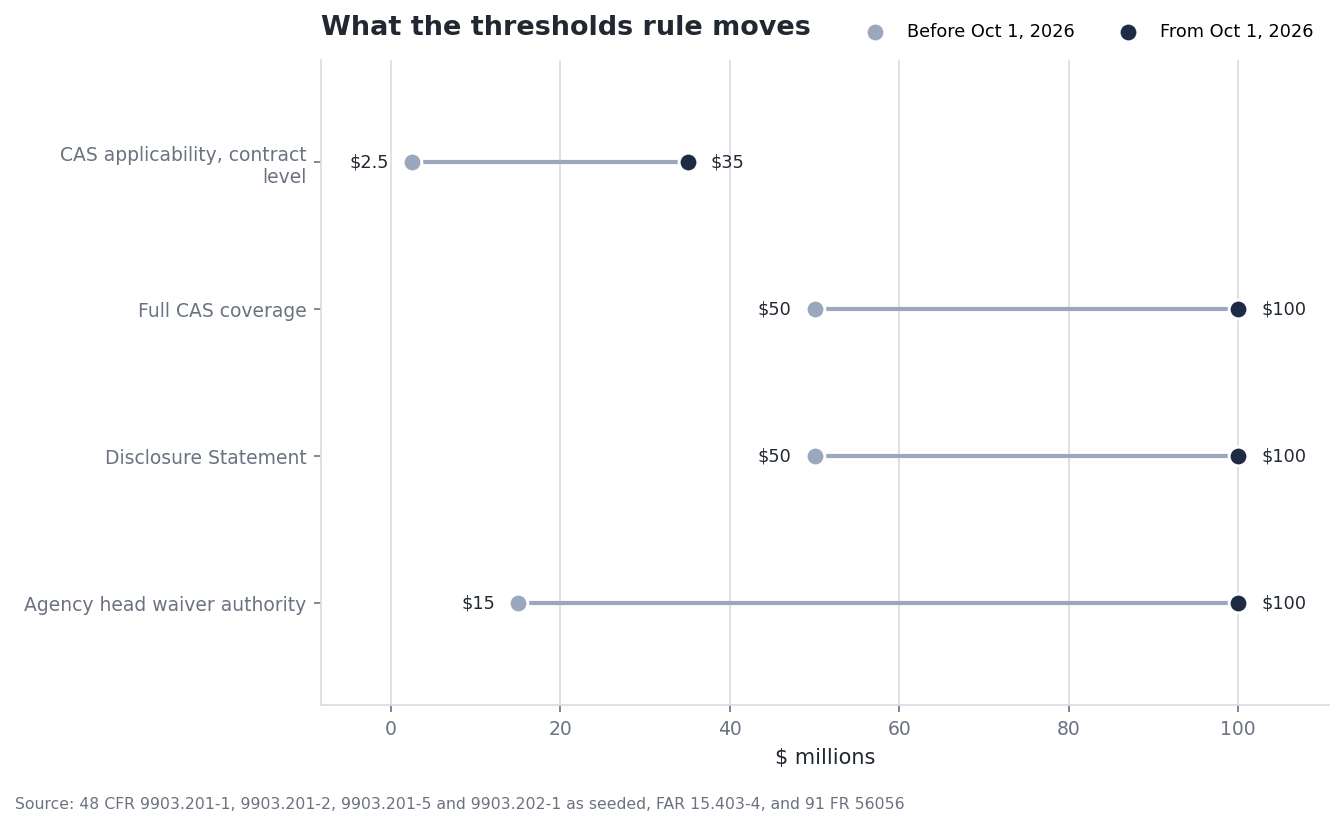
Then the Board moved for everyone. 91 FR 56056, published September 1, 2026 and effective October 1, 2026, writes the numbers into 48 CFR chapter 99 itself. The threshold for tentative CAS applicability at the contract level goes from the certified cost or pricing data threshold that FAR 15.403-4 states, $2.5 million, to $35 million stated in 48 CFR 9903.201-1 directly, a factor of 14, and the $7.5 million trigger contract disappears with it. Full coverage at 48 CFR 9903.201-2 and the Disclosure Statement at 48 CFR 9903.202-1 double, from $50 million to $100 million. The head of an agency's authority to waive CAS without going to the Board, at 48 CFR 9903.201-5, goes from $15 million to $100 million.
Two smaller changes in the same rule matter more than their size suggests. The Disclosure Statement test used to be counted for “any company which, together with its segments” crossed the line; the rule replaces that with “any business unit or segment” and removes the segment exemption that sat beneath it, so the question is now asked of each business unit on its own and the company-wide count is gone. And indefinite delivery contracts, which the Board notes carried over a third of all obligations in FY2024, get a rule of their own: on a multiple-award vehicle the exemptions are read at each task or delivery order, and on a single-award vehicle they are read once, at award, against the ceiling value.
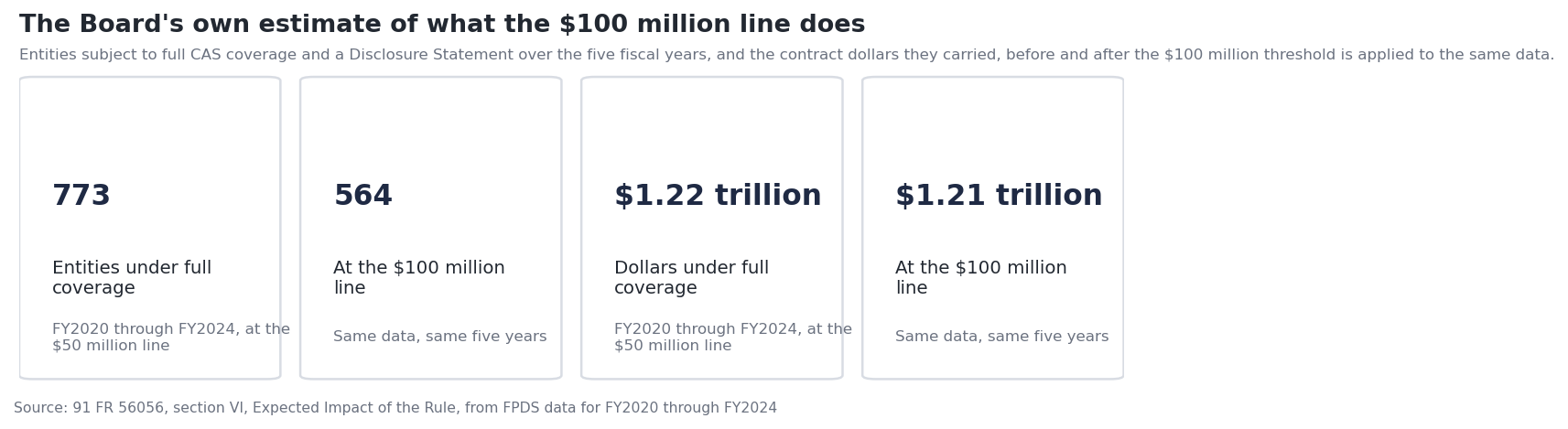
The Board's own estimate of the effect is worth reading closely, because it is the first time the Board has put a number on how many contractors CAS actually reaches. Over FY2020 through FY2024, 773 entities were subject to full coverage and a Disclosure Statement, carrying $1.22 trillion of contract value. Apply the $100 million line to the same data and 564 entities remain, carrying $1.21 trillion. That is a 27 percent reduction in entities, which the Board rounds to nearly 30 percent, against a 0.8 percent reduction in dollars, which it calls less than one percent. The statutory change is larger still: the Board estimated the $35 million applicability threshold would cut the number of CAS-covered business segments by about 60 percent while keeping over 90 percent of the dollars.
For a mid-sized contractor this is a genuine change in posture. A business unit that took full coverage and filed a Disclosure Statement at $50 million may transition its contracts to modified coverage at the start of its next full cost accounting period on or after October 1, 2026, and may certify that status on new solicitations from that date, on one condition industry asked for and the Board then qualified: the unit has no unresolved CAS noncompliances. The compliance saving is real, and so is the temptation to read it as freedom from the accounting rules.
05What replaces CAS is not nothing
Here is where the two tracks meet, and where the case law becomes practical rather than historical. FAR 31.201-2(a)(3) does not condition allowability on CAS alone. It conditions allowability on the CAS Board's standards if applicable, and otherwise on generally accepted accounting principles appropriate to the circumstances. That is a switch, not an off ramp. When a contract falls below the CAS threshold, or when a standard is rescinded, the test does not disappear. It changes rulebooks.
The Board said as much in the thresholds rule. It expects a contractor moving from full to modified coverage to keep following its existing practices, and it states that any practice change made in that transition is unilateral and subject to the contract price adjustment requirements. The same sentence appears, almost word for word, in the CAS 407 rule. Rescission removes a standard. It does not remove the disclosed practice, the consistency obligation under CAS 401, or the clause that prices a change.
And the GAAP rulebook behaves differently in litigation. A Cost Accounting Standard is a published regulation whose interpretation is a question of law, briefed on the text and the preamble, as Exelis, Inc. shows. Whether a practice complies with GAAP is a question of fact. In United Launch Services, LLC that meant dueling expert reports on whether a decades-old inventory practice was permissible under a statement of position issued in 1981, and a court declining to resolve it on summary judgment at all.
So the contractor who leaves CAS coverage trades a rulebook it can look up for one that is proved by expert testimony, and trades a Disclosure Statement that fixes its practices in advance for a record it will have to reconstruct years later. That may still be the better trade. It is not a trade anyone should make without noticing they made it.
06Takeaways
Do not read the conformance rules as a reduction in risk. Five standards are gone or going, and that removes real compliance work. But the 7 standards in the project produced 26 of the 159 standard mentions in these two corpora. Your pension, home office and allocation exposure is untouched.
Resolve open noncompliances under a rescinded standard anyway. The Board is explicit that a noncompliance must still be resolved if the practice occurred while the standard was in effect. Rescission runs forward from the effective date; it is not an amnesty for prior periods, and DCAA re-audits reach back years. From October 1, 2026 an unresolved noncompliance also costs you something new: it is the one thing that blocks a transition to modified coverage.
Know which regime your business unit is in until October 1, 2026. Until then the $100 million line belongs to a business unit with only Department of War contracts and subcontracts, under the class deviation. A unit with mixed federal work reads the codified $50 million. From October 1, 2026 the distinction dissolves, because the figure is in chapter 99 for everyone. A decision dated in between is governed by whichever line applied to that unit on that day, and the difference is doing a lot of work.
If you are moving down to modified coverage, do not change practices on the way. The transition is available at the start of the next full cost accounting period, to a unit with no unresolved noncompliances, and the Board expects existing practices to continue. A practice change made in the move is unilateral and priced as one. Take the coverage relief and leave the accounting alone.
If you fall out of coverage, write down your GAAP basis now. The accounting judgments that decide these cases, whether deferred costs remain probable of recovery, whether a practice is appropriate, are made contemporaneously and litigated a decade later. Contemporaneous documentation is what an expert will have to work from. Both decisions above turned on paper created long before anyone expected a dispute.
Watch CAS 415 and 416, and watch CAS 413 separately. Standard costs are done. Deferred compensation and insurance costs are still at the proposed rule stage with no proposed rule yet published, and CAS 415 already appears in 10 decisions here, more than any other standard in the project. CAS 413 has its own open case, but it is a pension adjustment rulemaking rather than a GAAP conformance, which tells you the Board sees that standard as a policy problem rather than a duplication problem.

GovConDash.ai
Research CAS the way this piece was written
GovConDash holds the Court of Federal Claims and ASBCA corpora with each decision's verbatim text, the codified 48 CFR chapter 99 sections, the CAS Board's open cases and its practitioner album, and every FAR Overhaul class deviation with its memo text. Every AI answer cites the record it came from. Free to start.