
The short version
- 1The Department of War is changing how it buys. On September 30, 2026, the Secretary of War directed Project Agincourt: a path to an Autonomous Warfare Command by October 1, 2027, and a new way of buying unmanned systems that prizes adapting in combat over any particular drone.
- 2The Department's clause now reaches the parts list. Revision 3 of class deviation 2026-O0025, issued September 3, 2026, carries clause 252.240-7994. It tests where the aircraft and each named part were made, and it flows down to every subcontract, commercial ones included.
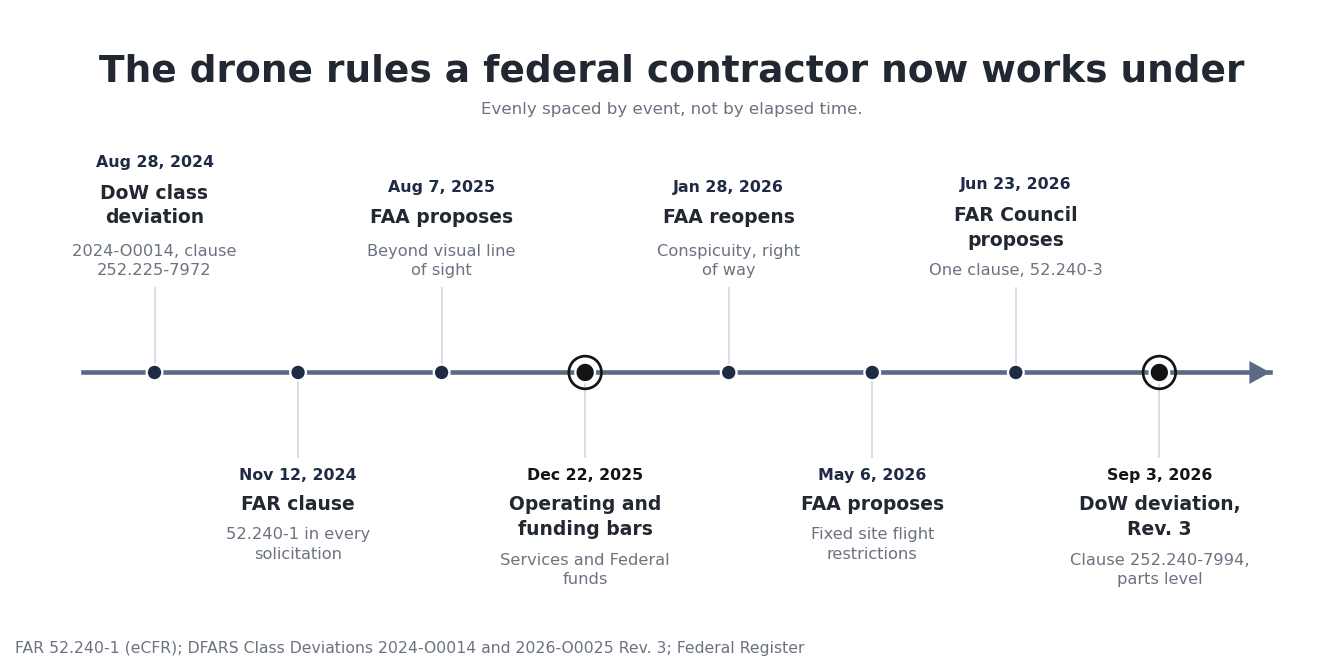
- 3Every agency bars the listed drones, and now bars flying them. FAR 52.240-1 goes into every solicitation and contract, down to the micro-purchase threshold. Since December 22, 2025, it also bars operating a listed drone on the contract and paying for one with Federal funds.
- 4More is coming. The FAR Council has proposed folding 52.240-1 into one security clause, 52.240-3, and the FAA has proposed rules for flying beyond the operator's sight and over designated facilities.
- 5More companies, the same money. Obligations for fiscal 2026 reached $1.90 billion by September 25, 2026, 98 percent of fiscal 2025, while 134 companies won their first award in the industry. Over fiscal 2024 through 2026, 414 did, up 40 percent on the three years before.
01The Department of War is changing: Project Agincourt
The rules in the next two parts decide what can be sold. A memorandum signed on September 30, 2026 changes who will be buying it. The Secretary of War directed Project Agincourt, Pathway to the Autonomous Warfare Command, and put the Direct Reporting Portfolio Manager for Unmanned Systems (DRPM-UxS) in charge of it. The memorandum opens on the reason: “Advanced computing now enables precise, low-cost weapons to be produced at massive scale”, and those weapons now threaten the costly platforms the military bought instead. Its conclusion is blunt: “We do not have a decade to transition our procurement and doctrine”.
A command of its own. The first mission sets the pathway to the Autonomous Warfare Command, a combatant command that will lead the Joint Force in unmanned and autonomous warfare and hold “directed manpower, budget, acquisition authorities”. The target date to establish it is October 1, 2027, and the DRPM-UxS is to work with Congress for the legislation it needs. Until then, work starts under existing authorities.
A new way to buy. The second mission is the one a seller should read closely. Alongside its existing mission, the DRPM-UxS is to prototype a new way of buying unmanned and autonomous systems, teaming operators with innovators and competitive manufacturers to “push decisions and dollars to the edge of our operational forces”. The command it builds toward will “test equipment and force designs with realistic opposition in demanding exercises and rugged environments, modify rapidly, and field what works”.
“This must yield a repeatable procurement system whose output is not a particular drone, but the ability to adapt in combat, on the right side of the cost exchange”
What that means for you: the memorandum amends no FAR or DFARS clause, so the clauses in part 02 still decide whether a drone can be sold. What changes is the buyer. Expect decisions and money to sit closer to operating units, competitions settled by demonstration against realistic opposition, and a premium on how fast a system can be changed rather than on any one airframe. The DRPM-UxS will also “recommend a rebalanced Joint Force investment allocation to the Deputy Secretary of War”, so the split of money between drones and the platforms they threaten is itself on the table.
The first marker to watch is the plan of action and milestones due to the Secretary within 30 days of the memorandum. After that, the DRPM-UxS reports monthly on results and Service adoption, and the date to hold the Department to is October 1, 2027.
02The rules today: a list, then a parts list
Two sets of rules apply, and they ask different questions. The FAR asks whether a drone is on a list. The Department of War asks where it and its parts were made.
Every agency
FAR 52.240-1
Department of War
DFARS 252.240-7994
Where it goes
All solicitations and contracts, at every agency the FAR governs
Department of War solicitations and contracts, commercial ones included
What it asks
Is the drone's maker on the Federal Acquisition Security Council's list, published in SAM?
Where were the aircraft and its parts made, where was its software developed, and where is its data kept?
What it bars
Delivering a listed drone; from December 22, 2025, flying one on the contract or paying for one with Federal funds
A drone that fails the test, a system for detecting drones that fails it, and a contractor operating certain makers' equipment
Before you bid
Search SAM for the list before proposing or using any drone
Represent in your offer that you will not provide or use one, and flow the clause to every subcontract
The FAR: every agency, every contract. FAR 52.240-1 has been in the FAR since November 12, 2024, and contracting officers insert it “in all solicitations and contracts”. It bars delivering a drone made or assembled by an entity on the Federal Acquisition Security Council's list, which is published in SAM, and the contractor must search SAM for that list before proposing or using any drone.
Since December 22, 2025, the bar covers flying, not just buying. Under FAR 40.202-3, an agency may not procure services for the operation of a listed drone or use Federal funds to buy or operate one, and the clause forbids “operating a FASC-prohibited unmanned aircraft system in the performance of the contract”. The rule reaches small buys too: under FAR 13.201, the prohibitions “in 40.202 apply to purchases at or below the micro-purchase threshold”. The Department of War, Homeland Security, State and Justice can exempt research, testing and counter-drone development under FAR 40.202-4.
The Department of War: every part. On September 3, 2026, the Department issued Revision 3 of its class deviation for DFARS Part 240, 2026-O0025. The revision it replaced, of July 16, 2026, did not mention unmanned aircraft at all; Revision 3 names them 17 times. It adds section 240.7008, a representation at 252.240-7993 and the clause at 252.240-7994. That carries into the Overhaul text the standalone deviation of August 28, 2024, 2024-O0014, and its clause 252.225-7972, which implemented section 848 of the NDAA for FY 2020 and section 817 of the NDAA for FY 2023.
“Uses flight controllers, radios, data transmission devices, cameras, or gimbals manufactured in a covered foreign country”
The same clause reaches three more things. A drone that “Uses a ground control system or operating software developed in a covered foreign country”, or that “Uses network connectivity or data storage located in, or administered by an entity domiciled in, a covered foreign country”. And a system for detecting or identifying drones, made in one of those countries or by a company based in one.
It also looks at the contractor itself. The contractor may not, “On or after October 1, 2024, be an entity that operates equipment, as determined by the Secretary of Defense, from” DJI, which the clause names as “Da-Jiang Innovations, or any subsidiary or affiliate of Da-Jiang Innovations”. The same bar covers equipment from a drone maker on the Commerce Department's Consolidated Screening List, or one based in those countries.
Two exceptions are written into the prescription: counter-drone surrogate testing and training, and intelligence, electronic warfare and information warfare work, plus a waiver by the Secretary. Everything else carries the clause, and the clause travels:
“The Contractor shall insert the substance of this clause, including this paragraph (c), in all subcontracts or other contractual instruments, including subcontracts for the acquisition of commercial products and commercial services”
What that means for you: the bill of materials is now a compliance document. A prime holding the clause has to put it in your subcontract, so expect to be asked where each flight controller, radio, camera and gimbal was made, where the ground control software was developed and where the data is stored. When you bid to the Department directly, the representation at 252.240-7993 has you state in your offer that you will not provide or use such a drone.
GovConDash.ai
Read the drone rules as they apply today, free
Create a free account and open Regulations & Policy. FAR & DFARS searches the FAR and DFARS as codified and lists the proposed rules that touch your line of business; FAR Overhaul lists the class deviations the codified text does not show, the Part 240 deviation among them. The research agent answers one question a week on the free plan.
03The rules proposed: one FAR clause, and the airspace
One clause for every security prohibition. On June 23, 2026, the FAR Council proposed rewriting the FAR's security prohibitions as part of the FAR Overhaul. If finalized, it would move 52.240-1 and the telecommunications, Kaspersky and ByteDance clauses into one place and “consolidate the requirements into a new clause at FAR 52.240-3, Security Prohibitions and Exclusion”. Comments closed July 23, 2026. The drone paragraph of the proposed clause keeps the same bars, including the one on operating a listed drone from December 22, 2025. What would change is where you find them.
Flying beyond the operator's sight. The FAA proposed rules to normalize beyond visual line of sight operations in a notice “published in the Federal Register on August 7, 2025”. On January 28, 2026, it reopened comment until February 11, 2026, saying “FAA seeks additional comments on the electronic conspicuity and right-of-way topics identified in this notice”. If you sell inspection, mapping or delivery by drone, this is the proposal to watch: it sets the terms for flying that work beyond the operator's sight.
Flying near designated facilities. On May 6, 2026, the FAA proposed “establishing a process for operators and proprietors of certain fixed site facilities to request and maintain an unmanned aircraft flight restriction”, with comments extended to August 5, 2026. If your work flies near a facility whose operator could ask for one, plan for airspace that may close to you.
04More companies, the same money
One term before the numbers. A Product and Service Code, or PSC, is the code a contracting officer assigns to what a contract buys. Unmanned aircraft have their own, PSC 1550, and every dollar figure in this part is an obligation recorded under it on USAspending.gov.
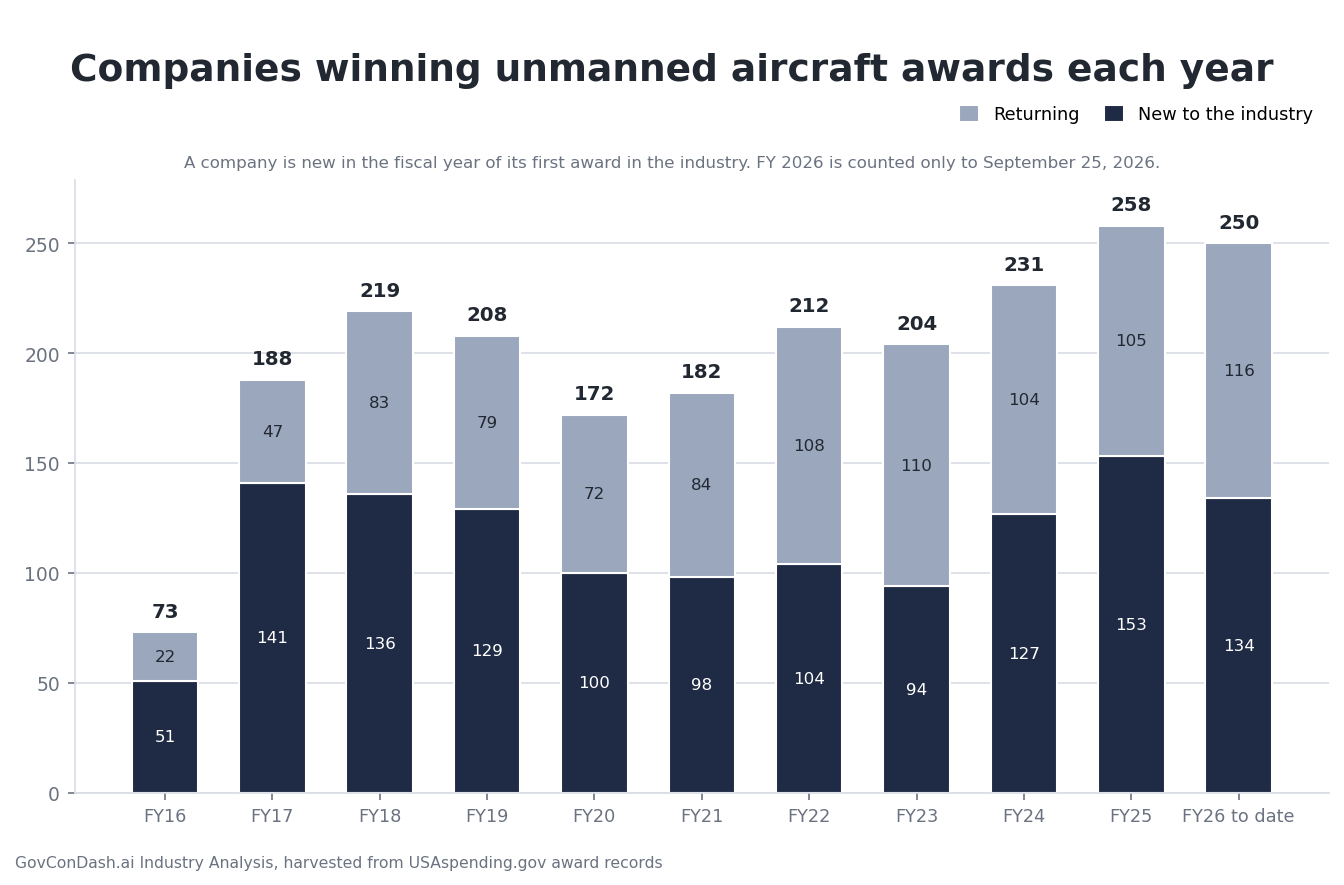
In fiscal 2026, 134 companies won their first award in the industry by September 25, 2026, out of 250 that won any. Over fiscal 2024 through 2026, 414 companies won their first, 40 percent more than the 296 of fiscal 2021 through 2023. The single biggest year was fiscal 2025, with 153, the most new companies of any year in these records, which reach back to fiscal 1997. Fiscal 2026 is counted only to September 25, 2026, so its count, and the three-year total with it, is a floor.
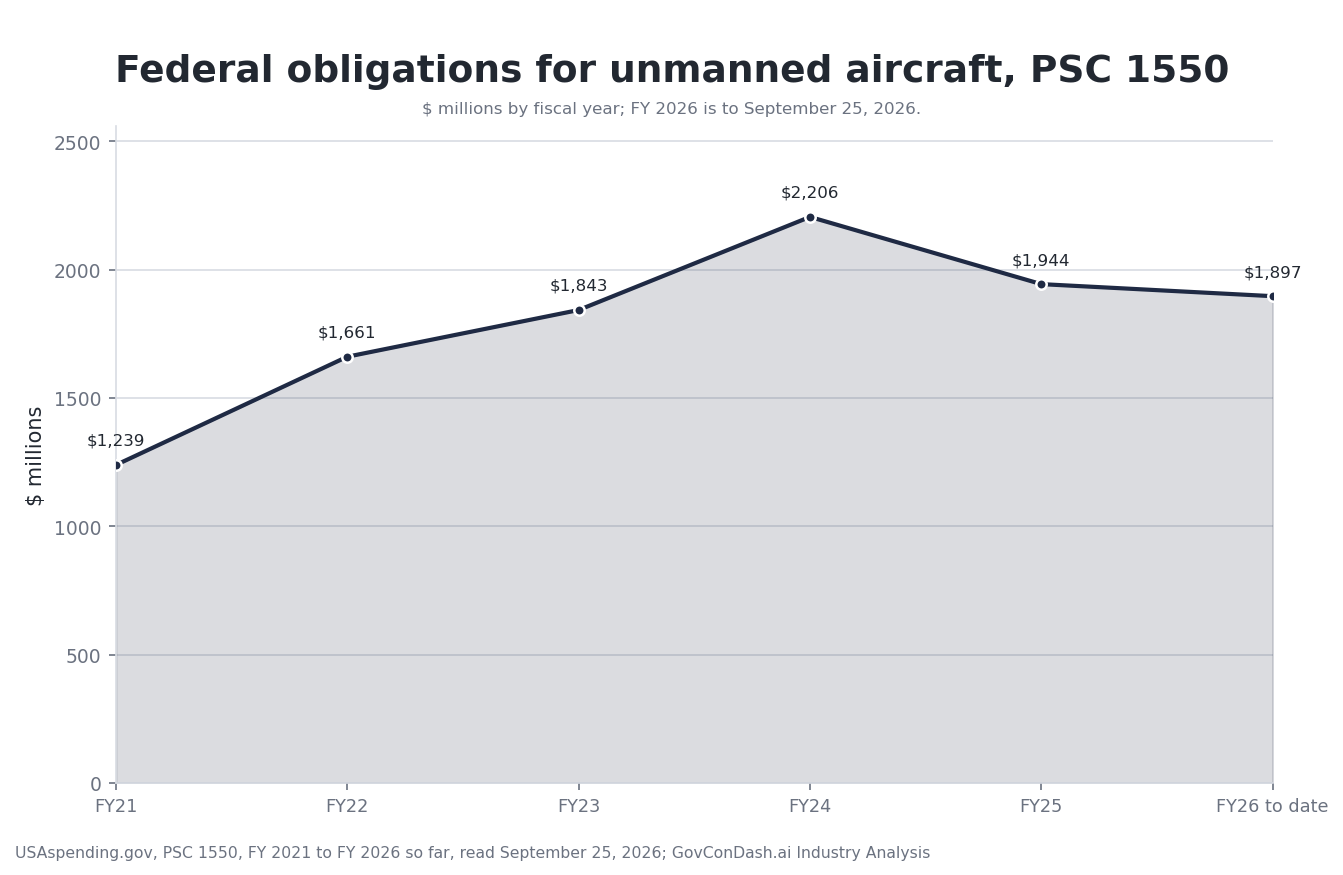
The money did not grow with them. Fiscal 2026 obligations reached $1.90 billion by September 25, 2026, 98 percent of fiscal 2025's $1.94 billion. That is two years at about the same level, both below the fiscal 2024 high of $2.21 billion (fiscal 2025 came in 12 percent under it). Across fiscal 2021 through fiscal 2025, plus fiscal 2026 to date, the government obligated $10.79 billion for unmanned aircraft.
Put the two charts together and the market today is more companies competing for money that is not growing. A newcomer's dollars come out of someone else's share, and part 06 shows how concentrated that share is and how small most first awards are.
It is still a small line in the aircraft budget. Of the obligations under the aircraft product codes, unmanned aircraft take 4.4 percent; fixed wing aircraft take 71 percent.
If you size this market by NAICS code, you will undercount it. Of the PSC 1550 dollars, 26 percent were reported under a NAICS other than 336411, Aircraft Manufacturing, the code most people would search. And $3.30 billion of work that names drones in its own description was coded under other product codes altogether, mostly research and development and engineering services. The honest search is by the product code and by the words, and this piece keeps the two apart: every figure above is the product code alone.
05Who buys: three military departments
The Department of War accounts for 96 percent of the obligations, $10.39 billion. (USAspending still publishes it under its former name, the Department of Defense.) Inside it, the money splits three ways: the Air Force at 40 percent of all obligations, the Navy at 28 percent and the Army at 28 percent.
Civilian agencies together are 3.7 percent. The largest are the Department of State at $144.6 million, the National Aeronautics and Space Administration at $105.6 million and the Department of Homeland Security at $50.7 million. For a company, that means the customer is almost always a military department, and the rules that decide a sale are the Department's before they are the FAR's.
06Who wins, and who the newest are
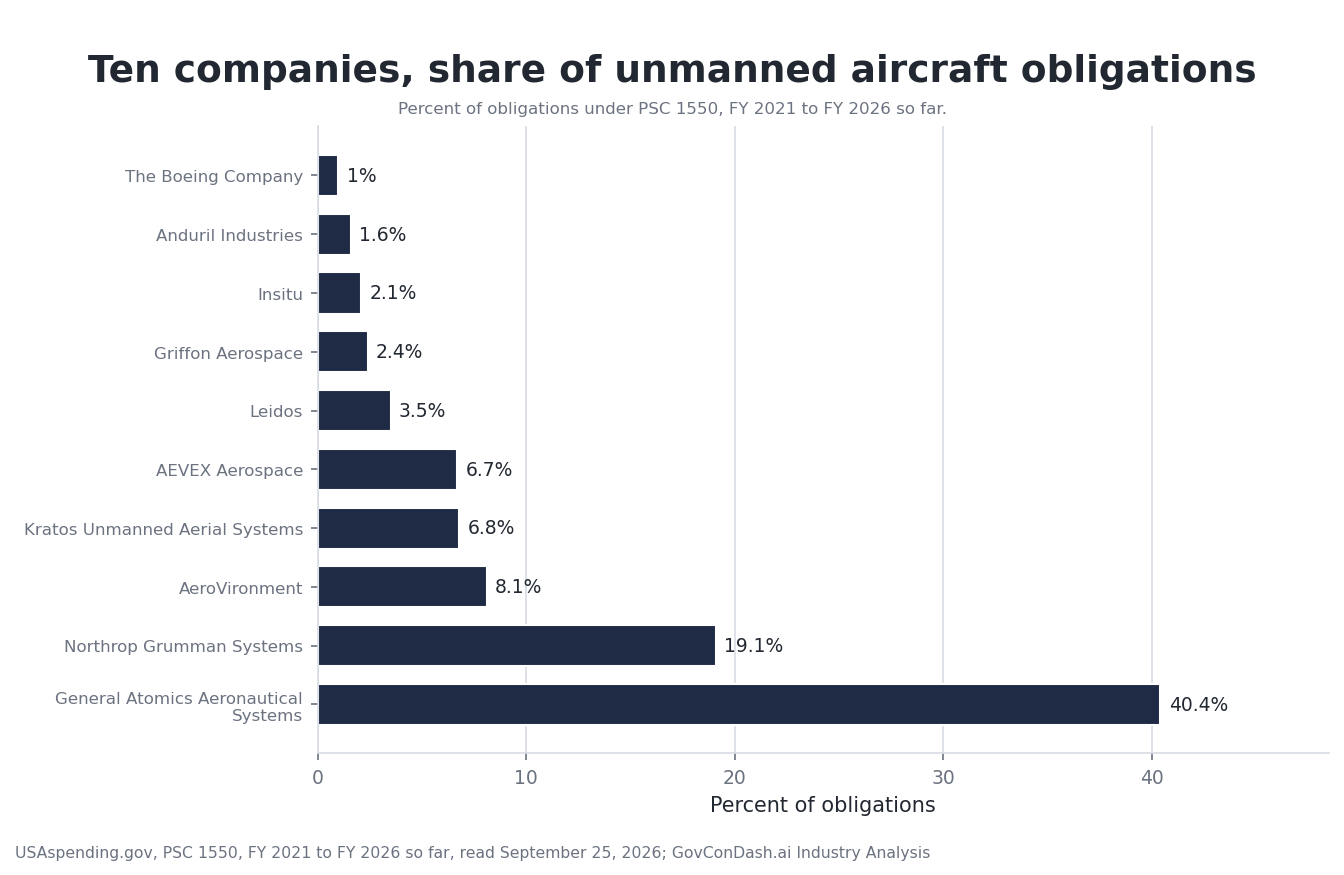
The top is concentrated. General Atomics Aeronautical Systems received 40.4 percent of the obligations, $4.35 billion, more than two times the next company. The five largest, General Atomics Aeronautical Systems, Northrop Grumman Systems, AeroVironment, Kratos Unmanned Aerial Systems and AEVEX Aerospace, together received 81 percent.
The bottom is open, and the newest enter small. The award records behind this piece name 1,388 companies in all.
Who the newest are. Of the 134 companies new in fiscal 2026, 73 won under PSC 1550 itself. 34 of them have nothing obligated yet, most holding a place on an ordering vehicle with no order placed against it. The other 39 were obligated $72.0 million, and the ten largest hold 95 percent of it. The table below lists all 39.
The largest newcomer, Stream Techno, won its $40.0 million from the Department of State, not from a military department; eight of the ten largest were bought by the Army, Navy or Air Force. Eight of those ten were obligated less than $5 million, which is what a way in usually looks like: a small first order that makes a company a known supplier before a larger one.
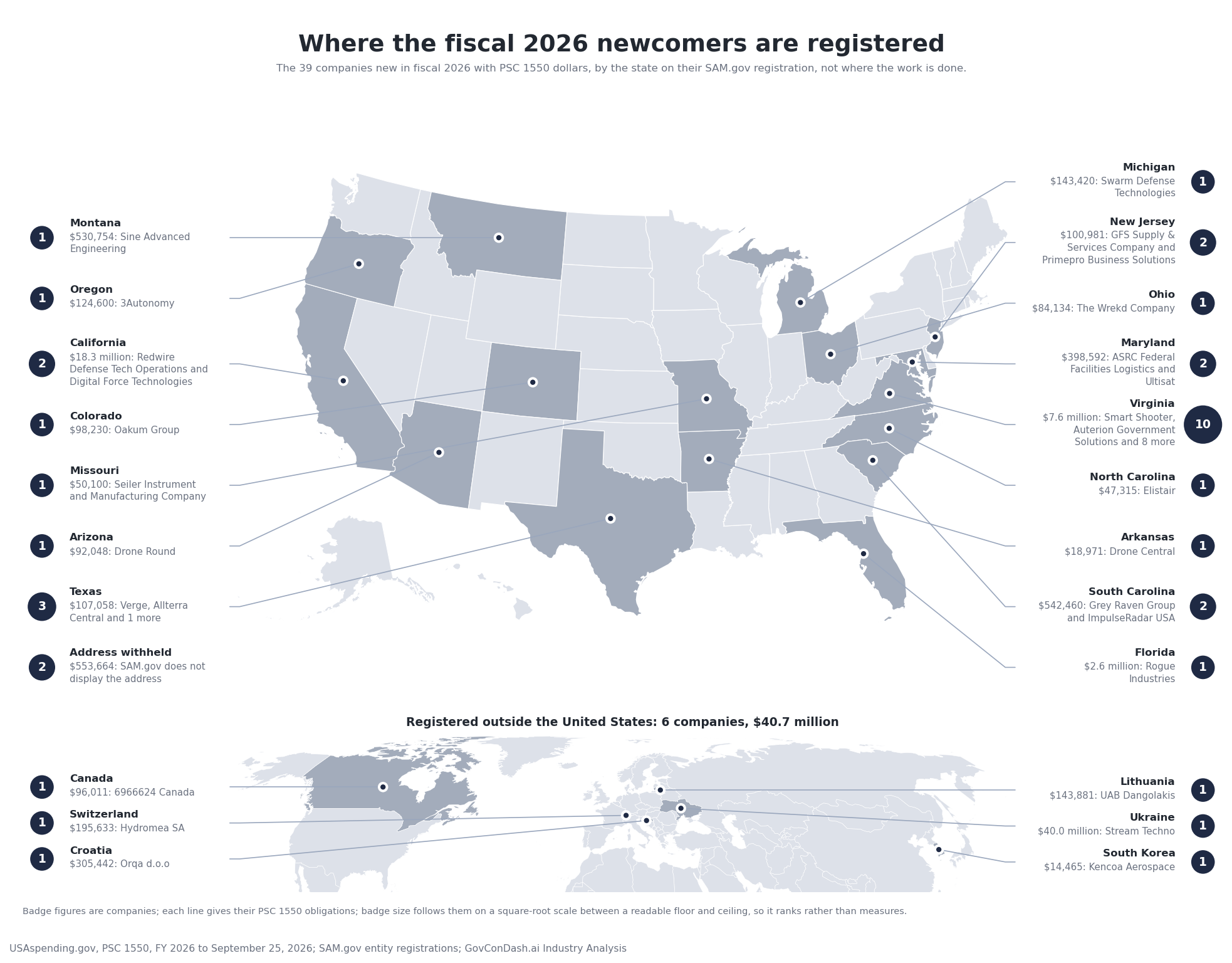
Companies new in fiscal 2026, by PSC 1550 obligations
| # | Company | State or country | Largest buyer | Obligated |
|---|---|---|---|---|
| 1 | Stream Techno | Ukraine | Department of State | $40.0 million |
| 2 | Redwire Defense Tech Operations | California | Army | $17.3 million |
| 3 | Smart Shooter | Virginia | Army | $3.2 million |
| 4 | Rogue Industries | Florida | Air Force | $2.6 million |
| 5 | Auterion Government Solutions | Virginia | U.S. Immigration and Customs Enforcement | $1.5 million |
| 6 | Cambridge International Systems | Virginia | Air Force | $953,554 |
| 7 | Digital Force Technologies | California | Air Force | $920,000 |
| 8 | Fedtribe | Virginia | Navy | $644,000 |
| 9 | Sine Advanced Engineering | Montana | Army | $530,754 |
| 10 | Grey Raven Group | South Carolina | Air Force | $487,370 |
| 11 | Gul | Withheld | Army | $454,164 |
| 12 | Aspetto | Virginia | Federal Bureau of Investigation | $390,267 |
| 13 | ASRC Federal Facilities Logistics | Maryland | Defense Logistics Agency | $378,812 |
| 14 | Napatree Technology | Virginia | Army | $340,000 |
| 15 | Orqa d.o.o | Croatia | Army | $305,442 |
| 16 | Cloudfit Software | Virginia | Air Force | $254,287 |
| 17 | Airgility | Virginia | U.S. Special Operations Command | $244,900 |
| 18 | Hydromea SA | Switzerland | Defense Logistics Agency | $195,633 |
| 19 | UAB Dangolakis | Lithuania | Army | $143,881 |
| 20 | Swarm Defense Technologies | Michigan | Army | $143,420 |
| 21 | 3Autonomy | Oregon | Army | $124,600 |
| 22 | Canine Defense Technologies | Withheld | Army | $99,500 |
| 23 | Oakum Group | Colorado | Army | $98,230 |
| 24 | 6966624 Canada | Canada | Army | $96,011 |
| 25 | Drone Round | Arizona | Air Force | $92,048 |
| 26 | The Wrekd Company | Ohio | Army | $84,134 |
| 27 | GFS Supply & Services Company | New Jersey | U.S. Geological Survey | $77,465 |
| 28 | ImpulseRadar USA | South Carolina | National Oceanic and Atmospheric Administration | $55,090 |
| 29 | Seiler Instrument and Manufacturing Company | Missouri | Army | $50,100 |
| 30 | Verge | Texas | Navy | $48,394 |
| 31 | Elistair | North Carolina | U.S. Special Operations Command | $47,315 |
| 32 | Allterra Central | Texas | Agricultural Research Service | $41,973 |
| 33 | Ghost Labs | Virginia | Navy | $37,915 |
| 34 | Primepro Business Solutions | New Jersey | Navy | $23,516 |
| 35 | Atlas Gate Contracting | Virginia | Army | $22,486 |
| 36 | Ultisat | Maryland | Army | $19,780 |
| 37 | Drone Central | Arkansas | Army | $18,971 |
| 38 | Vprime Tech | Texas | Drug Enforcement Administration | $16,690 |
| 39 | Kencoa Aerospace | South Korea | Army | $14,465 |
07Where the next dollars are
The Department's budget request for fiscal 2027 carries 25 procurement and research lines that name unmanned or counter-unmanned aircraft. The largest is the Army's procurement of counter small unmanned aerial systems, at $994.1 million, and five of the eight largest lines are counter-drone. The money the Department is asking for next leans toward stopping drones as much as buying them.
The ways in are wider than a prime contract. The records behind this piece hold 1,927 SBIR and STTR awards in the industry, to 687 firms, worth $964.0 million, and 567 other transaction actions. Of the 471 contract notices in the industry posted on SAM.gov since July 11, 2026, 218 were set aside for small business, 46 percent. The Small Business Administration's directory lists 2,045 small firms whose profiles match the industry.
Documents and data used in this piece
Every market figure is what the production site read from USAspending.gov and the platform's own records on September 25, 2026. Every quotation was checked against a stored copy of its source before this page was written, 56 checks in all, and every claim about which year was highest or which lines lead was worked out from the figures rather than typed. If a single check fails, nothing is written.
The market
- GovConDash.ai Industry Analysis, Unmanned Aircraft Systems
GovConDash.ai. Federal award data for Product and Service Code 1550 and the industry's measured keywords, as the platform held it on September 25, 2026.
- USAspending.gov
U.S. Department of the Treasury. The obligations, buyers and recipients every market figure is read from.
- Fiscal Year 2027 procurement programs (P-1)
Office of the Under Secretary of War (Comptroller). The budget request lines for unmanned and counter-unmanned aircraft.
The rules today
- FAR 52.240-1, Prohibition on Unmanned Aircraft Systems Manufactured or Assembled by American Security Drone Act-Covered Foreign Entities
eCFR. The clause every agency puts in every solicitation and contract.
- FAR 40.202-3, Prohibition
eCFR. What agencies may not buy, fund or have operated.
- Class Deviation 2026-O0025, Revision 3, DFARS Part 240
Defense Pricing, Contracting, and Acquisition Policy. Issued September 3, 2026; carries the Department of War's drone prohibition at 240.7008 and clause 252.240-7994.
- Class Deviation 2024-O0014, Prohibition on Procurement of Foreign-Made Unmanned Aircraft Systems
Defense Pricing, Contracting, and Acquisition Policy. The standalone deviation of August 28, 2024 that Revision 3 now carries.
The rules proposed
- Revolutionary FAR Overhaul Parts 1, 2, 4, 33, 39, 40, and 53 (proposed rule)
Federal Register. Published June 23, 2026; would fold 52.240-1 into one security prohibitions clause.
- Normalizing Unmanned Aircraft Systems Beyond Visual Line of Sight Operations (reopening of comment period)
Federal Register. The FAA's proposal for routine flight beyond the operator's line of sight.
- Designation: Restrict the Operation of Unmanned Aircraft in Close Proximity to a Fixed Site Facility
Federal Register. The FAA's proposal for flight restrictions over designated facilities.
The buyer changing
- Project Agincourt: Pathway to the Autonomous Warfare Command
Secretary of War. Memorandum of September 30, 2026; directs the DRPM-UxS to lead the pathway to the Autonomous Warfare Command and a new acquisition model for unmanned and autonomous systems.
Disclaimer. This piece is commentary on published award data, regulations, a class deviation, proposed rules and a Secretary of War memorandum. It is not legal advice, and it is not a determination about any contractor, product or contract. Confirm how these rules apply to your solicitation with the contracting officer, counsel or a government contracts professional.

Industry Insight takes one federal industry per edition: what the government buys under its own product codes, who wins it, and the rules that govern selling into it. This one is Unmanned Aircraft Systems.
Keep reading
The Federal Year-End Spike, MeasuredWhere federal contract dollars land in the last weeks of the fiscal year, measured over five years of award data.