
Jules Martin
October 5, 2026
DCAA Just Completely Rewrote Its Incurred Cost Guidance
If DCAA audits your incurred cost proposal, the chapter of its manual on how to do it now runs to 11 numbered paragraphs. On August 19, 2026, DCAA reissued Chapter 6, Incurred Cost Audit Procedures. The February 2025 revision had 241, and its sections on labor, material, indirect costs, cost vouchers and DCAA Form 1 are gone.
Very little of that text moved anywhere you can read it. The new chapter points auditors to five DCAA guidebooks, and DCAA's own guidance page links one of them. Meanwhile the two audit programs DCAA runs on incurred cost proposals still cite seven Chapter 6 paragraphs. None of them is in the chapter today.
The short version
- 1Ten sections became one. The chapter kept its introduction: audit objectives, approach, risk-based sampling, materiality, penalties on expressly unallowable costs, and how final rates are set. About 97 percent of the text is gone.
- 2The sampling conditions are no longer printed. The February 2025 revision listed up to seven conditions a proposal had to meet before DCAA could sample it instead of auditing it. The current one lists at most one.
- 3The detail went to guidebooks you may not be able to read. Of the five the chapter names, DCAA's guidance page links only the Selected Areas of Cost Guidebook.
- 4Your auditor's programs still cite the old chapter. Both post year end incurred cost audit programs, dated January 13, 2026 and still what DCAA publishes, send the auditor to paragraphs that no longer exist, including the materiality formula and DCAA Form 1.
- 5Cite the chapter by its revision date. Of the four Chapter 6 passages tribunals quoted, two are no longer in it.
01What DCAA cut
DCAA publishes its Contract Audit Manual one PDF per chapter, listed on its index, and replaces a file when it reissues the chapter. The Chapter 6 DCAA serves today is dated August 19, 2026 and runs to seven pages. The revision before it on this platform, dated February 25, 2025, had 241 numbered paragraphs in ten sections. The largest was labor, at 56 paragraphs on its own.
Nine of those sections have no counterpart in the new chapter: selected contract terms, material and purchased services, labor, other direct costs and credits, indirect costs, indirect rate administration, assist audits, suspensions (DCAA Form 1) and cost vouchers. Those sections are where an auditor learned how to test your timekeeping, your purchases, your indirect accounts and your vouchers, and how to suspend a cost on a voucher with DCAA Form 1. The new chapter does not mention DCAA Form 1 at all.
02What is left, and what changed inside it
What remains is the part of the old introduction that applies to every incurred cost audit. It is short enough to list whole:
Chapter 6 as DCAA publishes it, revised August 19, 2026
- 6-001Scope of Chapter
- 6-101Introduction
- 6-102.1Audit Objectives
- 6-102.2Audit Approach
- 6-103Audit Scope - Incurred Costs
- 6-104Scope -Risk-Based Sampling of Incurred Cost Proposals
- 6-104.1Determining Sampling Eligibility
- 6-105Materiality in Incurred Cost Audits
- 6-106Audit Objectives for Major Cost Elements
- 6-107Penalties on Expressly Unallowable Costs
- 6-108Approaches to Establish Indirect Costs
Three of those paragraphs matter most to a contractor, and each changed in a way worth knowing.
Sampling
DCAA does not audit every incurred cost proposal. It samples lower-risk ones instead, sorted by what it calls the sampling auditable dollar volume. Every tier both revisions print keeps the same audit cycle; the current one merges the two smallest tiers and adds one for $1 billion or more. What changed most is what the chapter prints about eligibility.
The February 2025 revision listed conditions for every tier. Among them: "There were no significant questioned costs in the last completed incurred cost audit", and "The contractor does not have a pre-award accounting system survey that resulted in an unacceptable opinion, or a disapproved accounting system based on a postaward accounting system audit".
The current revision opens its list with "Unless an exception applies" and does not say what the exceptions are.
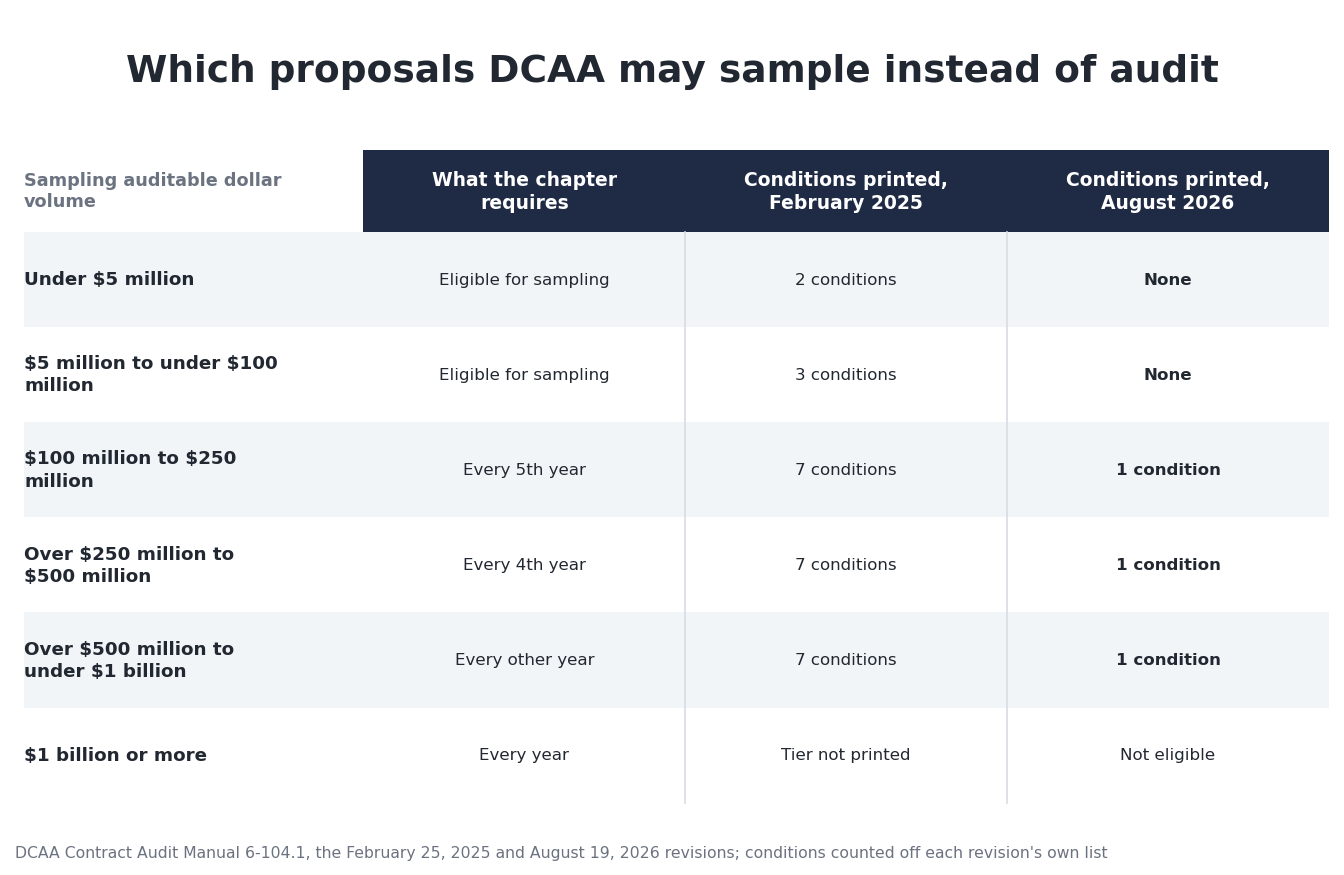
Sampling decides real disputes. In Advanced Technologies Group, Inc., decided by the ASBCA in 2020, DCAA rated a proposal low risk under this paragraph and skipped audit procedures, then reclassified it as high risk after the contractor appealed another year. If your proposal is sampled or pulled for audit, the current manual no longer prints the conditions that decided it.
Materiality
The February 2025 revision printed the formula an auditor used to set the dollar threshold below which an account need not be tested:
Materiality Threshold = $5,000 * ((Total Audit Subject Matter / $100,000) ^ .75)
The current chapter keeps the definition of materiality and replaces the formula with one sentence:
The process for establishing qualitative and quantitative materiality in Incurred Cost Audits is contained within the Materiality Guidebook.
Penalties
The penalty paragraph is new at its number and plain about who does what. It says "Contractors are responsible for affirmatively identifying and excluding expressly unallowable costs from their proposals and claims." It also says the auditor reports every potentially penalized cost with no floor:
The auditor is responsible for communicating all unallowable costs potentially subject to penalties to the ACO, regardless of materiality.
Materiality does not protect an expressly unallowable cost. Screen for those before the proposal goes in, because the auditor must report them however small they are.
03Where the rest went
We took every sentence of the February 2025 revision, 3,127 of them, and searched for each one word for word in everything DCAA publishes that this platform holds: the rest of the manual, the 75-chapter cost guidebook, DCAA's audit programs and its audit guidance memos. We found only 41. Of the 241 paragraphs, 219 have no sentence printed anywhere.
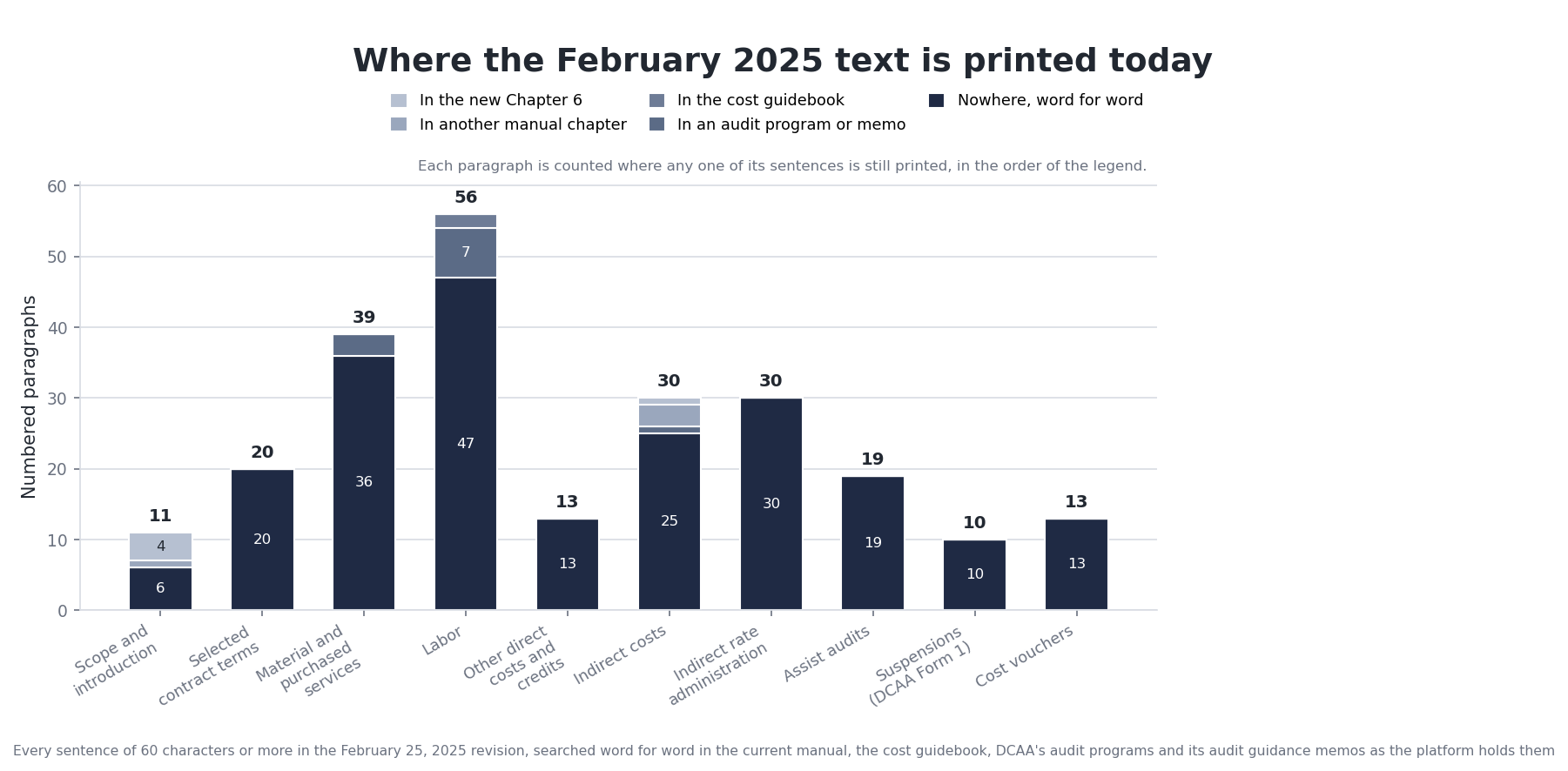
The chapter itself says where the detail went. It names five guidebooks. On billing rates and vouchers, for example, it says "These services are covered in the Advisory Service Guidebook." We read DCAA's guidance page for each one.
Named in the chapter, and linked from DCAA's guidance page
- Incurred Cost Audits Guidebook6-106Not linked
- Incurred Subcontract & Inter-Organizational Guidebook6-106Not linked
- Selected Areas of Cost Guidebook6-106Linked
- Materiality Guidebook6-105Not linked
- Advisory Service Guidebook6-103Not linked
Only the Selected Areas of Cost Guidebook is linked. The other four are not among the guidance page's links. For a contractor, that changes where you can look for what an auditor was told. The procedure behind a finding on your labor or your indirect accounts used to be a public paragraph you could quote back. Today it may sit in a guidebook you cannot see, so ask the auditor to identify the guidance a finding relies on.
04What your auditor's programs still cite
DCAA runs incurred cost audits from audit programs it publishes in its Directory of Audit Programs. The two for a year-end proposal are the Large program, version 12.5, and the Small program, version 6.5, both dated January 13, 2026. Between them they cite seven Chapter 6 paragraphs.
Cited by DCAA's post year end incurred cost audit programs
CAM 6-107.1 Materiality concepts
Cited by the Large and Small programs. Not in the current chapter. Paragraph 6-107 is now Penalties on Expressly Unallowable Costs.
CAM 6-107.2 The materiality formula
Cited by the Large and Small programs. Not in the current chapter. Paragraph 6-107 is now Penalties on Expressly Unallowable Costs.
CAM 6-305.3 Guidelines for auditing material costs
Cited by the Large and Small programs. Not in the current chapter.
CAM 6-414 Owner and executive compensation
Cited by the Large and Small programs. Not in the current chapter.
CAM 6-608.2 Choosing indirect accounts to test
Cited by the Large and Small programs. Not in the current chapter.
CAM 6-612 Indirect cost limit on basic research awards
Cited by the Small program. Not in the current chapter.
CAM 6-900 Suspending and disapproving costs (DCAA Form 1)
Cited by the Large and Small programs. Not in the current chapter.
The materiality step tells the auditor to "Calculate quantified materiality using the materiality formula" at CAM 6-107.2. That paragraph is gone, and number 6-107 now belongs to penalties on expressly unallowable costs. The step for a disagreement reads "If the contractor does not agree with the questioned cost(s) draft a DCAA Form 1", citing CAM 6-900, a section the chapter no longer has. The executive compensation step still points to CAM 6-414.
None of this makes a finding wrong. It does mean a paragraph number in a draft audit report or a Form 1 may point at text you cannot find in today's manual. Ask which revision the auditor relied on, and keep the February 2025 chapter on file.
05The Chapter 6 passages courts and boards quoted
This platform's case analysis ties 90 Armed Services Board decisions from 2010 to 2026 to an incurred cost audit. Some of those, and decisions elsewhere, quote Chapter 6 directly. We followed each quoted passage to where its words are today.
ASBCA, 2023, quoting CAM 6-608.2
A nomenclature review alone: "should not be accepted or rejected solely on the basis of a nomenclature review"
GAO, 2019, quoting CAM 6-705.1
Tyonek Global Services, LLC; Depot Aviation Solutions, LLC
What provisional billing rates are for: "used for interim reimbursement purposes until settlement is reached on final indirect cost rates"
CBCA, 2023, quoting CAM 6-103.1
Audit scope is a matter of judgment: "is a matter of audit judgment"
CBCA, 2023, quoting CAM 6-102.1
The auditor's primary objective: "in whatever form they may be presented"
The loss that matters most is the first. In Voxtel, Inc., the government had rejected indirect costs after reviewing account names, without testing transactions. The Board pointed to DCAA's own rule that categories of indirect expense should not be accepted or rejected solely on the basis of a nomenclature review. That sentence is not in the August 2026 chapter. A contractor facing a review of account names alone can still cite Voxtel, but not the current manual.
Other passages survived. The two the Civilian Board quoted in HPM Corporation are both still in the chapter: audit judgment moved to 6-103, and the auditor's primary objective is still 6-102.1. GAO's description of provisional billing rates in Tyonek Global Services, LLC; Depot Aviation Solutions, LLC points at a paragraph, CAM 6-705.1, that the chapter no longer has.
06Reading both revisions in GovConDash
Everything in this piece came out of the Audit Readiness and Incurred Cost Proposal tabs.
Audit Readiness / Contract Audit Manual
Both revisions of Chapter 6
The reader keeps the February 2025 revision beside the one DCAA publishes, so a paragraph number from an old audit report still opens. Free with an account.
Audit Readiness / Audit Program Explorer
The programs, step by step
Every DCAA audit program the platform holds, including the two incurred cost programs above, read step by step. Free with an account.
Incurred Cost Proposal / Overview
Your next proposal due date
When your next incurred cost proposal is due and which flexibly priced contracts make it due. Free with an account.
Incurred Cost Proposal / Prepare
Build the proposal
The schedules, DCAA's adequacy checklist and the validation checks for the proposal itself. Needs a paid plan.
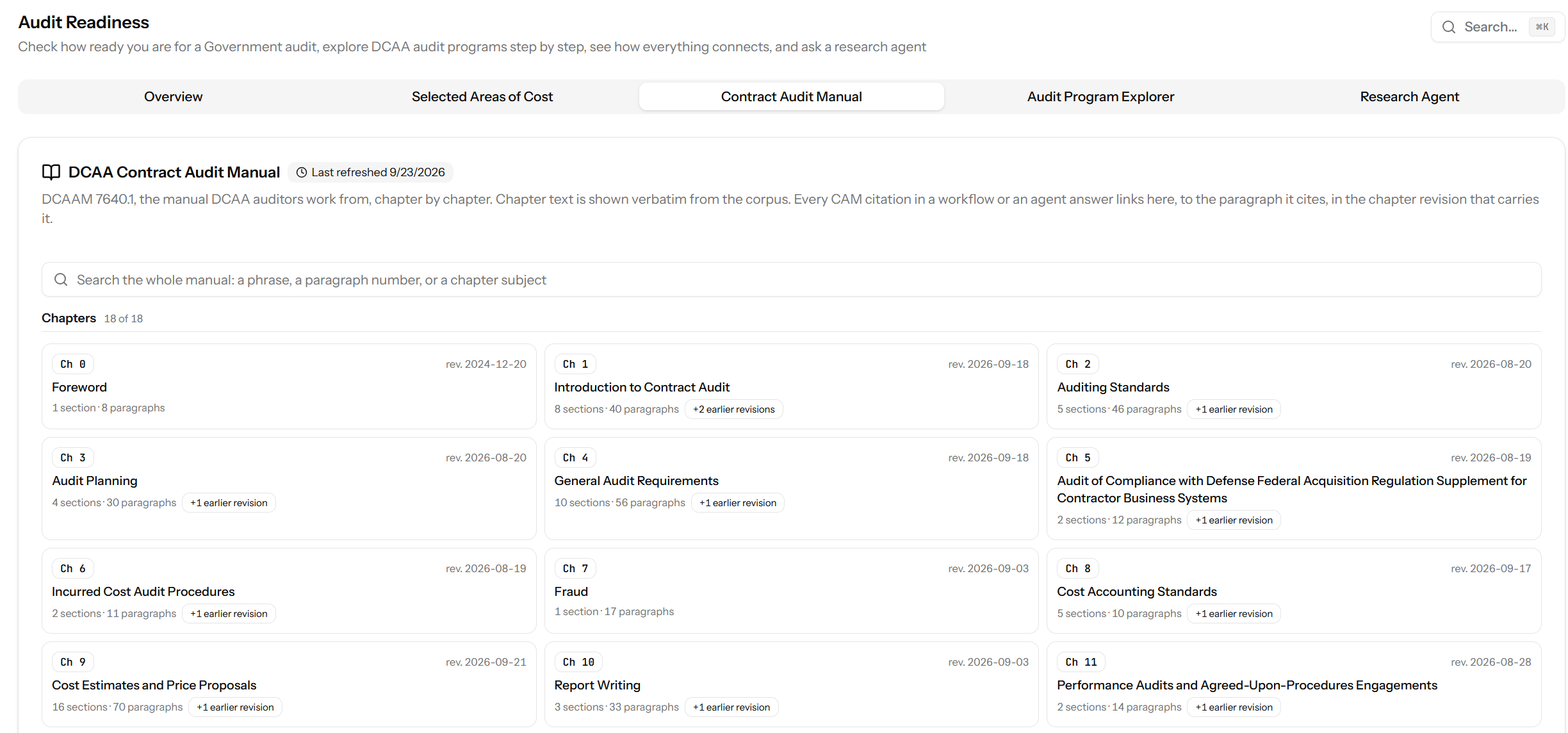
Try CAM 6-608.2, the nomenclature passage from Voxtel, or Chapter 6 as DCAA publishes it now.
Documents and data used in this piece
DCAA's own pages and documents
- DCAA Contract Audit Manual, DCAA's chapter index
Every chapter DCAA publishes, each file stamped with its revision date.
- DCAA Contract Audit Manual, Chapter 6: Incurred Costs Audit Procedures
The chapter as DCAA publishes it, revised August 19, 2026.
- DCAA, Guidance
DCAA's page of published guidance for contractors and auditors.
- DCAA, Selected Area of Cost Guidebook: FAR 31.205 Cost Principles
The one guidebook the new chapter names that DCAA's guidance page links.
- DCAA, Directory of Audit Programs
The audit programs DCAA publishes, one file per program.
- DCAA audit program 10100, Post Year End Incurred Cost Audit, Large, version 12.5
The program as DCAA publishes it, dated January 13, 2026.
- DCAA audit program 10100, Post Year End Incurred Cost Audit, Small, version 6.5
The program as DCAA publishes it, dated January 13, 2026.
The decisions that quoted Chapter 6
- Voxtel, Inc., ASBCA No. 60129 (ASBCA, March 9, 2023)
The tribunal's own copy of the decision.
- HPM Corporation, CBCA 7559 (CBCA, July 12, 2023)
The tribunal's own copy of the decision.
- Tyonek Global Services, LLC; Depot Aviation Solutions, LLC, B-417188.2 (GAO, October 4, 2019)
The tribunal's own copy of the decision.
This piece is commentary on published audit guidance and on published decisions. It is not legal advice, and it is not a determination about any contractor, contract or audit. The Contract Audit Manual is guidance to DCAA personnel and does not itself create obligations for a contractor. The tie between Board decisions and incurred cost audits is the platform's own case analysis; the words each decision is described by are its own.

Keep reading
DCAA Rewrote Seven Chapters of Its Contract Audit Manual in SeptemberThe rest of the manual: the chapters DCAA reissued in September, the decisions that cite the manual, and where the passages they quoted are now.