
The short version
- 1The program has named 16 companies for orders, four of them twice. Gauntlet I produced orders for 30,000 drones from eleven companies. Gauntlet II named nine for 60,000 more. Perennial Autonomy, Neros, Skycutter and ModalAI placed in both.
- 2The price is posted, and the order record confirms it. Eight prototype delivery orders sit in the other transaction record, $83.6 million in all. Each equals the company's leaderboard quantity at exactly $5,000 a drone.
- 3Delivery is where the leaderboard and the factory part ways. By October 1, 2026, 94 percent of the drones on the first round's base orders had shipped and 71 percent had been accepted. The highest scorer, Skycutter, had shipped 50 percent of its order.
- 4The supply chain rules are stricter than the law, on purpose. The program's Supply Chain Framework is not a statute. In five of the six component areas it compares, it asks for more than the law does, or asks sooner. No statute requires a non-Chinese motor in a small drone. The program does.
- 5Phase 3 is open until October 12, 2026, and delivery history is now an entry condition. A Gauntlet II winner that delivers late, or whose drones fail inspection, can be left out of Gauntlet III.
01How the program buys: a posted price and a field test
One term before the numbers. These drones are bought by other transaction, not by a FAR contract. In the words of the reference the platform's Other Transactions tab is built on: Other Transactions are procurement instruments other than contracts, grants, or cooperative agreements. The same reference lists what does not apply to one: the Federal Acquisition Regulation (FAR) and agency supplements, Competition in Contracting Act (CICA), Cost Accounting Standards (CAS) and Truth in Negotiations Act (TINA).
The program's own site states the plan: $1.1 billion in prototype orders under 10 U.S.C. 4022, over four phases, toward more than 200,000 drones. Each phase runs the same way. Companies bring drones to a field test the program calls a Gauntlet, military operators fly them, and the ranking decides who gets an order and how large.
Two videos before the numbers: the Department of War's own, and a short from The Wall Street Journal.
“the Department is posting quantities and prices up front and will award fixed price prototype deliveries with vendors whose systems meet the Gauntlet performance and delivery requirements”
For a company used to FAR contracts, that sentence removes the two things a proposal usually turns on. There is no price to propose, because the government sets it. And there is no cost build-up to negotiate, because the order is fixed-price for a delivered drone. What is left to compete on is the drone, the factory and the parts list. The orders themselves come from NSWC Crane through a consortium, S2MARTS, which part 03 finds in the record.
The program rests on two documents. Executive Order 14307, Unleashing American Drone Dominance, signed June 6, 2025, made favoring American drones the policy of every agency. The Secretary of Defense's memorandum of July 10, 2025 turned that policy into the Department's own plan for buying and fielding small drones. Part 06 reads both.
The program's own officers explain the design the same way. In a conversation with Ylber Bajraktari of the Special Competitive Studies Project at The Exchange, posted May 20, 2026, before Gauntlet II ran, Maj. Gen. Joseph D. Kunkel, the Military Deputy Director of the Defense Innovation Unit, summed up the approach in one word, capitalism, and gave the program's mantra: “if you build it, they will come”. Post the quantity and the price, and the industrial base grows to meet them. Without the order, he said, “it's not going to happen without a market for it”.
He was just as plain about what replaces the usual sales call. A company does not win these orders with a sales pitch; in his words, “you don't need to come to the Pentagon and do business development”. It wins them on the range:
“I want you to come to this test. We're going to put your product in the hands of war fighters.”
The winners are named in public and given orders, which they are expected to deliver within six months, and each later Gauntlet steps the quantity up and the price down while the capability bar rises. He also gave the reason the program buys from many new companies rather than building a stockpile from a few. A stockpiled weapon is at its best on the day it is bought: “they're very good the day you buy them, but every day after that they're not as good”. What matters instead, he said, is that “the key to success in combat is going to be the team that can adapt and scale most quickly”, and a supplier base of a handful of firms can do neither.
02Gauntlet I: the orders, and what has been accepted
The first Gauntlet was scheduled for February 17, 2026. Eleven of the 26 invited companies received orders: 22,320 drones on first orders, and 7,680 more on bonus orders to six of them. Then the program did something unusual. It kept publishing the count as the drones arrived.
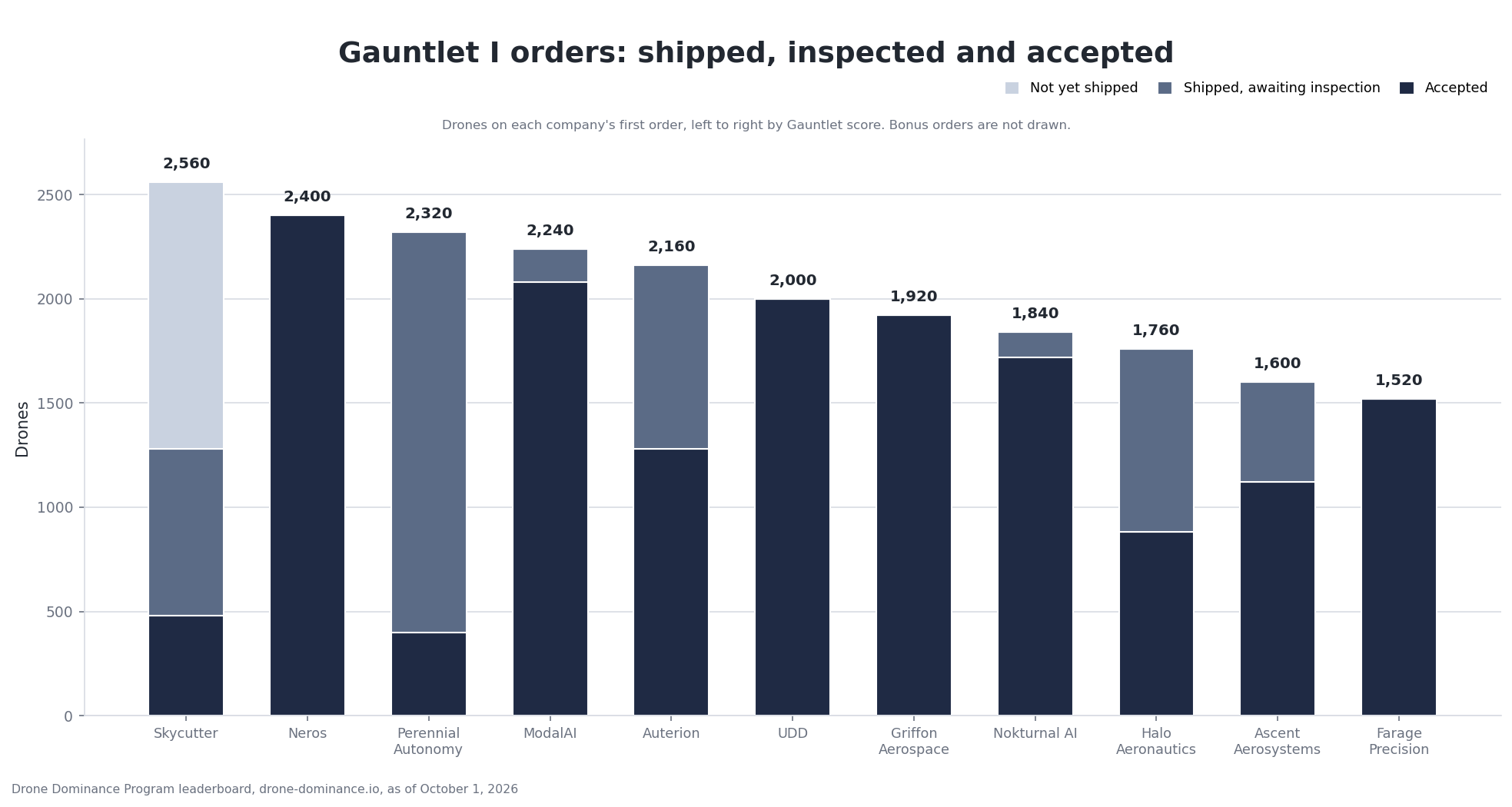
As of October 1, 2026, 21,040 of those 22,320 drones had shipped and 15,800 had been accepted; 5,200 were waiting on inspection. Four companies, Neros, Ukrainian Defense Drones, Griffon Aerospace and Farage Precision, had every drone on their first order accepted. Of the bonus orders, only the one to Neros had begun to ship.
The ranking and the deliveries do not line up. Skycutter, which scored highest, had shipped 1,280 of 2,560 and had 480 accepted. Perennial Autonomy, which ranked third, had shipped all 2,320 and had 400 accepted. The program's test directors said as much when they published the scores: the leaderboard is not a ranking of the best drones. “It is a snapshot of how the invited vendors performed against the mission vignettes designed by the warfighters”.
If you are a supplier choosing which drone maker to pursue, read the accepted column before the score. It is the only public measure of who is turning an order into inspected aircraft.
03What the orders look like in the federal record
These orders are public, if you know where they are filed. The platform's other transaction corpus, built from SAM.gov, holds a series of awards NSWC Crane issued under the S2MARTS base agreement. On February 2, 2026 and in the days after, it shows 25 awards of $25,000, each described as a Phase 1 Gauntlet award. Between March 20, 2026 and April 10, 2026 it shows eight orders described as initial prototype delivery, $83.6 million in all.
The prototype delivery orders in the other transaction record
| On the leaderboard | Member named on the order | Signed | Obligated | Drones |
|---|---|---|---|---|
| Auterion | Auterion Government Solutions Inc | March 20, 2026 | $10.8 million | 2,160 |
| Nokturnal AI | OKSI Ventures, Inc. | March 20, 2026 | $9.2 million | 1,840 |
| Ascent Aerosystems | Ascent Aerosystems Inc | March 20, 2026 | $8.0 million | 1,600 |
| Neros | Neros, Inc. | March 20, 2026 | $12.0 million | 2,400 |
| ModalAI | ModalAI, Inc. | March 24, 2026 | $11.2 million | 2,240 |
| Griffon Aerospace | Griffon Aerospace, Inc. | April 1, 2026 | $9.6 million | 1,920 |
| Skycutter | Responsibly Ltd | April 2, 2026 | $12.8 million | 2,560 |
| Ukrainian Defense Drones | UDD Tech Corporation | April 10, 2026 | $10.0 million | 2,000 |
Divide each order by the leaderboard quantity of the company it names and the answer is the same every time: $5,000. Seven of the eight were written as an option exercised on the company's own Gauntlet award, so the small award and the large order share one award number.
Two details matter if you go looking. The vendor of record on every one is the consortium's manager, National Security Technology Accelerator (NSTXL). The drone company appears only as the consortium member, so a search by vendor name finds none of them. And the legal name is not always the brand. The order for Nokturnal AI is to OKSI Ventures, Inc., and the order for Skycutter is to Responsibly Ltd, of the United Kingdom.
Three Gauntlet I companies, Perennial Autonomy, Halo Aeronautics and Farage Precision, had no delivery order in the record as of its newest action, signed September 25, 2026. No Gauntlet II order is there yet either. The program says those quantities are final on contract award.
GovConDash.ai
See the consortium these orders run through, free
Create a free account and open Other Transactions. The Consortia sub-tab lists S2MARTS with its sponsor, Naval Surface Warfare Center (NSWC) Crane, its manager, who can join and what membership costs, beside the agreements the record holds under it. The orders in the table above come from the same record.
04Gauntlet II: who was named for the next orders
Phase 2 added gates before the test. The program invited 49 companies to a Qualifier at Camp Grayling, Michigan in June 2026. Of those, 44 competed and 19 advanced. To enter Gauntlet II, each of those had to fill an order of 120 drones with lethality payloads in about five weeks.
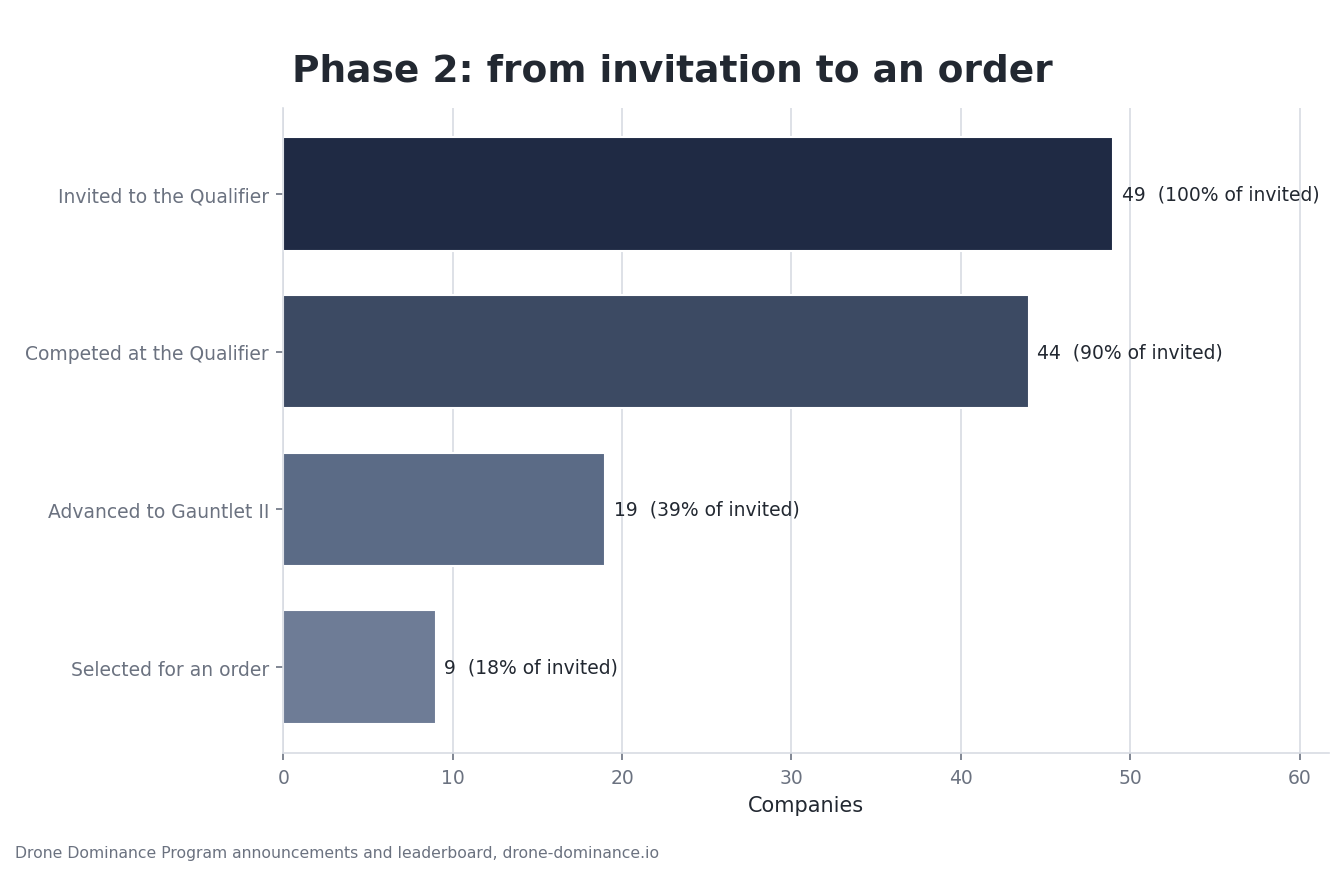
Gauntlet II ran in August 2026 at Fort Carson, Colorado, in two missions: Deep Strike and Close Quarters Battle. On September 15, 2026 the program named the top five in each: ten places taken by nine companies, 30,000 drones a mission. The leaderboard is careful about what that means: “The 10 companies selected for Gauntlet II are finalists for prototype contracts. Awards are not guaranteed.”
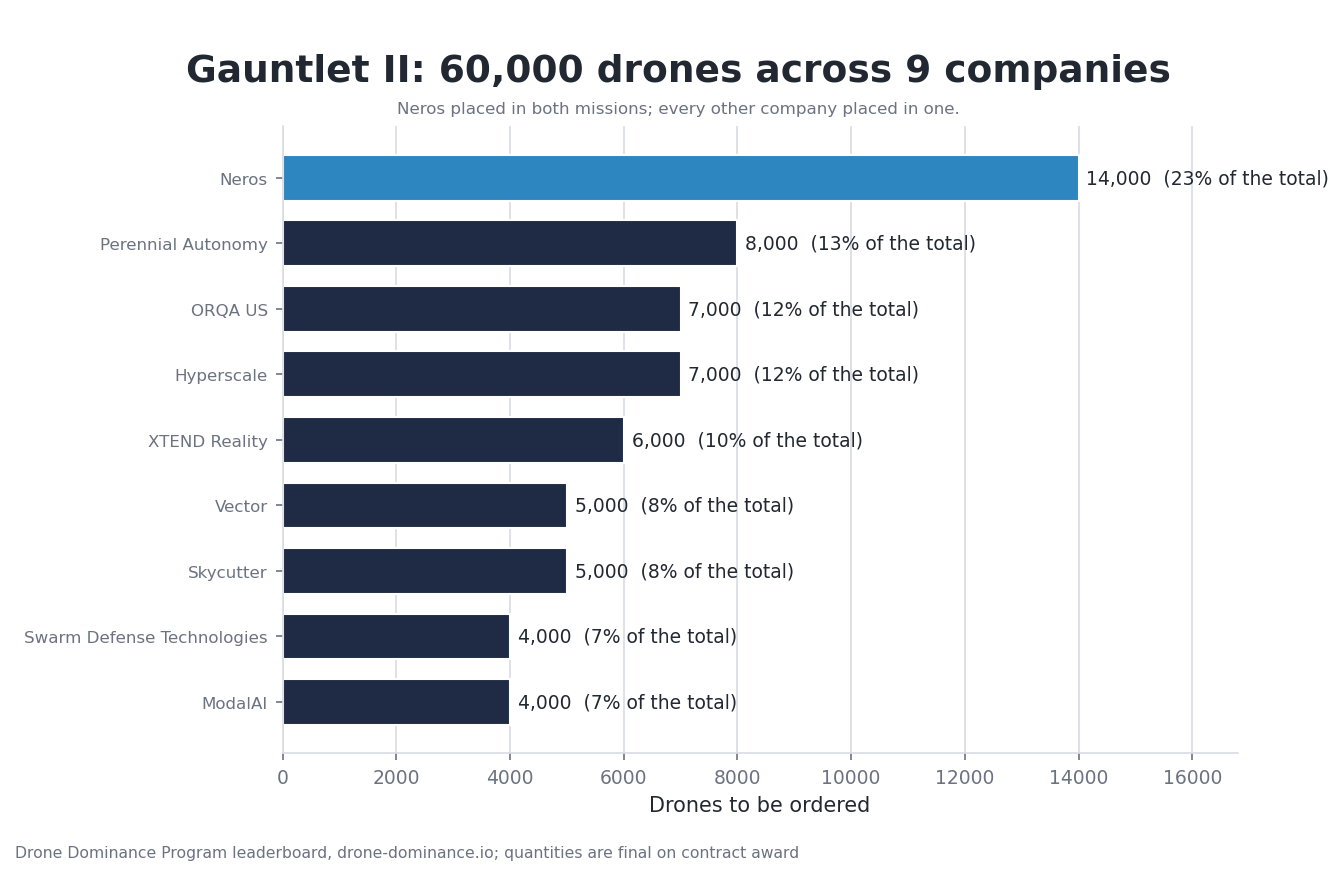
Neros placed in both missions and holds 14,000 of the 60,000, 23 percent. Five of the nine are new to the leaderboard: Hyperscale, Swarm Defense Technologies, ORQA US, XTEND Reality and Vector. And seven of the eleven Gauntlet I companies took no Gauntlet II order. The program had warned that the lineup could change, and it did.
The drones improved between rounds. DefenseScoop, quoting officials' posts, reports 1,858 sorties across 23 platforms. Each of the 11 platforms tested at long distance reached 15 kilometers; at Gauntlet I, 24 percent of drones reached 10 kilometers.
What changed for a bidder is the score itself. At Gauntlet II, the program says, “companies were scored based on their performance in the event, evaluations by military operators, and demonstrated production and supply chain capabilities”. The factory is now on the scorecard.
05Who the companies are
We matched the 16 names on the two leaderboards to SAM.gov registrations, and 15 resolved. Perennial Autonomy did not, by any test the method note at the end describes. Eight of the 15 give a business start date of 2023 or later. The newest, UDD Tech Corporation, gives January 8, 2026. These are young companies carrying orders for thousands of aircraft.
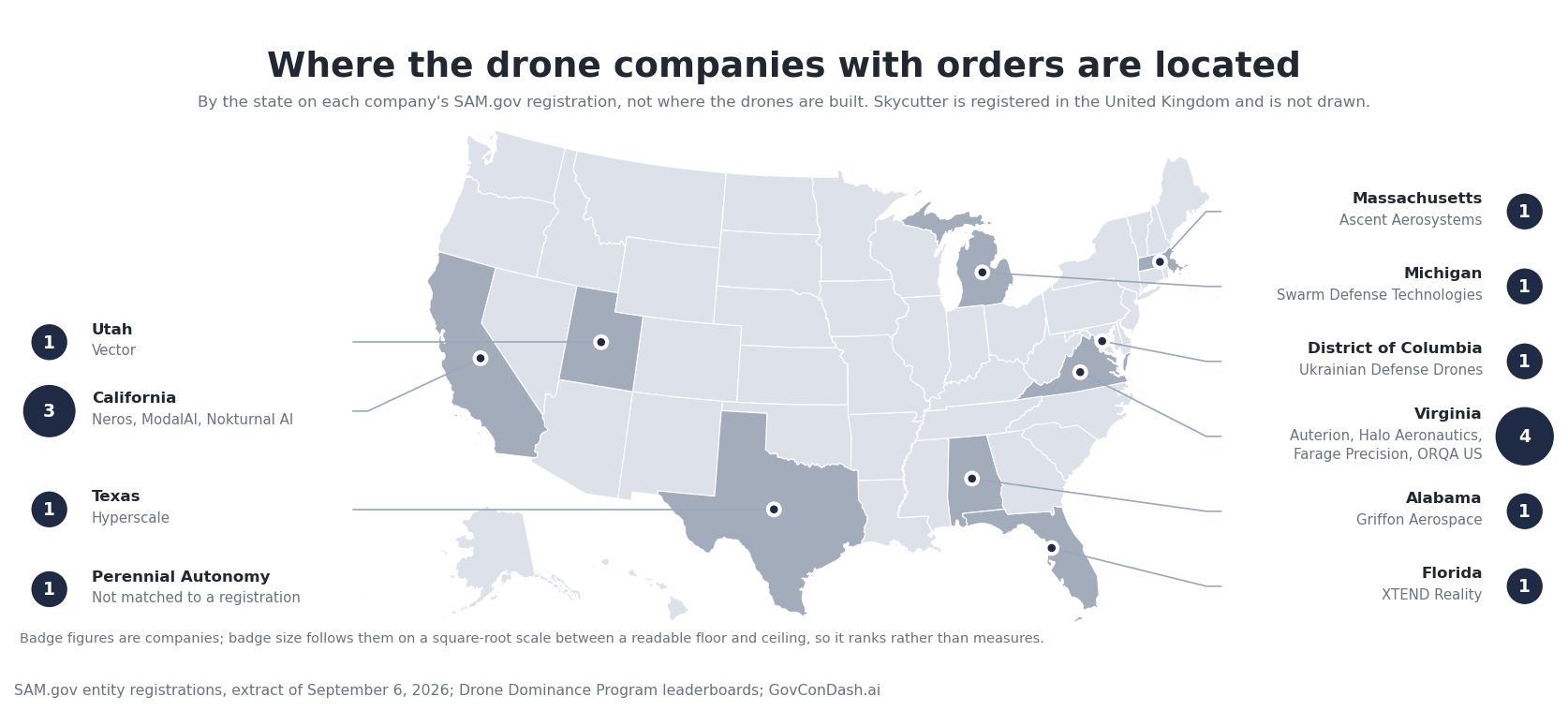
Virginia holds four and California three. One is abroad: Skycutter's order is to Responsibly Ltd of the United Kingdom. SAM.gov also holds a Skycutter Inc in Georgia, under the same website, with a start date of February 27, 2026, after the first Gauntlet.
Only two, Neros and ModalAI, hold an SBIR or STTR award in the Small Business Administration's file of 219,646 awards. The usual small business on-ramp is not how most of these companies arrived.
The companies named for orders, and where each is registered
| Company | Registered | Started | Gauntlet I | Gauntlet II |
|---|---|---|---|---|
| SkycutterResponsibly Ltd | United Kingdom | 2012 | 2,560 | 5,000, Deep Strike |
| NerosNeros, Inc. | California | 2023 | 4,960 | 14,000, both missions |
| Perennial Autonomy | Not matched | 2,320 | 8,000, Deep Strike | |
| ModalAIModalAI, Inc. | California | 2018 | 3,120 | 4,000, Close Quarters |
| AuterionAuterion Government Solutions Inc | Virginia | 2019 | 2,160 | |
| Ukrainian Defense DronesUDD Tech Corporation | District of Columbia | 2026 | 3,320 | |
| Griffon AerospaceGriffon Aerospace, Inc. | Alabama | 1995 | 3,160 | |
| Nokturnal AIOKSI Ventures, Inc. | California | 2024 | 2,720 | |
| Halo AeronauticsHalo Aeronautics, LLC | Virginia | 2023 | 2,560 | |
| Ascent AerosystemsAscent Aerosystems Inc | Massachusetts | 2015 | 1,600 | |
| Farage PrecisionFarage Precision, LLC | Virginia | 2019 | 1,520 | |
| HyperscaleHyperscale Manufacturing Inc. | Texas | 2024 | 7,000, Deep Strike | |
| Swarm Defense TechnologiesSwarm Defense Technologies, Inc | Michigan | 2024 | 4,000, Deep Strike | |
| ORQA USORQA US LLC | Virginia | 2025 | 7,000, Close Quarters | |
| XTEND RealityXTEND Reality Inc. | Florida | 2019 | 6,000, Close Quarters | |
| VectorVector Defense, Inc | Utah | 2024 | 5,000, Close Quarters |
06The rules: four labels and a framework
A drone supplier hears four labels, often used as if they meant the same thing. They do not, and one vendor's explainer sets them side by side. The program's Supply Chain Framework opens its definitions on the same point: “This schedule references multiple legal constructs that are not interchangeable”.
- NDAA compliant
- A statute, and the Department's clause. Since September 3, 2026, DFARS clause 252.240-7994 has barred a drone by its parts. One of its tests reads: “Uses flight controllers, radios, data transmission devices, cameras, or gimbals manufactured in a covered foreign country”. The covered countries are China, Russia, Iran and North Korea.
- American Security Drone Act
- A statute for every agency, carried by FAR 52.240-1. It bars drones from entities on a list the Federal Acquisition Security Council keeps, and since December 22, 2025 it bars operating one on a contract.
- Blue UAS
- A list, not a law. The Defense Innovation Unit built it as a “trusted catalog of secure, NDAA-compliant drones and components”. By November 19, 2025 it held more than 39 systems and 165 components, and on December 3, 2025 the unit handed it to the Defense Contract Management Agency. The Gauntlet I leaderboard carries the consequence: “All drones must pass NDAA/Blue UAS compliance verification by the DCMA”.
- FCC Covered List
- The Federal Communications Commission's list under the Secure Networks Act. On December 22, 2025 the FCC added uncrewed aircraft systems and their critical components produced in a foreign country. Items on the Blue UAS Cleared List, and domestic end products under the Buy American standard, are excepted until January 1, 2028.
The program itself follows from two documents. Executive Order 14307, signed June 6, 2025, told every agency to favor American drones: “All agencies shall prioritize the integration of UAS manufactured in the United States over those made abroad to the maximum extent permitted by law”. The Secretary of Defense's memorandum of July 10, 2025 then set the Department's course in one line: “Drone dominance is a process race as much as a technological race”.
The fifth rule is the program's own, and it is the one that decides an order. Version 2 of the framework, dated July 23, 2026, sets sourcing requirements for 15 component areas, from final assembly down to magnets and germanium. It applies to Phases Two through Four of the program, and the solicitation says each drone “must conform to the Drone Dominance Supply Chain Framework which is more restrictive than the NDAA and will be verified by the Drone Dominance Program”.
“The DDPSCF is not a statutory framework, though it takes guidance from many statutory provisions, including some now in force and some with future compliance dates”
It tightens on a schedule. For each component the framework sets a minimum and a preference, and “Each phase's preferred requirement becomes the next phase's minimum”. Final assembly shows how that works. The Phase 2 minimum, in August 2026, was final assembly outside a covered country. The Phase 3 minimum, in February 2027, is final assembly in the United States. And a minimum is not an opening position. The framework gives it two sentences: “The floor for Phase II participation. Non-compliance is disqualifying.”
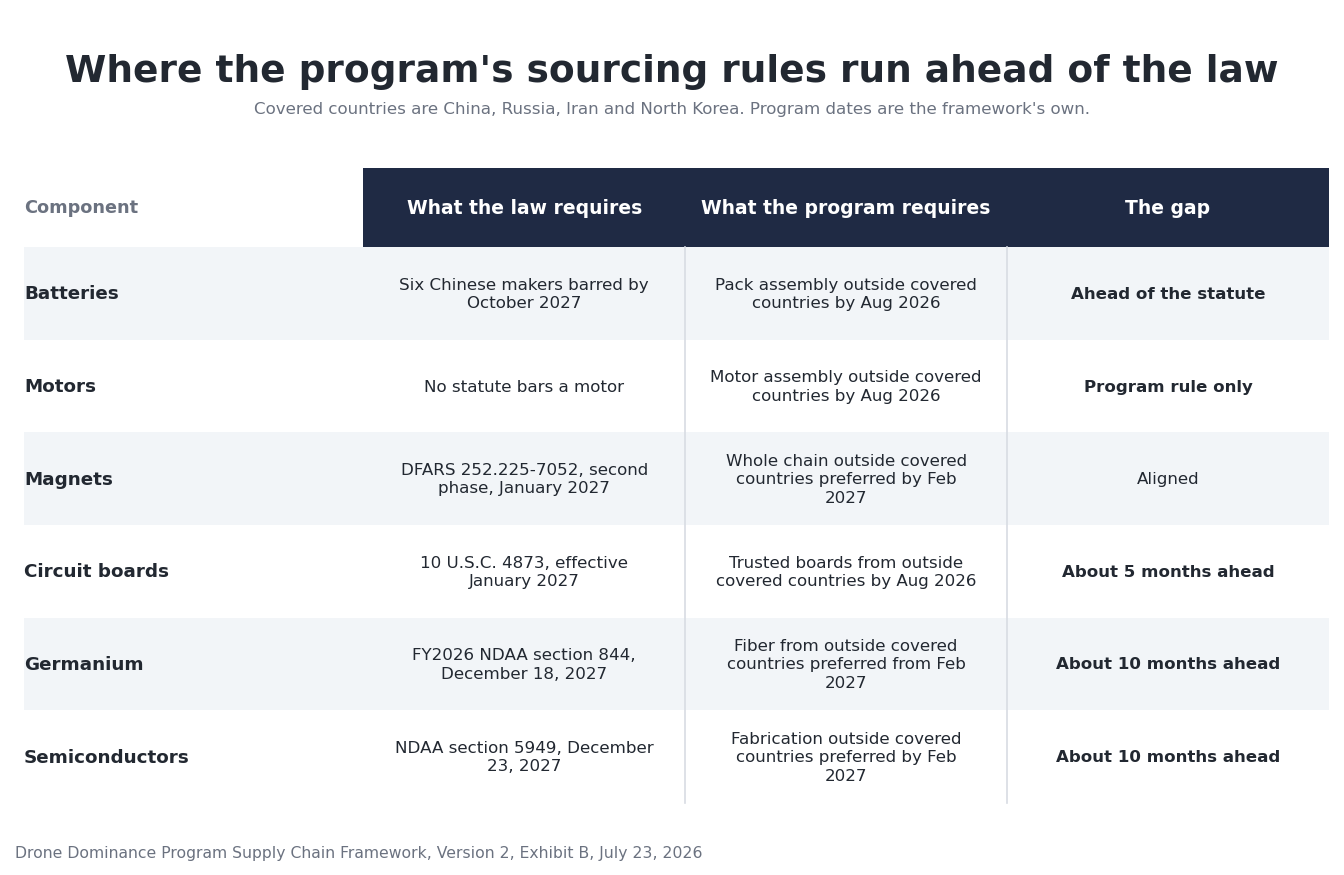
The program is ahead of the law in five of those six areas, and says why: “waiting for statutory deadlines means losing the industrial window”. Motors are the clearest case. The framework states that “No current statute mandates non-Chinese motors for Group 1 sUAS”, and requires it anyway. Magnets are the one area where it simply follows the regulation, DFARS 252.225-7052.
If you make a component, this is the part of the program that reaches you. It is not confined to these orders either. The framework tells industry what to expect: “industry could reasonably expect that the DoW will align around these standards over time”. It also corrects a common mistake. The 65 percent domestic content test people attach to the executive order is the Buy American test in FAR 25.101.
07The factory is the test
On October 2, 2026, Andreessen Horowitz's newsletter published The Case for the American Manufacturing Asset Class, by Connor Love and Collen Larson. It is a venture capital firm's case for investing in manufacturers, and it says of itself that it is not investment advice. It never mentions drones. Its argument still reads like a description of what this program is trying to do, and the program's documents answer it almost line for line.
The essay
Andreessen Horowitz
The program
Drone Dominance Program
The problem
“systems companies and their suppliers are often expected to prepare for a production ramp while the government remains noncommittal on how much it will buy or when”
“The higher cost of non-covered country components is largely a function of low volume, and volume will only come from committed procurement”
The answer
“they give investors a credible demand signal to finance new capacity, and they give companies enough certainty to commit to their suppliers before full-rate production begins”
“The DDP uses the purchasing power of a $1.1 billion advanced market commitment to create the demand signal that justifies private investment in domestic sUAS production capacity”
The limit
“one supplier several tiers down may impose a production ceiling on the entire end system”
“Vendors should only accept quantities they are confident they can deliver on time”
The essay's section heading says it plainly: “Factories Ramp on Orders, Not Maybes”. Its remedy is that “the Pentagon has to act as the anchor customer”. The Drone Dominance Program is that idea carried out. It posts the quantity and the price before anyone builds, so a company and its investors can finance a production line against an order rather than a hope.
The July 10, 2025 memorandum had already pointed the same way: “Leveraging private capital flows that support this industry, our overt preference is to Buy American”. The Secretary announced it in a video posted on X under the memorandum's own title.
“Our mission is threefold”, the memorandum says: build the manufacturing base, arm combat units with low-cost American drones, and “we'll train as we expect to fight”.
Its last line is the one the program has been living up to since: “The Department's bureaucratic gloves are coming off”.
The essay is equally clear about where an order stops helping: “Reliable demand, however, only unlocks the capacity decision”. The first round's numbers show the gap. The demand was certain and the price was fixed, and 71 percent of the drones on the base orders had been accepted months later.
The constraint sits below the drone maker. The essay counts 16,876 machine shops in the 2022 Economic Census; among those that operated all year, 83 percent employed fewer than 20 people. A drone's parts list runs through firms that size, and the framework now asks where each part was made.
One of the Gauntlet I companies makes the same point from the floor. In a sponsored post in Breaking Defense, the president of Robinson Unmanned, the business the program's directory lists as the contact for Ascent Aerosystems, put it this way: “Producing a capable aircraft is one challenge; producing thousands of them that perform consistently is another”. The post gives the company's order as 1,600 systems, the figure on the leaderboard and, at $5,000 each, the $8.0 million in the record.
The same case was made from the stage at the Small Business Administration's summit, in a panel titled Building America's Drone Supply Chain that AUVSI moderated. On it were James Mismash, the Deputy Assistant Secretary of War for Industrial Base Growth and Director of the Office of Small Business Programs; Allan Evans, the chief executive of Unusual Machines, a parts maker; and Ryan Gury, the co-founder and chief innovation officer of PDW, which builds finished drones. The quotations below are from the video's own transcript.
Evans described how the rules are meant to move a supply chain that normally fills one tier at a time, each supplier waiting for the demand above it. Here every tier is pushed at once: “And what they're saying to each tier is go as fast as you can”. A drone maker buys allied motors until American ones are good enough, and the motor maker buys allied magnets until the mines catch up, while the share that has to be domestic steps up. That is the framework's ratchet, seen from the factory floor.
Mismash said the Department's money is aimed at the same place. Its investment targets the lower tiers of the supply chain, the third, fourth and fifth, down to the rare earth elements, the minerals, the magnets and the motors. If the next round of funding passes, he said, $70 billion comes into the Office of Industrial Base Policy, and a large part of it would go to this industrial base.
His sharpest point was for any company counting on an exception to the coming procurement restrictions:
“The waiver is not going to be the default for our procurement restrictions.”
The restriction he singled out turns on the list the Department publishes each year under section 1260H of the National Defense Authorization Act for Fiscal Year 2021: Chinese military companies operating in the United States, directly or indirectly. He put it at 183 entities, growing by more than 40 percent a year. The Department is already barred from buying from the companies on it. The next step reaches the supply chain: “next June it becomes illegal for the department to procure any goods or services from companies that are selling us items with those companies in the supply chain”. His advice was to treat that as notice, ten months of it, and to read the list as a map of where an American small business can replace a supplier on it. Gury, for his part, said none of this came as a surprise to the drone makers; the signal had been plain for years.
Evans closed on the factory itself. “Most people here haven't seen a factory”, he told the room, and he gave a plain test for the scale the program is asking for: “you're at scale when your fail safes become features”. The program's delivery counts are that test, applied one order at a time.
For the longer version of the argument, from inside the Department, a conversation on School of War Podcast with Travis Metz, the Deputy Director of the Defense Innovation Unit, who helps run the program. The host put the question every factory owner and investor is asking: what happens if a company builds an American supply chain to meet the program's rising bar, and a later program lowers it again? Metz's answer was that the Department is likely to be the largest buyer of autonomous aerial systems in the world for years to come, and then:
“I don't think it's a big leap of faith for them to assume that we're going to maintain the same restrictiveness around origin of components.”
He was just as direct about cost. The program does not expect American drones to match Chinese prices: “we are always going to pay more for our drones than the Chinese do”. What it is buying, he said, is not a finished drone that would be outdated within a cycle or two, but companies that can “iterate on the drones at the pace of relevancy”.
His case for the early orders is the essay's case, put in production terms. In his view “it is much harder to get from zero to a few hundred thousand” than to go from there to millions. A company that has built its first line knows how to add a second and a third; the first one is the hard part, and it is the one these orders are meant to pay for.
08Phase 3 is open
The Phase 3 solicitation is open until October 12, 2026. It commits $450 million to roughly 60,000 drones, split evenly between the two missions, with an option for up to 40,000 more at prices the companies propose. The posted price moved in both directions: Deep Strike rose to $5,000 a drone from $4,500, and Close Quarters Battle fell to $3,000 from $3,500.
The path is a pitch deck, then a flight event for about eight companies in November, then a production test. Up to 14 companies go on to Gauntlet III, and each must first deliver 400 drones in about two months. The projected orders are fewer and bigger than before: 12,000, 10,000 and 8,000 drones for the top three in each mission, and none under 8,000.
“Gauntlet II winners may be excluded from an invitation if they have failed to deliver Gauntlet II drones on schedule or if delivered drones have failed to pass inspection”
Three terms are worth reading before you respond. Joining the consortium can wait: “NSTXL membership is not required to submit a response to this RFS. Membership will be required prior to any award.” A drone that misses the framework is not paid for: “Failure to meet these requirements may result in the rejection of the prototype delivery and forfeiture of payment”. And the cybersecurity clauses a FAR contract would carry are written in by name, DFARS 252.204-7021 among them.
If you supply parts rather than drones, the solicitation still reaches you. Each company that gets to the production test must load its bill of material into the Blue List site, with a technical contact for its sub-tier component suppliers. Being on a winner's parts list now means being on the Department's. And the prize at the end is larger than a prototype order: “Successful completion of a prototype delivery order under this OTA may allow the DoW to issue a follow-on production contract or other transaction without further competition”.
Documents and data used in this piece
The program
- Drone Dominance Program
U.S. Department of War. The program's own site: background, timeline, announcements and both leaderboards.
- Drone Dominance Program Supply Chain Framework, Version 2
U.S. Department of War. Dated July 23, 2026; the component sourcing requirements by phase and the statutes behind them.
- Request for Solutions, Drone Dominance Program Phase 3
S2MARTS, for the U.S. Department of War. The open solicitation; responses are due October 12, 2026.
The orders and the companies
- GovConDash.ai Other Transactions corpus
GovConDash.ai. SAM.gov other transaction awards as the platform held them on October 2, 2026: 51,777 actions, the newest signed September 25, 2026.
- SAM.gov entity registrations
U.S. General Services Administration. The public entity extract of September 6, 2026, as the platform holds it.
The rules
- Executive Order 14307, Unleashing American Drone Dominance
Federal Register. Signed June 6, 2025; 90 FR 24727.
- Unleashing U.S. Military Drone Dominance
Secretary of Defense. Memorandum of July 10, 2025.
- FAR 52.240-1, the American Security Drone Act clause
eCFR. The clause every agency puts in every solicitation and contract.
- Class Deviation 2026-O0025, Revision 3, DFARS Part 240
Defense Pricing, Contracting, and Acquisition Policy. Issued September 3, 2026; carries clause 252.240-7994.
- DIU's Blue UAS List To Transition to DCMA
Defense Innovation Unit. The transfer of the Blue UAS Cleared List, December 3, 2025.
- List of Equipment and Services Covered By Section 2 of The Secure Networks Act
Federal Communications Commission. The Covered List; foreign-produced drones and critical components were added December 22, 2025.
The argument about factories
- The Case for the American Manufacturing Asset Class
Andreessen Horowitz. By Connor Love and Collen Larson, October 2, 2026. A venture capital firm's newsletter.
- Pentagon unveils top performers in latest Gauntlet for Drone Dominance Program
DefenseScoop. The news report that carries the test statistics officials posted.
- The drone war will be won on the factory floor, not just the front line
Breaking Defense. A sponsored post presented by Robinson Unmanned, one of the companies on the first leaderboard.
- Blue UAS vs NDAA vs FCC Covered List
Dronehub. A drone infrastructure vendor's explainer of the three labels.
Video
- Drone Dominance
Department of War. The Department's own video, on its YouTube channel.
- A Rare Look at the Pentagon's Drone 'Gauntlet' Competition
The Wall Street Journal. A short video, on the publisher's YouTube channel.
- Inside America's Fight for Drone Dominance
School of War Podcast. A podcast episode with the Defense Innovation Unit's deputy director, on the show's YouTube channel.
- Building America's Drone Supply Chain
U.S. Small Business Administration. A panel at the SBA's summit, on the SBA's YouTube channel; the quotations are from the video's transcript.
- The Future of Autonomous Warfare: Drone Dominance with Maj. Gen. Kunkel
Special Competitive Studies Project. A conversation recorded at the Special Competitive Studies Project's forum, on its YouTube channel; the quotations are from the video's transcript.
- Secretary of War Pete Hegseth on X: Unleashing U.S. Military Drone Dominance
X. Posted July 11, 2025; the video that announced the memorandum.
Disclaimer. This piece is commentary on a Department of War program's published results and solicitation, public award and registration data, regulations, an executive order and published commentary. It is not legal advice or investment advice, and it is not a determination about any company, product or award. Delivery counts are the program's own and it says they are subject to change. Confirm how these rules apply to you with the agreements officer, counsel or a government contracts professional.

Industry Insight takes one federal industry or program per edition: what the government buys, who wins it, and the rules that govern selling into it. This one is The Drone Dominance Program. The bomber round the program calls Phase 2.5, with 17 companies invited for October 2026, is not covered here.
Keep reading
Drone Industry Insights: How the Department of War Is Changing and What the FAR and DFARS Now RequireThe first edition: the federal drone market, who buys and who wins it, and the FAR, DFARS and FAA rules in effect and proposed.