
The short version
- 1One task force now owns the problem. The Secretary's memorandum replaced the Army-run Joint Counter-small UAS Office with JIATF 401, reporting to the Deputy Secretary, and moved Department-wide counter-small UAS research under it. The services keep their existing programs of record.
- 2Domestic Shield went to ten companies, at $4.15 billion in ceilings. Seven of the IDIQs are at $500 million. A ceiling is not an order: the money moves when the task force orders against it.
- 3Not every winner was already in the record. Five held an earlier prime award whose description names counter-UAS, and three make a product the task force's own guide describes. Digital Force Technologies, PVP Advanced EO Systems and L3Harris WESCAM show up in none of those places.
- 4The market is filling with new names. Of the 210 companies in the counter-UAS award record, 91 won their first such award in FY2025 and FY2026. Before that, no year brought more than 18.
- 5The FY2027 request asks for $2,357.2 million, up from $1,505.5 million. The fastest-growing line, Army advanced technology, is more than 20 times its FY2026 figure.
01The buyer: one task force where there was an office
On August 27, 2025, the Secretary signed a memorandum directing the Secretary of the Army to close the Joint Counter-small Unmanned Aircraft Systems Office, the JCO, and set up Joint Interagency Task Force 401 in its place, reporting to the Deputy Secretary. The Department announced it the next day. Among the memorandum's references are Executive Order 14305 and 10 U.S.C. 130i, the law that lets the Department protect certain facilities and assets from drones.
The reason is in the memorandum itself. In its words, “the small UAS threat continues to grow exponentially and is becoming increasingly sophisticated”, and the Department had more and more offices working on it, often unconnected. Its answer: “DoD needs a single focal point to centralize, coordinate, and lead these efforts”.
The memorandum of August 27, 2025
Joint Interagency Task Force 401
- Reports to
- The Deputy Secretary, not a military department
- Replaces
- The Joint Counter-small UAS Office the Army ran (the JCO)
- Can approve
- Up to $50 million per effort, on the director's own authority
- Takes in
- Department-wide counter-small UAS research and testing, and Replicator 2
- Leaves alone
- The services' and Special Operations Command's existing programs of record
- Review
- A sunset review at 36 months
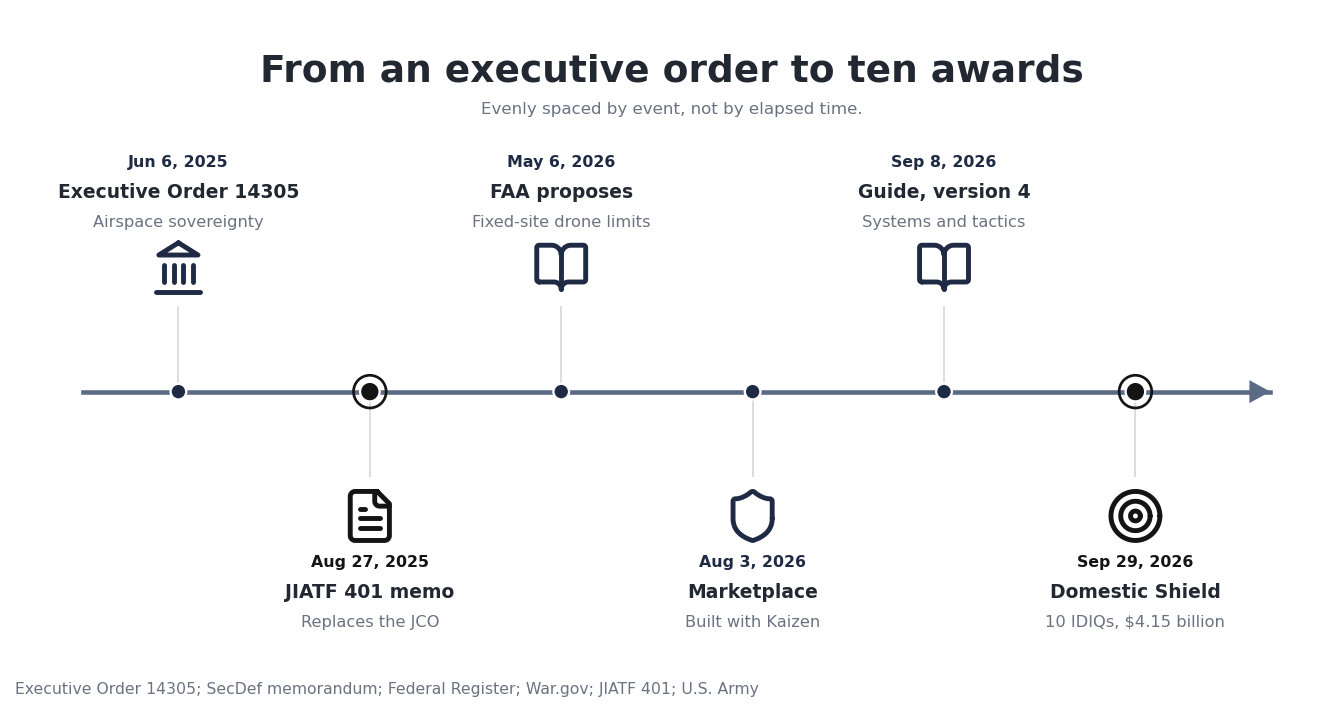
The memorandum gives the director acquisition and procurement authority, asks for an acquisition executive to support the task force's rapid buys, and tells the Department to “focus on speed over process”. It also tells the budget office to resource the task force in the FY2027 budget cycle, which is the request read in part 05. The Secretary put the reason in one line when he announced it: “there's no doubt that the threats we face today from hostile drones grow by the day”.
What it means for you: a new counter-drone capability now has one place in the Department to land, and that office can fund an effort up to $50 million without going elsewhere for approval. The memorandum leaves the services' existing programs of record out of the director's reach, so a company improving a fielded system still deals with that system's own program office. That last step is our reading of the carve-out, not a sentence the memorandum writes.
02Domestic Shield: the awards and who won them
The Army's announcement of September 29, 2026 describes Domestic Shield as “a Department of War effort to improve counter-unmanned aircraft systems (C-UAS) protection for risk-prioritized DoW facilities and assets within the United States”. The ten awards are multiple-award IDIQ contracts, and they support the task force's marketplace and other counter-drone requirements as well as Domestic Shield.
The technology runs “from smart optical scopes that help individual Soldiers shoot down drones with standard rifles, to automated robotic weapon stations, compact radar systems, and long-range tracking cameras”. The task force's director, in the same release: “Our approach allows us to identify the right capabilities for specific operational requirements and rapidly deliver those capabilities to the warfighter.”
The Domestic Shield awards, September 29, 2026
| Company | Base IDIQ | In the guide | Earlier award | Earlier OT |
|---|---|---|---|---|
| Allen Control Systems, Inc. | $500 million | Bullfrog | Yes | |
| Digital Force Technologies, LLC | $500 million | |||
| DroneShield, LLC | $500 million | Yes | ||
| Echodyne Corp. | $250 million | EchoShield | Yes | Yes |
| Napatree Technology LLC | $500 million | Yes | ||
| PVP Advanced EO Systems, Inc. | $250 million | |||
| RADA Technologies, LLC. | $500 million | Yes | ||
| SmartShooter Inc. | $150 million | SMASH 2000L | ||
| SRC Inc. | $500 million | Yes | ||
| L3Harris WESCAM | $500 million |
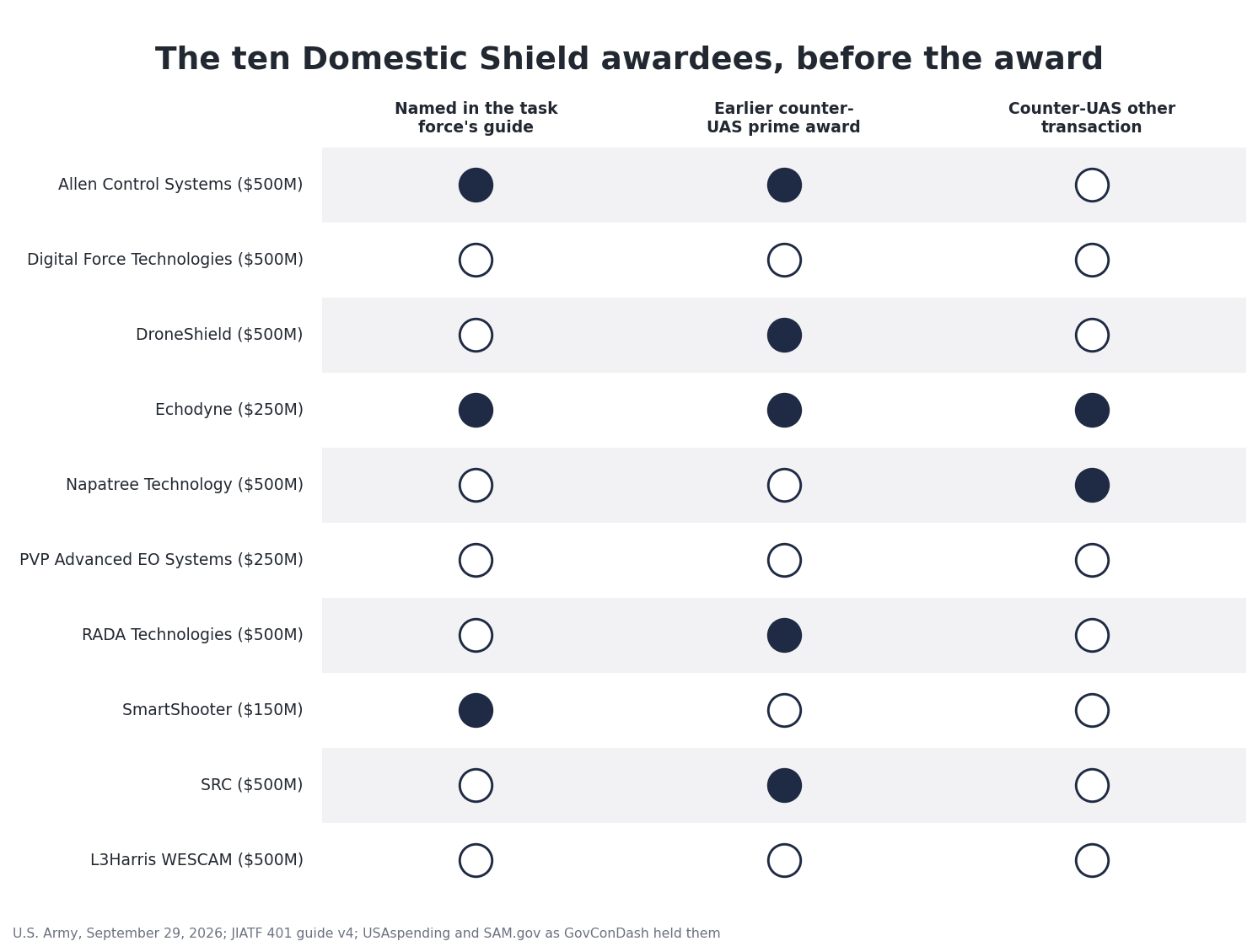
Read the table as a market signal. The task force's Quick Reference Guide credits three of the winners by name: the Bullfrog weapon station from Allen Control Systems, the EchoShield radar from Echodyne and the SMASH 2000L rifle optic from SmartShooter. Five of the ten held an earlier prime award whose description names counter-UAS, and two held a counter-UAS other transaction. Digital Force Technologies, PVP Advanced EO Systems and L3Harris WESCAM appear in none of those places, which says the task force went beyond the companies the record already knew. The guide says its own list is not complete, and a company can sell under a name the record spells differently, so read absence as unmeasured, not as new.
03The marketplace: a second way in
On August 3, 2026, the Department announced changes to the task force's C-UAS Marketplace, built with Kaizen Laboratories. It is meant for military organizations, domestic law enforcement agencies and allies and partners, so authorized users can “search technologies by operational requirements, review validated performance data, and purchase C-UAS products through a streamlined process”.
For a seller, the important part is the export lane. Through the Army's Foreign Military Sales Fast Lane, “industry partners submit their products for inclusion in the FMS Fast Lane”, and the task force evaluates and pre-clears them for sale to partner nations. The marketplace's own front page calls itself the government's central marketplace for counter-drone technology and opens on two questions a vendor will ask first: how vendors get approved, and who can buy. The answers sit behind an account.
The Army's acquisition chief tied the marketplace to the awards in the announcement of September 29, 2026: “This multi-vendor marketplace enforces strict open architecture standards, breaking proprietary vendor lock”. The task force's director put the urgency more simply: “Drones are a defining threat of our time”.
The other transaction record holds one action on the marketplace: a prototype agreement with Kaizen Laboratories, W912CH269A034, whose modification of May 26, 2026 the record describes as “C-SUAS MARKETPLACE ADMIN MOD TO CHANGE PAY OFFICE”. It carries no dollars, so the record says the agreement exists and nothing about its value.
04The market in the record: no product code, many new companies
One term first. Every federal contract action carries a Product and Service Code that says what was bought. Unmanned aircraft have one. Counter-UAS does not, so no single code finds it. GovConDash reads it instead by the words in the award text (“counter-UAS”, “C-UAS”, “counter unmanned aircraft”, “counter unmanned aerial”, “counter small unmanned”, “CUAS” and “counter-drone”), and every figure below is that reading.
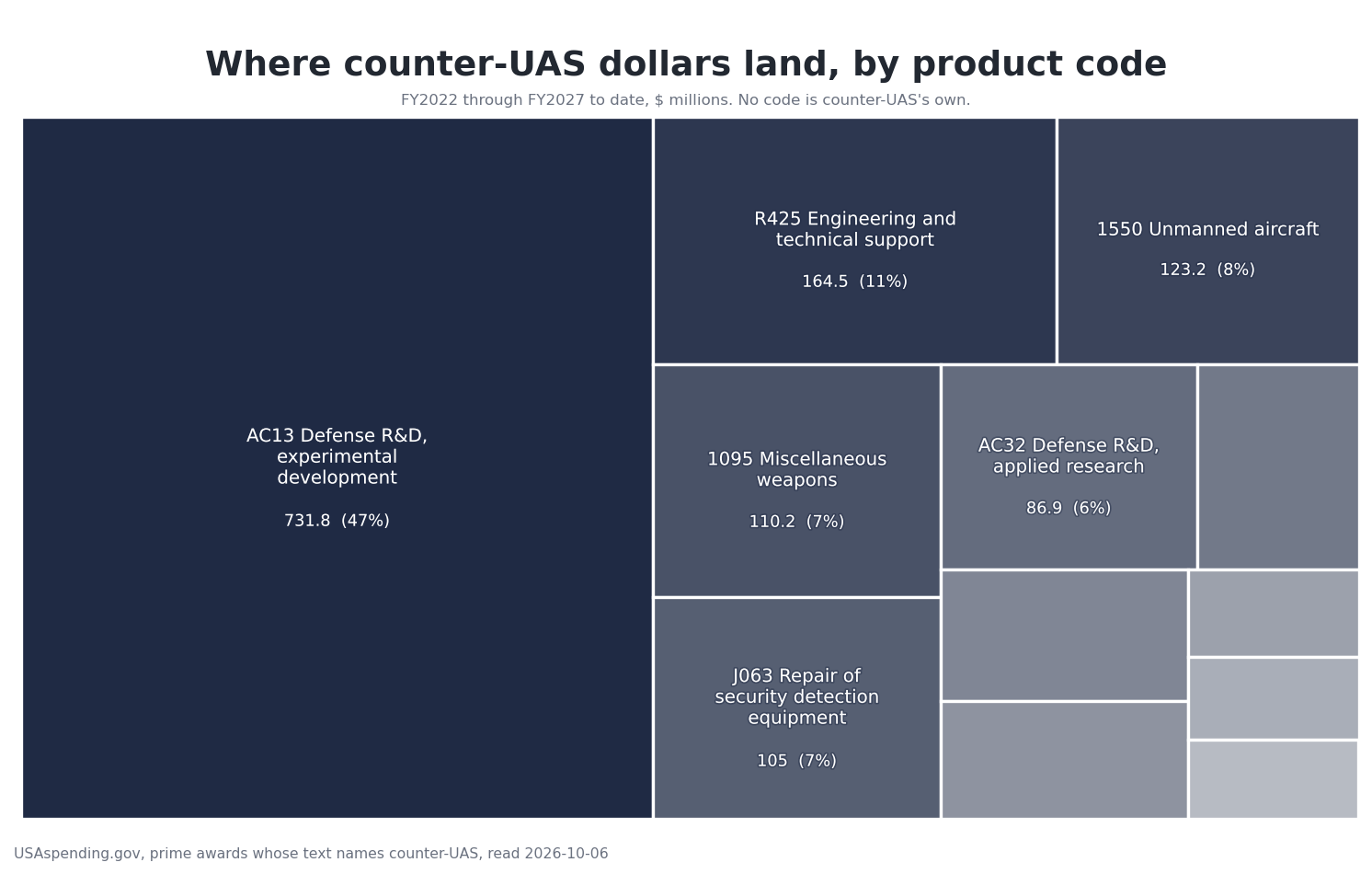
The award record GovConDash obtained from USAspending.gov on October 3, 2026 holds 210 companies with counter-UAS awards. It is concentrated at the top: the five largest hold 61.7 percent of award value and the ten largest 73.5 percent. The largest by far is RAYTHEON COMPANY, at $1,004.1 million across 10 awards, the first in FY2017.
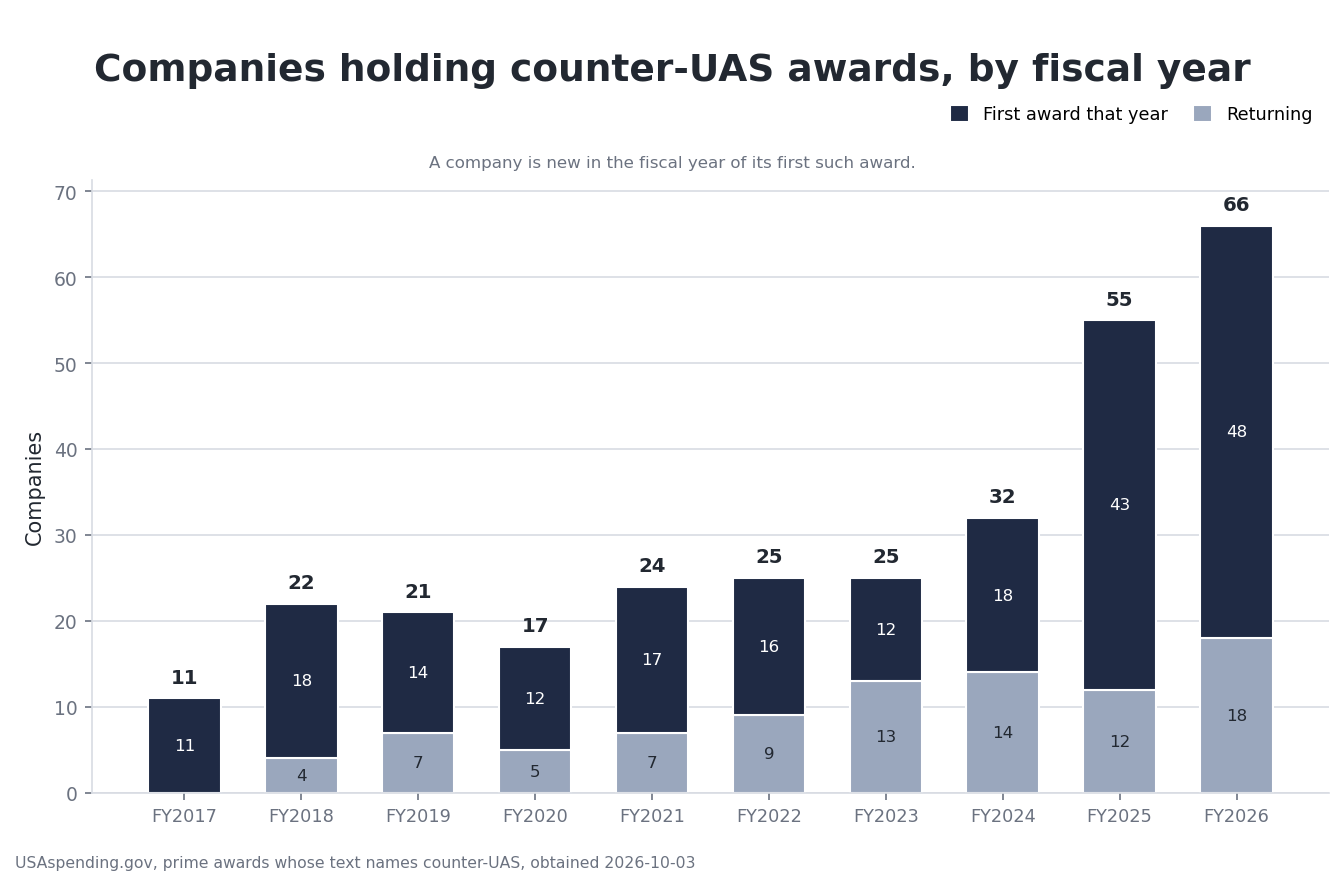
The bottom of the market is where it is changing. Of the 210 companies, 91 won their first counter-UAS award in FY2025 and FY2026, 43 percent of them. Before that, no year brought more than 18 newcomers. For a company new to the field, that is the encouraging number: the buyers are trying names they have not bought from before.
Other transactions tell the same story at prototype scale. The record holds 125 other transaction actions whose text names counter-UAS, $243.0 million obligated, and 104 of them went to companies flagged as nontraditional defense contractors. ANDURIL INDUSTRIES INC alone holds 59 actions and $86.8 million. Below the prime level, the SBIR and STTR record holds 60 counter-UAS awards to 49 firms, $37.6 million, 32 of them from the Air Force.
The notices are smaller and more frequent. Since July 11, 2026, SAM.gov has carried 21 counter-UAS notices in the platform's cache: 13 solicitations and 8 sources-sought notices, 10 of them set aside for small business. The SBA's directory lists 117 small businesses whose profile matches the field, 45 of them service-disabled veteran-owned. The practical lesson: search for the words, not the code, or you will miss most of this market.
GovConDash.ai
See the open notices that fit your company, free
Create a free account, add your company and open Opportunities. The Insights sub-tab charts recent SAM.gov solicitation notices matched to your company's profile, with a map of where the work is. On the Pro plan, Browse adds a keyword search over notice titles, so “counter-UAS” finds this market the way this piece counted it.
05The money the next budget asks for
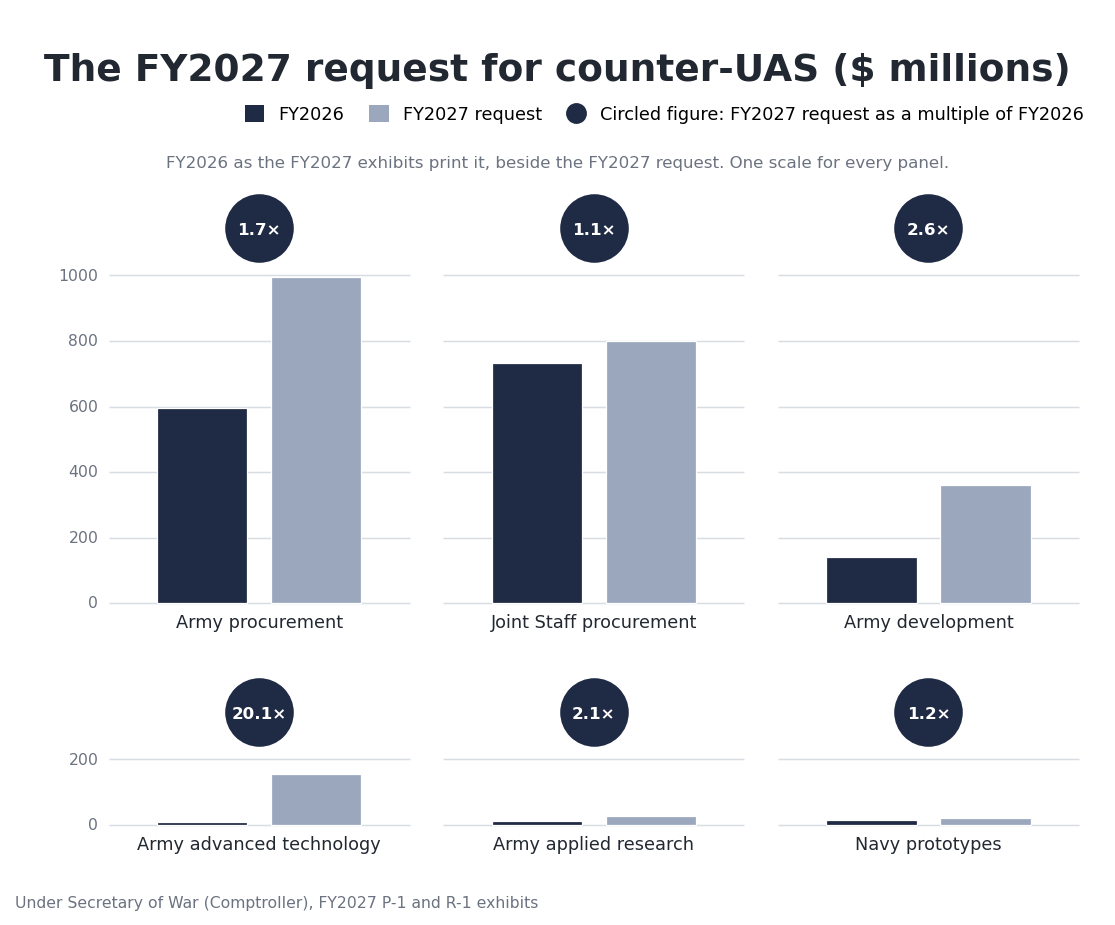
The Department's FY2027 procurement and research exhibits name six counter-UAS lines with a figure for both years. Together they ask for $2,357.2 million, against $1,505.5 million for FY2026: $851.7 million more. The Army's procurement line goes from $596.0 million to $994.1 million; the Joint Staff's from $732.0 million to $800.0 million; the Army's development line from $140.4 million to $359.2 million.
The sharpest change is in early research. The Army's advanced technology line goes from $7.8 million to $156.5 million, more than 20 times as much. That is the stage where new ideas become prototypes, which is where a small company usually gets in. One line drops out: the Army's counter-small UAS interceptor line shows $329.2 million for FY2025 and nothing after. The exhibits do not say which lines carry the task force's own money, so this is the counter-UAS budget, not the task force's.
06The rules a seller meets
The policy behind all of this is Executive Order 14305, Restoring American Airspace Sovereignty, signed June 6, 2025: “It is the policy of the United States to ensure control over our national airspace”. It is a domestic order, and it widens the set of buyers. Agencies “shall use all available existing authorities to employ equipment to detect, track, and identify drones and drone signals”. The Justice and Homeland Security departments are to let state, local, tribal and territorial agencies use their grants to buy equipment for detecting, tracking and identifying drones. The order also names two events for a new national counter-UAS training center to prepare for: the FIFA World Cup 2026 and the 2028 Summer Olympics.
It set the FAA to work too. The order asked the FAA to propose a rule restricting drone flights over fixed sites, and the FAA did on May 6, 2026, in Designation-Restrict the Operation of Unmanned Aircraft in Close Proximity to a Fixed Site Facility, extending the comment period on June 30, 2026. It also asked for a recommendation on whether borders, airports, federal facilities, critical infrastructure and military installations should be covered under 6 U.S.C. 124n and 10 U.S.C. 130i, the two laws that let Homeland Security, Justice and the Department act against a drone.
One FAR rule matters directly to anyone building or testing counter-drone gear. FAR 40.202-4 lets the Secretaries of Homeland Security, Defense and State and the Attorney General buy or operate an otherwise prohibited drone when it is required in the national interest and is for research, testing or training, including “development of unmanned aircraft system or counter-unmanned aircraft system technology”. A program that needs foreign drones as targets therefore has a route, but it runs through those four officials, not through the contractor.
“JIATF 401's mission is to synchronize the Department's counter-UAS (C-UAS) efforts and accelerate the delivery of effective capabilities to protect our warfighters and the homeland”
Finally, read the task force's own guide before you pitch it. It is 89 pages, version 4, posted September 8, 2026, and it is the plainest statement of how the buyer thinks. Its director's message opens the argument with “There is no silver bullet to address the C-UAS challenge.” and goes on: “Effective defense requires a layered approach that integrates sensors, command and control, kinetic and non-kinetic effects”. The guide also says that installation commanders hand down engagement authority under 10 U.S.C. 130i, and that these engagements need authority delegated in advance. A product that fits into that layered picture, and into a commander's rules for when to engage, is an easier sale than one that stands alone.
Documents and data used in this piece
The task force
- Establishment of Joint Interagency Task Force 401
Secretary of Defense. The memorandum signed August 27, 2025 that set up the task force.
- Hegseth calls for anti-drone task force
U.S. Army (DOD News). The Department's announcement of the task force, August 28, 2025.
- JIATF 401 Counter-Small Unmanned Aircraft Systems Quick Reference Guide
Joint Interagency Task Force 401. Version 4, posted September 8, 2026. The task force's reference to the systems and tactics in use.
- JIATF-401 advances Domestic Shield with counter-UAS contract awards
U.S. Army Public Affairs. The ten awards, announced September 29, 2026.
- Department of War Enhances C-UAS Marketplace to Expand Access to Validated Technologies
U.S. Department of War. The release of August 3, 2026 on the marketplace.
- C-UAS Marketplace
Joint Interagency Task Force 401. The marketplace itself. Buying and selling need an approved account.
The rules
- Executive Order 14305, Restoring American Airspace Sovereignty (90 FR 24719)
Federal Register. Signed June 6, 2025.
- FAR 40.202-4, Exemptions
Electronic Code of Federal Regulations. The codified section as the eCFR prints it today.
- Designation-Restrict the Operation of Unmanned Aircraft in Close Proximity to a Fixed Site Facility
Federal Aviation Administration, in the Federal Register. The proposed rule of May 6, 2026 that the order asked for.
The money
- Procurement Programs (P-1), Fiscal Year 2027 budget request
Under Secretary of War (Comptroller). The procurement lines drawn in the budget exhibit.
- Research, Development, Test and Evaluation Programs (R-1), Fiscal Year 2027 budget request
Under Secretary of War (Comptroller). The research lines drawn in the budget exhibit.
The market
- USAspending.gov award records
U.S. Department of the Treasury. The prime awards whose text names counter-UAS, obtained October 3, 2026.
- Other transaction actions reported to SAM.gov
SAM.gov Contract Awards. The platform's copy of every other transaction action, read on production.
Commentary
- JIATF 401 Explained: How the Pentagon's New Counter-UAS Task Force Is Changing Drone Defense
IDGA. An explainer by a defense events publisher. This piece takes its facts from the memorandum instead.
Video
- Department of War C-UAS Marketplace
Kaizen. A video by the company that built the marketplace, on its own YouTube channel.
Disclaimer. This piece is commentary on Department of War memoranda, releases and budget exhibits, an executive order, regulations, public award data and published commentary. It is not legal advice or investment advice, and it is not a determination about any company, product or award. Confirm how these rules apply to you with the contracting officer, counsel or a government contracts professional.

Industry Insight takes one federal industry or program per edition: what the government buys, who wins it, and the rules that govern selling into it. This one is Counter-UAS.
Keep reading
Drone Dominance Industry Insights: The Companies, the Orders and the Supply Chain RulesThe previous edition: the Drone Dominance Program, the companies it has ordered from and the supply chain rules that reach every component.