
Defense Contract Audit Agency, audit alert
CCLD 730.3.b
MRD 26-CCLD-010(R)
October 6, 2026
Three pages
Audit Alert on NDC Exemptions under Section 1826 of the FY 2026 NDAA
Implements nothing on its own. It tells DCAA's auditors what section 1826 of the National Defense Authorization Act for Fiscal Year 2026 changed and what to do when a contractor claims the status.
The short version
- 1The test is one sentence, and it looks back a year. You qualify if, in the year before the solicitation, you neither performed nor were performing any Department of War contract or subcontract under full CAS coverage. Modified coverage does not count against you.
- 2Seven of the ten exemptions are in the DFARS already. Five class deviations issued between July 22, 2026 and September 9, 2026 carry them. The accounting system, material management and business system clauses wait for one.
- 3The exemptions do not end the data requests. The contracting officer still decides whether your price is fair and reasonable and may ask for actual cost information. The memo says "NDCs must still comply with reasonable data requests", and a refusal sends the auditor to formal data denial procedures.
- 4Any exemption can be switched back on. The head of the contracting activity may apply one or more of the requirements to your contract by written determination, and Congress hears about each waiver.
- 5In other transactions, the status is the condition most prototype awards rest on. Of the Department of War prototype agreements in this platform's record for fiscal 2017 through 2026, 91.3 percent name significant nontraditional participation as their basis. The House's FY2027 bill would make it a consideration instead.
Section 1826 at a glance
The statute, the memo and 91 FR 56056
Requirements exempted
Ten
cost, pricing and business system rules
Already in the DFARS
Seven
through five class deviations
Still statute only
Three
all in DFARS Part 242
Full coverage line
$100 million
one CAS-covered award, from October 1, 2026
Look-back
One year
before the solicitation
01What a nontraditional defense contractor is
The memo quotes the definition from 10 U.S.C. 3014, and the DFARS defines the term at DFARS 202.101. A nontraditional defense contractor is
10 U.S.C. 3014, as the memo quotes it
"an entity that is not currently performing and has not performed, for at least the one-year period preceding the solicitation of sources by the Department of Defense for the procurement or transaction, any contract or subcontract for the Department of Defense that is subject to full coverage under the cost accounting standards"
The statute's own words, which still name the Department of Defense.
One term before the rest. Full coverage is the heavier of the two kinds of CAS coverage. Under 48 CFR 9903.201-2, it applies to a business unit that receives a single CAS-covered award of $100 million or more, or $100 million or more in net CAS-covered awards in its preceding cost accounting period. Those are the figures from October 1, 2026, under the CAS Board's final rule at 91 FR 56056. Below that line, modified coverage asks for only a short list of standards, starting with consistency in estimating, accumulating and reporting costs. Coverage is set when a contract is awarded and does not change afterward, so an award made before October 1, 2026 is read against the lines in force then: full coverage at $50 million, as DCAA's guidance on the rule recalls.
A few words in the definition decide most cases. It counts only Department of War work: a CAS-covered contract with a civilian agency does not make you traditional. It counts only full coverage, so a company holding modified-coverage contracts can still qualify. And it counts subcontracts the same as prime contracts, for the year before the solicitation and for whatever you are performing on the day it issues.
The exemptions do not cover your company as a whole. The statute exempts the products and services a nontraditional defense contractor provides under Department of War contracts, subcontracts and agreements, and the status behind them is measured from each solicitation. A company that takes on fully CAS-covered Department of War work can lose the status for its next solicitation.
What it means for you. The status is measured from each solicitation, so it can change between two proposals. Check it every time you bid, not once a year.
02How to tell whether you qualify
Nobody certifies you as a nontraditional defense contractor. The status is your own statement. The Part 215 class deviation's provision 252.215-7994, which governs requests for an exception to certified cost or pricing data, has an offeror claim the status by giving "a statement that the entity is not currently performing and has not performed, for at least the 1-year period preceding the solicitation of sources by DoD for the procurement or transaction, any contract or subcontract for DoD that is subject to full coverage under the cost accounting standards". The same provision gives the contracting officer the right to examine your books and records before award to verify the request.
Work it as four questions.
- Which Department of War contracts and subcontracts did you perform, or were you performing, in the year before the solicitation?
- Which of those are exempt from CAS altogether? 48 CFR 9903.201-1(b) exempts contracts with small businesses, acquisitions of commercial products and services, firm-fixed-price awards made on adequate price competition without certified cost or pricing data, and negotiated awards at or below $35 million, among others.
- Did any of the rest put the business unit under full coverage: a single award of $100 million or more, or $100 million in net covered awards in the prior cost accounting period? A subcontract carries the coverage a prime contract to the same business unit would.
- If none did, you can make the statement. Keep the analysis behind it.
The four questions, as a flowchart
Did you perform, or were you performing, any Department of War contract or subcontract in the year before the solicitation?
Nontraditional defense contractor
Nontraditional defense contractor
Are all of them exempt from CAS?
48 CFR 9903.201-1(b) exempts a contract or subcontract that is:
- (b)(1)Sealed bid contracts
- (b)(2)Negotiated awards at or below $35 million
- (b)(3)Small businesses
- (b)(4)Foreign governments, and foreign concerns for every standard but 401 and 402
- (b)(5)Prices set by law or regulation
- (b)(6)Commercial products or services
- (b)(7)NATO PHM Ship program subcontracts performed abroad by a foreign concern
- (b)(8)Firm fixed price, competed, without certified cost or pricing data
Nontraditional defense contractor
Nontraditional defense contractor
Did any CAS-covered contract put the business unit under full coverage?
Full coverage arrives either way: a single award of $100 million or more, or $100 million or more in net CAS-covered awards in the prior cost accounting period (48 CFR 9903.201-2).
A subcontract carries the coverage a prime contract to the same business unit would. Modified coverage does not count.
Traditional defense contractor
Traditional defense contractor
Nontraditional defense contractor
Keep the analysis behind it: the contracting officer may examine your books and records before award. Start with the quick check below, which reads your Department of War prime awards and reported subcontracts from the public record.
The quick check below answers 01 for prime awards and for the first-tier subcontracts primes reported, reads the small business, commercial, firm-fixed-price and dollar-floor exemptions off each prime award, and values 03 the way the CAS rules do. Lower-tier subcontracts, business units, the CAS clause and the other exemptions are yours to confirm in the contract files.
The public record can answer part of those questions for prime contracts and for the first-tier subcontracts primes have reported, and it answers them for any company, not only yours. Run the check below on your own company before you make the statement. Run it on a teaming partner or a prospective subcontractor before you build a bid on its status: a prototype OT proposal that rests on a partner's significant participation, or a subcontract priced on the expectation that the exemptions apply, depends on that company qualifying.
Enter a company name or UEI and it reads the company's SAM.gov registration and SBA directory profile, its Department of War prime awards on USAspending.gov, and the first-tier subcontracts primes have reported there under Department of War awards. It values the largest of those prime awards the way the CAS rules do, with all options or at the ceiling of the single-award IDV an order falls under, and screens each against the exemptions its record shows and the lines in force on the day it was signed: from October 1, 2026, the $35 million floor and the $100 million line; before then, the $2.5 million floor, the $7.5 million trigger contract and the $50 million line. It also sums the covered awards signed in each preceding fiscal year, the second way full coverage arrives. A reported subcontract is screened on the amount its prime reported, the one figure a subaward report carries, and the order it is filed under is read for the value, dates and terms the report lacks, so a reported amount larger than the order, or an order that ended before the year began, is called out.
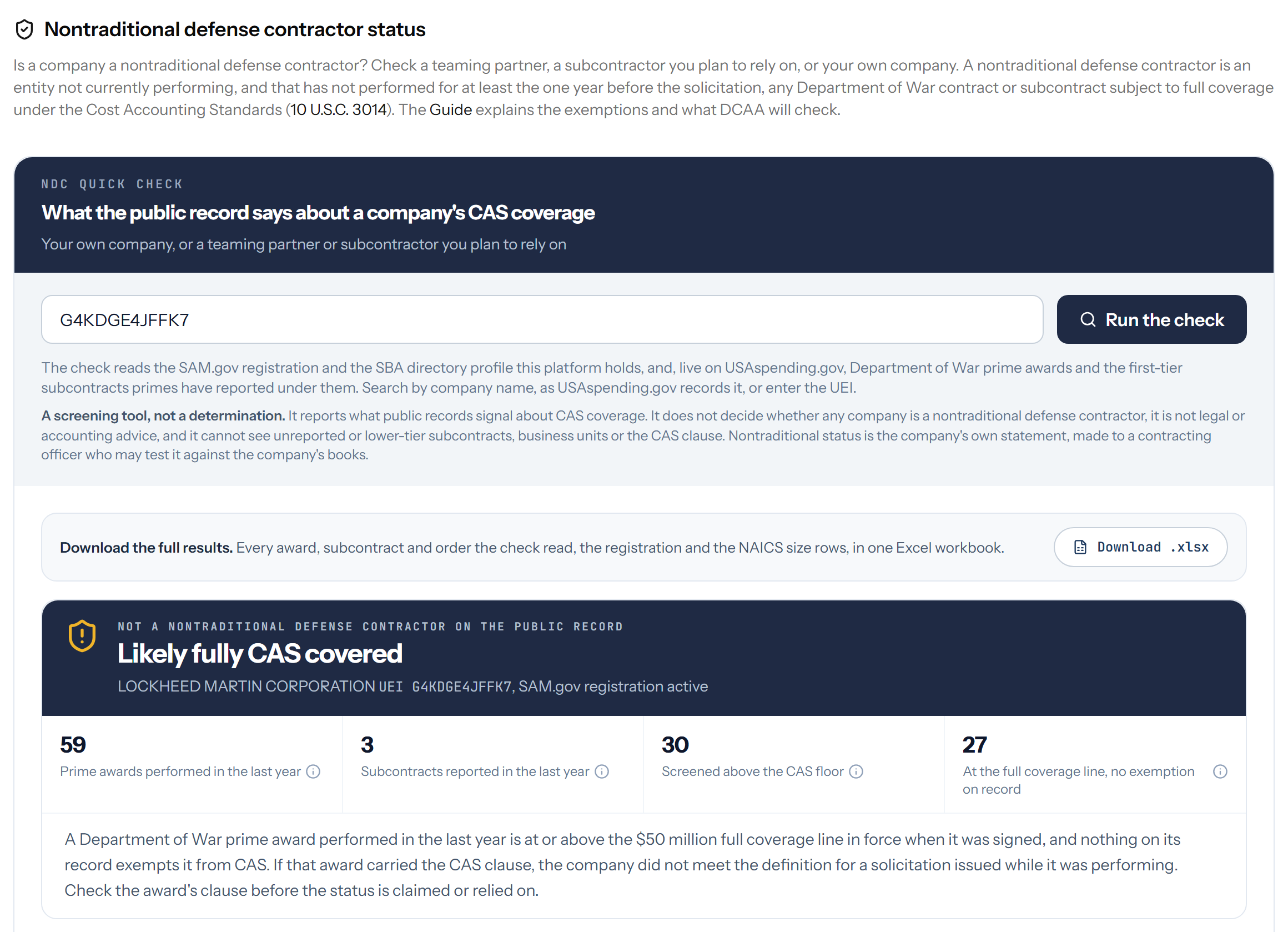
NDC Quick Check
What the public record says about a company's CAS coverage
Your own company, or a teaming partner or subcontractor you plan to rely on
The check reads the SAM.gov registration and the SBA directory profile this platform holds, and, live on USAspending.gov, Department of War prime awards and the first-tier subcontracts primes have reported under them. Search by company name, as USAspending.gov records it, or enter the UEI.
A screening tool, not a determination. It reports what public records signal about CAS coverage. It does not decide whether any company is a nontraditional defense contractor, it is not legal or accounting advice, and it cannot see unreported or lower-tier subcontracts, business units or the CAS clause. Nontraditional status is the company's own statement, made to a contracting officer who may test it against the company's books.
What it means for you. A clean result says the public award record does not contradict the statement. It sees only the first-tier subcontracts primes have reported, and it cannot see whether an award carries the CAS clause. For your own company, check those in your contract files before you sign. For a partner, ask for its written statement and the analysis behind it before you rely on its status.
03The ten exemptions and where each stands
Section 1826 lists the requirements by number, and the memo repeats them with their names. Seven are DFARS clauses for contractor systems. The other three are the special cost or pricing areas at DFARS 215.407, the certified cost or pricing data requirement at 10 U.S.C. 3702, and the cost principles of FAR Part 31.
No.
Requirement
In the DFARS
- 01DFARS 252.242-7006Accounting System AdministrationNo class deviation yet
- 02DFARS 252.234-7002Earned Value Management SystemClass Deviation 2026-O0011, Rev. 1, August 5, 2026
- 03DFARS 252.215-7002Cost Estimating System RequirementsClass Deviation 2026-O0048, Rev. 1, July 22, 2026
- 04DFARS 252.242-7004Material Management and Accounting SystemNo class deviation yet
- 05DFARS 252.245-7003Contractor Property Management System AdministrationClass Deviation 2026-O0046, Rev. 1, September 9, 2026
- 06DFARS 252.244-7001Contractor Purchasing System AdministrationClass Deviation 2026-O0015, Rev. 1, July 29, 2026
- 07DFARS 252.242-7005Contractor Business SystemsNo class deviation yet
- 08DFARS 215.407Special Cost or Pricing Areas / Defective PricingClass Deviation 2026-O0048, Rev. 1, July 22, 2026
- 0910 U.S.C. 3702Truthful Cost or Pricing Data / Truth in NegotiationsClass Deviation 2026-O0048, Rev. 1, July 22, 2026
- 10FAR Part 31Contract Cost Principles and ProceduresClass Deviation 2026-O0032, Rev. 1, August 4, 2026
The deviations do the work a regulation does: they stop the clauses from going into a nontraditional defense contractor's contract. The Part 242 deviation in force, 2026-O0050 of March 6, 2026, rewrites the accounting system, material management and business system clauses and does not mention nontraditional defense contractors at all. The memo says the Department is developing deviations for the remaining business system clauses. Until one issues, the Accounting System Administration, Material Management and Accounting System and Contractor Business Systems clauses can still appear in a solicitation.
The waiver rule comes from the statute. The head of the contracting activity may waive or modify an exemption for a product or service by written determination, or apply one or more of the ten requirements to a contract with a nontraditional defense contractor on a written justification. Each waiver is reported to the congressional defense committees within 60 days. Who may sign is not phrased the same way everywhere: the statute allows delegation only to a senior contracting official or higher, the Part 215 deviation says the same, and the Part 244 and Part 234 deviations say no lower than the chief of the contracting office.
One more benefit predates section 1826. Under 10 U.S.C. 3457, a contracting officer may buy a nontraditional defense contractor's supplies and services as commercial products or services. The Part 215 deviation's notice to offerors adds that this "does not require a commercial product or commercial service determination and does not mean the supplies or services are commercial".
What it means for you. Read every Department of War solicitation for the three Part 242 clauses and for a waiver. If a clause section 1826 exempts appears in your contract, ask the contracting officer for the written determination that put it there and who approved it.
04What the memo changes in an audit
The memo does not say audits stop. It says "evaluation approaches for NDCs will differ from traditional defense contractors", and it gives auditors four steps.
- Verify the status. "Determine whether a contractor meets the statutory definition of a nontraditional defense contractor".
- Know the exemptions. All ten apply unless the head of the contracting activity waives or modifies them in writing.
- Work with the contracting officer on the data the officer actually needs.
- Support the contracting officer through audits or advisory services, before and after award.
The contracting officer keeps final responsibility for a fair and reasonable price and may request actual cost information from you and from your suppliers. Those requests follow the hierarchy of 10 U.S.C. 3705, as FAR 15.402 and 15.403 implement it for commercial products and services: existing price information first, then information other than certified cost or pricing data.
The memo is direct about what happens next. It says "NDCs must still comply with reasonable data requests".
If you refuse, it says "auditors should pursue formal data denial procedures". DCAA is also "establishing a process to monitor and track contractors claiming NDC status".
What it means for you. Expect the first question in a pricing audit to be about your status, and expect the auditor to compare your statement with what DCAA already holds about you. Have the four-question analysis ready, and treat a data request as a request you must answer, even though certified cost or pricing data is off the table.
05Nontraditional defense contractors and other transactions
An other transaction already sits outside most of what section 1826 exempts. The OT guide this platform carries lists the Federal Acquisition Regulation (FAR) and agency supplements, Competition in Contracting Act, Cost Accounting Standards and Truth in Negotiations Act among the laws that do not apply to one. So inside an OT, the status matters for a different reason: under 10 U.S.C. 4022, it is one of the conditions that let an agency use the authority at all. A prototype OT needs one of these:
- At least one non-traditional defense contractor participates to a significant extent.
- All significant participants are small businesses or non-traditional defense contractors.
- At least one third of the total cost is provided by sources other than the government, where there is no non-traditional defense contractor participation.
- The Agency Senior Procurement Executive determines that the circumstances justify a transaction providing for innovative business arrangements not feasible or appropriate under a contract, or an opportunity to expand the defense supply base that is not practical or feasible under a contract.
Agencies record which condition they used. Across 4,815 Department of War prototype agreements and agreement vehicles in the federal procurement record for fiscal 2017 through 2026, 91.3 percent rest on nontraditional significant participation, 6.4 percent on cost sharing and 2.3 percent on a determination of exceptional circumstances.
How prototype other transactions met the participation condition
Fiscal 2026: 550 prototype agreements
Records through September 25, 2026. Federal procurement data reports with a lag, so the year's last weeks may still be filling in.
- Nontraditional significant participation495
- Cost sharing16
- Determination of exceptional circumstances39
That could change. Section 823 of H.R. 8800, the National Defense Authorization Act for Fiscal Year 2027, which the House passed on July 22, 2026, would replace the conditions with a list of determinations an agreements official could make, among them that the transaction would expand or strengthen the defense industrial base in a way a contract could not. Nontraditional participation would move to a list of additional considerations, as "significant participation by one or more nontraditional defense contractors (as defined in section 3014 of this title) or small business concerns". The latest action recorded, on September 14, 2026: Received in the Senate. It is not law.
What it means for you. If your OT rests on a partner's nontraditional participation, the agreements officer is relying on that partner's status as much as a contracting officer would rely on yours. Run the quick check on each partner, get its statement in writing, and keep both in the OT file. If you are the nontraditional participant, make the same four-question analysis part of yours. And watch section 823 through conference: if it survives, the status becomes a strength to argue rather than the gate.
06Where GovConDash fits
Two parts of the platform carry the work this piece describes: one tells you what the public record says about a company's status before you make the statement, and the other holds DCAA's guidance for the day an auditor tests it.
NDC Status
Check a company before you rely on its status
The NDC Status tab runs the quick check above inside the dashboard, on your own company, a teaming partner or a subcontractor. Enter a name or UEI and it reads the SAM.gov registration, the SBA directory profile and the Department of War awards and subcontracts on USAspending.gov, screens each award against the CAS lines, and gives you the full results as an Excel workbook. The Guide beside it walks through the definition, the ten exemptions and their class deviations, how the status is claimed, and what DCAA will check.
Audit Readiness / Overview
Follow DCAA's guidance as it issues
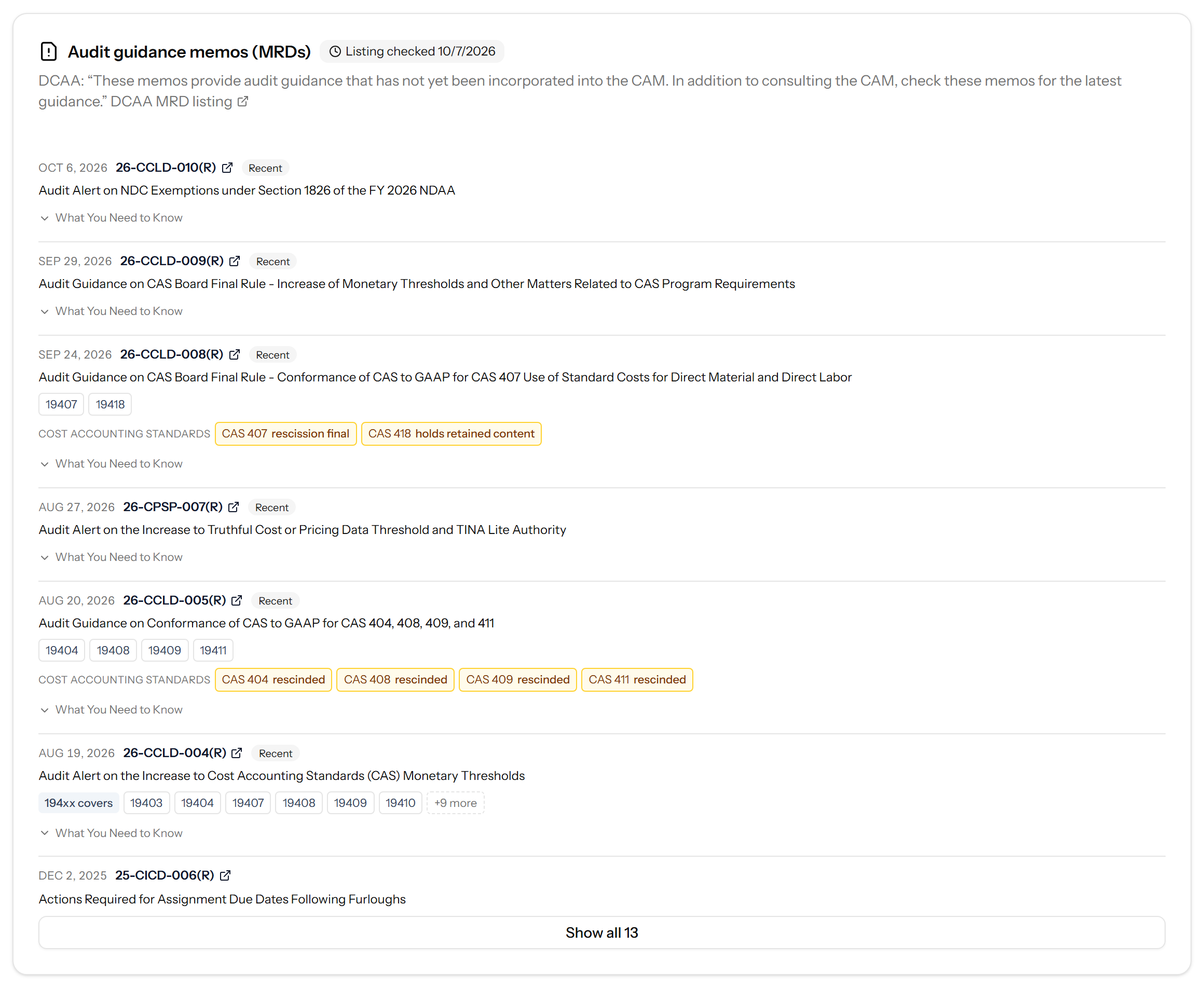
The Audit Readiness Overview lists DCAA's audit guidance memos as DCAA posts them, MRD 26-CCLD-010(R) among them, each linked to the memo itself. The same tab holds the references an auditor works from, the Contract Audit Manual, the Audit Program Explorer and the DCAA Selected Areas of Cost guidebook, and a Research Agent over the same material.
Regulations & Policy / FAR Overhaul
The class deviations
Each of the five deviations above, read in full beside the part it changes, with its revision history.
Other Transactions / Active Agreements
Your other transactions
The agreements your UEI holds, as awardee or consortium member, with the Guide one tab over for the prototype conditions.
Documents and data used in this piece
DCAA
- DCAA, MRD 26-CCLD-010(R), Audit Alert on NDC Exemptions under Section 1826 of the FY 2026 NDAA, October 6, 2026
The audit alert this piece reads: three pages.
- DCAA, MRD 26-CCLD-009(R), Audit Guidance on CAS Board Final Rule - Increase of Monetary Thresholds and Other Matters Related to CAS Program Requirements, September 29, 2026
DCAA's guidance on the CAS Board's final rule, including the lines in force before it.
- DCAA, MRDs, Audit Guidance Memos
DCAA's index of the memorandums it issues to its auditors.
Statute
- Public Law 119-60, National Defense Authorization Act for Fiscal Year 2026, section 1826
Enacted December 18, 2025 from S. 1071; section 1826 lists the ten exemptions and the waiver rule. The text on congress.gov.
- 10 U.S.C. 3014
The section in the Office of the Law Revision Counsel's U.S. Code, release point 119-120.
- 10 U.S.C. 3702
The section in the Office of the Law Revision Counsel's U.S. Code, release point 119-120.
- 10 U.S.C. 3705
The section in the Office of the Law Revision Counsel's U.S. Code, release point 119-120.
- 10 U.S.C. 4022
The section in the Office of the Law Revision Counsel's U.S. Code, release point 119-120.
- 10 U.S.C. 3457
The section in the Office of the Law Revision Counsel's U.S. Code, release point 119-120.
- H.R. 8800, National Defense Authorization Act for Fiscal Year 2027, as passed by the House
Section 823 rewrites the conditions for a prototype other transaction. The text on congress.gov; the quotations here are read from the engrossed version.
Class deviations
- DPCAP, DFARS and FAR Overhaul class deviations
The index the memo points to for every Department of War class deviation.
- Class Deviation 2026-O0048, Revision 1, DFARS Part 215, July 22, 2026
One of the deviations that puts section 1826 into the DFARS.
- Class Deviation 2026-O0015, Revision 1, DFARS Part 244, July 29, 2026
One of the deviations that puts section 1826 into the DFARS.
- Class Deviation 2026-O0032, Revision 1, DFARS Part 231, August 4, 2026
One of the deviations that puts section 1826 into the DFARS.
- Class Deviation 2026-O0011, Revision 1, DFARS Part 234, August 5, 2026
One of the deviations that puts section 1826 into the DFARS.
- Class Deviation 2026-O0046, Revision 1, DFARS Part 245, September 9, 2026
One of the deviations that puts section 1826 into the DFARS.
- Class Deviation 2026-O0050, Revision 0, DFARS Part 242, March 6, 2026
The Part 242 deviation in force, which does not mention nontraditional defense contractors.
- DFARS 252.215-7994 (DEVIATION 2026-O0048), Requirements for Certified Cost or Pricing Data and Data Other Than Certified Cost or Pricing Data
The provision in the Part 215 deviation where an offeror states nontraditional status, opened at page 51 of the memo.
Regulations as codified
- DFARS 202.101, Definitions
The section as the eCFR prints it today.
- DFARS 252.242-7006, Accounting System Administration
The section as the eCFR prints it today.
- DFARS 252.234-7002, Earned Value Management System
The section as the eCFR prints it today.
- DFARS 252.215-7002, Cost Estimating System Requirements
The section as the eCFR prints it today.
- DFARS 252.242-7004, Material Management and Accounting System
The section as the eCFR prints it today.
- DFARS 252.245-7003, Contractor Property Management System Administration
The section as the eCFR prints it today.
- DFARS 252.244-7001, Contractor Purchasing System Administration
The section as the eCFR prints it today.
- DFARS 252.242-7005, Contractor business systems
The section as the eCFR prints it today.
- 48 CFR 9903.201-1, CAS applicability
The section as the eCFR prints it today.
- 48 CFR 9903.201-2, Types of CAS coverage
The section as the eCFR prints it today.
- FAR 15.402, Pricing policy
The section as the eCFR prints it today.
- FAR Part 31, Contract Cost Principles and Procedures
The whole part as the eCFR prints it today; the owner chose the part page over the scope section.
- DFARS 215.407, Special cost or pricing areas
The section on acquisition.gov, where the Defense Pricing, Contracting, and Acquisition Policy office publishes the DFARS; the owner chose it over the eCFR, which prints 215.407 as a heading with no body.
- FAR 15.403, Obtaining certified cost or pricing data
The section on acquisition.gov, where the General Services Administration publishes the FAR; the owner chose it over the eCFR, and the seed holds only its subsections.
Other transactions
- MITRE AiDA, Other Transactions
The OT guide whose prototype conditions this piece lists.
Data the quick check reads
- USAspending.gov
Department of War prime contract awards and the first-tier subcontracts primes reported under them, read live for the UEI you enter.
- SAM.gov
The registration, from the public entity extract this platform holds.
- SBA, Small Business Search
The small business directory profile and its certifications.
This piece is commentary on a statute, published audit guidance and class deviations. It is not legal advice, and it is not a determination that any company is or is not a nontraditional defense contractor. The quick check reads public records and reports what they signal; the status is the company's own statement, made to a contracting officer who may test it. Where this piece says what a change means for you, that is its own reading, not DCAA's or the Department's.

Keep reading
CAS Is on the Way Out. Your Outside Auditor Is on the Way In.The other half of the same deregulation: the Department of War's memorandum moving contract cost accounting off a government-only rulebook, and who already has the audited statements it asks for.