

































Memorandum for senior Pentagon leadership
- Subject
- Fostering One Strong Industrial Base
- From
- Deputy Secretary of War
- Office
- 1010 Defense Pentagon, Washington, DC 20301-1010
- Signed
- September 14, 2026
- Posted
- September 15, 2026
- Length
- 8 pages, 21,168 characters of text
The short version
- 1The memorandum is an instruction to the Department, not a change to the regulation. Nothing in it amends FAR 30.201-1 or the Cost Accounting Standards themselves. It directs the Department to ask the Cost Accounting Standards Board to change them, within 60 days, and it tells contracting officers what to do in the meantime.
- 2One thing takes effect immediately, and it is the one to read first. Until the Board acts, a solicitation that would pull a business unit newly under full CAS coverage needs the Under Secretary of War for Acquisition and Sustainment's written approval of the acquisition strategy. That is a brake on new coverage, applied on signature.
- 3The substitute for Department review is an audit somebody else performs. A modernized Disclosure Statement becomes a certification against audited GAAP statements, and business system review becomes a registered firm's certification. That artifact exists, by construction, for companies that file with the Securities and Exchange Commission.
- 4Most performers of the work this reaches are small businesses. Of the 2,557 distinct companies holding a flexibly priced Department of War award in this platform's corpus, 2,182, or 85 percent, are listed in the Small Business Administration's own directory. The share holds across every pricing type.
- 5Deregulation is not the same thing as less reaching you. The four standards the Board conformed to GAAP on July 8, 2026 are gone from the regulation, but four of their requirements moved into CAS 405, which applies to modified coverage as well as full. Read the rescissions before assuming any of them narrow your obligations.
01What the memorandum actually says
The framing sentence is in the first paragraph on page one, and it is not hedged.
The DoW will move from government-unique Cost Accounting Standards (CAS) to the accounting every American company already uses
The Cost Accounting Standards are the government-unique rulebook that sentence is about. They attach through 48 CFR 9903.201-1 and the FAR's own applicability rule, and a covered business unit files a Disclosure Statement under 48 CFR 9903.202-1 describing the cost accounting practices it will follow. Generally Accepted Accounting Principles are what the rest of the economy uses: the codification the Financial Accounting Standards Board maintains, which is not law and which no contracting officer administers.
Three shorter sentences frame everything else. The memorandum restates the executive order that put fixed-price contracting first: “Executive Order 14402 makes fixed-price contracts the default and reserves cost-based contracts for basic research and for the development of major systems.” It is careful that a request for information is not itself a hook: “Asking for information does not, by itself, create a cost-reimbursement contract or CAS coverage, and it does not alter the thresholds or exceptions for certified cost or pricing data.” And it makes one promise directly to contractors, which the rest of this article tests: “No new accounting systems or special data formats will be required.”
02The part that is already in force
Most of the document is a set of tasks with deadlines. One paragraph is not. It operates from the signature, and it is the paragraph a capture manager should read first.
Until the Board acts, no solicitation from the DoW that could bring a business unit not previously subject to CAS under full CAS coverage may be issued unless the Under Secretary of War for Acquisition and Sustainment has approved the acquisition strategy in writing.
That is a hold on new full CAS coverage, and nothing more. It does not exempt anyone and it does not waive anything; the memorandum says in the same breath that the approval concerns the acquisition strategy only. The practical effect falls on the government side of the table. Before a Component issues a solicitation that would sweep in a business unit not previously covered, the Under Secretary has to sign off, and the request has to explain why competition, commercial acquisition, a competed fixed-price structure, an exemption or the existing waiver authority at FAR 30.201-5 could not meet the requirement instead.
If your company is approaching the coverage line, that is the paragraph to cite. The waiver policy and standing justification templates the memorandum orders are due on November 13, 2026, day 60, and they name your situation: new entrants, predominantly commercial segments, and businesses outgrowing small-business classifications.
A second immediate instruction runs the other way, at Components rather than contractors. Within 30 days the Under Secretary is to “prohibit Components from imposing on exempt awards and other transactions the equivalent of CAS coverage, disclosure, business-system review, or practice-change governance under another name”. The memorandum repeats the point later in plainer words, “No Component may recreate a retired regime through local policy, checklists, approvals, or clauses.” and puts a ceiling on its own implementing guidance: “The attached appendix directs these actions; implementing guidance may not add requirements beyond this memorandum and applicable law.” Those are the sentences to hold up when a Component's instruction arrives asking for more than the memorandum did.
03Every clock the memorandum starts
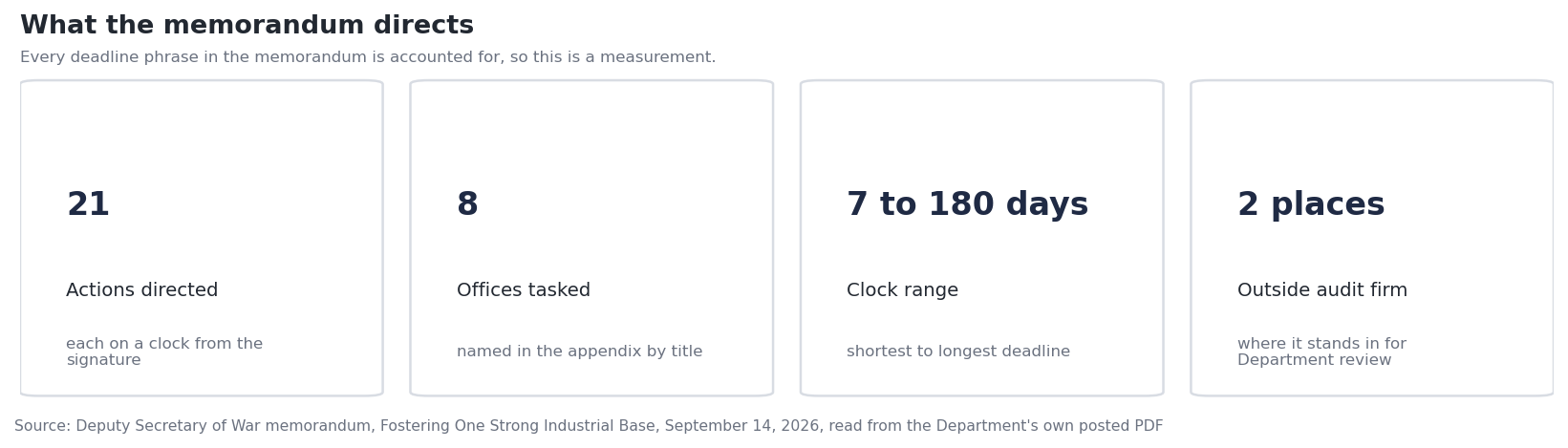
The appendix assigns 21 actions to 8 offices, on clocks from 7 to 180 days. Laid out on a calendar, the shape of the reform is visible in a way it is not in the document: almost everything lands inside the first quarter, and the two longest bars, the Other Transactions Guide reissue and the advance market commitments, are not about accounting at all.
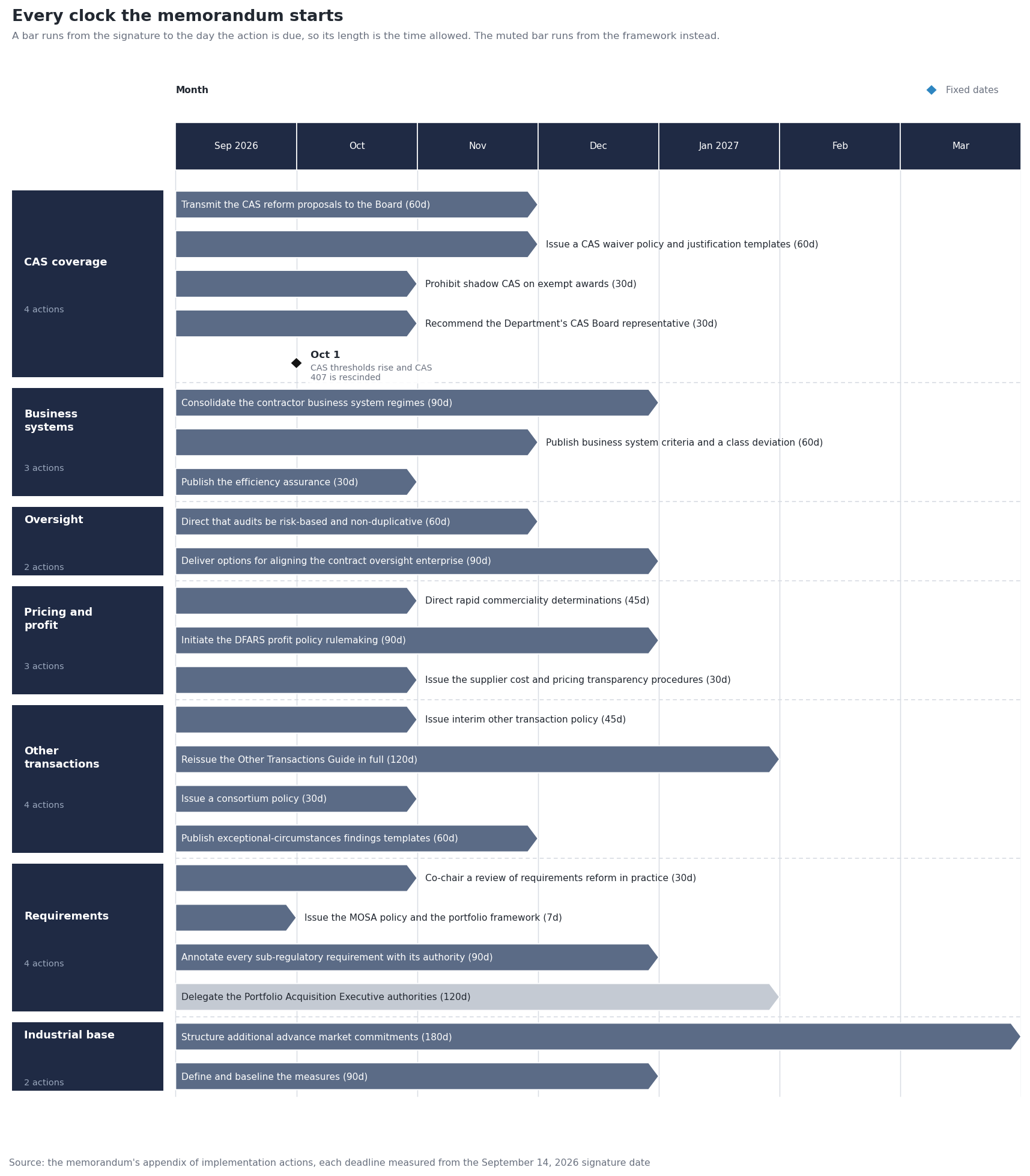
The nearest deadlines are the ones worth a calendar entry, because each produces a document a contractor can read and hold the Department to.
| Due | Action | Office |
|---|---|---|
| September 21, 2026day 7 | Issue the MOSA policy and the portfolio framework | USW(A&S) |
| October 14, 2026day 30 | Prohibit shadow CAS on exempt awards | USW(A&S) |
| October 14, 2026day 30 | Publish the efficiency assurance | USW(A&S) and USW(C) |
| October 14, 2026day 30 | Issue the supplier cost and pricing transparency procedures | USW(A&S) |
| October 14, 2026day 30 | Recommend the Department's CAS Board representative | USW(C) |
| October 14, 2026day 30 | Issue a consortium policy | USW(A&S) |
Of those, the efficiency assurance due on day 30 is the one most likely to change a negotiation. It is a statement of enforcement posture for fixed-price work and other transactions where the performer carries the cost risk.
a performer that becomes more efficient against a fairly negotiated price keeps the savings for that contract, and the Department captures efficiencies only prospectively, in the next negotiation, at a fair margin
Note what it leaves alone: “it does not waive statutory remedies for fraud or defective pricing, CAS price adjustments where CAS applies, or final indirect-cost-rate settlement on cost-reimbursement work”. If you perform under cost-reimbursement contracts subject to FAR 16.301-3, your incurred cost submission and your final rate settlement are exactly where they were.
04The substitution, stated twice
Strip out the scheduling and one design choice runs through the whole document. Where the Department performs a review today, the memorandum proposes to rely on an audit performed by someone else. It names that someone two times, in the same words each time: a registered independent public accounting firm.
The first is the Disclosure Statement. Today a covered business unit files one under FAR 30.202-1 describing its cost accounting practices in the Board's own format. The memorandum asks the Board for something else.
a short certification that contract cost accounting follows the contractor's annual GAAP financial statements, audited by a registered independent public accounting firm, supplemented only by legally required disclosures, with a schedule of departures, in a machine-readable, versioned electronic submission format
The second is business system review. Today the Department decides whether a system is acceptable, and a significant deficiency under DFARS 242.7000 can support a payment withhold through the clause prescribed at DFARS 242.7001. The memorandum directs a class deviation on November 13, 2026, day 60.
issue a class deviation, grounded in the Department's statutory reliance authorities, accepting a registered independent public accounting firm's certification against those criteria in place of Department review
A third instruction names the artifact without naming the firm. On November 13, 2026, day 60, the Under Secretary of War (Comptroller) is to “direct that the Department consider a contractor's audited GAAP financial statements and internal-control attestations before performing additional work”. The same paragraph closes off the second look: “Ensure that no office will request an audit of a cost or system that has already been audited or reopen closed years absent indicators of fraud or material misstatement.” And it sets a test every audit request has to pass before it is made.
Every audit will identify the risk, its materiality to a government decision, the records needed, and why existing evidence is insufficient.
Those are answerable propositions. An audit request that cannot state its risk, its materiality to a government decision, and why what you already produced is not enough has been answered by the memorandum itself.
05Who actually has that audit
An audited GAAP financial statement signed by a registered independent public accounting firm is not a document every company has lying around. It is what a public company produces because the securities laws require it, performed by a firm registered with the Public Company Accounting Oversight Board. This platform holds the annual reports of 87 publicly traded defense contractors and can read the audit firm off the cover of 79 of them. 13 firms sign all of those statements, and four of them cover 62 of the companies and 98.3 percent of the revenue.
Now the other side of the table. CAS coverage, incurred cost audits and business system reviews reach companies performing flexibly priced work, which is to say cost-reimbursement and its neighbors rather than firm fixed price. This platform holds 11,953 such Department of Defense awards, held by 2,557 distinct companies. Matched on Unique Entity Identifier against the 615,725 profiles in the Small Business Administration's own directory, here is what that population looks like.
2,182 of 2,557
companies performing flexibly priced Department of Defense work are listed in the SBA small business directory, 85 percent of the population. The remaining 375 are the ones for whom a registered firm's audit is even a possibility, and not all of those are public companies either.
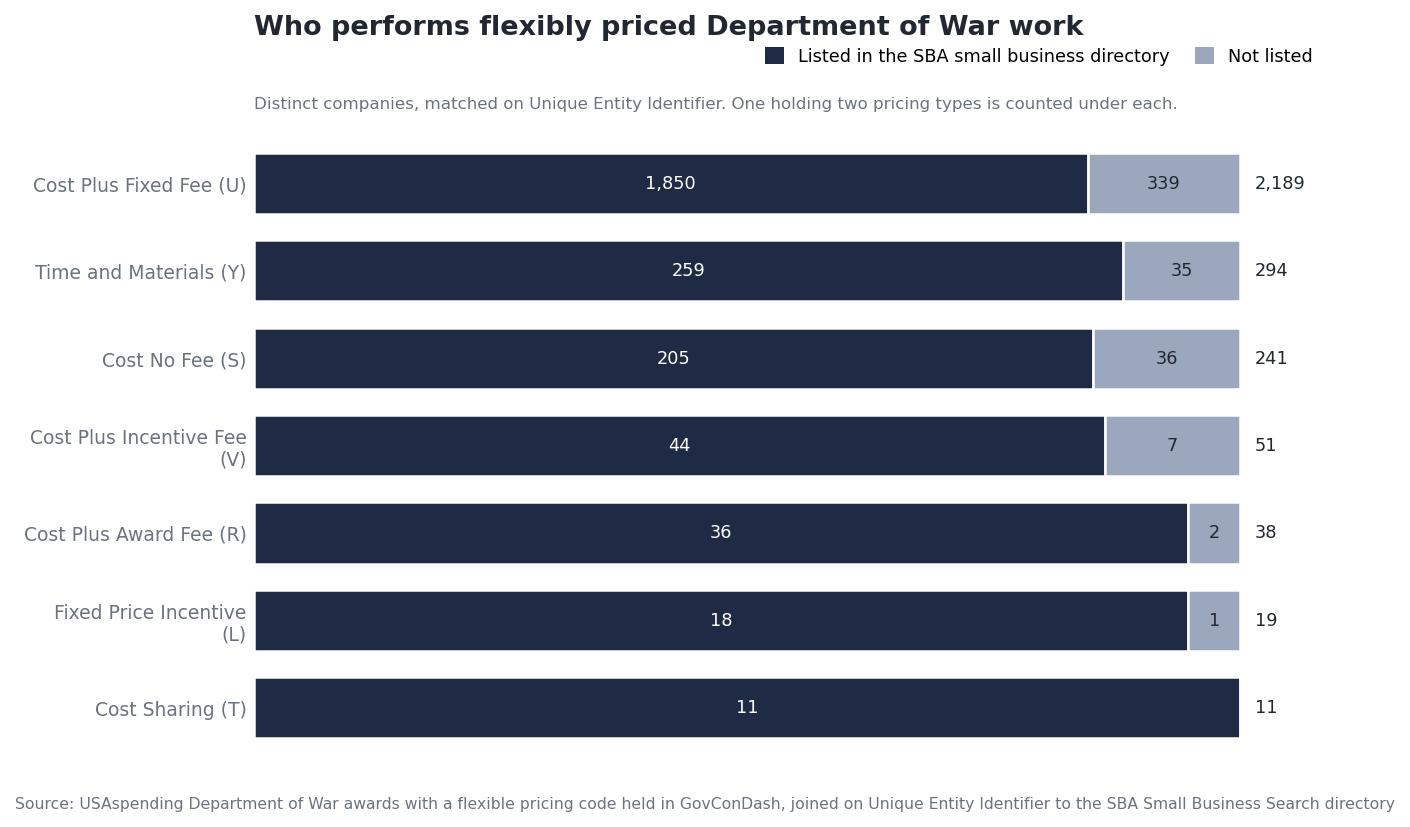
Two honest limits. A listing in the SBA directory is a company's own registration, not a size determination for any particular procurement, and a listed company can still be other than small for the code it is competing under. And the corpus is a slice of Department of War prime awards, not a census of the industrial base. Neither moves the conclusion, because both errors run the same direction: subcontractors and the smaller end of the base are under-represented in prime award data, not over-represented.
So the substitution works cleanly at the top of the base and has nothing to substitute at the bottom of it. That is not an argument for keeping CAS. It is a reason to read the business system deviation carefully when it lands on December 13, 2026, because the question a small business needs answered is what it presents when it has no registered firm's certification to present. For exempt performers the memorandum does answer that, in one sentence.
Cost data from exempt performers will be requested as already maintained in their books and records.
06The six systems, and what happens to each
The clause at DFARS 252.242-7005 defines six contractor business systems, each by reference to the clause that prescribes it. The memorandum touches every one, and the verb is different for each.
Accounting system
DFARS 252.242-7006consolidated intoBecomes the single simplified, commercial-aligned criteria set, satisfied outside the covered CAS core by the contractor's GAAP books and a contract-level ledger.
Earned value management system
DFARS 252.234-7002confinedConfined to major development programs and, where the Government keeps cost risk, major long-duration production. The separate validation regime is retired.
Estimating system
DFARS 252.215-7002retired as a separate reviewFolded into the accounting-system criteria, its separate review retired, with the statutory proposal-integrity protections retained.
Material management and accounting system
DFARS 252.242-7004retired as a separate reviewFolded into the accounting-system criteria, its separate review retired, with inventory-accounting standards retained.
Property management system
DFARS 252.245-7003retired as a separate reviewThe separate review overlay goes, in favor of the government-wide FAR property stewardship duties and remedies.
Purchasing system
DFARS 252.244-7001narrowedThe review threshold rises and reviews are reserved for demonstrated risk. An approved system ends subcontract-consent withholding.
The estimating system at DFARS 252.215-7002 and the material management and accounting system at DFARS 252.242-7004 lose their separate reviews into the accounting system criteria at DFARS 252.242-7006. Earned value management under DFARS 252.234-7002 is confined to major development programs, with the government validation regime retired in favor of integrated baseline reviews. Property management under DFARS 252.245-7003 loses its review overlay to the government-wide FAR duties. The purchasing system at DFARS 252.244-7001 keeps its review, at a higher threshold and reserved for demonstrated risk.
Two operational details in that section are worth more than the headline. The first puts a clock on the government side of a corrective action plan, which has historically had none: “Establish a 90-government-day clock for final disposition of contractor's corrective action plan, tolled while necessary contractor information is outstanding and elevated to the head of the contracting activity upon expiration.” The second is an instruction to unwind what the deviations retire, contract by contract.
To the maximum extent permitted by law and contract, Components will cease enforcing superseded requirements, and contracting officers will offer bilateral no-cost modifications removing affected clauses at the next practicable opportunity.
That is a thing to ask for by name at your next modification, and the contract administration office that would process it is the one assigned under FAR 42.302.
07Does the machinery actually come down?
This is where a record helps more than a reading. The Cost Accounting Standards Board has already been conforming standards to GAAP, and this platform's seeded copy of the Code of Federal Regulations, refreshed September 13, 2026, can be asked what survives. It carries 113 sections across 15 standards. For the four the Board conformed in its July 8, 2026 final rule, it carries none. The control is CAS 406, which the Board did not take up and which still carries 8 sections, so the zeros are a rescission rather than a gap in the corpus.
Ask a second corpus the same question. DCAA publishes a directory of audit programs, and this platform holds 71 of those documents, which reduce to 62 currently published programs once superseded versions are set aside. Among them is a compliance audit program for each of the four standards the regulation no longer carries.
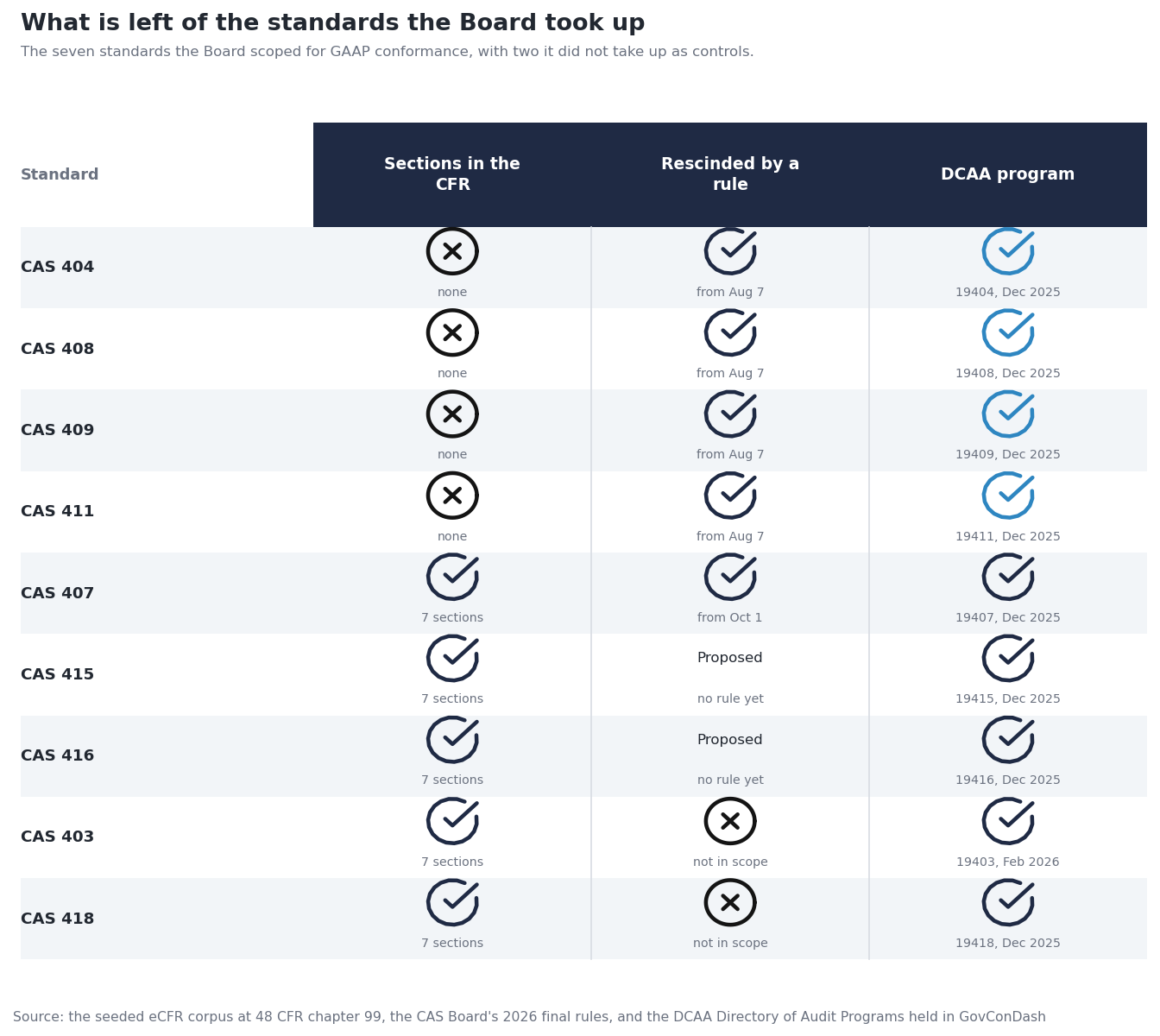
DCAA was ahead of the memorandum on this. Three weeks before it was signed, the agency issued guidance to its own directorate directors about exactly those standards.
DCAA guidance
The Agency is removing the audit programs and deactivating activity codes 19404, 19408, 19409, and 19411. Do not plan any new comprehensive CAS compliance audits for these standards.
Those are the same four activity codes. One list comes from the audit program directory, the other from the memo itself, and they match. So the chart above shows a catalog between revisions rather than an oversight gap: the instruction went out on August 20, 2026, and a published directory is refreshed on its own cycle. If one of these audits is open on your books, the guidance is what governs it, and it is specific: “If there is no known risk or evidence of noncompliance, audit teams should cancel the engagement.” It is equally specific about what the rescission does not reach: “From the effective date forward, these four standards no longer apply to any contracts or subcontracts; however, any noncompliance that occurred prior to the effective date must still be resolved.”
One detail in that memo cuts the other way from everything else in this article. The Board did not delete all four standards outright. It moved four requirements out of CAS 404 and CAS 409 into CAS 405, accounting for unallowable costs, and that relocation changes who they reach.
DCAA guidance
While CAS 404 and 409 applied strictly to fully CAS-covered contracts, CAS 405 applies to all CAS-covered contracts, meaning these four requirements now extend to contracts under modified coverage as well.
If you hold modified coverage, a conformance rule that deleted two standards you were never subject to has just extended four of their requirements to you. That is what a deregulatory program looks like from underneath, and it is the reason none of this is a reason to stop reading the standards.
The companion memo, issued the day before, qualifies the reading of the regulation this section opened with. The Department has already deviated from chapter 99, and DCAA told its auditors so.
DCAA guidance
This deviation immediately requires contracting officers to use the revised FAR Overhaul Part 30 CAS Administration in lieu of 48 CFR 99
So the sections still sitting in chapter 99 are not what a Department of War contracting officer works from today. The same memo states the thresholds now in force: “If none of the CAS exemptions apply, contracts and subcontracts that are greater than $35 million are CAS covered.” And on waivers: “The head of an executive agency CAS waiver authority threshold was increased from $15 million to $100 million.” A waiver authority that moved from fifteen million dollars to a hundred million is a different instrument, and the waiver policy due on November 13, 2026 is being written against the larger one. For audits already in flight, the instruction is to “Coordinate with the Cognizant Federal Acquisition Official (CFAO) to determine the need to continue CAS audits.”
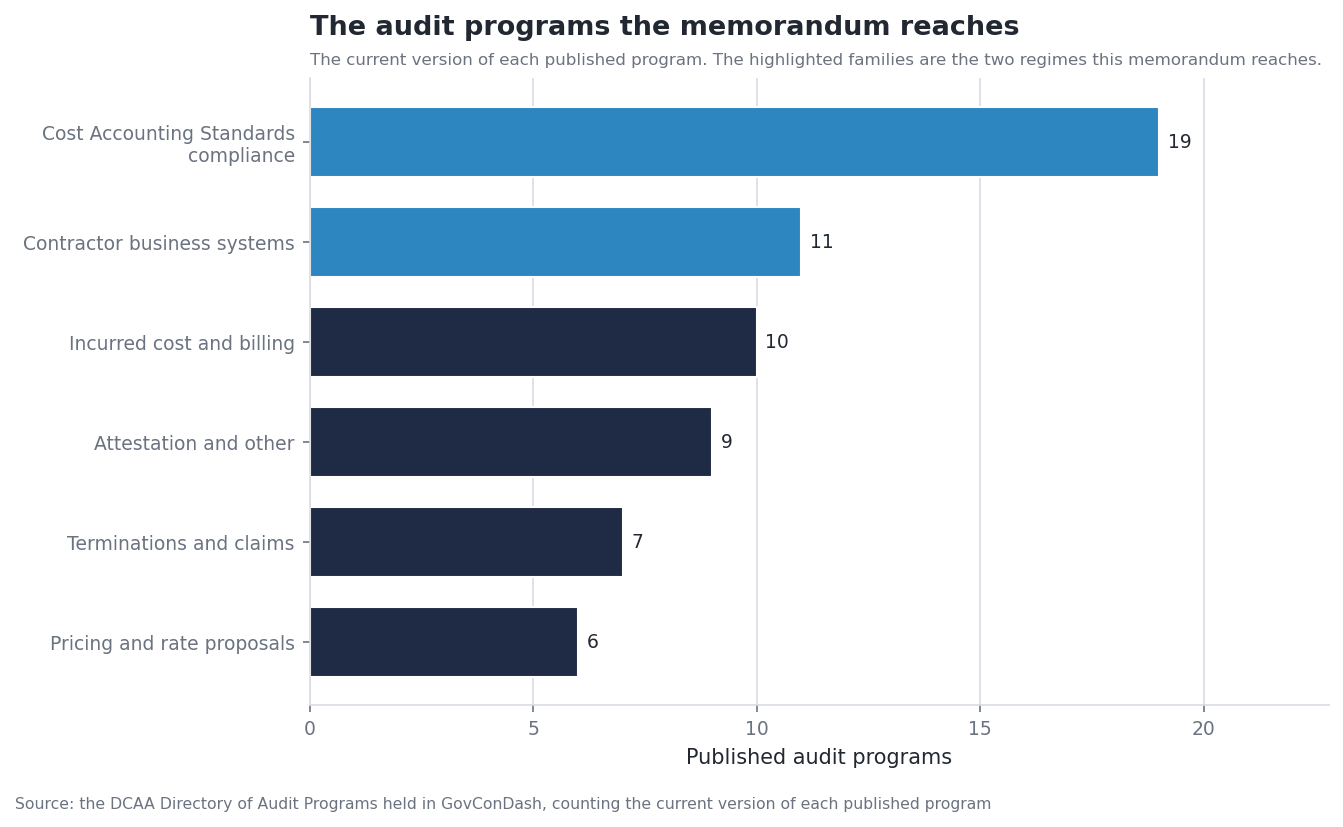
Sized against the whole catalog, the two regimes this memorandum reaches are the two largest families in it: 19 Cost Accounting Standards programs and 11 contractor business system programs, 30 of 62 together. And DCAA has been clear that removing a standard does not remove the audit: “Regardless of the removal of these standards, a core requirement of every contract audit includes testing for compliance with CAS, FAR Part 31, DFARS Part 231, and GAAP.”
The Department has also been doing exactly this kind of work at speed. The memorandum directs class deviations where required, and the Revolutionary FAR Overhaul deviation corpus this platform tracks already carries a Department class deviation for 48 DFARS parts, including every one of the 7 parts this memorandum touches. The instrument the appendix reaches for is one the Department has used 48 times already.
And the Board itself has put a number on the scale of what is moving. In the threshold rule effective October 1, 2026, using its own procurement data for FY2020 through FY2024, it estimated that the entities subject to full CAS coverage and a Disclosure Statement fall from 773 to 564. This memorandum asks the Board to go considerably further, and to make exemption the default.
08What to do about it
The memorandum ends by naming the eight things the Department will measure, and it is unusually direct about why.
These measures are the test of this memorandum.
- Government-unique requirements eliminated
- Business units under full CAS coverage
- Business systems subject to review
- Audit and oversight cycle time
- Commercial content
- Performers at production per program
- New entrants and returning commercial firms
- Declined solicitations, where observable
The baselines are due on December 13, 2026, and the memorandum forecloses the usual way a deadline slips: “No discretionary study, pilot, working-group determination, or approval not required by law may delay these actions.” Two of the eight are business units under full CAS coverage and business systems subject to review, the two counts this article has been circling, and the Department has now committed to publishing them. Until it does, here is what is actionable.
- 1Do not change a single accounting practice yet. The regulation has not moved. If you are CAS covered today, you are CAS covered tomorrow, and a unilateral practice change still carries a cost impact. The memorandum is an instruction to the Department about what to ask for next.
- 2If a pending solicitation would pull you newly under full coverage, say so now. The written approval requirement is in force on signature, and the request has to address competition, commercial acquisition, a competed fixed-price structure, exemptions and existing waiver authority before it can be granted.
- 3Put December 13, 2026 and November 13, 2026 in the calendar. Those are the business system class deviations. Between them they decide whether your estimating system review, your material management review and your property review still exist, and what a certification in their place has to look like.
- 4Inventory what your auditor already produces. If you carry a financial statement audit, an internal control attestation or a single audit, that is now an asset in an audit conversation rather than a cost of doing business. If you do not carry one, the answer for you is the books and records sentence, and it is worth holding the Department to it.
- 5Ask for the no-cost modification. The memorandum tells contracting officers to offer bilateral no-cost modifications removing clauses tied to retired regimes at the next practicable opportunity. Nobody is going to run that list for you.
- 6Keep answering audits from the record. Risk-based does not mean fewer questions in the near term; it means each question is supposed to carry a stated risk and a stated materiality. An answer that cites the regulation as it stood at award, the audit program being worked, and how the boards and courts have ruled on the same issue is the answer that survives either regime.
This piece is commentary on a published Department of War memorandum, published final rules, and public regulatory and procurement data. It is not legal advice, and it is not a determination about any contractor, any solicitation or any audit.

GovConDash.ai
Know which rulebook your contract is actually under
GovConDash holds the regulation as it stood at award, the 48 DFARS parts the Department has already deviated from, DCAA's own audit programs and manual, and how the Board, the Court of Federal Claims and the Federal Circuit have ruled on the same cost issue. Every answer cites the record it came from. Free to start.
Keep reading
CAS Is Shrinking. Your Accounting Rules Are Not.What the Cost Accounting Standards Board has already done about GAAP, rule by rule, read against every decision in this platform's Court of Federal Claims and ASBCA corpora that names a standard.