
U.S. Department of Justice, National Fraud Enforcement Division
October 1, 2026
Directive 26-12
Five pages
Colin M. McDonald, Assistant Attorney General
Corporate Enforcement in the Fight Against Fraud
Addressed to every Fraud Division prosecutor. It sets the corporate investigations they should open first, the factors that weigh on whether a company is charged, and a direction to build incentives for whistleblowers.
The short version
- 1Procurement fraud is priority two of four. Health care comes first, revenue evasion third, and tariff evasion, imports and forced labor last. The procurement priority reaches beyond contracts to other government functions.
- 2The charging factors read like an audit file. Concealment from auditors, threats to military readiness, harm to more than one program, a scheme that runs for years: prosecutors are told to give each of them great weight.
- 3One matter carried most of the 2026 False Claims Act year. Perfectus Aluminum Inc. and Related Companies agreed to pay $549.5 million over evaded customs duties, 69.7 percent of the $788.4 million the year's 39 matters announced. The other 38 add up to $238.9 million, and 16 of all 39 name the Department of War first.
- 4Disclosure is the hinge. The directive promises credit to companies that disclose and asks for whistleblower incentives. The FAR already requires a timely written disclosure, and a principal's knowing failure to make one is a cause for debarment.
The directive and the year, at a glance
Directive 26-12 and the Department's 2026 releases
Investigation priorities
Four
procurement is no. 2
Charging factors
Ten
given great weight
2026 matters
39
through October 8
Announced
$788.4 million
69.7 percent in one matter
Brought by a whistleblower
48.7 percent
19 of 39 matters
01What the directive does
Directive 26-12 is a memorandum from Colin M. McDonald, Assistant Attorney General for the National Fraud Enforcement Division, to all Fraud Division personnel. Its opening sets the tone: "Division prosecutors will take an aggressive, all-tools approach to investigating and prosecuting our health care, government, tax, and trade fraud priorities". It then sets out how the Division handles companies, as distinct from the people who work for them.
Before it reaches the priorities, it does more groundwork. It tells prosecutors to follow the Department's existing rules for business organizations, the Principles of Federal Prosecution of Business Organizations in the Justice Manual and the Corporate Enforcement and Voluntary Self-Disclosure Policy. It routes every corporate case through the Division's new Corporate Enforcement Section: prosecutors had seven days from the directive to report every open corporate investigation to the Section's chief, and the Section now evaluates whether a company keeps the terms of a criminal resolution. And it promises balance: "we will also firmly guard against overbroad corporate enforcement".
In opening and conducting a corporate investigation, Fraud Division prosecutors should prioritize
- 01Health careFraud schemes involving the health care industry, including health care fraud, distribution of controlled substances, and violations of the Federal Food, Drug, and Cosmetic Act
- 02Procurement and government contractsFraud schemes involving the public trust or financial integrity of Americans and markets related to procurement, government contracts, and other government functions
- 03Revenue evasionFraud schemes involving significant evasion of internal or external revenue
- 04Tariffs, imports and forced laborFraud schemes involving tariff evasion, importation of goods or services, or forced labor
Two things narrow the reach. The priorities govern cases the Fraud Division opens or supervises; a footnote leaves out cases a U.S. Attorney's Office assigns to its own District Fraud Counsel without Division supervision. And the directive is about criminal enforcement. The word "fraud" appears in it 42 times; the False Claims Act, the civil statute most procurement fraud is resolved under, appears nowhere.
02The ten factors, read from a contractor's side
When a Division prosecutor recommends what to do with a company, the directive says the prosecutor "must place great weight on the following factors in determining whether to bring charges and negotiating plea or other agreements". The list is not exhaustive, and it sits on top of the Justice Manual's own factors rather than replacing them.
The factors that carry great weight
Shaded: read below
- 01Knowledge of or involvement in fraud scheme by corporate management
- 02Efforts to conceal fraud from government agencies or auditors or otherwise impede or obstruct a government function or oversight
- 03Conduct that furthers the scheme lasting three years or more
- 04Actions that threaten the safety or security of Americans, including military readiness
- 05Conduct that causes substantial financial hardship to a taxpayer funded program or government function
- 06Conduct that affects multiple taxpayer funded programs or government functions
- 07Conduct that affects three federal districts or more
- 08Conduct that results in financial harm to twenty-five or more victims or $25 million or more in loss
- 09Conduct that involves the exfiltration of American dollars to support foreign adversaries
- 10Conduct that involves immigration offenses
Five of them can be read straight out of a government contract file. Factor 2 names concealment from auditors and obstruction of oversight: in a defense contract the auditor is usually DCAA, and an incomplete or altered response to an audit request is the kind of record this factor describes. Factor 4 names threats to military readiness, which is what a nonconforming part in a weapon system or a skipped test on military equipment amounts to. Factor 6 names conduct affecting more than one taxpayer funded program: of the 2026 matters below, 16 named more than one agency.
Factor 8 sets a line at $25 million in loss. Loss is not what a company pays to settle a civil case, which can include multiple damages and penalties or be well below the loss; three of the year's civil matters were announced at that amount or more, and the figure says nothing about the loss behind any of them. Factor 9 names the exfiltration of American dollars to support foreign adversaries, a factor that sits close to the trade fraud priority.
03The 2026 False Claims Act record
Two terms before the numbers. A matter is one resolution; the Department often announces the same resolution twice, once from the Civil Division and once from the U.S. Attorney's Office, so the 46 releases of calendar 2026 through October 8 come down to 39 matters, and every count here is a count of matters. A qui tam case is one a private whistleblower filed on the government's behalf under 31 U.S.C. 3730; the liability itself is in 31 U.S.C. 3729.
Across those 39 matters the Department announced $788.4 million. Whistleblowers brought 19 of them, 48.7 percent. All but one were settlements, which means a defendant paid without a finding of liability.
The 2026 False Claims Act record, month by month
September: 9 matters, $54.5M (5 brought by a whistleblower)
- Honeywell Aerospace Inc.$2 million
- Franklin Towne Charter High School and Its Former CEO$4 million
- Accenture$25 million
- University of Hawaii$499,950
- Bribery Case Involving Millions in DOW Contracts in Alaska$1.3 million
- Lifeview Group, Inc.$5.06 million
- PPP Fraud Enforcement Initiative$9.2 million
- KDHK, Inc.$2.5 million
- Frazier Aviation, Inc.$4.9 million
The dollars are not spread evenly. Perfectus Aluminum Inc. and Related Companies agreed to pay $549.5 million to resolve allegations of evading antidumping and countervailing duties on aluminum extrusions imported from China, which is 69.7 percent of the year. Set it aside and the other 38 matters total $238.9 million. The next largest, Tetra Tech EC Inc. at $57 million, resolved allegations that soil samples were swapped and data falsified at the former Hunters Point Naval Shipyard.
Every matter of the year, largest first
- Perfectus Aluminum Inc. and Related Companies$549.5 millionDHSqui tam
- Tetra Tech EC Inc.$57 millionDoWqui tam
- Accenture$25 millionNames no agency
- Deloitte$21.5 millionNames no agencyqui tam
- Broadway Electric Inc. and Cornerstone Contracting Inc.$21.3 millionDoWqui tam
- Canadian Steel Companies and Owner$19 millionDHSqui tam
- W International LLC, W International SC LLC and Precision Metal Equipment Handling LLC$10.5 millionDoWqui tam
- PPP Fraud Enforcement Initiative$9.2 millionSBAqui tam
- Sierra Nevada Company, LLC$7.75 millionDoW
- Ascend Elements$7.5 millionDOE
- New York Packaging II LLC$7.3 millionDHSqui tam
- Taiwan LED Manufacturer$5.15 millionDHSqui tam
- Lifeview Group, Inc.$5.06 millionDoWqui tam
- Frazier Aviation, Inc.$4.9 millionDoWqui tam
- Franklin Towne Charter High School and Its Former CEO$4 millionEducation
- Officium Global LLC and Loyal Source Government Services LLC$3.6 millionVAqui tam
- Hanford Contractor, Hanford Mission Integration Solutions (HMIS)$3.45 millionDOEqui tam
- Sea Box, Inc.$2.6 millionDoW
- KDHK, Inc.$2.5 millionDoW
- Phillips-Glenwood Construction, Inc.$2.4 millionUSPS
- Enterprise Technology Solutions, Inc.$2.25 millionSBAqui tam
- Ohio State University$2.1 millionNASA
- Echelon Fitness Multimedia, LLC$2.1 millionDHSqui tam
- Honeywell Aerospace Inc.$2 millionDoWqui tam
- AiNET Corp. and Deepak Jain$1.8 millionNames no agency
- Teledyne Electronic Safety Products$1.5 millionDoW
- Insect Shield LLC and Co-Founder’s Estate$1.4 millionDoWqui tam
- Bribery Case Involving Millions in DOW Contracts in Alaska$1.3 millionDoWqui tam
- Judd Wire Inc.$1.01 millionDoW
- A-Plus Management, LLC$1 millionUSPS
- Companies Operated by New York Man$1 millionDoWqui tam
- LOGZONE Inc. of Huntsville$507,144DoW
- University of Hawaii$499,950Names no agency
- Advanced Global Services, Ltd. and Paradigm Shift Technologies$223,618DoW
- Former HR Executive$160,000State
- Genoverde Bioscience, Inc.$152,500NSF
- Sherwood Avionics and Accessories, Inc.$109,618DHS
- Ventana Productions, Inc.$50,000Commerce
- Air Force Active Duty Member$24,000SBA
By theory, small business program fraud is the most frequent, in 8 matters, among them Broadway Electric Inc. and Cornerstone Contracting Inc., which paid $21.3 million over contracts reserved for service-disabled veteran-owned small businesses. The Department of War is the agency named first in 16 of the 39, 41 percent, more than any other.
Whose contract it was: the agency each release names first
Department of War: 16 matters, $120.6M
Teledyne Electronic Safety Products; Insect Shield LLC and Co-Founder’s Estate; Sea Box, Inc.; W International LLC, W International SC LLC and Precision Metal Equipment Handling LLC; Broadway Electric Inc. and Cornerstone Contracting Inc.; LOGZONE Inc. of Huntsville; Advanced Global Services, Ltd. and Paradigm Shift Technologies; Sierra Nevada Company, LLC; Judd Wire Inc.; Tetra Tech EC Inc.; Honeywell Aerospace Inc.; Bribery Case Involving Millions in DOW Contracts in Alaska; Lifeview Group, Inc.; KDHK, Inc.; Frazier Aviation, Inc.; Companies Operated by New York Man
Browse every matter
The False Claims Act section holds every release behind these charts, and every one since 2009, with the settlement agreements the releases link. Look up a teaming partner or a competitor before you rely on its record. Anyone can browse the whole set; searching and filtering it takes a Pro or Max plan.
04Where the year's matters meet the directive
The civil matters are not criminal cases, and nothing here says any of them would have been charged. But several match the conduct the directive names, and they show what that conduct looks like in a contract.
Trade. Five matters alleged customs duty evasion, the conduct priority 4 covers, led by Perfectus Aluminum Inc. and Related Companies. The releases for New York Packaging II LLC and Taiwan LED Manufacturer describe the Department's cross-agency Trade Fraud Task Force as drawing on both its Civil and Criminal Divisions.
Readiness. Four matters alleged a nonconforming product: Teledyne Electronic Safety Products over a part in the sequencer units of military ejection seats, Insect Shield LLC and Co-Founder’s Estate over falsified test results for insect repellent on Army uniforms, Judd Wire Inc. over tests skipped on wire and cable used by the Navy, and Tetra Tech EC Inc. over the shipyard soil tests. These are the facts factor 4 is written for.
Certifications. Two matters were about cybersecurity representations in defense contracts, Honeywell Aerospace Inc. and LOGZONE Inc. of Huntsville, and three were civil rights certification cases, among them Accenture at $25 million and Deloitte at $21.5 million. In each, the allegation was that the company did not meet a contract requirement it had agreed to or certified.
Criminal first, civil second. In four of the year's matters, the release records a criminal case behind the civil one. Sierra Nevada Company, LLC paid $7.75 million over its hiring of a Department of War official who kept working on its contracts; the official had pleaded guilty. KDHK, Inc. and its owners paid civil penalties after guilty pleas over Army housekeeping contracts; the government won a civil judgment after a bribery conviction over construction contracts in Alaska; and the University of Hawaii settled a grant case that grew out of earlier prosecutions.
05Disclosure: what the directive rewards and the FAR requires
The directive says the Department must "appropriately credit those that demonstrate a willingness to disclose misconduct, cooperate, and remediate". Its last section tells Division leadership to "design and implement policies and programs that appropriately incentivize whistleblowers to bring forward credible information pertaining to fraud", including people who took part in the conduct.
The Department is also looking on its own. With data analytics at a National Fraud Detection Center, the directive says, "the Fraud Division is proactively generating leads and opening new individual and corporate fraud investigations at a rapid pace".
A contractor does not have to wait for that program. If your contract carries FAR 52.203-13, Contractor Code of Business Ethics and Conduct, the duty to disclose is already a term of it:
FAR 52.203-13(b)(3)(i)
"The Contractor shall timely disclose, in writing, to the agency Office of the Inspector General (OIG), with a copy to the Contracting Officer"
The clause continues: whenever, in connection with the contract or a subcontract, the contractor has credible evidence that a principal, employee, agent or subcontractor committed (A) a federal criminal fraud, conflict of interest, bribery or gratuity violation, or (B) "A violation of the civil False Claims Act (31 U.S.C. 3729-3733)".
The clause says "timely" and sets no number of days. It flows down to subcontracts above the clause's threshold, and FAR 52.203-17 requires you to tell your employees in writing about their whistleblower protections. The consequence of staying silent sits in Part 9. FAR 3.1003 says a contractor may be suspended or debarred for a principal's knowing failure to disclose whether or not the clause is in the contract, and FAR 9.406-2 lists it as a cause for debarment:
FAR 9.406-2(b)(1)(vi)
"Knowing failure by a principal, until 3 years after final payment on any Government contract awarded to the contractor, to timely disclose to the Government"
Credible evidence of a federal criminal fraud, conflict of interest, bribery or gratuity violation, a violation of the civil False Claims Act, or a significant overpayment.
The year's record shows what disclosure buys. In three matters the release credits the company's cooperation: Ascend Elements received credit for a timely self-disclosure and paid $7.5 million over a Department of Energy grant, and Judd Wire Inc. and Teledyne Electronic Safety Products were each credited for cooperating with the investigation.
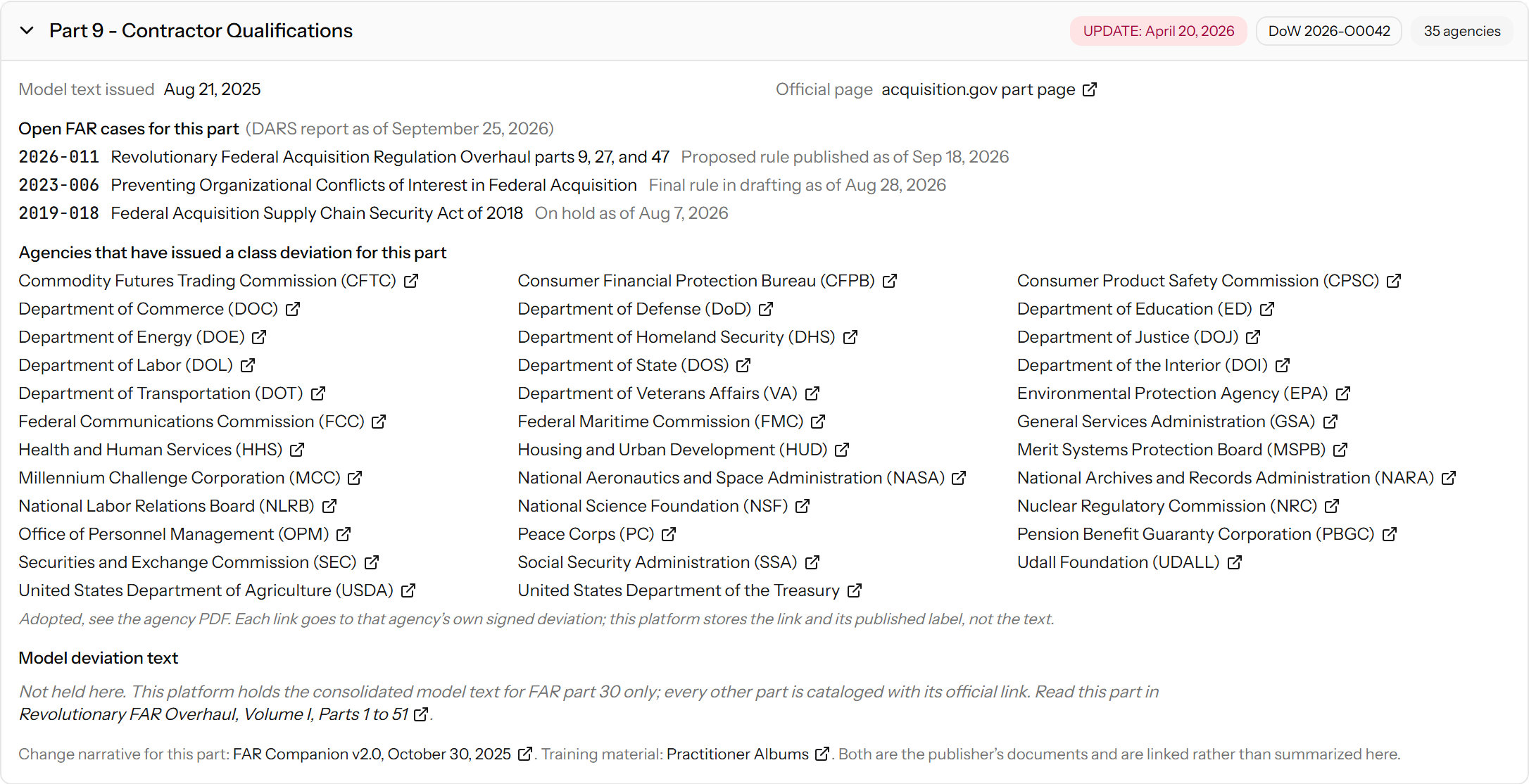
Part 9 is also being rewritten. The Department of War's Class Deviation 2026-O0042 puts the FAR Overhaul's Part 9 in force for its contracts, and 35 agencies have issued one. The rule that would codify it, FAR Case 2026-011, covering Parts 9, 27 and 47, was published as a proposed rule on September 18, 2026. Comments close October 19, 2026. The passages above are the codified FAR as the eCFR prints it; read the overhauled Part 9 your contract incorporates beside them.
06Where GovConDash fits
The regulations this piece quotes and the record it counts are two tabs of the platform you can open today.
Regulations & Policy / FAR Overhaul
Every overhauled FAR part
Each part with the agencies that have adopted it by class deviation and the open FAR cases that would codify it.
Regulations & Policy / FAR Cases
The open FAR cases
The rulemakings in progress, with their Federal Register documents and comment deadlines.
False Claims Act / Browse
Every False Claims Act matter
The Department's releases from 2009 on, one row per matter, with Insights beside them.
Step 1Read the Part 9 that governs your contract
Part 9 holds suspension and debarment. The FAR Overhaul sub-tab opens it with the Department of War deviation that applies it, the open FAR cases for the part, including FAR Case 2026-011, and a link to every agency's own signed deviation.
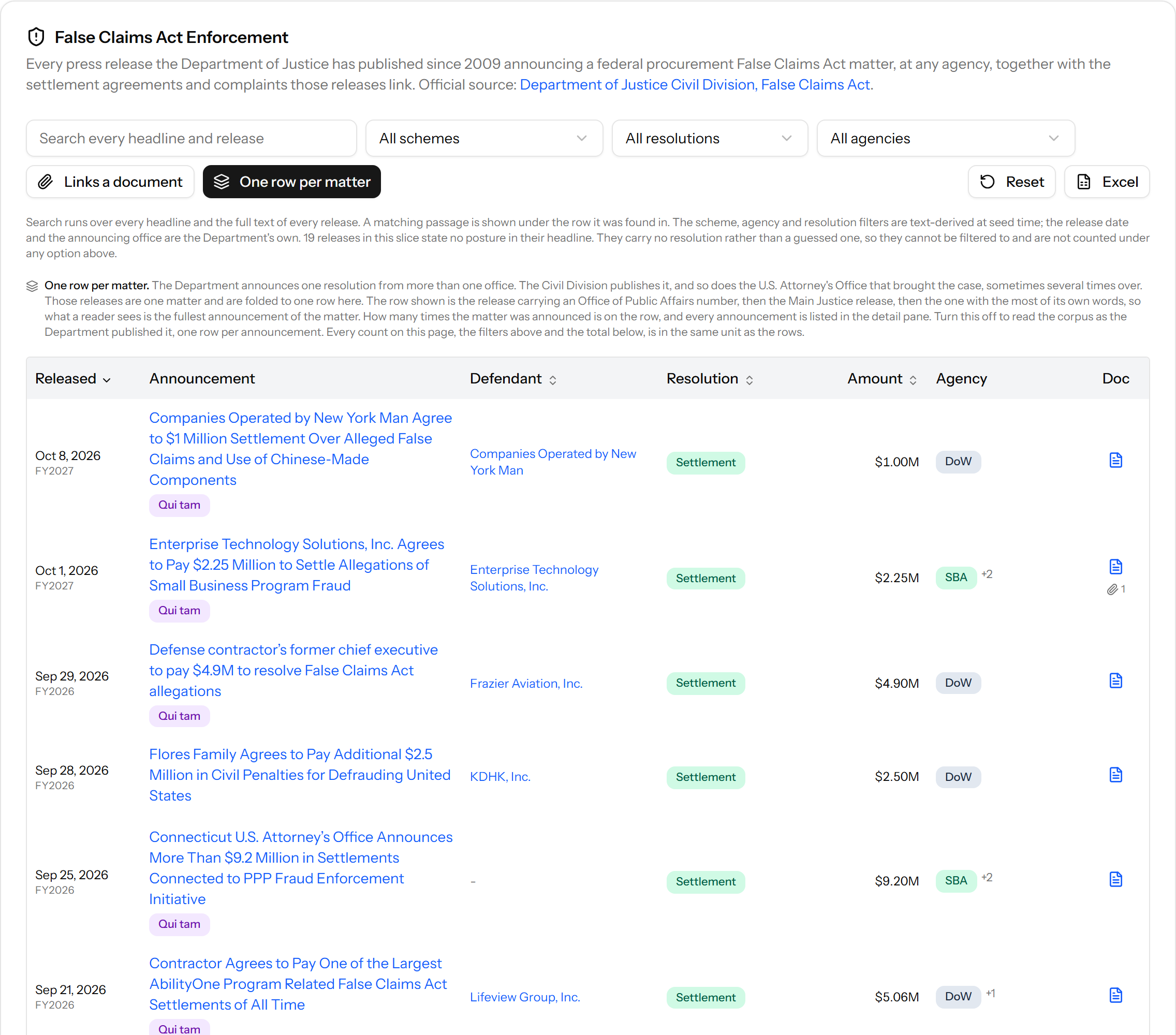
Step 2Find the matters that look like your business
Browse lists the matters newest first, one row per matter, with the scheme, resolution and agency filters, a search over every headline and release, and an Excel export.
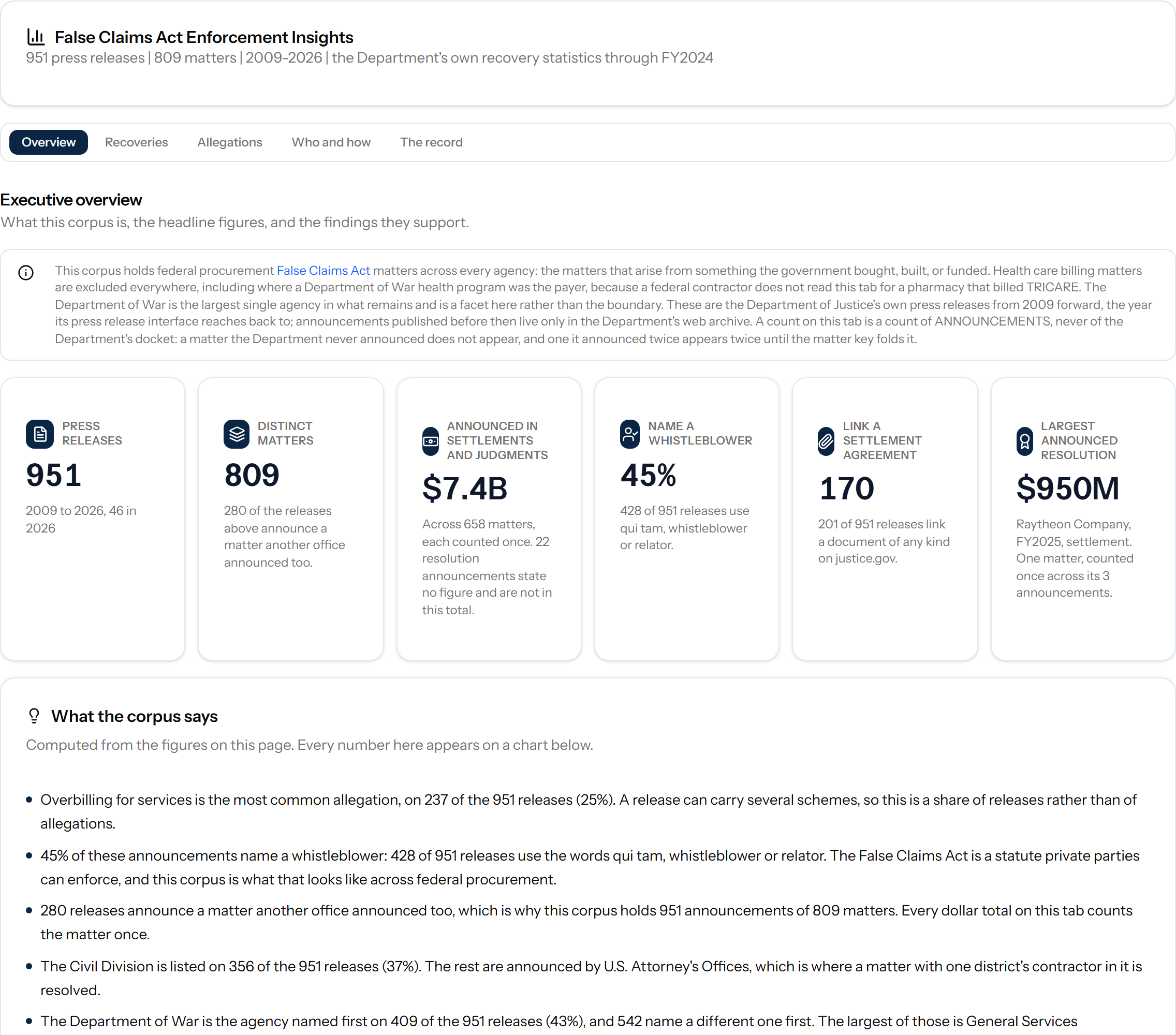
Step 3See the whole record before you read one case
Insights opens on an executive overview of the whole corpus, then breaks it down by recoveries, allegations and who brought each case.
Documents and data used in this piece
The directive
- U.S. Department of Justice, National Fraud Enforcement Division, Directive 26-12: Corporate Enforcement in the Fight Against Fraud, October 1, 2026
The memorandum this piece reads: five pages, signed by Assistant Attorney General Colin M. McDonald.
- U.S. Department of Justice, Justice Manual 9-28.000, Principles of Federal Prosecution of Business Organizations
The Department's rules for prosecuting companies, which the directive tells prosecutors to follow.
- U.S. Department of Justice, Justice Manual 9-28.300, Factors to Be Considered
The factors the directive's own list sits on top of.
- U.S. Department of Justice, Corporate Enforcement and Voluntary Self-Disclosure Policy
The Department-wide policy the directive tells prosecutors to follow, at the address the directive prints.
The False Claims Act
- Department of Justice Civil Division, False Claims Act
The Civil Division's own page on the Act.
- 31 U.S.C. 3729, False claims
The section in the Government Publishing Office's edition of the U.S. Code.
- 31 U.S.C. 3730, Civil actions for false claims
The section in the Government Publishing Office's edition of the U.S. Code.
- Department of Justice press releases API v1
Where the platform reads every release it holds, 2009 forward.
Releases this piece names
- Teledyne Electronic Safety Products Agrees to Pay $1.5M to Resolve False Claims Act Allegations Involving the Sale of Non-Conforming Parts to the Department of Defense, January 5, 2026
The Department's release.
- Insect Shield LLC and Co-Founder’s Estate Agree to Pay $1.4M to Settle False Claims Act Allegations, February 4, 2026
Announced two times; this is the fullest announcement.
- Perfectus Aluminum Inc. and Related Companies Agree to Pay $549.5M to Settle False Claims Act Allegations Relating to Evaded Customs Duties, May 12, 2026
Announced two times; this is the fullest announcement.
- Government Contractor and Executives to Pay $21.3M to Resolve Fraud Scheme Involving Service-Disabled Veteran-Owned Small Business Contracts, June 9, 2026
The Department's release.
- Alabama Defense Contractor Agrees to Pay $507,144 to Resolve False Claims Act Liability Relating to Cybersecurity Violations, June 18, 2026
Announced two times; this is the fullest announcement.
- Redi-Bag USA and CEO Agree to Pay $7.3M to Settle False Claims Act Allegations Relating to Evaded Customs Duties, July 15, 2026
Announced two times; this is the fullest announcement.
- Defense contractor to pay $7.75M to resolve False Claims Act allegations, July 28, 2026
The Department's release.
- United States Reaches $7.5 Million Settlement with Ascend Elements to Resolve False Claims Act Allegations Involving Department of Energy Grant, July 30, 2026
The Department's release.
- Taiwan LED Manufacturer Agrees to $5.15M Settlement of False Claims Act and Administrative Allegations of Evading Customs Duties, August 5, 2026
The Department's release.
- Judd Wire Inc. Agrees to Pay $1.014 Million to Settle False Claims Act Allegations for Failing to Test Wire and Cable Used By the United States, August 10, 2026
The Department's release.
- Tetra Tech EC Inc. Agrees to Pay $57M to Settle False Claims Act Allegations for Falsifying Soil Test Results at the Hunters Point Naval Shipyard in San Francisco, August 24, 2026
Announced two times; this is the fullest announcement.
- Deloitte Agrees to Pay $21.5M to Resolve Alleged Employment Discrimination Violations, August 25, 2026
Announced two times; this is the fullest announcement.
- Honeywell Aerospace Inc. Agrees to Pay Over $2M to Settle False Claims Act Allegations of Failing to Comply with Cybersecurity Requirements in a U.S. Department of Defense Contract, September 1, 2026
Announced two times; this is the fullest announcement.
- Accenture Agrees to Pay $25M to Resolve Alleged Employment Discrimination Violations, September 14, 2026
The Department's release.
- University of Hawaii Agrees to Resolve Allegations of Insufficient Oversight of AmeriCorps Grants, September 15, 2026
The Department's release.
- U.S. to Collect over $1.3 Million after Judgment Ordered in Bribery Case Involving Millions in DOW Contracts in Alaska, September 18, 2026
The Department's release.
- Flores Family Agrees to Pay Additional $2.5 Million in Civil Penalties for Defrauding United States, September 28, 2026
The Department's release.
Regulations as codified
- FAR 52.203-13, Contractor Code of Business Ethics and Conduct
The section as the eCFR prints it today.
- FAR 9.406-2, Causes for debarment
The section as the eCFR prints it today.
- FAR 3.1003, Requirements
The section as the eCFR prints it today.
- FAR 52.203-17, Contractor Employee Whistleblower Rights
The section as the eCFR prints it today.
The FAR Overhaul
- Class Deviation 2026-O0042, DFARS Part 209 and FAR Part 9
The Department of War deviation that puts the overhauled Part 9 in force for its contracts.
- FAR Case 2026-011, proposed rule, 91 FR 59584, September 18, 2026
Comments close October 19, 2026.
- FAR Case 2026-011 docket on Regulations.gov
Where comments are filed.
This piece is commentary on a published Department of Justice directive, the Department's public announcements and the Federal Acquisition Regulation. It is not legal advice. A settlement resolves allegations without a finding of liability, and nothing here says any company named committed a crime or would be charged under the directive.

GovConDash.ai
Check a company's False Claims Act record before you rely on it
The False Claims Act section holds every procurement matter the Department has announced since 2009, one row per matter, with the settlement agreements the releases link. Browse finds a teaming partner, a competitor or a scheme like yours; Insights shows the whole record by recoveries, allegations and who brought each case.
Keep reading
DCAA Replaced Its Cost Chapter With a Fraud ChapterWhat a DCAA auditor is told to do when the fraud this directive prioritizes turns up in an audit: the Contract Audit Manual's fraud chapter, read paragraph by paragraph.