
Defense Pricing, Contracting, and Acquisition Policy
October 14, 2026
Version 1.0
An HTML guidebook
Seven sections
Guide to Prototype Other Transactions (10 U.S.C. § 4022 and § 2808a)
Issued by the memorandum Fostering One Strong Industrial Base Through Other Transactions, signed by John M. Tenaglia, Principal Director, Defense Pricing, Contracting, and Acquisition Policy.
The short version
- 1An OT is now the instrument the Department prefers when the criteria are met. The guide rests that on five sources, from a 2018 NDAA section to the Deputy Secretary's memorandum, and calls itself guidance, not a regulation.
- 2Your word on nontraditional status counts. Agreements officers rely where lawful on self-certification, verify by exception and decide within 10 business days. Significant participation means any unique, material contribution, with no percentage or dollar test.
- 3No government accounting rules by another name. The adequate accounting system requirement does not apply to an OT, the guide tells teams to work from your existing records, and pricing need not be weighed when solutions are assessed.
- 4Approval has moved down the chain. The head of the contracting activity approves a prototype OT over $100 million up to $500 million; above that, the senior procurement executive, with 30 days' notice to Congress.
- 5Production is planned from the start. Follow-on production gets its own section, and the guide mentions it 39.8 times per ten thousand words, against 20.4 in July 2023.
01Why the guide was rewritten
The Deputy Secretary's memorandum, Fostering One Strong Industrial Base, set two clocks for the rewrite, "within 45 days issue interim other transaction (OT) policy, followed by the full Guide reissue within 120 days", and named what the reissue must do. The DPCAP memorandum that issued the guide on October 14, 2026 cites it by name. That was 30 days after the order, inside the 45-day clock for interim policy, and it is a complete guide, Version 1.0, not an interim note.
What the memo ordered, and what the new guide carries
5 of 7 carried in full
The memorandum of September 14, 2026
"as any unique contribution material to the prototype project, without percentage-of-workshare or dollar thresholds as eligibility tests"
The guide of October 14, 2026
"is any unique contribution material to the prototype project, without percentage-of-workshare or dollar thresholds as eligibility tests"
Appendix A, Significant Extent
Five orders are carried nearly word for word. The other two are not. The memorandum ordered a separate consortium policy; the guide carries one sentence promising project-level eligibility, direct-award preference and management fee transparency for consortium awards, and no separate policy. It also ordered pre-approved templates and a signing standard for exceptional-circumstances determinations; the guide says an OT may proceed on such a determination and stops there.
02The Department now prefers an OT
Guide to Prototype Other Transactions, Version 1.0
"It is the Department's policy to prefer use of OTs over other acquisition instruments (including FAR procurement contracts) if the criteria for use of OTs are met"
The guide says the preference rests on statute and policy and lists five sources:
- Section 867 of the National Defense Authorization Act for Fiscal Year 2018, December 12, 2017
- Executive Order 14265, Modernizing Defense Acquisitions and Spurring Innovation in the Defense Industrial Base, April 9, 2025
- Secretary of War memorandum, Transforming the Defense Acquisition System into the Warfighting Acquisition System, November 7, 2025
- Under Secretary of War memorandum, Implementation of Commercial-First and Alternative Proposals Policy, September 8, 2026
- Deputy Secretary of War memorandum, Fostering One Strong Industrial Base, September 14, 2026
The oldest of them is real law. Section 867 of the National Defense Authorization Act for Fiscal Year 2018 directed the Secretary to establish a preference for other transactions in science, technology and prototyping programs, in circumstances the Secretary considers appropriate. The guide is where the Department now states that preference in its own guidance. It is still guidance, not a rule: the guide says "The Guide is an internal DoW document that is not subject to public rulemaking".
The policy record behind the new guide
Oct 2026: New prototype OT guide
Version 1.0 Read it
03Nontraditional status: your statement, checked by exception
One condition that lets an agency use the prototype authority is a nontraditional defense contractor participating to a significant extent. Under 10 U.S.C. 3014, and DFARS 202.101, that is a company that has not performed, in the year before the solicitation, any Department of War contract or subcontract under full CAS coverage.
The July 2023 guide put the burden on the agreements officer: "AOs should validate and document an NDC's status prior to OT award", and it suggested running a federal procurement report on the CAS clause code. That suggestion is gone.
The new guide asks the agreements officer to document the eligibility basis before award, "relying where lawful on offeror self-certification against standard representations and conducting additional verification by exception", and to make any determination within 10 business days. It still expects more diligence on larger or more complex OTs, and it is candid about the limits: it points to a Warfighting Acquisition University guide for a SAM.gov report of a company's fully CAS-covered prime awards, and says no business system can track that coverage on subcontracts.
Significant participation is redefined the same way. The guide's glossary now reads:
Significant Extent, Appendix A
"any unique contribution material to the prototype project, without percentage-of-workshare or dollar thresholds as eligibility tests"
The July 2023 guide asked the agreements officer to weigh the totality of the circumstances with technical advisors; the new one states the rule outright.
Both guides warn against blanket thresholds, and a company keeps the status for the whole period of performance, including modified work under the same agreement.
Self-certification puts the statement in your hands, so check the record before you make it. The quick check below reads the public record for any company, by name or UEI, and screens its Department of War awards and reported subcontracts against the CAS lines.
NDC Quick Check
What the public record says about a company's CAS coverage
Your own company, or a teaming partner or subcontractor you plan to rely on
The check reads the SAM.gov registration and the SBA directory profile this platform holds, and, live on USAspending.gov, Department of War prime awards and the first-tier subcontracts primes have reported under them. Search by company name, as USAspending.gov records it, or enter the UEI.
A screening tool, not a determination. It reports what public records signal about CAS coverage. It does not decide whether any company is a nontraditional defense contractor, it is not legal or accounting advice, and it cannot see unreported or lower-tier subcontracts, business units or the CAS clause. Nontraditional status is the company's own statement, made to a contracting officer who may test it against the company's books.
04Accounting, audit and price
The guide now says plainly that "the requirement for an adequate accounting system does not apply to an OT agreement but may apply to a follow-on production contract or other future FAR-based contracts". Where payment is based on your cost records, it still expects an accounting system capable of complying with generally accepted accounting principles, with controls over project funds, which the July 2023 guide also asked for.
But the guide now tells the Government team to "rely on the performer's existing records and controls without importing government-unique accounting or business-system requirements from other awards". The July 2023 guide told teams to consider holding a performer with other cost-type awards to those awards' accounting standards; the new one allows that only where it would benefit the performer. A note adds that section 1826 of the FY2026 NDAA exempted nontraditional defense contractors from business system requirements such as the accounting system clause at DFARS 252.242-7006, and the statute reaches agreements as well as contracts.
DCAA's role is smaller on paper. The July 2023 guide said DCAA could provide financial advisory services to the agreements officer; that sentence is gone, and what remains is that DCAA and DCMA can report on a prospective awardee's accounting system. Audit is unchanged: fixed-amount agreements generally should carry no audit provisions, and everything else is negotiated.
Price moves further back. The guide says "There is no requirement to consider pricing information as part of the assessment process for a Prototype OT". When the team does test value, it is not limited to the proposal analysis techniques of FAR 15.404-1, and the guide suggests valuing a prototype as the cost of not developing it. The agreements officer must still exhaust other means before asking you for cost information, as before, but the July 2023 guide's line that price reasonableness is a key consideration before award is gone, and so is a fair and reasonable price from the list of documents the agreement file should hold. Across the guide, words about price fall from 14.6 to 9 mentions per ten thousand.
Payments now carry a stated preference: "The preference is for fixed-amount and milestone-based payment structures", citing the Deputy Secretary's memorandum.
05Who approves, and at what value
Section 816 of the FY2025 NDAA rewrote the approval ladder in 10 U.S.C. 4022(a) after the July 2023 guide was written, and the new guide follows it. Below $100 million, each Component sets its own approvals. Over $100 million up to $500 million, the head of the contracting activity approves, or the director of DARPA, the Missile Defense Agency or the Defense Innovation Unit. Above $500 million, the senior procurement executive or one of those directors approves, and Congress is notified 30 days before. Neither authority can be delegated.
Who approves a prototype OT
Follow-on production, over $100 million
A covered officialChanged
written determination; notice to Congress
July 2023 guide: Left to Appendix E policy
Prototype OT, over $500 million
SPE, or Director of DARPA, MDA or DIUChanged
not delegable; 30-day notice to Congress
July 2023 guide: Not stated
Prototype OT, over $100 million to $500 million
HCA, or Director of DARPA, MDA or DIUChanged
written determination; not delegable
July 2023 guide: SPE, or Director of DARPA or MDA
Prototype OT, below $100 million
Each Component sets its ownChanged
no statutory approval
July 2023 guide: SPE, who may delegate to the HCA and AO
Two details matter to a bidder. Value includes all options, and it is measured per transaction, not across every agreement in a prototype project. A follow-on production award above $100 million still needs a written determination by a covered official, such as a service acquisition executive, and notice to Congress.
06Modifications and follow-on production
The guide removes the brake on growing an agreement. Because the Competition in Contracting Act does not apply, "the value of the Prototype OT at the time of initial award is not a factor in whether it may be subsequently modified", and the FAR idea of scope does not apply either. The July 2023 guide warned that projects should not go on indefinitely; that warning is gone. The guide also encourages multiple awards instead of one, and holding white papers for award up to 180 days after they arrive.
Follow-on production moves from a subsection to its own section, and the team "should include follow-on production planning in every prototype OT". The guide still recommends telling bidders in the request for solutions that production may follow, and notes that another organization can make the production award.
07Small business, priority ratings and cyber
Small businesses get a warning: "Prototype OT agreements awarded to small businesses will not count towards socio-economic goals". If your award rests on all participants being small, make sure the NAICS code is written into the request and the agreement, because the contract action report used to record an OT has no field for it.
Two obligations flow down. A priority rating under the Defense Priorities and Allocations System can now be placed on an OT, and the guide says "The application of a DPAS rating to an OT is authorized and does not convert the OT into a FAR-based procurement contract". The rating must flow to your sub-tier suppliers. And program offices should generally require the DFARS cybersecurity requirements, such as DFARS 252.204-7012, that apply to Department contracts.
08What the guide does not say yet
Construction OTs are in the title and get a short introduction in the opening section, but Appendix D, where their guidance belongs, reads in full, "Place holder for Construction OTs (10 U.S.C. § 2808a) guidance". The authority itself is 10 U.S.C. 2808a, enacted by the FY2026 NDAA. It lets the Secretary of a military department use construction, operations and maintenance, or research funds for facility repair and construction projects, requires notice to Congress 14 days before each transaction, and allows a follow-on award without further competition only once the participants have delivered "a complete and useable facility" or improvement.
The new guide also covers less ground. It is a prototype guide; research OTs now have their own guide, and it does not say it supersedes the July 2023 guide, which was still posted when this piece was written. These are gone:
In the July 2023 guide, not in the new one
- The case studies (DARPA's satellite servicing, the Air Operations Center, Global Hawk)
- The research, prototype and production comparison table
- The conditions for a research OT under 10 U.S.C. 4021
- DCAA's financial advisory services to the agreements officer
- A price fair and reasonable as part of the agreement file
- Price reasonableness as a key consideration before award
- The FPDS search on the CAS clause code to validate NDC status
- The warning that projects should not go on indefinitely
09Where GovConDash fits
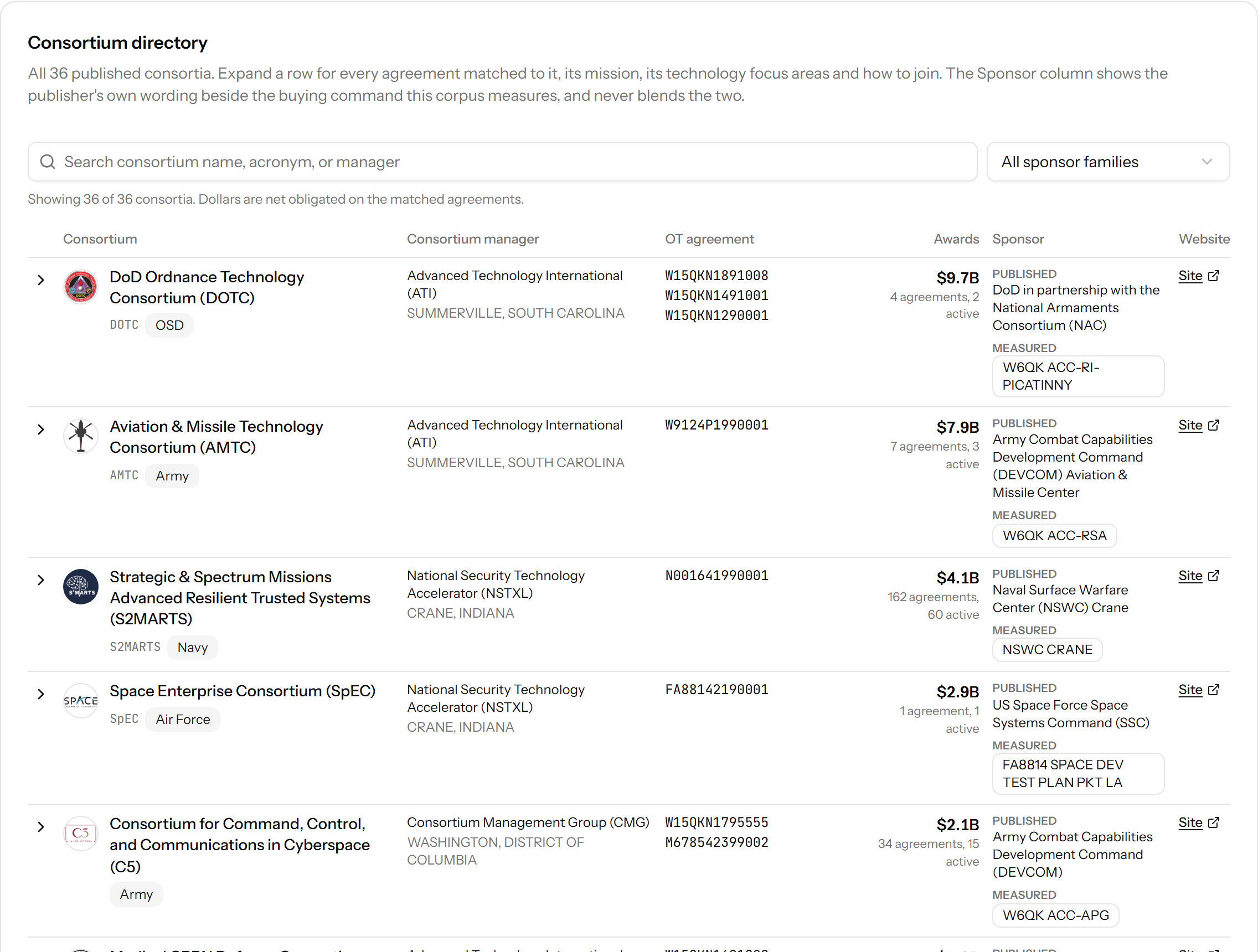
Appendix F of the guide is about consortia. It says section 4022 neither defines nor limits how they are used, sets out the questions an agreements officer should weigh before relying on one, and now promises project-level eligibility, direct-award preference and management fee transparency for consortium awards. If your route to a prototype OT runs through a consortium, start by knowing which ones exist, who manages them and whom they serve.
Other Transactions / Consortia
Find the consortium before the request for solutions
Other Transaction Consortia in GovConDash lists 36 published consortia with their managers, their OT agreements, the obligations matched to each, their sponsors and how to join. No paid plan needed.
Documents and data used in this piece
The guides and the memorandum that issued them
- Guide to Prototype Other Transactions (10 U.S.C. § 4022 and § 2808a), Version 1.0
The guide this piece reads, an HTML guidebook on the Defense Pricing, Contracting, and Acquisition Policy site, as captured on October 15, 2026. DPCAP says it will maintain it as a living page.
- Other Transactions Guide, July 2023, Version 2.0 (508 update)
The guide it follows: 53 pages.
- DPCAP memorandum, Fostering One Strong Industrial Base Through Other Transactions, October 14, 2026
The memorandum the new guide is issued under, signed by the Principal Director of Defense Pricing, Contracting, and Acquisition Policy.
The policy behind the rewrite
- Deputy Secretary of War, Fostering One Strong Industrial Base, September 14, 2026
The memorandum that ordered the guide's reissue and listed what it must say.
- Secretary of War, Transforming the Defense Acquisition System into the Warfighting Acquisition System, November 7, 2025
One of the five sources the guide lists for its preference for OTs.
- USW(A&S), Authority for Use of Other Transactions for Prototype Projects under 10 U.S.C. 4022, August 27, 2025
The delegation memorandum the guide sends readers to for how an OT's value is measured.
- Warfighting Acquisition University, NDC Status Validation Guide
The guide the new OT guide points to for a SAM.gov report of a company's fully CAS-covered prime awards.
- Executive Order 14265, Modernizing Defense Acquisitions and Spurring Innovation in the Defense Industrial Base, April 9, 2025
One of the five sources the guide lists for its preference for OTs, on the Federal Register.
Statutes
- 10 U.S.C. 4022
The section in the Office of the Law Revision Counsel's U.S. Code, release point 119-120, the same edition the guide links.
- 10 U.S.C. 3014
The section in the Office of the Law Revision Counsel's U.S. Code, release point 119-120, the same edition the guide links.
- 10 U.S.C. 2808a
The section in the Office of the Law Revision Counsel's U.S. Code, release point 119-120, the same edition the guide links.
- Public Law 115-91, National Defense Authorization Act for Fiscal Year 2018, section 867
Enacted December 12, 2017. Section 867: Preference for use of other transactions and experimental authority.
- Public Law 118-159, Servicemember Quality of Life Improvement and National Defense Authorization Act for Fiscal Year 2025, section 816
Enacted December 23, 2024. Section 816: Modifications to authority to carry out certain prototype projects using other transaction authority.
- Public Law 119-60, National Defense Authorization Act for Fiscal Year 2026, section 1826
Enacted December 18, 2025. Section 1826: Exemptions for nontraditional defense contractors.
Regulations as codified
- DFARS 202.101, Definitions
The section as the eCFR prints it today.
- FAR 15.404-1, Proposal analysis techniques
The section as the eCFR prints it today.
- DFARS 252.204-7012, Safeguarding Covered Defense Information and Cyber Incident Reporting
The section as the eCFR prints it today.
- DFARS 252.242-7006, Accounting System Administration
The section as the eCFR prints it today.
- 48 CFR 9903.201-1, CAS applicability
The section as the eCFR prints it today.
- 48 CFR 9903.201-2, Types of CAS coverage
The section as the eCFR prints it today.
Data the quick check reads
- USAspending.gov
Department of War prime contract awards and the first-tier subcontracts primes reported under them, read live for the UEI you enter.
- SAM.gov
The registration, from the public entity extract this platform holds.
- SBA, Small Business Search
The small business directory profile and its certifications.
This piece is commentary on published Department guidance, memorandums and statutes. It is not legal advice. The guide itself tells agreements officers to consult counsel on statutory, regulatory and policy requirements, and so should you. Where this piece says what a change means for you, that is its own reading, not the Department's.

Keep reading
Are You a Nontraditional Defense Contractor? DCAA Will Now Check.What a nontraditional defense contractor is, the exemptions section 1826 of the FY2026 NDAA grants, how to tell whether you qualify, and what DCAA will check.