OtherTransactions
Other Transaction Authority, the agreements it produces, the law that applies and the law that does not, and the consortia that award most of the work. Then see every OT agreement in the federal record, matched to your company and its teaming partners, in GovConDash.
OT agreements
SAM.GOV OTHER TRANSACTION MODULE
Net obligated
FISCAL 2001 TO 2027
Published consortia
31 MATCHED TO AWARDS
Authorized agencies
CONGRESSIONAL OT AUTHORITY
What is an Other Transaction?
Other Transactions are procurement instruments other than contracts, grants, or cooperative agreements. They enable flexible business arrangements generally used to acquire research and development, support technology advancement, or develop a prototype. Federal agencies have varying statutory authorizations for OT uses, limitations, and restrictions.
OTs are a mechanism to access innovative solutions, especially from non-traditional contractors who may be challenged by the requirements of traditional contracts, grants, or cooperative research and development agreements. They can be used with traditional contractors when the applicable statutory requirements are met.
OTs allow terms and conditions to be negotiated beyond what is permitted under the statutes and regulations that apply to FAR-based contracts. An OT agreement may be fixed-price, expenditure-based, or hybrid.
Nontraditional defense contractor
32 CFR 3.4 defines a non-traditional defense contractor as a business unit that has not, for a period of at least one year prior to the date of the OT agreement, entered into or performed on (1) any contract that is subject to full coverage under the cost accounting standards prescribed pursuant to section 26 of the Office of Federal Procurement Policy Act (41 U.S.C. 422) and the regulations implementing that section; or (2) any other contract in excess of $500,000 to carry out prototype projects or to perform basic, applied, or advanced research projects for a Federal agency, that is subject to the Federal Acquisition Regulation.
Check a company's NDC statusDoes not apply to an OT
Still applies
Protest posture
- OTs are not subject to the procurement protest process at FAR Part 33.
- An OT may be protested to the U.S. Court of Federal Claims.
- GAO has limited jurisdiction to review OT decisions.
Agencies authorized to use Other Transactions
| Agency | Authority | Scope and limitations | Guidance |
|---|---|---|---|
| Dept of Commerce (DOC) | 15 U.S.C. 4659 | No limitations or restrictions. | None listed |
| National Oceanic and Atmospheric Administration (NOAA) | 15 U.S.C. 8531(d) | Research and development activities to enhance the effectiveness of data, satellite, and other observing systems to meet NOAA missions. |
|
| Dept of War | 10 U.S.C. 4021 | Research projects to carry out basic, applied, and advanced research projects. | |
| Dept of War | 10 U.S.C. 4022 | Prototype projects to enhance the mission effectiveness of DoD personnel, platforms, systems, components, or materials. | |
| Dept of Energy (DOE) | 42 U.S.C. 7256 | Authorizes use of 10 U.S.C. 4021 for research, development, and demonstration projects. |
|
| Advanced Research Projects Agency - Energy (ARPA-E) | 42 U.S.C. 16538(f) | Advanced technology projects in support of ARPA-E objectives. | None listed |
| Dept of Health and Human Services (HHS) | 42 U.S.C. 247d-7e | Promote countermeasure and product advanced research and development, including establishing and maintaining domestic manufacturing surge capacity and capabilities. | None listed |
| Centers for Disease Control (CDC) | 42 U.S.C. 242c(e) | Infectious disease research, biosurveillance, infectious disease modeling, and public health preparedness and response. | None listed |
| National Institutes of Health (NIH) | 42 U.S.C. 282(n) | Projects to carry out the Precision Medicine Initiative, the Common Fund, and high impact cutting-edge research that increases fundamental biological understanding leading to the prevention, diagnosis, or treatment of diseases and disorders, or research urgently required to respond to a public health threat. |
|
| National Institutes of Health (NIH) | 42 U.S.C. 285(b)(3) | Conduct the National Heart, Lung, and Blood Institute Director's functions. |
|
| National Institutes of Health (NIH) | 42 U.S.C. 284n | Demonstration projects for high-impact, cutting-edge research that increases fundamental biological understanding leading to the prevention, diagnosis, and treatment of diseases and disorders. | None listed |
| National Institutes of Health (NIH) | 42 U.S.C. 287a(e)(3)(C) | Projects to carry out Cures Acceleration. | None listed |
| Advanced Research Projects Agency for Health (ARPA-H) | 42 U.S.C. 290c(g) | Authorizes use of 42 U.S.C. 247d-7e for advanced research and development. | None listed |
| Dept of Homeland Security (DHS) | 6 U.S.C. 391 | Prototype projects leveraging 10 U.S.C. 4022. | None listed |
| Domestic Nuclear Detection Office (DNDO) | 6 U.S.C. 596 | No limitations or restrictions. | None listed |
| Transportation Security Administration (TSA) | 49 U.S.C. 114(m) | Authorizes the authority provided under 49 U.S.C. 106(l). | None listed |
| U.S. Coast Guard (USCG) | 14 U.S.C. 1158(a) | Authorized for use to operate, test, and acquire cost-effective technology for meeting USCG mission needs. | None listed |
| Dept of Transportation (DOT) | 49 U.S.C. 5312 | Research, development, and demonstration to advance innovation of public transportation. | None listed |
| Federal Aviation Administration (FAA) | 49 U.S.C. 106(l) | No limitations or restrictions. |
|
| National Aeronautics and Space Administration (NASA) | 51 U.S.C. 20113(e) | No limitations or restrictions. |
|
| National Science Foundation (NSF) | 42 U.S.C. 19116 | Carry out activities of the Technology, Innovation, and Partnerships Directorate. |
|
| Office of the Director of National Intelligence (ODNI) | 50 U.S.C. 3024(n)(5) | Authorizes use of 10 U.S.C. 4021 and 10 U.S.C. 4022 for basic, applied, and advanced research projects and prototype projects. | None listed |
| Office of the National Cyber Director (ONCD) | 6 U.S.C. 1500(e)(1)(F) | Conduct the work of the ONCD. | None listed |
Who approves a Department of War OT
The approving official rises with the value of each transaction, options included, and differs between the prototype award and the production award that can follow it.
Approval authorities for Prototype Project OT awards
| Organization | Up to $100M | $100M to $500M | Over $500M |
|---|---|---|---|
| Combatant Commands with contracting authority | Head of Contracting Activity (HCA) | Senior Procurement Executive (SPE) | USD(R&E) or USD(A&S) |
| Defense Agencies and Field Activities with contracting authority | HCA | SPE | USD(R&E) or USD(A&S) |
| Military Departments | HCA | HCA | SPE |
| DARPA, DIU, and MDA | HCA | Director | Director |
- The value shall include all options.
- Value is measured per TRANSACTION, not by the total of every transaction in a prototype project. A prototype project may consist of several transactions to the same or different parties, and each is considered separately against these thresholds.
- Transaction value includes all options priced in the agreement as awarded, plus any cost sharing borne by the performer where the basis for the OT is 4022(d)(1)(C).
- A separate approval is required for each phase, prototype and follow-on production, and separately within a phase for each transaction.
- The authority of the head of the contracting activity, the directors of DARPA, DIU, or MDA, or the SPE may not be delegated, under section 4022(a)(3).
Approval authorities for follow-on Production contracts and OT agreements
| Organization | Up to $100M | $100M to $500M | Over $500M |
|---|---|---|---|
| Combatant Commands with contracting authority | Commanding Officer | USD(R&E) or USD(A&S) | USD(R&E) or USD(A&S) |
| Defense Agencies and Field Activities with contracting authority | Director | USD(R&E) or USD(A&S) | USD(R&E) or USD(A&S) |
| Military Departments | Service Acquisition Executive (SAE) | SAE | SAE |
| DARPA, DIU, and MDA | Director | Director | Director |
- As a matter of policy, approving a follow-on production OT agreement or contract valued over $100 million requires prior coordination with the appropriate Under Secretary.
How OT consortia work
Consortium Sponsor (the government sponsor and its contracting office)
- Awards an OT agreement to a Consortium Manager for a specific technology domain. This is the base OT agreement.
- Establishes the consortium's objectives and the overarching guidelines for executing it.
- Selects the projects awarded to the consortium, based on compatibility with those objectives and the fit of the project for an OT award.
- Approves the evaluation selection criteria and the project OT award selections.
Consortium Manager (specifics vary among consortia)
- Establishes the application process and membership terms, and collects membership fees or dues.
- Executes a consortium member agreement with each member organization.
- Collects a percentage fee on each project OT awarded under the base OT agreement.
- Works with the government sponsor to develop problem statements, requests for white papers, requests for prototype proposals, phased selection processes, and evaluation criteria.
- Communicates those requests to members, usually through an internal portal, so the details are often available only to members.
- Manages proposal evaluation, award selection, negotiation, and cost analysis, with the government sponsor giving final approval.
- Manages post-award administration on behalf of the government customer, such as monitoring deliverables, tracking invoices and payments, and reporting.
The Consortium and its members
- Membership is open to qualifying US entities, which varies by consortium: traditional and non-traditional contractors, non-profit organizations, and academic institutions. Some consortia are open to foreign entities.
- A qualifying entity may join one consortium or several.
- Members are subject to terms of membership, which may include an annual fee and a fixed-percentage fee on each project OT awarded.
- Members typically get access to requests for white papers and requests for prototype proposals from government customers specific to that consortium.
- Members may partner with one another to propose solutions, and may negotiate unique terms for individual projects.
- A traditional contractor must be prepared to meet the cost-sharing requirements of the underlying OT authority.
Why contractors join
- A pool of vendors aligned to the consortium's focus area promotes collaboration with the government and among members.
- Consortia execute OT agreements, which allow a more collaborative process than FAR source selection.
- Established, streamlined processes move through white papers, demonstrations, proposals, evaluations, and selections, and often award faster than traditional programs.
What to weigh first
- Non-traditional vendors, non-profits, and academic organizations may be challenged by the financial side of membership, given fees and the percentage charged on awards.
- Some consortia are in high demand and are resource constrained, whether by workload or by the availability of the assigned government contracting office.
- Many consortia do not award follow-on production activities.
Why consortium members rarely appear as the awardee
This model is why a contractor can hold real OT work and never appear as an awardee. The government awards the base OT to the consortium or its management firm, and a project award to a member is reported with the CONSORTIUM in the awardee field and the performing member in the Primary Consortia Member field.
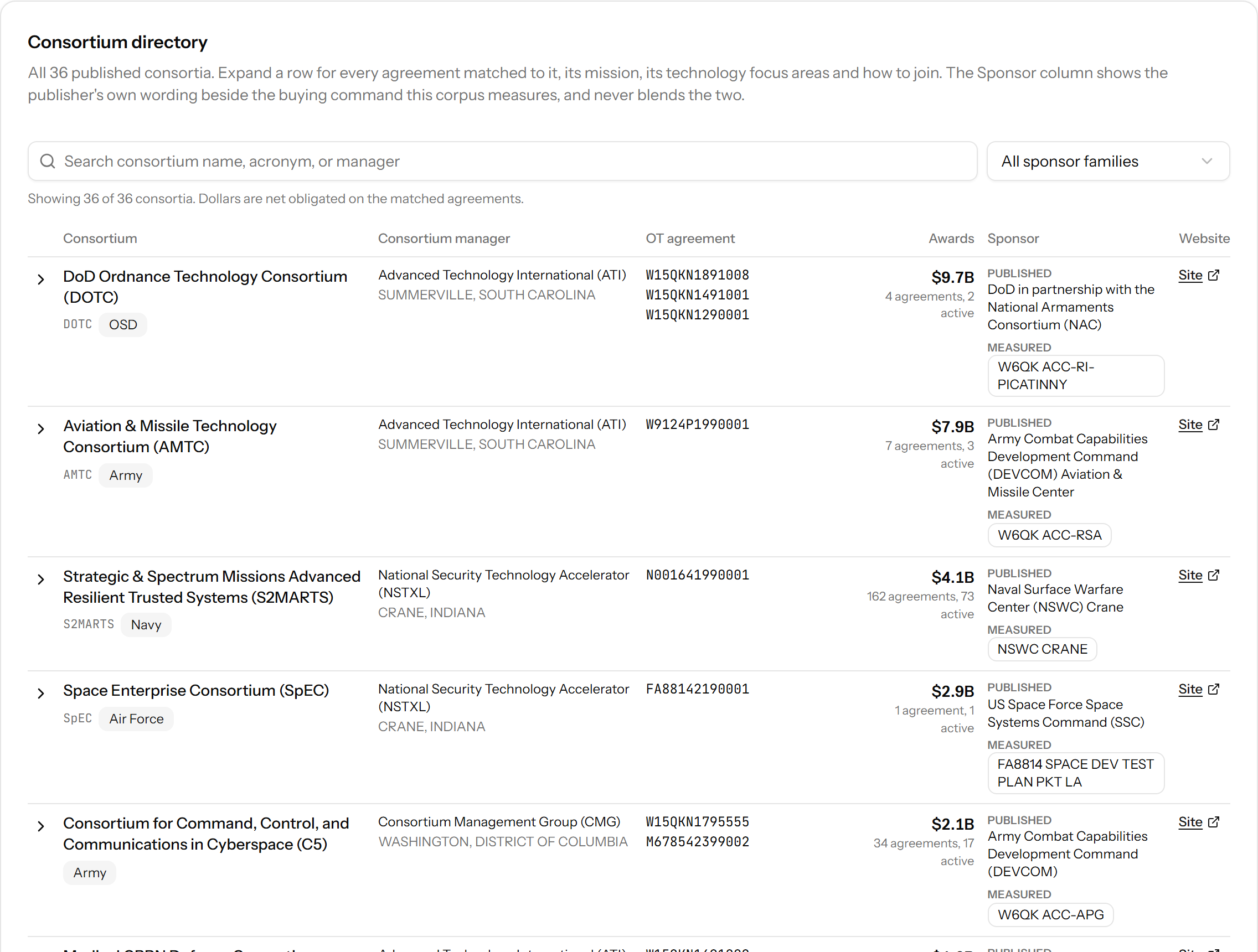
All 36 published OT consortia
Showing 36 of 36 consortia. Awards are net dollars obligated on the agreements matched to each consortium in the SAM.gov Other Transaction module.
| Consortium | Consortium manager | Government sponsor | Awards | Links | |
|---|---|---|---|---|---|
DoD Ordnance Technology Consortium (DOTC) DOTCOSD | Advanced Technology International (ATI) Summerville, South Carolina | DoD in partnership with the National Armaments Consortium (NAC) | $9.7B 4 agreements, 2 active | ||
Aviation & Missile Technology Consortium (AMTC) AMTCArmy | Advanced Technology International (ATI) Summerville, South Carolina | Army Combat Capabilities Development Command (DEVCOM) Aviation & Missile Center | $7.9B 7 agreements, 3 active | ||
Strategic & Spectrum Missions Advanced Resilient Trusted Systems (S2MARTS) S2MARTSNavy | National Security Technology Accelerator (NSTXL) Crane, Indiana | Naval Surface Warfare Center (NSWC) Crane | $4.1B 162 agreements, 60 active | ||
Space Enterprise Consortium (SpEC) SpECAir Force | National Security Technology Accelerator (NSTXL) Crane, Indiana | US Space Force Space Systems Command (SSC) | $2.9B 1 agreement, 1 active | ||
Consortium for Command, Control, and Communications in Cyberspace (C5) Army | Consortium Management Group (CMG) Washington, District Of Columbia | Army Combat Capabilities Development Command (DEVCOM) | $2.1B 34 agreements, 14 active | ||
Medical CBRN Defense Consortium (MCDC) MCDCOSD | Advanced Technology International (ATI) Summerville, South Carolina | DoD Joint Program Executive Office for Chemical, Biological, Radiological, and Nuclear Defense (JPEO-CBRND) | $1.6B 1 agreement, 1 active | ||
Medical Technologies Enterprise Consortium (MTEC) MTECArmy | Medical Technology Enterprise Consortium (MTEC) Summerville, South Carolina | U.S. Army Medical Research and Development Command (USAMRDC) | $1.5B 194 agreements, 81 active | ||
Countering Weapons of Mass Destruction (CWMD) Consortium CWMDOSD | Advanced Technology International (ATI) Summerville, South Carolina | DoD Joint Program Executive Office for Chemical, Biological, Radiological, and Nuclear Defense (JPEO-CBRND) | $1.3B 1 agreement, 1 active | ||
Undersea Technology Innovation Consortium (UTIC) UTICNavy | Advanced Technology International (ATI) Summerville, South Carolina | Naval Undersea Warfare Center (NUWC) | $1.0B 105 agreements, 31 active | ||
Cornerstone Consortium OSD | US Army Combat Capabilities Development Command - Chemical Biological Center Government managed | OSD Office of the Deputy Assistant Secretary of Defense for Industrial Policy via Manufacturing Resiliency and Assurance Office, and Industrial Base Analysis and Sustainment (IBAS) Program | $900M 81 agreements, 46 active | ||
Information Warfare Research Project (IWRP) IWRPNavy | Advanced Technology International (ATI) Summerville, South Carolina | Naval Information Warfare Systems Command (NAVWAR) | $778M 199 agreements, 14 active | ||
Defense Automotive Technologies Consortium (DATC) DATCArmy | Defense Automotive Technologies Consortium (DATC) Troy, Michigan | Army Combat Capabilities Development Command (DEVCOM) Ground Vehicles Systems Center | $582M 1 agreement, 1 active | ||
AFLCMC Consortium Initiative (ACI) - a SOSSEC Other Transaction Agreement ACIAir Force | SOSSEC, Inc. Salem, New Hampshire | Air Force Lifecycle Management Center (AFLCMC) | $574M 9 agreements, 2 active | ||
Defense Industrial Base Consortium (DIBC) DIBCOSD | Advanced Technology International (ATI) Summerville, South Carolina | OSD Manufacturing, Capability Expansion, and Investment Prioritization Directorate (MCEIP) | $436M 53 agreements, 19 active | ||
Sensors, Communications, and Electronics Consortium (SCEC) SCECArmy | SOSSEC, Inc. Salem, New Hampshire | Army Combat Capabilities Development Command (DEVCOM) C5ISR Center | $331M 34 agreements, 2 active | ||
Marine Sustainment Technology and Innovation Consortium (MSTIC) MSTICNavy | Advanced Technology International (ATI) Summerville, South Carolina | Naval Surface Warfare Center, Philadelphia Division (NSWCPD) | $250M 84 agreements, 19 active | ||
Supply Chain Consortium Initiative (SSCI) - a SOSSEC Other Transaction Agreement SSCIAir Force | SOSSEC, Inc. Salem, New Hampshire | 448th Supply Chain Management Wing (SCMW) | $217M 1 agreement, 0 active | ||
National Advanced Mobility Consortium (NAMC) NAMCArmy | National Advanced Mobility Consortium (NAMC) Ann Arbor, Michigan | Army Combat Capabilities Development Command (DEVCOM) Ground Vehicle Systems Center (GVSC) | $154M 35 agreements, 20 active | ||
AFRL OTAFI - a SOSSEC Other Transaction Agreement Air Force | SOSSEC, Inc. Salem, New Hampshire | Air Force Research Laboratory (AFRL) | $95M 19 agreements, 5 active | ||
AFLCMC Propulsion Consortium Initiative (PCI 2.0) - a SOSSEC Other Transaction Agreement PCI2.0Air Force | SOSSEC, Inc. Salem, New Hampshire | Air Force Lifecycle Management Center (AFLCMC) Propulsion Acquisition Directorate | $94M 25 agreements, 6 active | ||
University Consortium for Applied Hypersonics (UCAH) UCAHOSD | Texas A&M Engineering Experiment Station (TEES) College Station, Texas | Under Secretary of Defense for Research and Engineering (R&E) and Joint Hypersonics Transition Office | $94M 29 agreements, 2 active | ||
Training and Readiness Accelerator II (TReX) Consortium TReXArmy | Advanced Technology International (ATI) Summerville, South Carolina | Army Program Executive Office for Simulation, Training, and Instrumentation (PEO STRI) | $93M 41 agreements, 6 active | ||
AFLCMC Propulsion Directorate Consortium Initiative (PCI) - a SOSSEC Other Transaction Agreement PCIAir Force | SOSSEC, Inc. Salem, New Hampshire | Air Force Lifecycle Management Center (AFLCMC) Propulsion Acquisition Directorate | $84M 1 agreement, 0 active | ||
Expeditionary Missions Consortium-Crane (EMC2) EMC2Navy | Advanced Technology International (ATI) Summerville, South Carolina | Naval Surface Warfare Center, Crane Division (NSWC Crane) | $79M 15 agreements, 9 active | ||
Naval Aviation Systems Consortium (NASC) NASCNavy | Consortium Management Group (CMG) Washington, District Of Columbia | Naval Air Systems Command (NAVAIR) | $58M 14 agreements, 1 active | ||
Consortium for Energy, Environment, and Demilitarization (CEED) CEEDArmy | Consortium Management Group (CMG) Washington, District Of Columbia | Army Combat Capabilities Development Command (DEVCOM) | $42M 10 agreements, 5 active | ||
Engineer, Research, and Development Center (ERDC) - a SOSSEC Other Transaction Agreement ERDCArmy | SOSSEC, Inc. Salem, New Hampshire | U.S. Army Engineer Research and Development Center (ERDC) | $37M 9 agreements, 0 active | ||
Cyberspace Operations Broad Responsive Agreement (COBRA) - a SOSSEC Other Transaction Agreement COBRAArmy | SOSSEC, Inc. Salem, New Hampshire | Program Executive Office Enterprise Information Systems (PEO EIS) | $27M 1 agreement, 1 active | ||
Vertical Lift Consortium (VLC) VLCOSD | Advanced Technology International (ATI) Summerville, South Carolina | Under Secretary of Defense for Research and Engineering (R&E) | $18M 1 agreement, 0 active | ||
National Spectrum Consortium (NSC) NSCOSD | Member-led Consortium | Office of the Under Secretary of Defense for Research & Engineering (R&E) | $5.8M 2 agreements, 1 active | ||
Naval Surface Technology and Innovation Consortium (NSTIC) NSTICNavy | Advanced Technology International (ATI) Summerville, South Carolina | Naval Surface Warfare Center (NSWC) Dahlgren | $1.4M 3 agreements, 2 active | ||
Defense Electronics Consortium (DEC) DECOSD | Advanced Technology International (ATI) Summerville, South Carolina | Department of Defense, facilitated by the Cornerstone Consortium | No matched agreements | ||
Strategic & Spectrum Missions Advanced Resilient Trusted Systems (S2MARTS) Research S2MARTSNavy | National Security Technology Accelerator (NSTXL) Crane, Indiana | Naval Surface Warfare Center (NSWC) Crane | No matched agreements | ||
Homeland Security Technology (HSTech) Consortium HSTechNon-DoD | Advanced Technology International (ATI) Summerville, South Carolina | Department of Homeland Security (DHS) Customs and Border Patrol (CBP) | No matched agreements | ||
National Geospatial-Intelligence Agency (NGA) - a SOSSEC Other Transaction Agreement NGANon-DoD | SOSSEC, Inc. Salem, New Hampshire | NGA Office of Ventures and Innovation (OVI) | No matched agreements | ||
Rapid Response Partnership Vehicle (RRPV) Consortium RRPVNon-DoD | Advanced Technology International (ATI) Summerville, South Carolina | Biomedical Advanced Research and Development Authority (BARDA) | No matched agreements |
Directory adapted from MITRE AiDA, Existing Other Transaction Consortia, captured 2026-08-19. Award figures are measured from the SAM.gov Other Transaction module.
Protesting an Other Transaction
Protesting an OT at the Court of Federal Claims
Whether an OT competition is "in connection with a procurement" under 28 U.S.C. 1491(b)(1). The court has moved from declining jurisdiction over a stand-alone OT competition to treating itself as the forum for OT protests, while limiting what it will review inside one.
Space Exploration Technologies Corp. v. United States
Department of the Air Force · 10 U.S.C. 2371 and 2371b
The Launch Service Agreements were OTs, not procurement contracts, and the LSA competition was separate and distinct from the later FAR-based launch services procurement, so the award decisions were not "in connection with" a procurement. Later OT protest decisions distinguish it.
Dismissed for lack of jurisdiction; transferred to the Central District of California
Kinemetrics, Inc. v. United States
Department of the Air Force · 10 U.S.C. 2371b (Commercial Solutions Opening)
Distinguishing SpaceX, the court took jurisdiction over a Commercial Solutions Opening whose awards could be OTs, because rejection in the evaluation phase disqualified the offeror from the follow-on production contract. Review was limited to whether the agency followed its own CSO process, and the peer-review evaluation stood.
Dismissed for failure to state a claim
Hydraulics Int'l, Inc. v. United States
Department of the Army · 10 U.S.C. 4021 and 4022
Prototype OTAs that begin the process of determining the Army's need, and that can exclude an offeror from a follow-on production contract, are "in connection with" a proposed procurement, whether or not that procurement ever occurs. On the merits the Army's evaluation and selection were reasonable.
Motion to dismiss denied; judgment on the administrative record for the government
Independent Rough Terrain Center, LLC v. United States
Department of the Army · 10 U.S.C. 4022(f)
A follow-on production contract after a completed OT prototype phase is reviewable whether it was solicited under OT or FAR authority. The protester still lacked standing, and errors in the closed prototype phase could not supply it.
Jurisdiction found; dismissed for lack of standing
Raytheon Co. v. United States
Missile Defense Agency · 10 U.S.C. 4021 and 4022
The court called itself the de facto forum for protests of OTs awarded under 10 U.S.C. 4021 and 4022. A guaranteed follow-on production contract is not required for jurisdiction, and an OTA's dispute resolution clause cannot impose an exhaustion requirement on a bid protest.
Motion to dismiss denied
Telesto Group, LLC v. United States
Department of the Army · 10 U.S.C. 4022(d)(1)(A) and 4022(f)
Jurisdiction over an OT reaches claims that the agency violated a statute or failed to follow the OT's founding document (here the PPON), but not an ordinary challenge to every evaluation judgment. On the reviewable claims, the Army met the nontraditional defense contractor participation requirement and followed its PPON.
Dismissed in part; judgment on the administrative record for the government
GAO's limited review of OT awards
OTs are not procurement contracts, so GAO does not review how an OT was evaluated or awarded. It hears only a timely protest, filed before the closing date, that the agency is using its OT authority to acquire what should be bought with a procurement contract.
Blade Strategies, LLC
Department of the Army · 10 U.S.C. 2371b
A challenge to an agency's choice of an OT instead of a FAR contract is a challenge to the solicitation's terms and must be filed before initial proposals are due. A protester that competes and protests only after losing is untimely.
Dismissed
MD Helicopters, Inc.
Department of the Army · 10 U.S.C. 2371b
OTAs are not procurement contracts, so GAO has no jurisdiction over the evaluation and award of a prototype OT, and the word "generally" in 4 C.F.R. 21.5(m) reserves no discretion to hear one.
Dismissed
System Architecture Information Technology
Department of the Army · 10 U.S.C. 2371b
The rule applies when the solicitation comes from a consortium manager under an existing prototype OTA: a challenge to the elimination of a white paper is outside GAO's jurisdiction.
Dismissed
Spartan Medical, Inc.
Department of the Air Force · 10 U.S.C. 2371b
The only exception to GAO's refusal to review OT awards is a timely protest, filed before the closing date, that the agency is misusing its OT authority. A challenge raised only after elimination is untimely, and the evaluation challenge is outside GAO's jurisdiction.
Dismissed
Lunar Resources, Inc.
National Aeronautics and Space Administration · 51 U.S.C. 20113(e)
The same rule governs civilian OT authority: a Funded Space Act Agreement is not a procurement contract, and a challenge to its evaluation and award is outside GAO's jurisdiction.
Dismissed
Whether the agency used its OT authority properly
The merits of the one question GAO will hear: is the work a valid prototype, may a follow-on production OT be awarded without competition, and does the OT statute constrain an award made under a different statute.
MorphoTrust USA, LLC
Transportation Security Administration · 49 U.S.C. 106(l)(6), through 49 U.S.C. 114(m)(1)
TSA's OT authority reaches any purpose necessary to carry out its functions, and its knowing, documented choice of OT agreements over a procurement contract was authorized. GAO will not second-guess an OT choice the statute permits.
Denied
Oracle America, Inc.
Department of the Army · 10 U.S.C. 2371b(f)
A non-competitive follow-on production OT is available only if the prototype OT itself provided for one (language in the solicitation does not count) and the prototype project was successfully completed. Neither condition was met, so the Army lacked authority to award the production OT to REAN Cloud.
Sustained
ACI Technologies, Inc.
Department of the Navy · 10 U.S.C. 2371b(a)
GAO reviewed whether a consortium prototype OT solicitation stayed within prototype authority and found the Navy reasonably explained that the challenged technology areas fit the DoD OT Guide's definition of a prototype.
Denied in part; dismissed in part
DRS Sustainment Systems, Inc.
Department of the Army · 10 U.S.C. 2371b(f)
The OT follow-on production limits do not govern a sole-source follow-on awarded as a FAR contract under competition-in-contracting authority, even where the incumbent earlier held a prototype OT.
Denied (OT argument dismissed)
Air Tractor, Inc.
Department of the Air Force · 10 U.S.C. 2371b(f)
After prototype OT experiments, the Air Force bought aircraft under a separate statute. The 2371b argument was untimely and in any event lacked merit, because the OT statute does not bar an agency from using another authority consistent with that authority's own terms.
Dismissed in part; denied in part
Other Transactions in GovConDash
Active Agreements
Your own OT portfolio, matched on your UEI through both channels: as the awardee of record, and as the consortium member SAM.gov names on a project award. Each match says which channel produced it.
Market Overview
The whole Other Transaction module: KPIs, a place-of-performance map, the fiscal-year trend, the PSC mix, the top agreements and vendors, and every contracting department, agency and office.
Consortia
All 36 published consortia joined to the corpus by each consortium's base instrument, with the matched agreements, the performing members, the buying commands and a map of where managers and buyers sit.
OT Guide
The authorities, the prototype and follow-on conditions, approval thresholds, the consortium model and the OT protest case law, with every citation linked to its source.
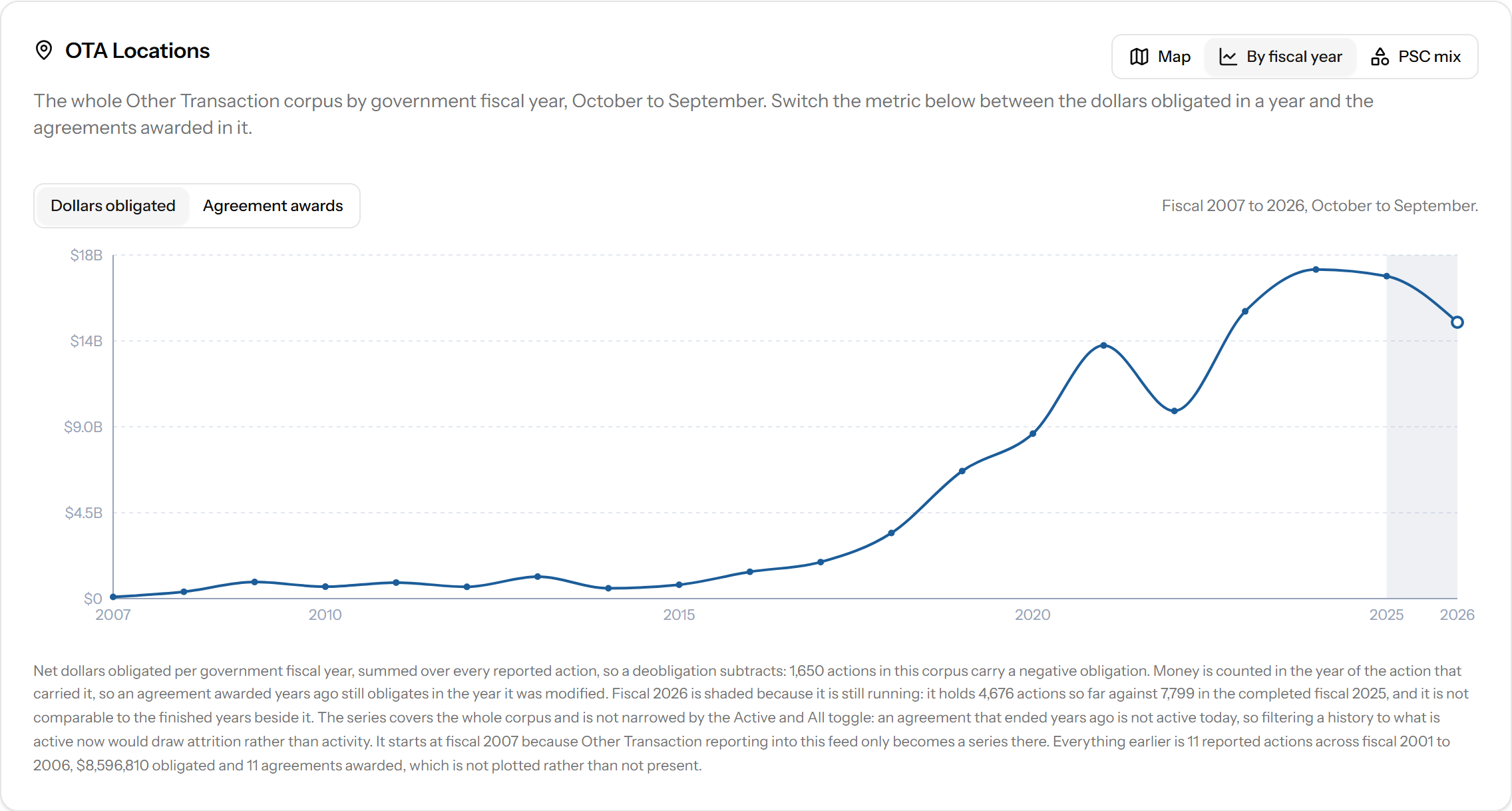
The whole Other Transaction market, by fiscal year
Net dollars obligated, or agreements awarded, per government fiscal year across the corpus, with the running year shaded so it is never read as a decline.
Every consortium, its manager, its base agreement and its awards
The published sponsor beside the buying command the corpus measures, never blended. Expand a row for every matched agreement and its performing member.
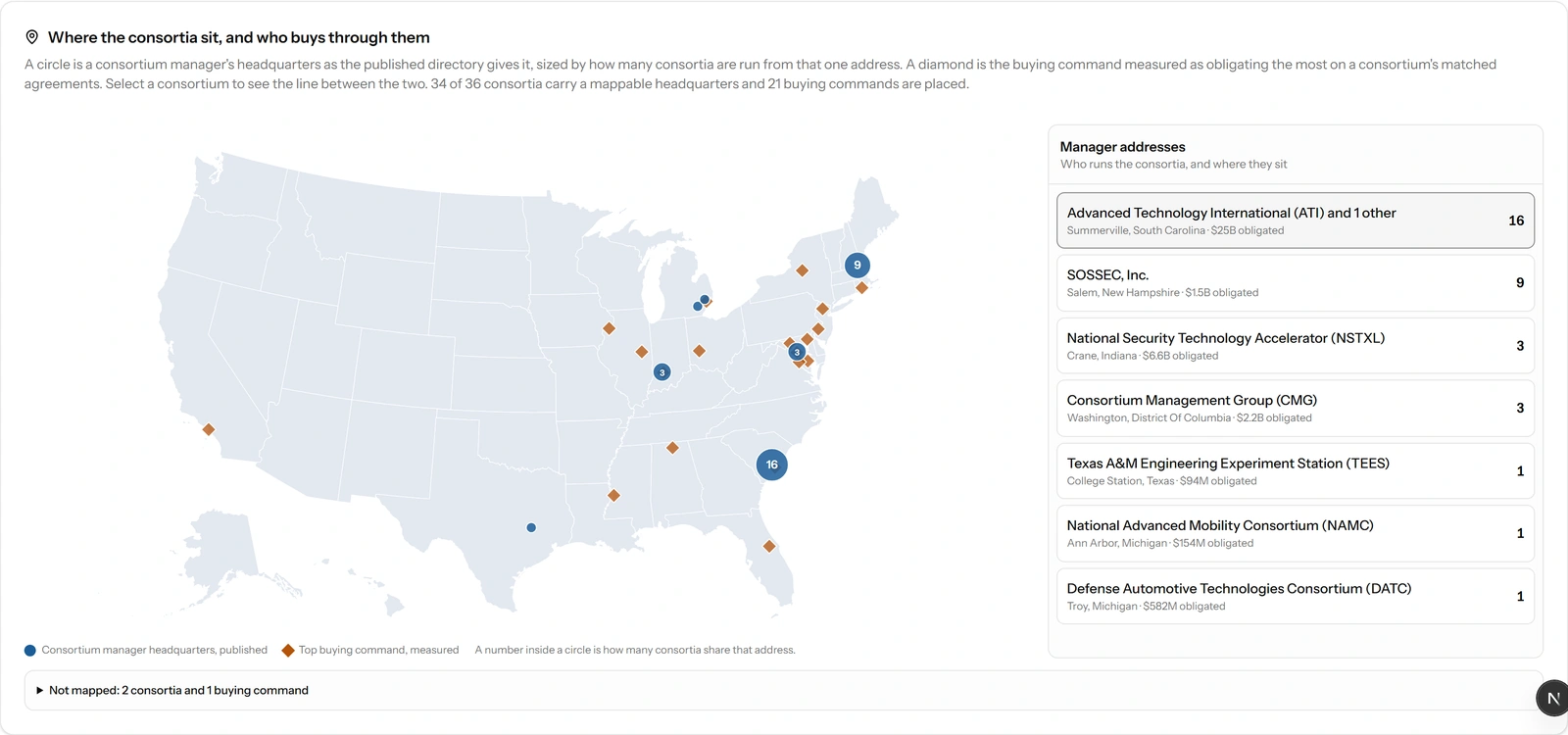
Where the consortia sit, and who buys through them
Manager headquarters against the buying command that obligates the most on each consortium's agreements. Select one to see the line between the two.
Other Transaction questions
What is an Other Transaction?
Other Transactions are procurement instruments other than contracts, grants, or cooperative agreements. They enable flexible business arrangements generally used to acquire research and development, support technology advancement, or develop a prototype. Federal agencies have varying statutory authorizations for OT uses, limitations, and restrictions. An OT sits outside the Federal Acquisition Regulation (FAR) and agency supplements, Competition in Contracting Act (CICA), Cost Accounting Standards (CAS), Truth in Negotiations Act (TINA), while the Procurement Integrity Act still applies and competitive practices apply to the maximum extent practicable.
What is the difference between a research OT and a prototype OT?
A research OT under 10 U.S.C. 4021 funds basic, applied, and advanced research projects pursuing the development and application of dual-use technology, usually with cost sharing, and carries no authority to transition to production. A prototype OT under 10 U.S.C. 4022 funds research, development, and prototyping activities that enhance the mission effectiveness of military personnel and the platforms, systems, components, or materials supporting them, and can lead to a follow-on production OT or contract without a new competition.
What conditions must a prototype OT meet?
At least one: At least one non-traditional defense contractor participates to a significant extent; or All significant participants are small businesses or non-traditional defense contractors; or At least one third of the total cost is provided by sources other than the government, where there is no non-traditional defense contractor participation; or The Agency Senior Procurement Executive determines that the circumstances justify a transaction providing for innovative business arrangements not feasible or appropriate under a contract, or an opportunity to expand the defense supply base that is not practical or feasible under a contract.
Which agencies can use Other Transactions?
Only agencies Congress has explicitly authorized, and only through a warranted Agreements Officer. 19 departments and agencies hold OT authority today, among them the Department of War under 10 U.S.C. 4021 and 4022, the Department of Energy, Health and Human Services and NIH, Homeland Security, the FAA, NASA and the National Science Foundation.
What is an OT consortium?
An OT consortium is a relationship between a government sponsor and a collection of traditional and non-traditional vendors, non-profit organizations, and academic institutions aligned to a technology domain such as cyber, space, undersea, or propulsion. A single entity manages them, and the group focuses on innovative solutions to government technology challenges within the scope and purpose of other transactions.
Can an Other Transaction award be protested?
OTs are not subject to the procurement protest process at FAR Part 33. An OT may be protested to the U.S. Court of Federal Claims. GAO has limited jurisdiction to review OT decisions. GAO hears only a timely protest that the agency is using its OT authority to acquire what should be bought with a procurement contract.
Authoritative sources
Guide to Prototype Other Transactions (10 U.S.C. 4022 and 2808a), Version 1.0
Office of the Under Secretary of War for Acquisition and Sustainment, October 2026
The prototype OT guide, issued with the DPCAP memorandum of 14 October 2026. Covers prototype and follow-on production OTs under 10 U.S.C. 4022, and construction OTs under 10 U.S.C. 2808a in Appendix D.
Guide to Research Other Transactions Under 10 U.S.C. 4021 (12 February 2026)
DARPA, February 2026
The research OT guide. This edition supersedes the September 2023 edition the source page lists.
DoD Other Transactions Guide (July 2023, 508 update July 2025)
Office of the Under Secretary of Defense for Acquisition and Sustainment, July 2023
The earlier prototype OT guide under 10 U.S.C. 4022: conditions for use plus guidance for planning and executing prototype and follow-on production OTs.
DPCAP Memorandum, Fostering One Strong Industrial Base Through Other Transactions
Defense Pricing, Contracting, and Acquisition Policy, 14 October 2026
The memorandum the Guide to Prototype Other Transactions is issued under.
MITRE AiDA, Other Transaction Authority
MITRE, Captured 19 August 2026
The source this guide is adapted from. Statutory citations here are reproduced as published.
USD(A&S) and USD(R&E) Memorandum, Definitions and Requirements for Other Transactions Under Title 10, United States Code, Section 2371b
Under Secretary of Defense (Acquisition and Sustainment)
The definitions the prototype and follow-on cards on this page cite. Section 2371b is now codified at section 4022.
USD(A&S) Memorandum, Authority for Use of Other Transactions for Prototype Projects Under Title 10, United States Code, Section 4022
Under Secretary of Defense (Acquisition and Sustainment)
The approval thresholds, and the delegations that cannot be delegated further.
MITRE AiDA, Existing OT Consortia
MITRE
The maintained directory of active consortia, their sponsors, and their management firms.
COFC No. 24-1824C, determining the scope of COFC jurisdictional authority to adjudicate bid protests involving Other Transactions
U.S. Court of Federal Claims, February 2025
The forum question for an OT protest, decided at the court rather than at GAO.
GAO Decision B-333150, Health and Human Services, application of fiscal law to Other Transactions
GAO, April 2024
Other Transaction Agreements: DOD Can Improve Planning for Consortia Awards
GAO, September 2022
Audit of DoD Other Transactions and the Use of Nontraditional Contractors and Resource Sharing
DoD Office of Inspector General, September 2022
Audit of Other Transactions Awarded to Consortiums
DoD Office of Inspector General, April 2021
GAO Decision B-416061, Oracle America Inc., protest of a production OTA to REAN Cloud LLC
GAO, May 2018
CCON 023 Other Transaction Authority (OTA) Credential
Defense Acquisition University, March 2024
Non-traditional Defense Contractor Status Validation Guide
SAM.gov and Defense Acquisition University
Nontraditional Defense Contractor status
GovConDash: the free NDC Quick Check, the Section 1826 exemptions and NDC participation in prototype OTs.
Adapted from MITRE AiDA, Other Transaction Authority, captured 2026-08-19.
