
Jules Martin
October 7, 2026
Congress wants a public company auditor to grade DCAA and DCMA
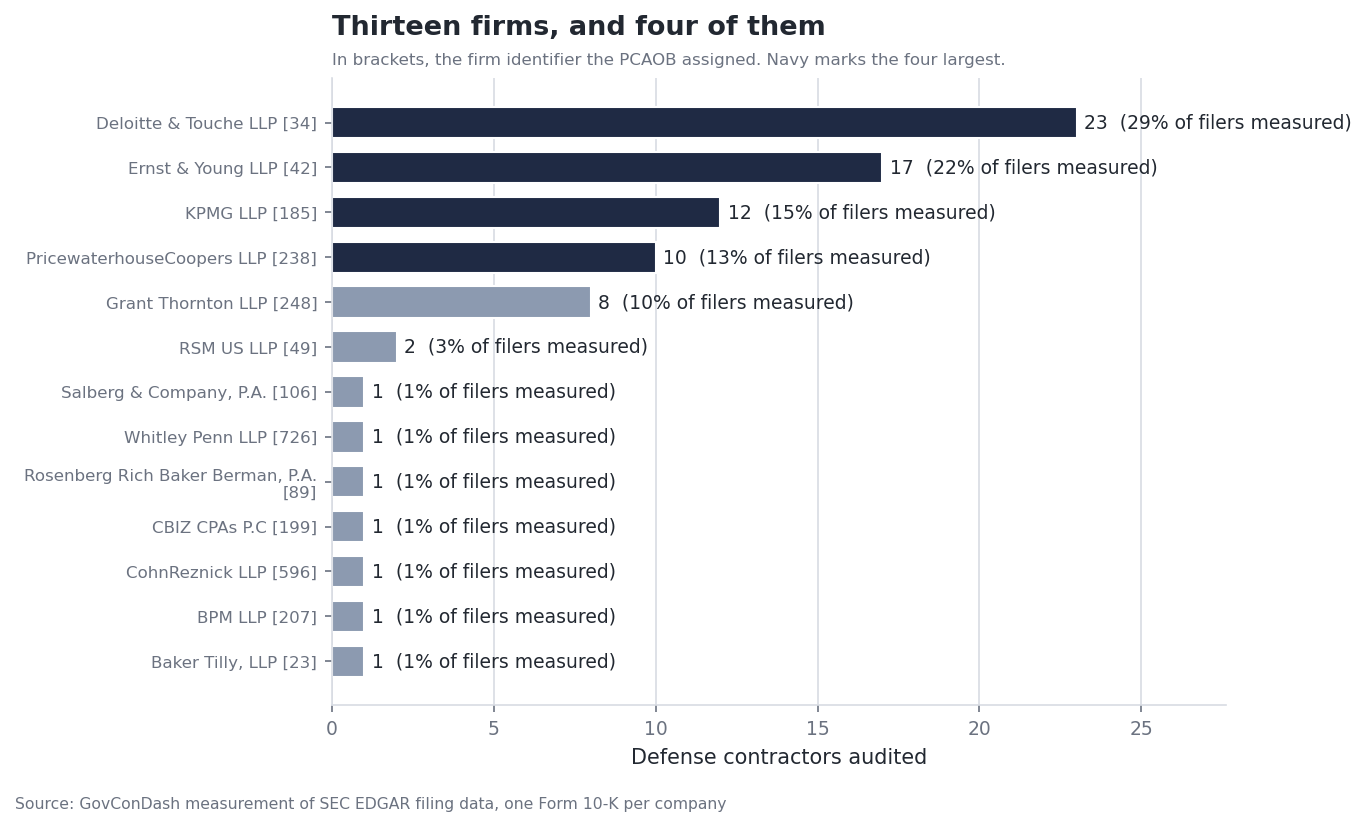
Section 811 of the House-passed defense bill would have the Secretary of War hire a firm that audits companies listed on a national securities exchange, and have that firm review how the Defense Contract Audit Agency and the Defense Contract Management Agency audit defense contractors. So we counted those firms. Across 79 publicly traded defense contractors, exactly 13 accounting firms sign the financial statements, and four of them cover 62 of the companies and 98.3 percent of the revenue.
H.R. 8800, sec. 811
Review of defense audit agencies
- Bill
- National Defense Authorization Act for Fiscal Year 2027, 119th Congress
- Version read
- Engrossed in House, July 22, 2026
- Placement
- Title VIII, subtitle A, Acquisition Policy and Management
- Senate
- S. 4784, introduced, its own text not read here
Read from the House-passed text on congress.gov.
62 of 79
Audited by four firms
13 firms sign the financial statements of the publicly traded defense contractors this platform tracks. Four of them cover 78 percent of the companies and 98.3 percent of the revenue those companies report.
01What section 811 actually says
Within 180 days of enactment, the Secretary of War would seek a contract with an outside firm to find ways to improve how DCAA and DCMA audit, review and surveil defense contractors. Within a year, that firm would deliver a report to the Secretary and to the Inspector General. Sixty days after that, the Inspector General would send an unaltered copy of the report to the congressional defense committees, along with any comments or recommendations of its own.
The review would compare the processes and standards DCAA and DCMA use, including their use of materiality standards, with industry best practices, and assess the extent to which those practices are applicable and transferable to the audits, reviews, and surveillance of defense contractors. The firm's report would present findings on the effectiveness of both agencies, along with recommendations for:
- improving the training of the staff who conduct audits, reviews, and surveillance;
- improving the accuracy and reliability of that work;
- ensuring the use of a materiality standard similar to the one in generally accepted auditing standards;
- improving the processes the agencies use to conduct that work;
- relieving the burden on defense contractors without undermining the effectiveness and integrity of the work; and
- ensuring the agencies implement the recommendations, with effective monitoring of that implementation.
Two definitions in section 811 frame the review. The bill defines a defense audit agency as exactly two organizations, the Defense Contract Audit Agency and the Defense Contract Management Agency. It defines industry best practices by reference to the audits of companies listed on a national securities exchange, conducted under generally accepted auditing standards.
the Secretary of Defense shall seek to enter into a contract with an entity that conducts audits, reviews, or surveillance of companies listed on a national securities exchange, to conduct a comprehensive review of the standards, guidance, and policies of the defense audit agencies.
The term industry best practices means the best practices used to conduct audits, reviews, and surveillance of companies listed on a national securities exchange, in accordance with generally accepted auditing standards or national securities exchange requirements, as appropriate.
02Who actually signs the defense industry's financial statements
A listed company has to say who audits it, in machine-readable form, on the cover of its own annual report. We took the most recent Form 10-K on file for every company in this platform's defense contractor catalog and read the auditor off the filing itself. 80 filings resolved. 79 of them carry an auditor tag.
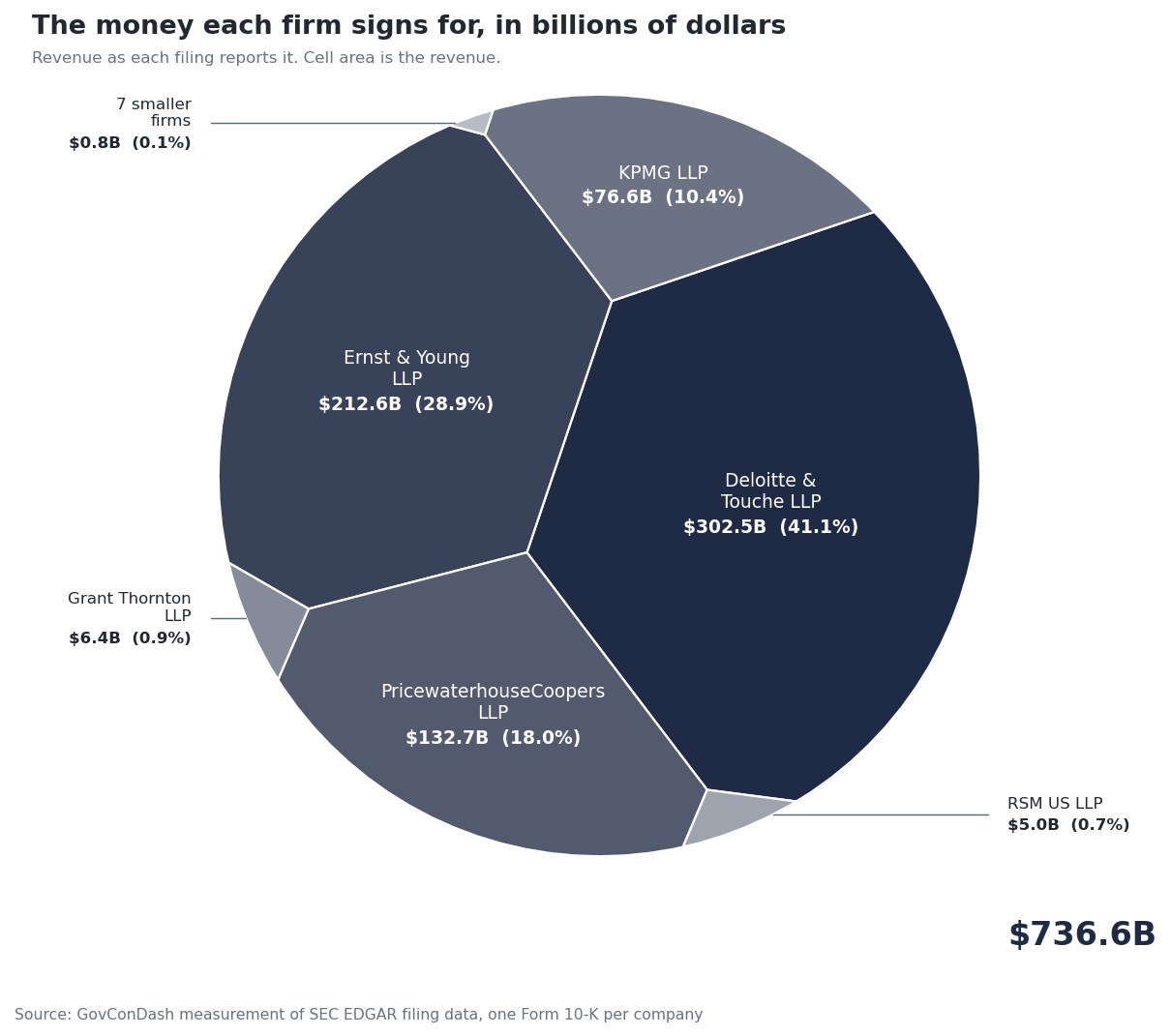
Seven of the smaller firms audit one publicly traded defense contractor each. Measured by the revenue these companies report in the 10-K filings, the four largest firms cover 98.3 percent and everyone else covers 1.7 percent.
03The names DCAA writes down itself
DCAA's Strategic Plan FY 2026 to 2030 reports that the agency has moved from a regional structure to three directorates, Sea, Air and Land, and names the major contractors each one covers. The table below lists those contractors beside the firm that signs each one's financial statements.
Who audits whom
| DCAA directorate | Contractor, as DCAA names it | Signs its financial statements |
|---|---|---|
| Sea DirectorateHeadquarters: Virginia | General Dynamics | KPMG LLPPCAOB firm 185 |
| BAEfiles no Form 10-K with the Securities and Exchange Commission | No SEC annual report to sign | |
| Air DirectorateHeadquarters: California | Northrop Grumman | Deloitte & Touche LLPPCAOB firm 34 |
| Boeing | Deloitte & Touche LLPPCAOB firm 34 | |
| Land DirectorateHeadquarters: Texas | Lockheed Martin | Ernst & Young LLPPCAOB firm 42 |
| RTX | PricewaterhouseCoopers LLPPCAOB firm 238 | |
| L3the registrant is L3Harris Technologies, Inc. | Ernst & Young LLPPCAOB firm 42 |
04What happens next
Section 811 is in the House-passed bill only. The Senate's bill, S. 4784, has its own text, and the provision becomes law only if it survives conference. If it does, the Secretary would have 180 days to seek a contract, the firm would report within a year, and the Inspector General would send the report unaltered to the defense committees 60 days later.
05What DCAA changed in the last three months
Section 811 would commission a review of DCAA's standards, guidance and policies. Those documents have not stood still while the bill waits. Between July 6 and October 6, 2026, GovConDash recorded six new audit guidance memos, a revision to every one of the 14 chapters of the Contract Audit Manual and 11 reissued audit programs.
Audit guidance memos
Four of the six memos address the Cost Accounting Standards: two cover the higher CAS monetary thresholds and two cover conforming individual standards to generally accepted accounting principles. The fifth covers the increase to the truthful cost or pricing data threshold and TINA Lite authority. The sixth, issued October 6, alerts auditors to the ten exemptions Section 1826 of the FY 2026 NDAA gives nontraditional defense contractors, from the DFARS business system clauses to truthful cost or pricing data and FAR Part 31.
Memoranda for regional directors, July to October 2026
| Issued | Memo | Subject |
|---|---|---|
| August 19, 2026 | 26-CCLD-004(R) | Audit Alert on the Increase to Cost Accounting Standards (CAS) Monetary Thresholds |
| August 20, 2026 | 26-CCLD-005(R) | Audit Guidance on Conformance of CAS to GAAP for CAS 404, 408, 409, and 411 |
| August 27, 2026 | 26-CPSP-007(R) | Audit Alert on the Increase to Truthful Cost or Pricing Data Threshold and TINA Lite Authority |
| September 24, 2026 | 26-CCLD-008(R) | Audit Guidance on CAS Board Final Rule - Conformance of CAS to GAAP for CAS 407 Use of Standard Costs for Direct Material and Direct Labor |
| September 29, 2026 | 26-CCLD-009(R) | Audit Guidance on CAS Board Final Rule - Increase of Monetary Thresholds and Other Matters Related to CAS Program Requirements |
| October 6, 2026 | 26-CCLD-010(R) | Audit Alert on Nontraditional Defense Contractor Exemptions under Section 1826 of the Fiscal Year 2026 National Defense Authorization Act |
Contract Audit Manual
DCAA reissued all 14 chapters of the manual between July 16 and September 29. Chapter 1 was revised twice, on July 16 and again on September 18, and the table shows each chapter's current revision.
DCAAM 7640.1, current revisions
| Chapter | Title | Revised |
|---|---|---|
| 1 | Introduction to Contract Audit | September 18, 2026 |
| 2 | Auditing Standards | August 20, 2026 |
| 3 | Audit Planning | August 20, 2026 |
| 4 | General Audit Requirements | September 18, 2026 |
| 5 | Audit of Compliance with Defense Federal Acquisition Regulation Supplement for Contractor Business Systems | August 19, 2026 |
| 6 | Incurred Cost Audit Procedures | August 19, 2026 |
| 7 | Fraud | September 3, 2026 |
| 8 | Cost Accounting Standards | September 17, 2026 |
| 9 | Cost Estimates and Price Proposals | September 21, 2026 |
| 10 | Report Writing | September 3, 2026 |
| 11 | Performance Audits and Agreed-Upon-Procedures Engagements | August 28, 2026 |
| 12 | Contract Terminations Delay/Disruption and Other Requests for Equitable Adjustment or Claims | September 18, 2026 |
| 13 | Audits at Educational Institutions, Nonprofit Organizations, and Federally Funded Research and Development Centers | September 29, 2026 |
| 14 | Other Contract Audit Assignments | August 28, 2026 |
Audit programs
Eleven audit programs carry a July, August or September 2026 effective date. Eight of them cover three contractor business systems: the accounting system, the estimating system and the material management and accounting system.
Audit programs reissued, July to September 2026
| Activity code | Program | Version | Effective |
|---|---|---|---|
| 10100 | Audit Corporate Office | 11.0 | Jul 2026 |
| 11070FWU | Follow-Up Accounting System Audit | 1.2 | Sep 2026 |
| 11070ST | Accounting System Audit | 4.5 | Sep 2026 |
| 12500FWU | Follow-Up Material Management and Accounting System (MMAS) | 1.2 | Sep 2026 |
| 12500ST | Audit Program for Material Management and Accounting System (MMAS) | 13.5 | Sep 2026 |
| 17500 | Progress Payment Cost | 11.0 | Sep 2026 |
| 17741FWU | Follow-Up Post Award Accounting System Audit for Nonmajor Contractors | 1.2 | Sep 2026 |
| 17741ST | Post Award Accounting System Audit at Nonmajor Contractors | 7.6 | Sep 2026 |
| 21000 | Audit Program for Price Proposal | 6.0 | Sep 2026 |
| 24010DC | Estimating System - Compliance with DFARS 252.215-7002 by Criteria | 1.2 | Sep 2026 |
| 24010FWU | Follow-Up - Estimating System - Compliance with DFARS 252.215-7002 by Cost Element | 1.2 | Sep 2026 |
06Where GovConDash fits
GovConDash keeps the bill, the SEC filings, the regulations and DCAA's guidance in one place. Use it to follow section 811, see what DCAA changed and check your own audit readiness.
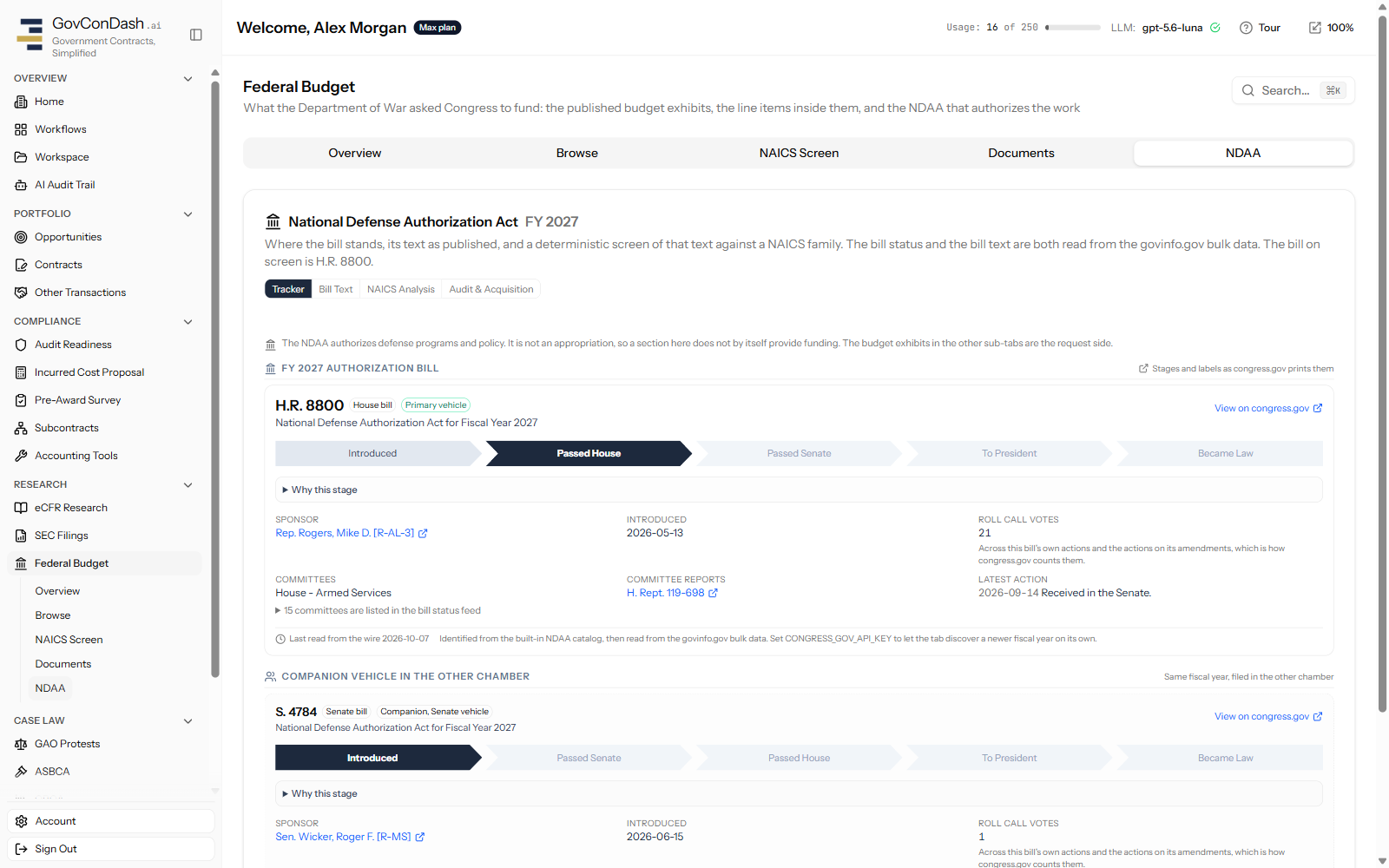
Track the NDAA before it becomes law. The NDAA sub-tab of the Federal Budget tab follows H.R. 8800 and its Senate companion, S. 4784, stage by stage, read straight from the government's own bill status data. The full bill text sits beside the tracker, along with a NAICS screen that finds the sections touching your industry.
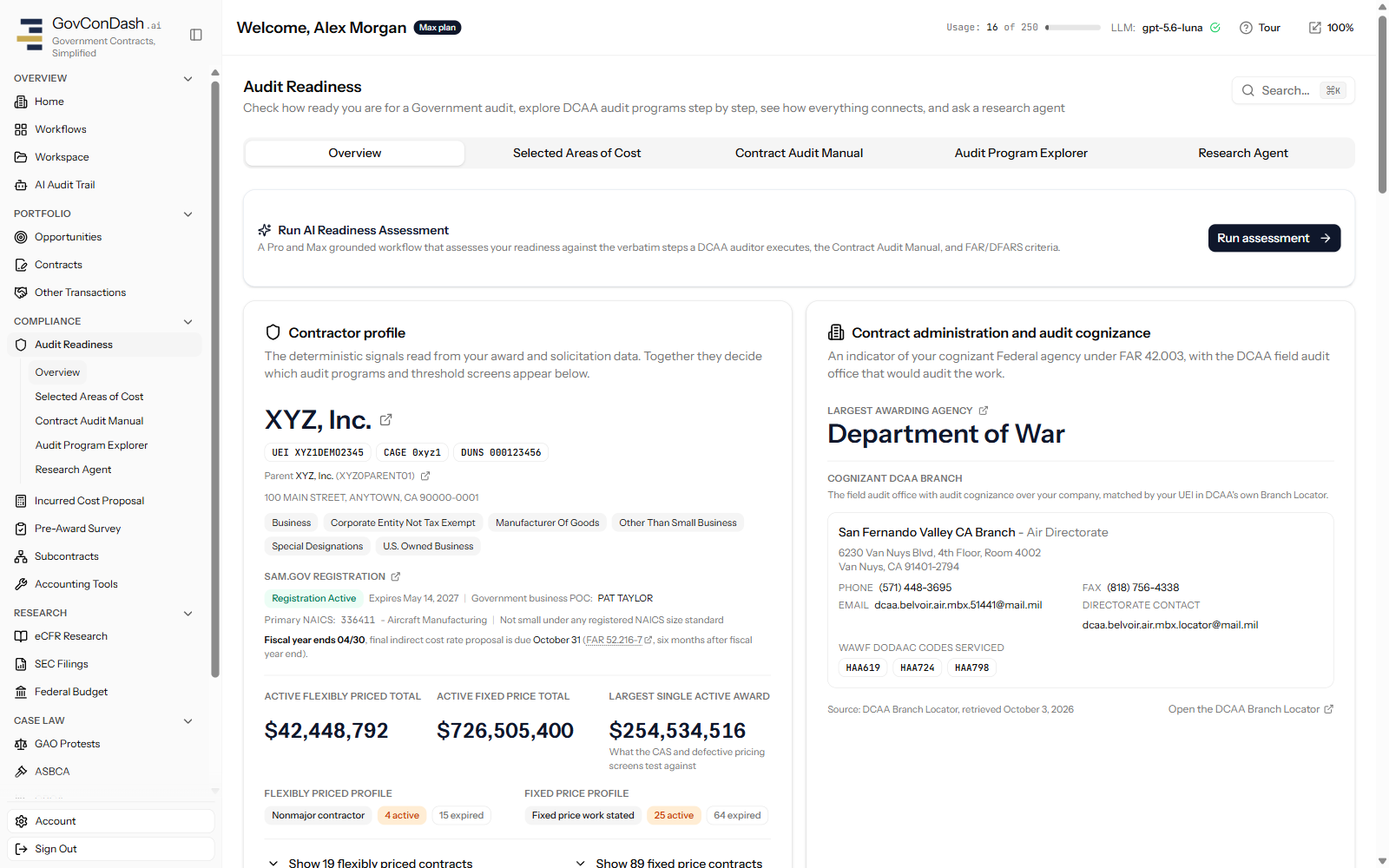
Audit Readiness is where the DCAA side of this story lives. It builds a contractor profile from award and registration data, names the cognizant DCAA branch from DCAA's own Branch Locator, and links the audit programs, the Selected Areas of Cost guidebook and the Contract Audit Manual a DCAA auditor works from.
This piece is commentary on public filings, a published bill and published rules, not legal advice, and it is not a compliance determination about any company or firm named in it.

GovConDash.ai
Track the bill and the filings in one place
GovConDash holds the annual and quarterly filings of 87 publicly traded defense contractors beside the FAR, the DFARS, the Cost Accounting Standards, DCAA guidance and the defense authorization bill as it moves. Every AI answer cites the record it came from. Free to start.
Keep reading
- DCAA Just Completely Rewrote Its Incurred Cost Guidance
DCAA reissued Chapter 6 of its Contract Audit Manual, the incurred cost audit chapter, on August 19, 2026. What was cut, where it went, and what DCAA's own incurred cost audit programs still cite.
- DCAA Rewrote Seven Chapters of Its Contract Audit Manual in September
The chapters DCAA cut hardest are the ones courts and boards quote. What changed, and what the decisions citing the manual did with it.
- DCAA Replaced Its Cost Chapter With a Fraud Chapter (CAM Chapter 7)
As of September 3, 2026, Chapter 7 covers fraud referral, the contractor disclosure program and obstruction of audit instead of selected areas of cost.
- The Pentagon Put AI on Every Computer. Your DCAA Auditor Is on It Too.
What DCAA has published about running incurred cost audits on generative AI, and what contractors can put on their own side of the table.