


































I.A launch program born outside the FAR
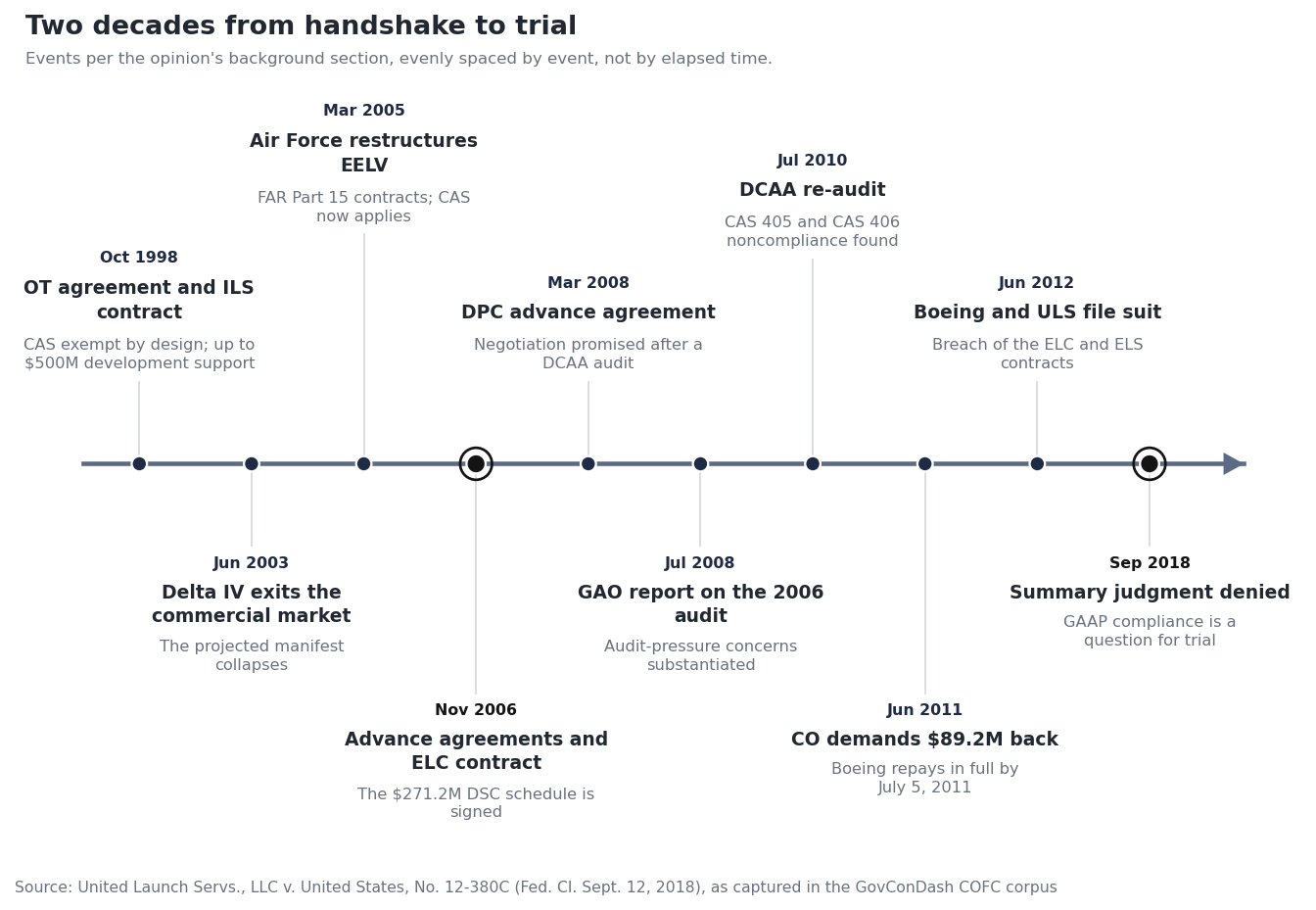
The dispute traces to 1994, when national space transportation policy directed the Department of Defense to evolve the country's expendable launch vehicle fleet. The Air Force answered with the Evolved Expendable Launch Vehicle program, and by 1998 it had settled on a deliberately light-touch commercial structure. Each of the two competitors, Boeing and Lockheed Martin, would receive a development agreement under the Air Force's other transaction authority, worth “not more than $500M,” and a firm fixed-price initial launch services contract awarded under FAR Part 12, the commercial items part. An other transaction agreement sits outside the procurement statutes and the FAR entirely, and neither instrument was subject to the Cost Accounting Standards. The opinion is explicit that this was a feature: the structure would tolerate some “accounting flexibility” in meeting the government's launch needs.
The flexibility rested on a market thesis. The parties expected the government to be one customer among many, perhaps 30 percent of each contractor's launch business, in what the Air Force called a highly competitive, lucrative world market. Boeing's own estimate at award was more than 390 Delta IV launches by 2020.
On that thesis Boeing built its accounting. It adopted what it called lot accounting: it defined a production lot of eighteen major hardware end items, expected early units to cost more than later ones as the factory learned, and averaged costs across every mission that would consume the lot. Costs were not expensed when incurred. They went onto the balance sheet as work-in-progress inventory, an asset, and were recognized mission by mission as launches flew, using an estimated cost at completion divided across projected missions. Common support costs traceable to direct labor, which Boeing classified as program management and hardware support, went into the lot the same way.
Average-cost accounting is unremarkable when the denominator holds. This denominator did not.
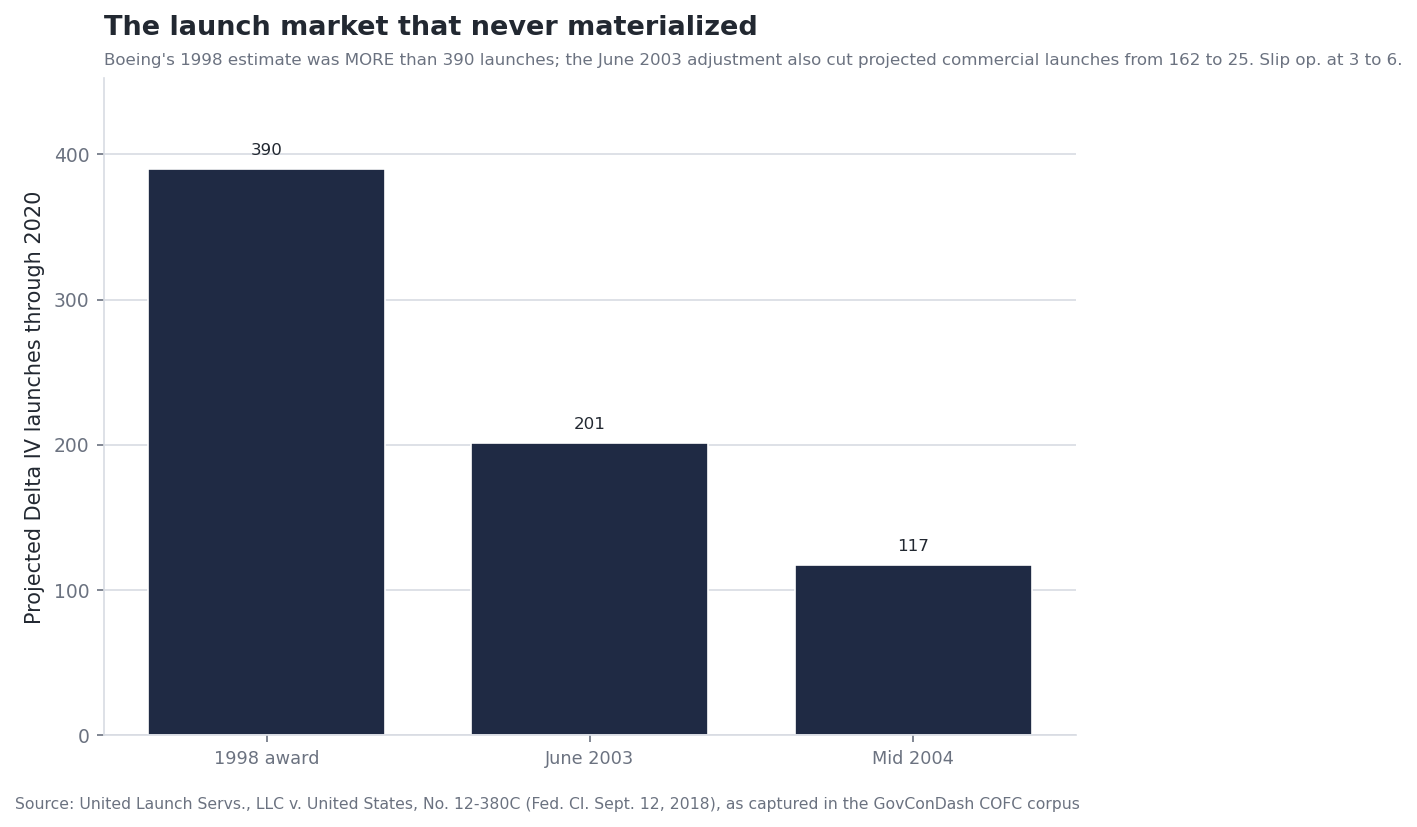
The commercial launch market of the projections never materialized. By June 2003 Boeing had essentially pulled the Delta IV off the commercial market and cut its projected launches through 2020 from 369 to 201, with the commercial share falling from 162 launches to 25. The consequences compounded: the lot would now take nearly a decade longer to consume than planned, its estimated cost at completion drifted upward rather than down, and nearly all of its end items would now fly on government missions whose prices Boeing had already fixed in 1998. Boeing recorded significant losses on its definitized contracts in the second quarter of 2003. That same year, a Procurement Integrity Act investigation cost Boeing seven of its awarded launches, transferred to Lockheed Martin, and a temporary suspension. By mid-2004 the projection stood at 117 launches.
II.The restructure brings CAS into the room
In January 2005, updated national space policy conceded that the commercial downturn had undermined industry's ability to recoup its investment, and committed the government to stable funding for “assured access to space.” The Air Force's implementing strategy restructured the program onto two FAR Part 15 contracts per provider: a cost-reimbursable launch capability contract (ELC) covering infrastructure, critical skills, factory support and program management, and a firm fixed-price launch services contract (ELS) for the launches themselves. Two consequences followed. The Cost Accounting Standards would now apply. And the strategy stated flatly that losses incurred under the 1998 agreements would not be recoverable under the restructured contracts.
That combination created the problem this case is about. Boeing was carrying, in inventory, support costs it had incurred before 2006 and associated with future missions that would now fly under the new contracts. The parties came to call them deferred support costs, DSC. A parallel wedge of already-incurred hardware production costs, the deferred production costs or DPC, arose in 2007 when the new Boeing and Lockheed joint venture, United Launch Alliance, abandoned lot accounting altogether. To recover the stranded costs, Boeing sought advance agreements.
DCAA's first look was skeptical. Its July and August 2005 audits found Boeing's proposals inadequate for negotiation and flagged potential noncompliance with CAS 406, the standard governing cost accounting periods, in rolling roughly $333 million of previously incurred support costs forward onto the new contract. The Air Force considered obtaining CAS waivers. It never did.
Then the audit posture changed. DCAA's May 2006 report on the revised proposal omitted any reference to CAS noncompliance and graded the proposal merely “inadequate in part.” In September 2006, asked directly by the Defense Contract Management Agency whether the draft advance agreements complied with CAS and the FAR, DCAA answered that its audit had not disclosed any noncompliances. A contract management board of review convened in November 2006 was visibly uneasy. Its own minutes record that “to some, [the] PM&HS [costs] appeared to consist of failed business costs being carried forward.” The Review Board declined to give lot accounting its own express approval. Instead it revised the agreement so that the compliance finding was the contracting officer's, and it attached a sentence that would matter later.
“This determination is not intended to and does not prevent the revocation, withdrawal, or reconsideration of this determination if subsequent facts indicate that some aspect of this disclosed practice is noncompliant with CAS or FAR.”
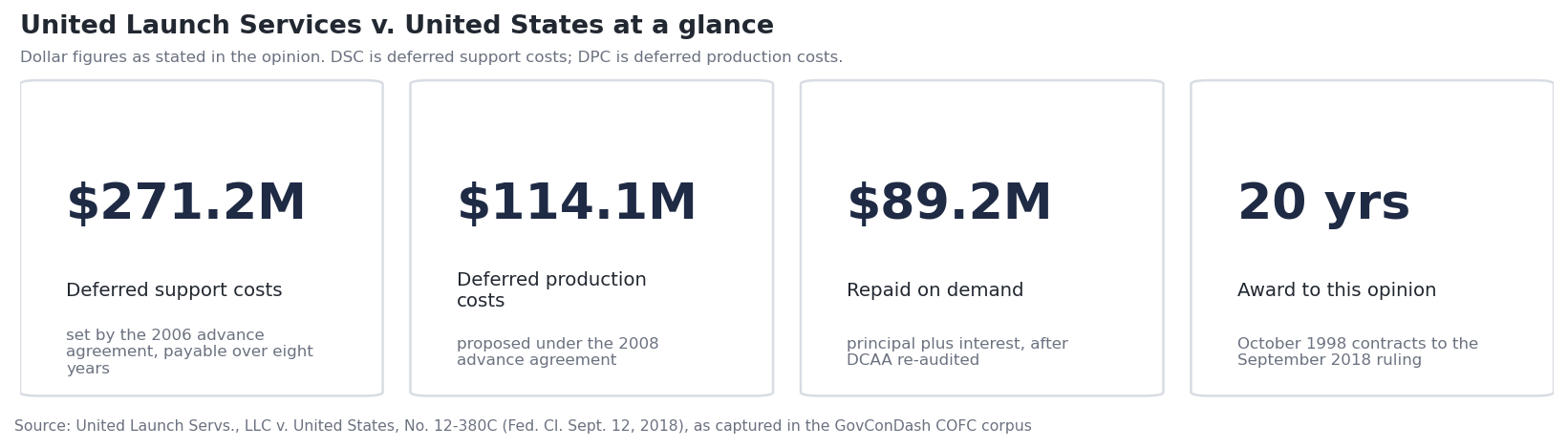
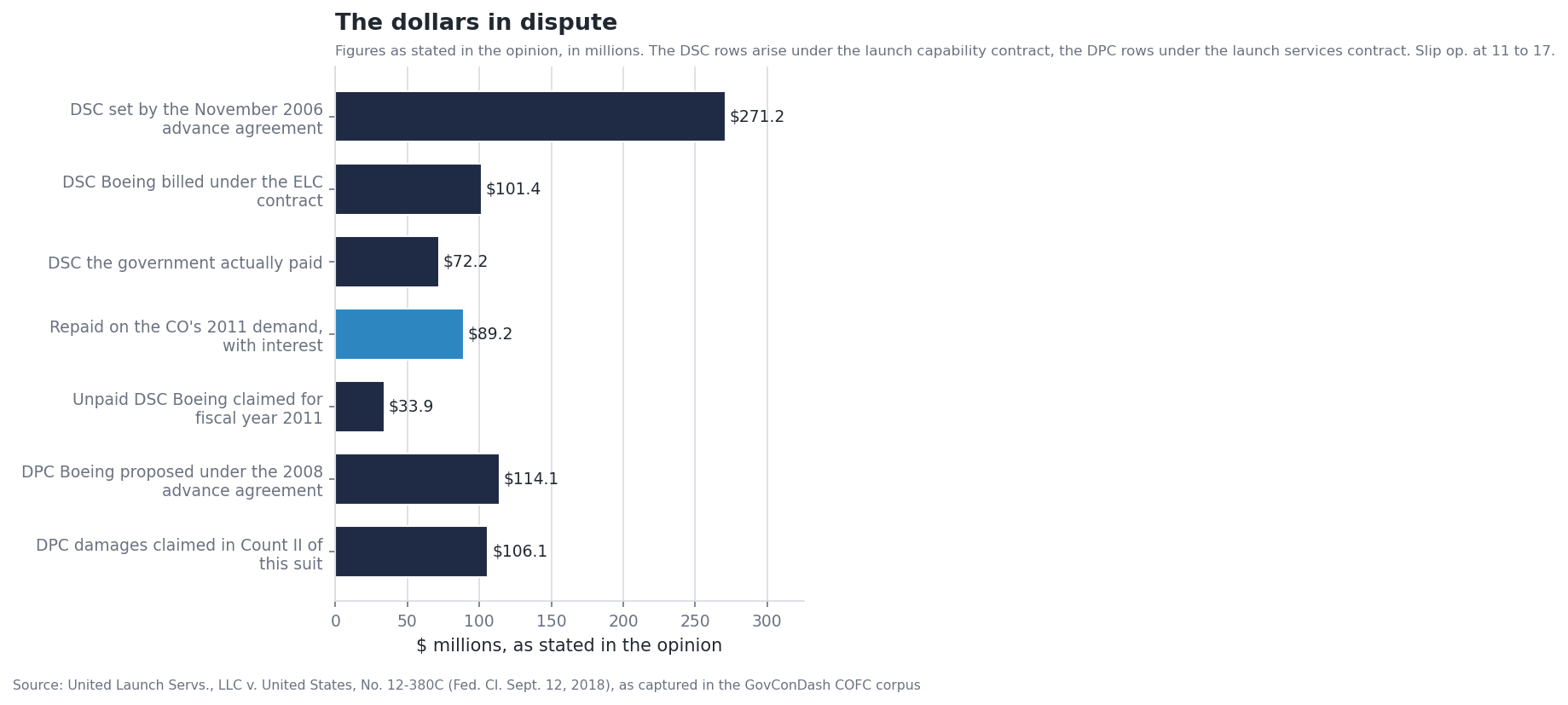
The deal closed in a single November week in 2006: the DSC advance agreement on November 8, the Lot Accounting advance agreement on November 13, and the ELC contract, expressly incorporating both, on November 16. The DSC agreement recited that $271,152,672 represented program management and hardware support costs “incurred and placed in an inventory account prior to June 1, 2006” that were “neither allocable to nor payable under” any prior contract, and set a schedule paying one eighth of that amount per year. The first two contract line items were worth $67,788,168 together.
Then Boeing's own side of the record turned. United Launch Alliance began operations in December 2006, and as a new company needed one accounting practice across the Atlas and Delta programs. It chose Lockheed's annual production cycle method, retroactively, and rejected Boeing's heritage practice in writing. ULA's controller told the government that the company could not adopt lot accounting because the lot accounting inventory process “does not conform to GAAP.” That sentence, from the plaintiff's side of the caption, is quoted in the opinion. The switch stranded the second cost wedge, the DPC, and in March 2008 the parties signed a second advance agreement: DCAA would audit the amount, allowability and allocability of the proposed costs, and the parties would then negotiate a fair and reasonable value. Boeing proposed $114.1 million.
III.The audit trail reverses
In July 2008, the Government Accountability Office published the report that unwound the 2006 comfort. Investigating DCAA audit quality, GAO concluded it had substantiated concerns about buying command and contractor pressure for a favorable opinion on the 2006 ELC audit, and about an unsupported change in the draft audit opinion directed by regional officials. Auditors told GAO they had been instructed not to document CAS compliance issues in their workpapers. A Senate hearing followed, then a Department of Defense Inspector General investigation that called the 2006 audit flawed and recommended suspending payments and reassessing the advance agreements.
DCAA re-audited. Its July 2010 report found Boeing in noncompliance with CAS 406 and CAS 405, and characterized the deferred support costs as losses on other contracts, expressly unallowable under FAR 31.205-23. By then Boeing had billed $101,435,379 of the DSC and been paid $72,198,875. In June 2011 the administrative contracting officer issued a final decision demanding that money back with interest, $89,235,167 in all. Boeing repaid it within three weeks. On the DPC side, DCAA questioned the proposed costs in total, found the same noncompliances, and took the position that the DPC advance agreement itself was invalid under FAR 31.109(c). Boeing submitted a certified claim seeking the repaid $89,235,167, another $33,894,084 of unpaid fiscal year 2011 DSC, and $106,095,968 in DPC for ordered missions. The Air Force denied it, and Boeing and United Launch Services filed suit on June 14, 2012.
IV.What the court held
Boeing moved for summary judgment on its two breach counts in late 2017, and Judge Kaplan's opinion resolves the motion in three steps. Each one is worth reading closely, because each strips away a protection contractors tend to assume they have.
The standard: does illegality have to be obvious?
Boeing argued
The government can escape its payment promises only if they were plainly and palpably illegal at the time of contracting. Anything less obvious, and the agreements must be enforced as written, on the authority of United States v. Amdahl Corp. and John Reiner & Co.
The court held
Wrong line of cases. Amdahl and Reiner concern cancelled contract awards and the equitable relief that follows cancellation. This case concerns the enforceability of specific payment provisions, where Yosemite Park, Barrett Refining and Urban Data Systems control: a contracting officer simply lacks authority to bind the government to payment terms contrary to statute or regulation, and no heightened obviousness showing is required. The court noted that quantum meruit or quantum valebant recovery may remain available, but that is restitution, not the contract.
The test: does GAAP govern allowability here?
Boeing argued
CAS 406 does not reach the DSC payments at all, because paying an agreed sum is not a cost accounting practice, and FAR 31.205-23 is beside the point because the government agreed to pay through fixed-price line items, where the cost principles only inform a fair and reasonable price.
The court held
Allowability runs through GAAP three separate ways. FAR 31.201-2(a) conditions allowability on CAS compliance or, where CAS does not apply, on GAAP directly. CAS 406-50(b) requires “appropriate practices” for deferrals, and appropriateness is measured against GAAP, which the Federal Circuit has held supplements CAS where CAS is silent. And whether deferred costs are losses on other contracts under FAR 31.205-23 is itself determined by reference to GAAP. The fixed-price label changed nothing: cost was essentially the sole factor in the price, and Boeing itself consistently described the payments as reimbursement.
The record: is GAAP compliance genuinely disputed?
Boeing argued
GAAP tolerates a range of reasonable treatments, and the government has not shown that Boeing's choices fell outside it. No reasonable factfinder could conclude otherwise, so summary judgment should enter.
The court held
Three genuine disputes of material fact, each with dueling experts. Whether SOP 81-1 paragraph 38 permits combining existing contracts with merely anticipated ones for average costing at all. Whether what Boeing did was actually program accounting, which SOP 81-1 excludes and which the AICPA audit guide says is not appropriate for government contracts, a label Boeing's own internal documents repeatedly used. And whether the deferred costs remained probable of recovery under ARB 43 and SFAS No. 5 as the manifest shrank and per-mission costs rose between 2003 and 2006. Summary judgment denied.
The regulatory spine of the second holding deserves to be quoted rather than summarized, because it is the part practitioners will reach for.
The contracting officer is not authorized “to agree to a treatment of costs inconsistent with this part.”
The practices required of the contractor “shall include appropriate practices for deferrals, accruals, and other adjustments to be used in identifying the cost accounting periods among which any types of expense and any types of adjustment to expense are distributed.”
Unallowable: any “excess of costs over income under any other contract.” The theory, as the opinion puts it, is that each contract stands alone.
A footnote-level detail that practitioners will appreciate: on that last principle the court quotes the leading treatise, Karen Manos's Government Contract Costs & Pricing. Manos appears on the first page of the same opinion as of counsel for the plaintiffs.
V.Takeaways
An advance agreement manages disputes; it does not manufacture allowability. FAR 31.109 exists to record a shared understanding before costs are incurred, and FAR 31.109(c) draws its outer limit: a contracting officer cannot agree to a treatment of costs inconsistent with Part 31. If the underlying practice is noncompliant, the agreement built on it is unenforceable, no matter how many signatures it carries. Negotiate the agreement, but stress-test the accounting practice underneath it as if the agreement did not exist.
Read your advance agreement for what it reserves, not just what it promises. The Review Board deliberately withheld institutional approval of lot accounting, placed the compliance finding on the contracting officer alone, and inserted an express revocation clause. Boeing signed it. When the government later invoked exactly that reserved ground, the clause read as consent.
A clean DCAA opinion is not a legal determination, and DCAA says so itself. The 2010 re-audit expressly disclaimed any legal determination of compliance, and the clean 2006 audit was later found by GAO and the Inspector General to have been the product of pressure. Audit posture can reverse years after the money is paid, and the demand that follows arrives with interest. Treat a favorable audit as a snapshot of one auditor's file, not as a vested right.
Flexibility born on OTs and commercial contracts does not migrate to covered ones. Every accounting choice Boeing made was lawful when made, on instruments that were CAS-exempt by design. The practice failed, if it failed, at the border crossing: the moment previously incurred costs were carried onto CAS-covered, FAR Part 15 contracts. Programs moving from other transaction agreements onto conventional contracts, a route more traveled now than in 1998, should plan that transition as an accounting event, not just a contracting one.
GAAP is a government contracts compliance requirement. Not merely a financial reporting one. FAR 31.201-2(a)(3) makes it a condition of allowability, CAS 406 imports it into deferral practices, and FAR 31.205-23 uses it to decide what counts as a loss on another contract. The recoverability judgments this opinion litigates, whether inventoried costs remained probable of recovery as the market fell, are exactly the judgments auditors ask about contemporaneously. Document them when you make them; in this case they became trial exhibits a decade later.
Your own paper will testify. The government's best evidence came from the plaintiffs' side of the caption: internal Boeing emails calling lot accounting very similar to program accounting, a draft titled “Lot-Costing/Program-Accounting,” and ULA's controller writing that the practice does not conform to GAAP. Consistency between what a company tells its auditors, its partners and its customer is not a formality; in litigation it is the record.
What happened next
Boeing sought to take the question upstairs before trial. On Nov 1, 2018, the court denied leave to pursue an interlocutory appeal, finding none of the requirements for certification present, and the GAAP question stayed on the road to trial. That order is in the corpus too: the five-page denial makes a tidy coda to a 35-page opinion.
How this piece was grounded: every dollar figure, launch count and quotation above was transcribed from the opinion with a slip-opinion page cite, then re-located in the verbatim opinion text the GovConDash Court of Federal Claims corpus stores for this decision (25 anchors verified against 110,347 characters of captured text) before the page could be built. A figure that fails that check stops the build. This piece is commentary on a public decision, not legal advice.
