Your nextincurred cost proposal,with an agent beside you
The incurred cost proposal has been a spreadsheet exercise for decades. GovConDash makes it a guided workspace with a research agent beside every step: it answers from the FAR, DCAA's own guidance and the case law, reviews your rate structure, and cites every source, while a deterministic engine builds Schedules A through O and checks them against DCAA's adequacy questions before you sign.
After each fiscal year end
FAR 52.216-7(D)(2)(I)
Schedules, A through O
DCAA'S MODEL SCHEDULES
Adequacy questions
DCAA CHECKLIST, VERSION 3.4, DECEMBER 2021
Pre-submission checks
BEFORE YOU SIGN
From a spreadsheet to an agent
The requirement has not changed: an adequate proposal, six months after year end, that DCAA can audit. What changes is how much of the expertise sits beside the person preparing it.
A spreadsheet model rebuilt by hand every year, with formulas nobody wants to touch.
A saved proposal that rolls forward to next year, with every version kept and restorable.
Rules looked up in a separate browser tab, then paraphrased from memory.
A research agent beside every step that answers from the FAR, DCAA's own guidance and the case law, and cites each source.
Unallowable costs and broken ties found by the auditor, after submission.
Expressly unallowable costs, cross-schedule ties and DCAA's adequacy questions checked before you sign.
Rate strategy decided by instinct, if it is considered at all.
A rate structure review that names the options worth a look and models each one without touching the proposal.
An incurred cost specialist beside every step
Ask which G&A base CAS 410 allows, what DCAA traces from the chart of accounts, or what happens when the six-month deadline is missed. The agent searches the sources a seasoned practitioner would, and returns an answer you can verify line by line.
The Incurred Cost Research Agent
One agent with the tools an incurred cost specialist reaches for: the FAR and DFARS rules, DCAA's Contract Audit Manual chapter 6, the 10100 incurred cost audit program, DCAA's audit guidance memos, the adequacy checklist, and decisions of the ASBCA, the Court of Federal Claims and the CBCA.
Beside every step
Ask the agent from inside the workspace. Its starter questions follow the step on screen: base selection on Setup, unallowable accounts on the Chart of Accounts, Schedule H on the job cost ledger.
Rate structure review
Deterministic screens read your generated rates and name what is worth a look, such as a value added G&A base or a material handling pool. Try any option as a what-if scenario, or ask the agent for a full review.
Suggested answers
The Setup step's General Questions are pre-answered from the flexibly priced award history on record for your company, and each suggestion states the evidence behind it. You confirm every one.
Smart import
Drop in your chart of accounts, general ledger and job cost ledger as Excel or CSV. Columns are mapped from their headers, and company details auto-fill from your SAM.gov registration.
Unallowable cost screen
Every account is screened against the FAR 31.205 cost principles. Expressly unallowable costs are flagged with the paragraph, the schedule and the ledger account; high-scrutiny accounts are listed for review.
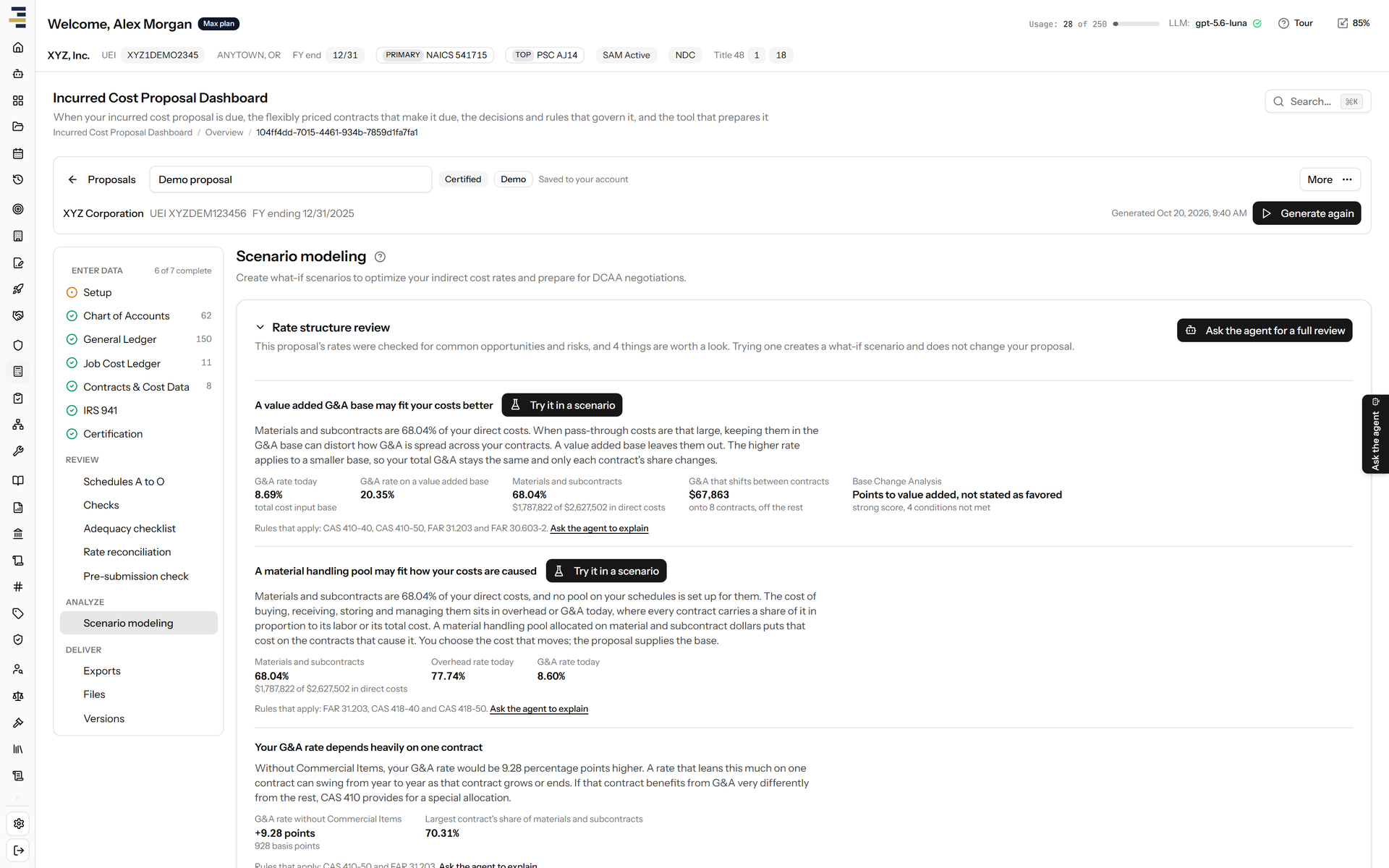
A rate structure review, with the agent one click away
The screens read the proposal's own rates and say why each option matters, with the rules that apply. Try it in a scenario, or ask the agent to explain.
Your next proposal, with an agent beside you
Open it beside any step, or ask for a full review from the rate structure review. With your rates shared, it reads the proposal's own figures, weighs them against the rules and DCAA's guidance, and lists every source it used under the answer. The same agent has its own tab for longer research, and each answer saves to your Workspace.
What the agent searches
Your proposal and your company
- Your flexibly priced awards, your SAM.gov fiscal year end and the due date it sets
- This proposal's rates, when you choose to share them
DCAA
- The Contract Audit Manual, chapter 6 first
- The 10100 incurred cost audit program, in the variant your contractor class selects
- The 47-question adequacy checklist, cited to DCAA's document
- DCAA's audit guidance memos and publications on the proposal
The regulations
- The FAR and DFARS rules that require, shape and settle the proposal
- The Cost Accounting Standards
The case law
- Decisions of the ASBCA, the Court of Federal Claims and the CBCA
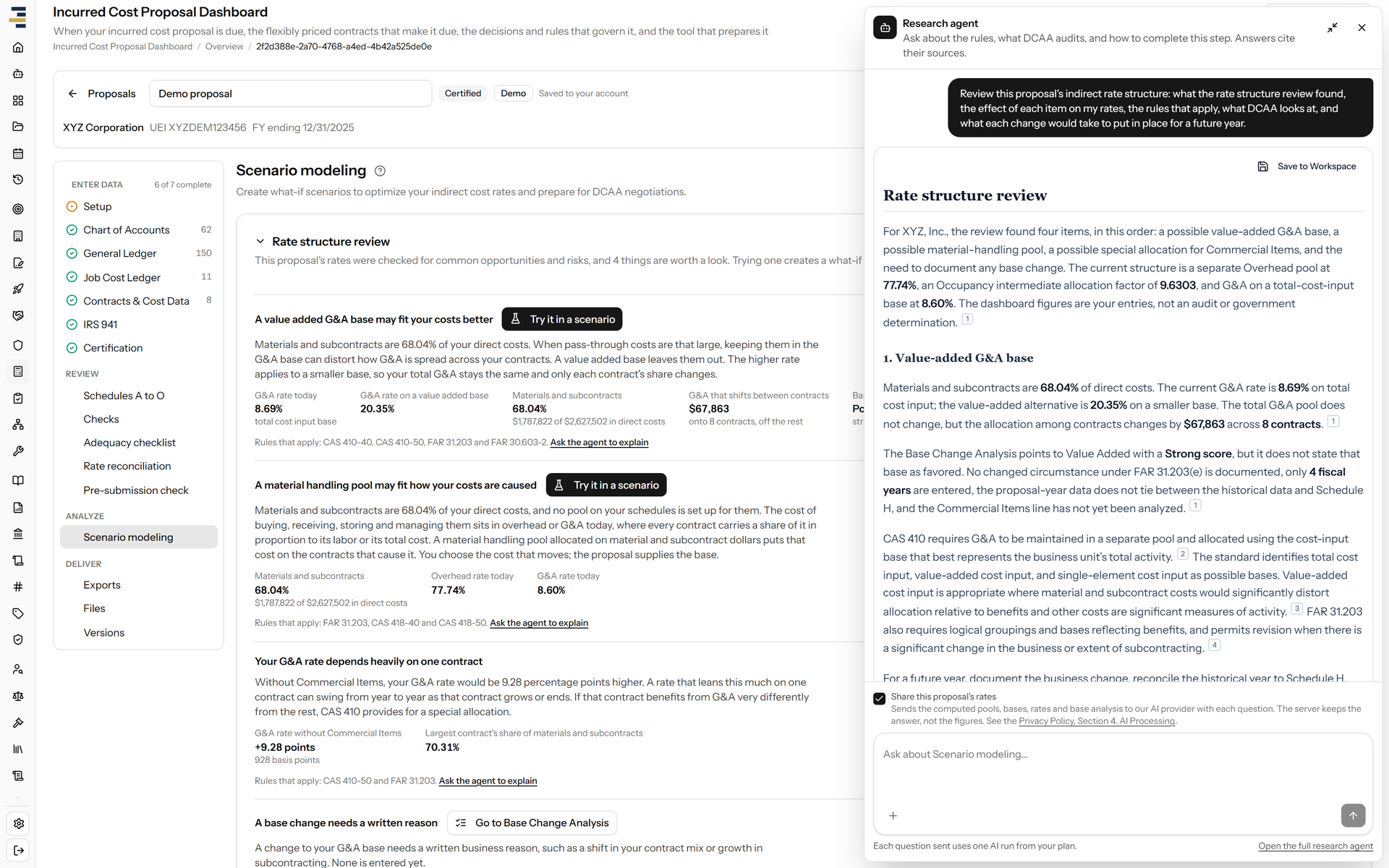
A full review of the proposal's rates
Asked from the rate structure review with the rates shared, the agent works from the engine's own figures. Any amount it writes that the tools did not return is flagged under the answer.
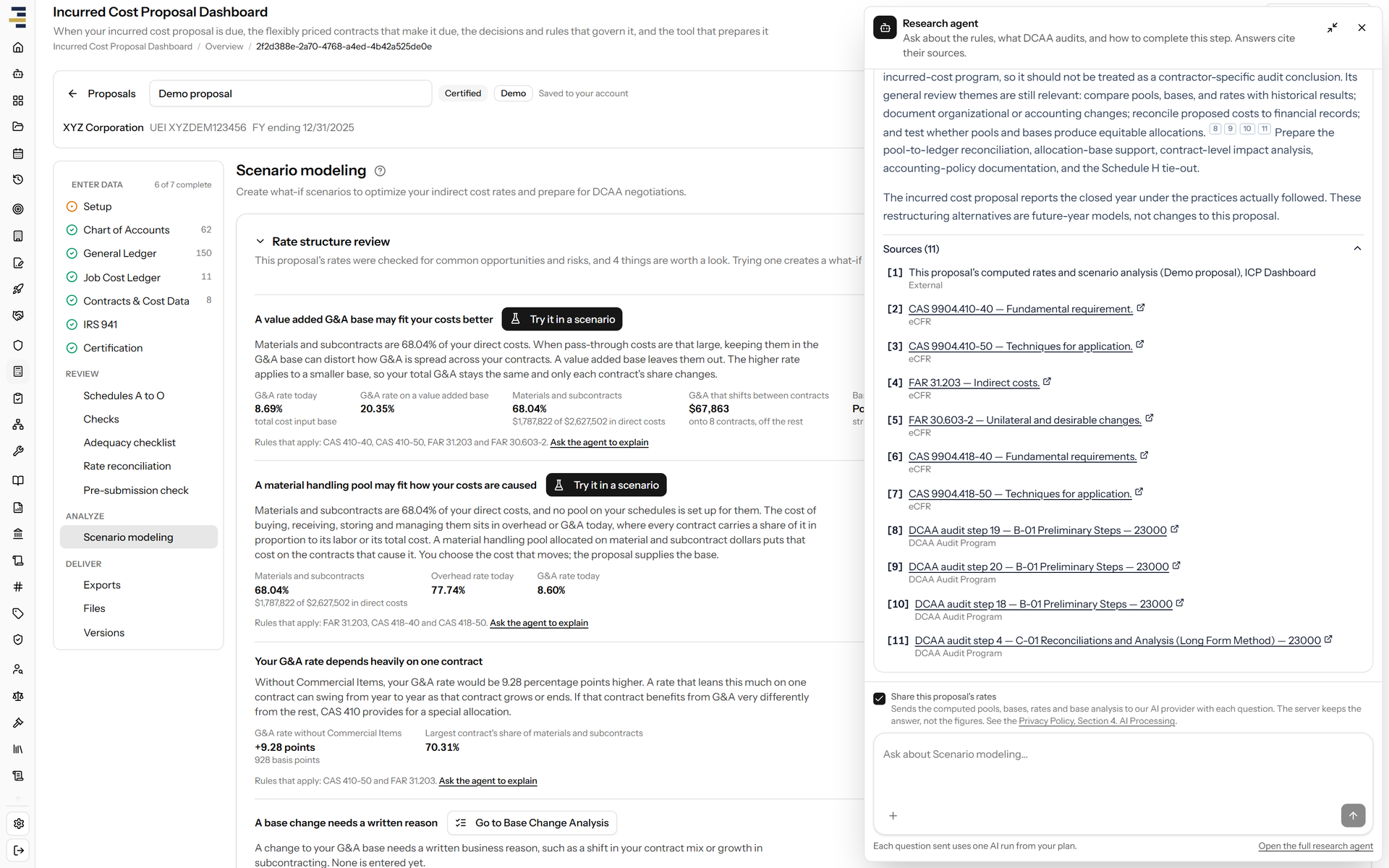
Every source it used, numbered to the answer
The Sources list is built from what the tools retrieved, never parsed from the prose, so each [n] in the answer opens the regulation, the DCAA document or the decision behind it.
AI that knows its place in a certified proposal
An officer of your company signs the Certificate of Final Indirect Costs (FAR 52.242-4), and the penalties for claiming expressly unallowable costs fall on the contractor (FAR 42.709). So the agent researches, explains and reviews, and it never writes a number into your schedules.
Every run is recorded in your AI Audit Trail, and every answer saves to your Workspace beside the proposal it was about.
The engine computes, the model does not
Every schedule, rate, tie and export is calculated by a deterministic engine. The agent reads those figures; it never produces one.
Every figure checked
Each dollar amount and percentage in an answer is matched against the numbers the tools returned, and anything that does not match is shown to you as unverified.
Sources from the tools, not the prose
Citations come from what the agent actually retrieved, numbered to the answer, each linking to the regulation, the DCAA document or the decision.
Your figures stay yours
The agent sees your proposal's rates only when you choose to share them. Company names, UEIs, CAGE codes and contract numbers are masked before any question leaves for the model.
Enter, review, analyze, deliver
One proposal per fiscal year, saved to your account. Start fresh, or roll last year's proposal forward so the setup, accounts and pools carry over and only the year's figures are new.
Enter
- Setup
- Chart of Accounts
- General Ledger
- Job Cost Ledger
- Contracts and Cost Data
- IRS 941
- Certification
Review
- Schedules A to O
- Checks
- Adequacy checklist
- Rate reconciliation
- Pre-submission check
Analyze
- Rate structure review
- What-if scenarios
- Base Change Analysis
Deliver
- Schedules in Excel and PDF
- DCAA ICE workbook
- Submission package
- Audit package
Roll forward
Next year's proposal starts from this year's setup, chart of accounts and pools.
Versions
Every saved state is kept as a version, and a restore keeps the current one first, so it can be undone.
Due date
The next due date, from your SAM.gov fiscal year end, on your dashboard and calendar.
What DCAA will check, checked first
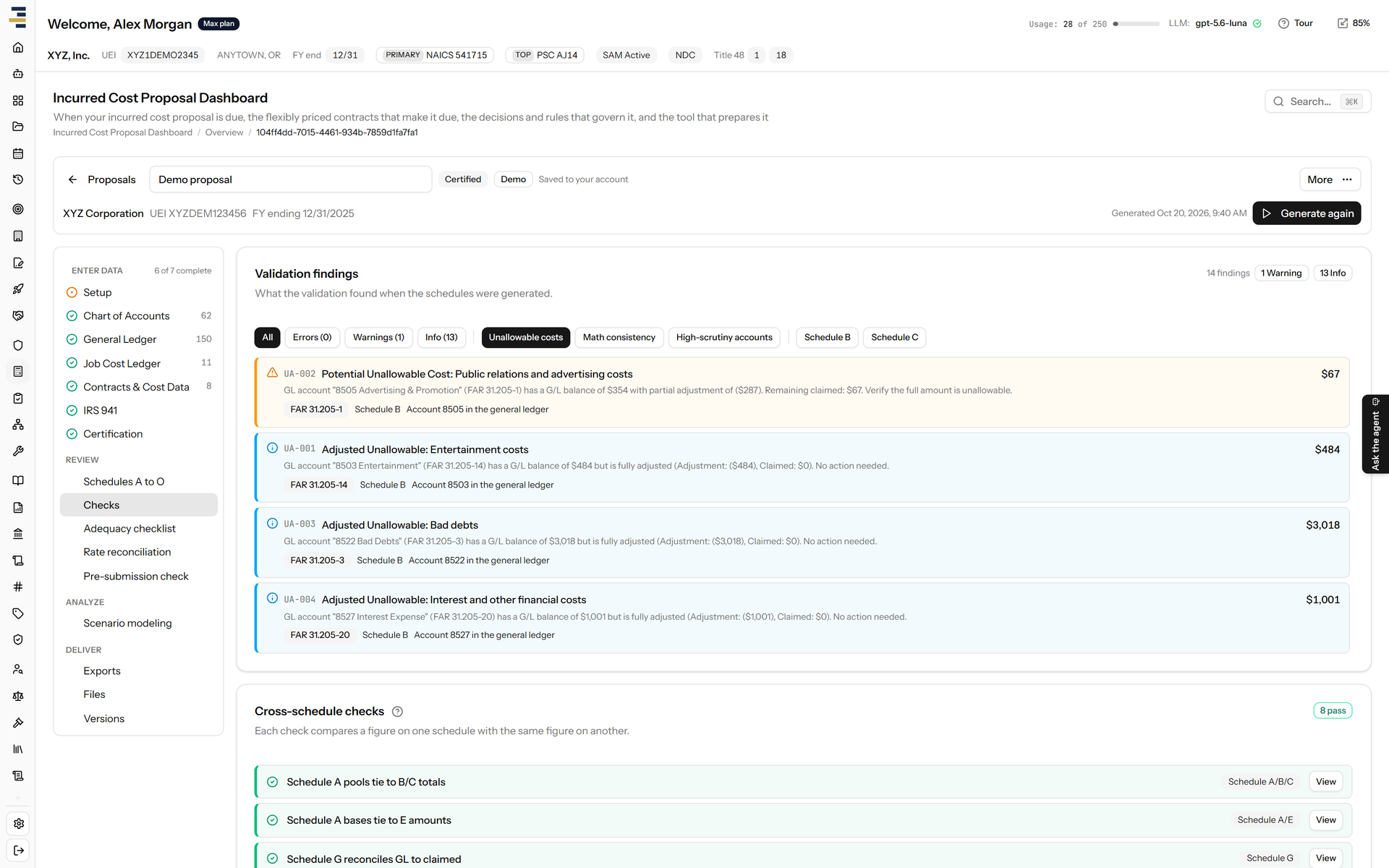
Unallowable costs and cross-schedule ties, before DCAA sees them
Each finding names the FAR 31.205 paragraph, the schedule and the general ledger account, and each tie compares a figure on one schedule with the same figure on another.
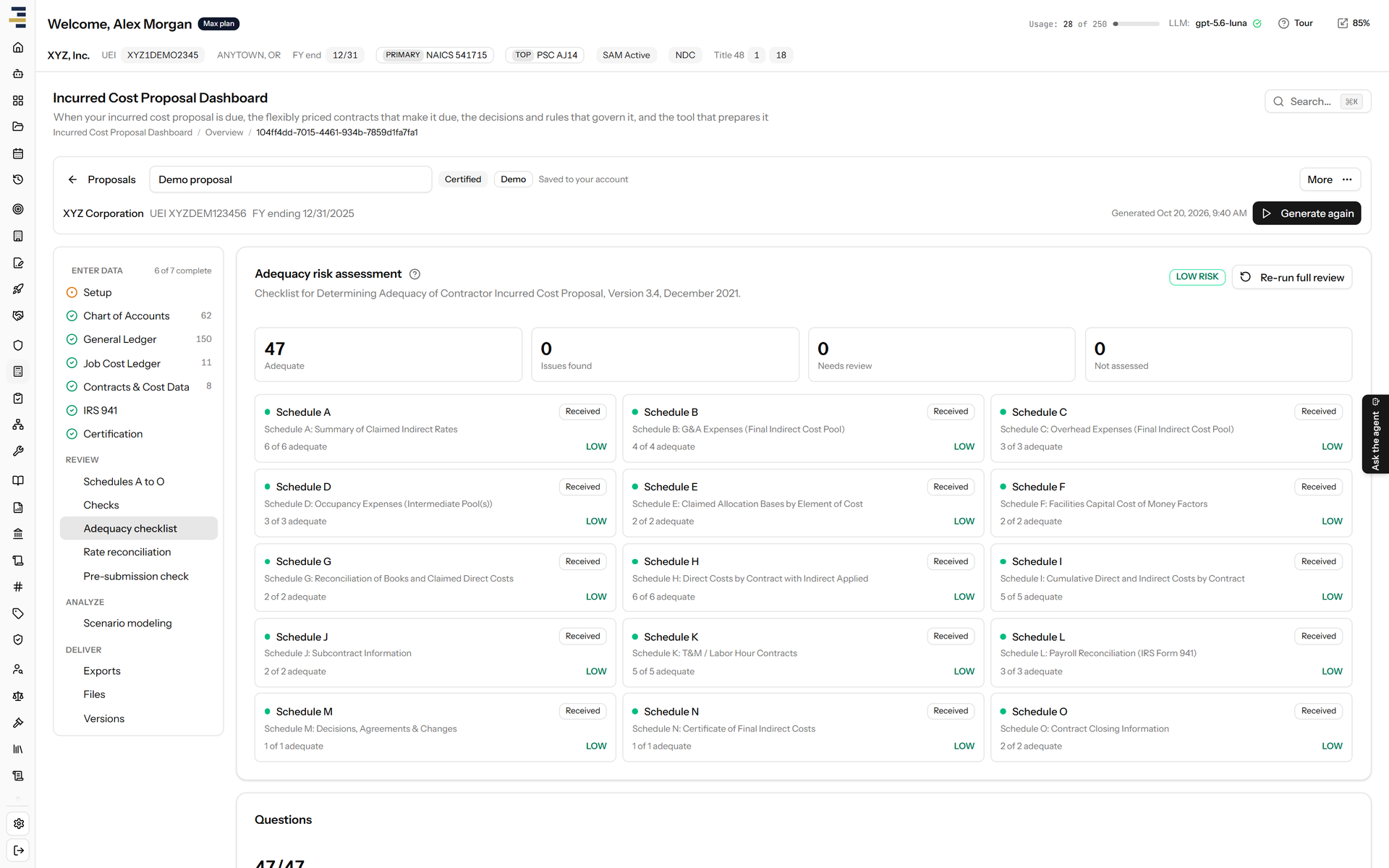
DCAA's 47 adequacy questions, schedule by schedule
The same checklist DCAA's auditors answer before accepting a proposal for audit, Version 3.4, December 2021, with a risk level for each schedule.
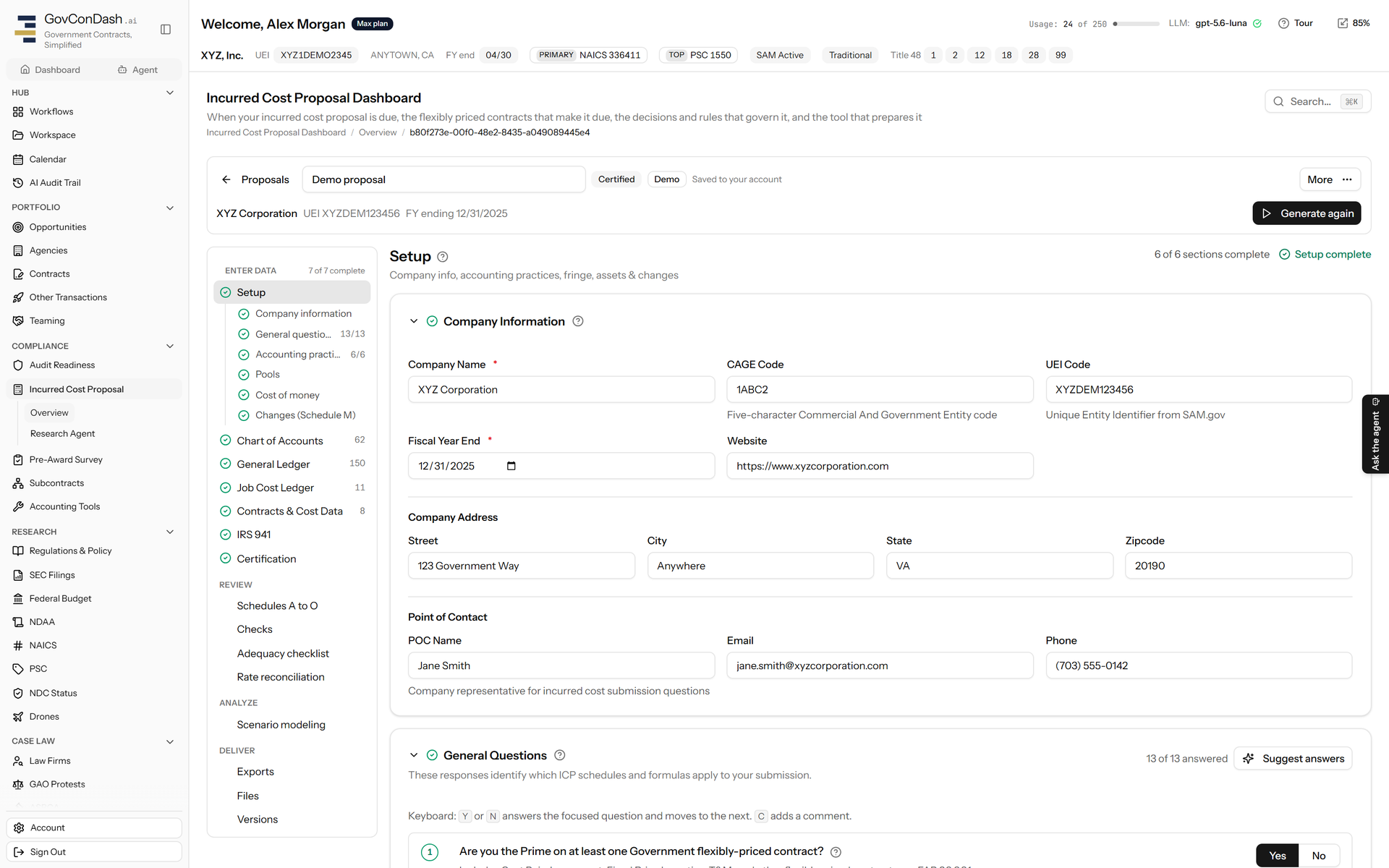
Seven guided steps, saved to your account
Setup captures your company, accounting practices, pools, fringe and changes, and the rail shows what is complete. Suggest answers fills the General Questions from your award history.
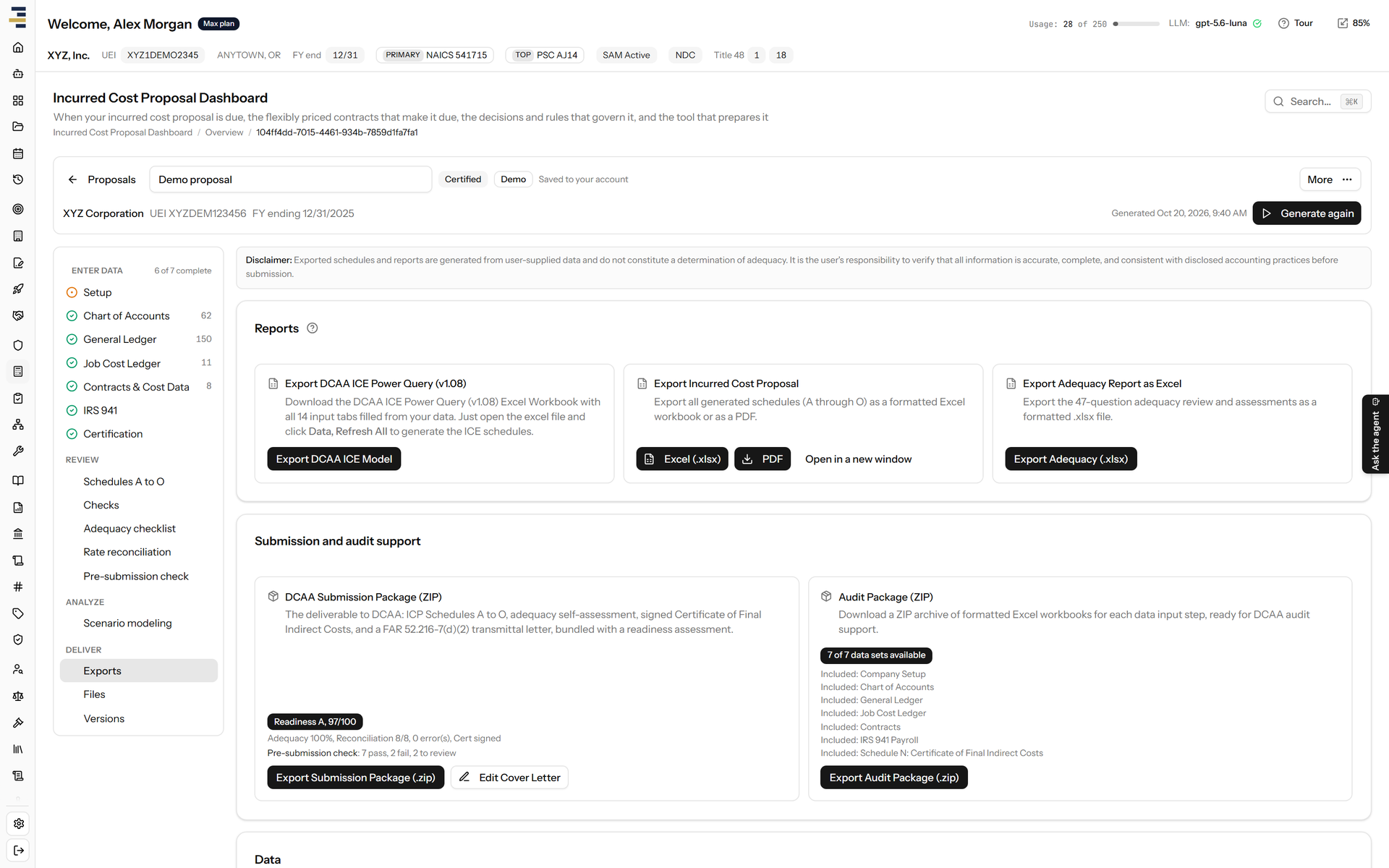
The submission package, ready to send
Schedules A to O, the adequacy self-assessment, the signed Certificate of Final Indirect Costs and the FAR 52.216-7(d)(2) transmittal letter, bundled with a readiness assessment. The cover letter is edited right in the workspace, and the schedules also export as Excel, as a PDF, or into DCAA's ICE workbook.
Every schedule DCAA expects
The workspace generates all 15 of DCAA's model schedules from your ledgers and answers, then ties them to each other: Schedule A's pools to the totals on B and C, its bases to Schedule E, and Schedule G back to the general ledger.
The Adequacy checklist then runs the 47 questions of DCAA's own checklist, and the pre-submission check lists eleven items to clear before you sign, including the executive compensation cap. It informs and never blocks.
- ASummary of Claimed Indirect Rates
- BG&A Expenses (Final Indirect Cost Pool)
- COverhead Expenses (Final Indirect Cost Pool)
- DOccupancy Expenses (Intermediate Pools)
- EClaimed Allocation Bases by Element of Cost
- FFacilities Capital Cost of Money Factors
- GReconciliation of Books and Claimed Direct Costs
- HDirect Costs by Contract with Indirect Applied
- ICumulative Direct and Indirect Costs by Contract
- JSubcontract Information
- KT&M and Labor Hour Contracts
- LPayroll Reconciliation (IRS Form 941)
- MDecisions, Agreements and Changes
- NCertificate of Final Indirect Costs
- OContract Closing Information
The case law on incurred cost audits
107 decisions of the three Contract Disputes Act forums GovConDash holds name the incurred cost proposal, its audit, or the final indirect rates it settles: the phrases incurred cost proposal, incurred cost submission, incurred cost audit, final indirect cost rate, final indirect cost rates or indirect cost rate proposal. The research agent searches them, and every one opens in full.
ASBCA
81ARMED SERVICES BOARD OF CONTRACT APPEALS, 2010 TO 2026
Allard Nazarian Group, Inc., dba Granite State Manufacturing
ASBCA Nos. 62413, 62414, July 27, 2023
Sustained / Appellant Prevailed“Our decision in Thorpe See-Op does not address the issue presented in these appeals and does not support a finding that the government may assess an indirect cost rate decrement to direct labor hour rates based upon appellant’s alleged failure to submit auditable final indirect cost rate proposals on time and material contracts.”
SRI International
ASBCA No. 56353, February 18, 2011
Sustained / Appellant Prevailed“Because DCAA lacks resources to audit every element of an incurred cost proposal, it identifies areas of costs it would examine based on "risk assessments" (tr. 2/9, 51).”
Strategic Technology Institute, Inc.
ASBCA No. 61911, January 5, 2022
Denied / Government Prevailed“Following submission of an ICP, the normal procedure is for the Defense Contract Audit Agency (DCAA) to audit the ICP, and for the contracting officer to set final incurred cost rates.”
CACI International Inc.
ASBCA No. 63663, May 6, 2025
Partially Sustained“CACI’s self-disclosure would have been sufficient to require waiving of the penalties if CACI had withdrawn the incurred cost proposal before DCAA began its audit.”
Allard Nazarian Group, Inc. dba Granite State Manufacturing
ASBCA Nos. 62413, 62414, January 31, 2024
Denied / Government Prevailed“We granted Allard’s motion, finding that appellant’s alleged failure to submit auditable final indirect cost rate proposals on its time and material contracts did not provide a proper basis for the government to then assess a decrement on Allard’s costs for direct labor, which were determined by contractually mandated and agreed upon hourly labor rates.”
The 5 that name the most of the phrases, of 81.
Court of Federal Claims
14U.S. COURT OF FEDERAL CLAIMS, 2006 TO 2025
Citizant, Inc.
No. 18-856, March 25, 2019
For plaintiff“The submission includes the contractor’s proposed final indirect cost rates, which are used to determine a final rate and adjust the interim payments.”
Reliability and Performance Technologies, LLC
No. 22-13, May 23, 2024
Split ruling“In short, a factfinder could reasonably conclude that the Government failed to promptly negotiate the final indirect rates as required under the Allowable Cost and Payment clause and that it did not have a valid basis to delay its negotiation of the final indirect rates.”
Information Systems & Networks Corp.
No. 06-387, May 26, 2020
Split ruling“In this opinion, the court holds that the unambiguous terms of an earlier settlement agreement between the United States and ISN bar ISN’s claim for declaratory relief regarding the correct final indirect cost rates for fiscal years (FY) 1987-1995.”
United States Enrichment Corp.
No. 13-365, June 3, 2015
Motion denied“Thus, in the context of a challenge to provisional rates, COs have the legal and factual basis for the final indirect rates sought by the contractor and the opportunity to rule on the contractor’s proposed final indirect rates.”
ATK Thiokol, Inc.
No. 99-440, May 31, 2007
Motion denied“Therefore, any final indirect cost rates and final payments due under these contracts will be resolved in the normal course of business by the DACO.”
The 5 that name the most of the phrases, of 14.
CBCA
12CIVILIAN BOARD OF CONTRACT APPEALS, 2009 TO 2023
Group Health Incorporated
CBCA 3407, January 22, 2015
Ruled on a motion“Even if the subcontract had run its normal course, the post-completion costs incurred by DCCS in supporting the Government’s audit and settling final indirect cost rates would still be allowable and allocable to the subcontract.”
Javis Automation & Engineering, Inc.
CBCA 938, November 13, 2009
Ruled on a motion“With respect to JAVIS’s fiscal years 2003 and 2004, the contracting officer adopted DCAA’s recommendation to apply a twenty percent decrement to direct and indirect costs.”
HPM Corporation
CBCA 7559, July 12, 2023
Dismissed on other grounds“The Board is in no position to impose some type of myopic limitation on the scope of documentation that auditors need to support an audit of the cost-reimbursement aspects of this contract or of HPMC’s indirect cost rates.”
CH2M WG IDAHO, LLC
CBCA 3876, September 7, 2017
Granted in part“Because the report did not identify any unallowable costs and final indirect rates have been approved, DOE-ID authorizes [CWI] to submit a fee invoice of $4,086,945, as requested in the referenced letter.”
Systems Management and Research Technologies Corporation
CBCA 4068, April 6, 2016
Granted in part“Contracting Officer may release up to 90 percent of the fee withholds under this contract based on the Contractor’s past performance related to the submission and settlement of final indirect cost rate proposals.”
The 5 that name the most of the phrases, of 12.
When the audit itself was the question
Decisions that quoted DCAA's incurred cost audit procedures, chapter 6 of the Contract Audit Manual, on how the audit was done.
Voxtel, Inc.
ASBCA No. 60129, March 9, 2023
Indirect costs. The manual says a nomenclature review alone cannot reject a cost, and the government never tested transactions.
HPM Corporation
CBCA 7559, July 12, 2023
Audit scope is a matter of audit judgment, and auditors and contracting officers share information.
Advanced Technologies Group, Inc.
ASBCA Nos. 59986, 61092, November 18, 2020
Incurred cost. DCAA rated a proposal low risk under the manual's sampling paragraph and skipped audit procedures.
The rules behind the proposal
“The Contractor shall submit an adequate final indirect cost rate proposal to the Contracting Officer (or cognizant Federal agency official) and auditor within the 6-month period following the expiration of each of its fiscal years. Reasonable extensions, for exceptional circumstances only, may be requested in writing by the Contractor and granted in writing by the Contracting Officer.”
The requirement
The clause that requires the proposal, and the deadline it sets.
- FAR 52.216-7 Allowable Cost and Payment
The clause that requires the proposal. Paragraph (d)(2)(i) sets the deadline and (d)(2)(iii) lists what an adequate proposal contains.
- FAR 16.307 Contract clauses
Prescribes when 52.216-7 goes into a contract, which is what makes a contract one that owes a proposal.
- FAR 42.703-2 Certificate of indirect costs
The certification that accompanies the proposal, signed at a level no lower than a vice president or chief financial officer.
- FAR 52.242-4 Certification of Final Indirect Costs
The clause carrying the certificate's text and the consequence of a proposal that includes expressly unallowable costs.
Settling the rates
How the final indirect cost rates are established once the proposal is in.
- FAR 42.705 Final indirect cost rates
The two roads to a settled rate: a contracting officer determination or an auditor determination.
- FAR 42.705-1 Contracting officer determination procedure
Which business units settle rates with a contracting officer, and the negotiation that follows the audit.
- FAR 42.705-2 Auditor determination procedure
When the cognizant auditor, rather than a contracting officer, establishes the final rates.
- FAR 42.703-1 Policy
The policy that a single agency establishes final indirect cost rates for each business unit, which every other agency then uses.
What the proposal may claim
The cost principles the claimed costs are tested against, and the penalty for claiming what they exclude.
- FAR 31.201-2 Determining allowability
The five tests a claimed cost has to pass, and the record the contractor must keep to show it did.
- FAR 31.201-6 Accounting for unallowable costs
Unallowable costs are identified and excluded from every billing, claim and proposal, and the directly associated costs go with them.
- FAR 31.203 Indirect costs
How indirect cost pools and allocation bases are formed, which is the arithmetic the proposal's schedules present.
- FAR 42.709 Penalties for Unallowable Costs
The penalty assessed when a final indirect cost rate proposal includes expressly unallowable costs.
- FAR 52.230-6 Administration of Cost Accounting Standards
For a CAS-covered contractor, the clause governing changes to the cost accounting practices the proposal rests on.
Billing and closeout
The provisional rates that run until the final ones settle, and how a contract closes after them.
- FAR 42.704 Billing rates
The provisional rates interim vouchers are paid on until the final rates settle.
- FAR 42.708 Quick-closeout procedure
Closing a physically completed contract before the final rates settle, within the limits the section sets.
- FAR 4.804-5 Procedures for closing out contract files
The closeout steps that wait on settled final indirect cost rates.
Department of War
The DFARS provisions that apply the same rules on a defense contract.
- DFARS 252.242-7006 Accounting System Administration
The accounting system criteria a defense contractor's proposal is prepared under, and the withholds that follow a significant deficiency.
- DFARS 242.705-1 Contracting officer determination procedure
The defense supplement to FAR 42.705-1.
- DFARS 242.705-2 Auditor determination procedure
The defense supplement to FAR 42.705-2.
Who decides a questioned cost
After the audit: the auditor advises, the contracting officer decides, and a final decision can be appealed.
- FAR 42.101 Contract audit responsibilities
The auditor's job is advice on the acceptability of incurred and estimated costs. A questioned cost is a recommendation until a contracting officer adopts it.
- FAR 42.201 Contract administration responsibilities
A contract assigned for administration goes to a contract administration office. For a Department of War contractor that is almost always DCMA.
- FAR 42.302 Contract administration functions
The office issues the notice of intent to disallow, establishes the final indirect cost rates, and issues decisions under the Disputes clause.
- FAR 42.705-1 Contracting officer determination procedure
Final indirect cost rates are settled by the cognizant administrative contracting officer.
- FAR 33.211 Contracting officer's decision
A final decision starts two clocks: 90 days to the Board of Contract Appeals or 12 months to the Court of Federal Claims. No decision within the required time is a deemed denial.
Prepare it on Pro
Pro and Max
Prepare, check and deliver the proposal. Monthly Pro starts with a 14-day free trial.
- Saved proposals in the guided workspace, with roll-forward and versions
- The Incurred Cost Research Agent, in its own tab and beside every step
- Checks, the adequacy review, the pre-submission check and scenario modeling
- Excel, PDF, DCAA ICE workbook, submission package and audit package exports
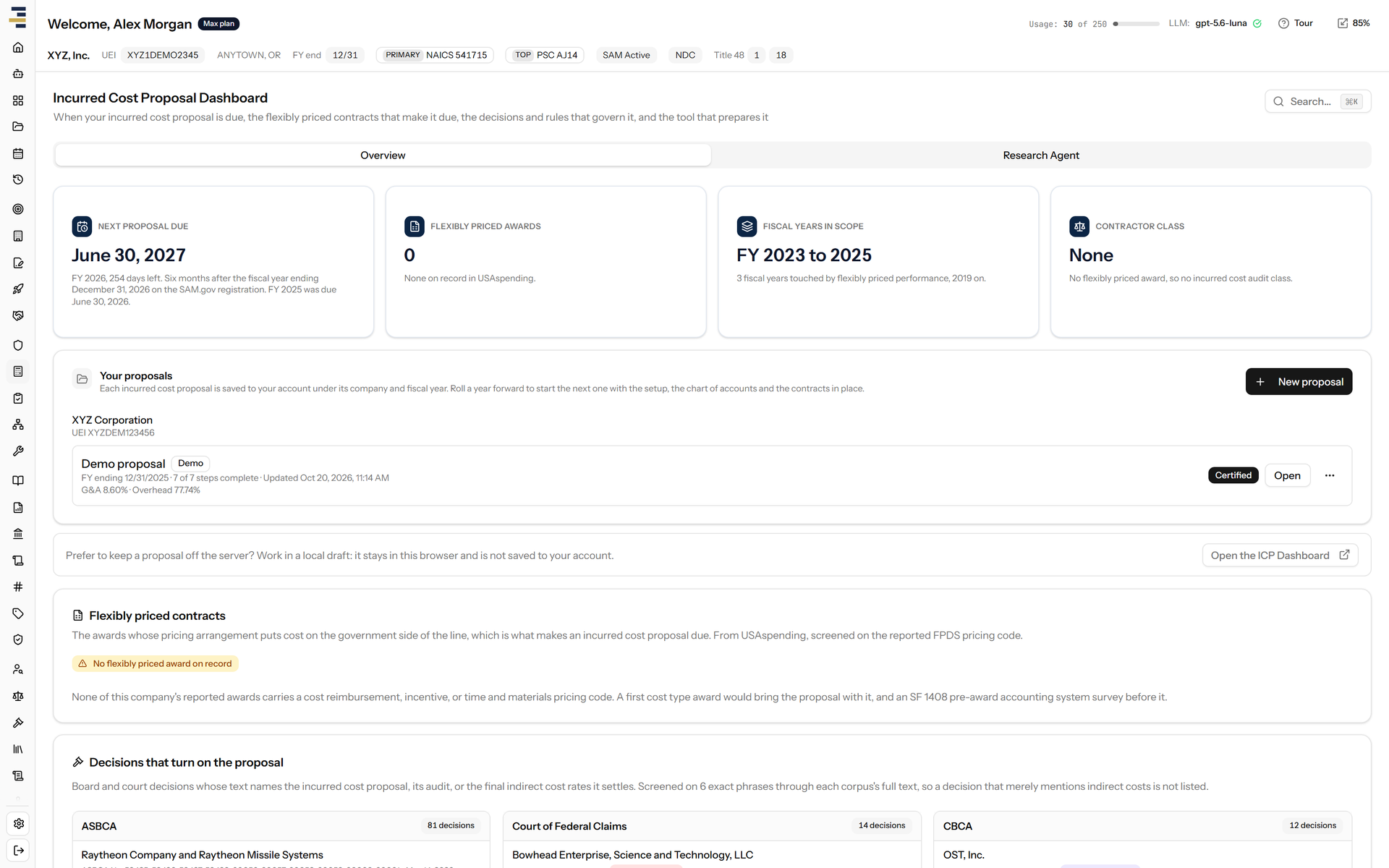
Incurred cost proposal questions
What is an incurred cost proposal?
It is the final indirect cost rate proposal a contractor with flexibly priced contracts (cost-reimbursement, time-and-materials, labor-hour and fixed-price incentive with adjustable rates) submits after each fiscal year, so the government can settle final indirect rates. FAR 52.216-7(d)(2)(i) requires it: "The Contractor shall submit an adequate final indirect cost rate proposal to the Contracting Officer (or cognizant Federal agency official) and auditor within the 6-month period following the expiration of each of its fiscal years. Reasonable extensions, for exceptional circumstances only, may be requested in writing by the Contractor and granted in writing by the Contracting Officer."
When is the incurred cost proposal due?
Within six months after the end of each fiscal year. A contractor whose fiscal year ends December 31 owes its proposal by June 30. Extensions are for exceptional circumstances only, requested and granted in writing. GovConDash reads your fiscal year end from your SAM.gov registration and shows the next due date on the free Overview.
What is an agentic incurred cost proposal?
A proposal prepared with an AI research agent working beside you at every step. The agent retrieves the rules, DCAA's guidance and the case law that apply to the step you are on, reviews your rate structure when you share it, and cites every source it used. A deterministic engine still computes every schedule and rate, so the figures you sign are the engine's, not the model's.
Does the AI calculate my indirect rates?
No. Schedules A through O, the rates, the cross-schedule ties and every export are computed by the same deterministic engine whether or not you use the agent. The agent reads those figures, and every amount or percentage it writes is checked against the numbers its tools returned.
What case law does the research agent search?
Decisions of the Armed Services Board of Contract Appeals, the Court of Federal Claims and the Civilian Board of Contract Appeals. 107 of them name the incurred cost proposal, its audit, or the final indirect cost rates it settles, and the agent cites each decision it relies on so you can open it in full.
Is my proposal data sent to the AI model?
Only what you choose. Your proposal's rates travel with a question only when you tick Share this proposal's rates, and company names, UEIs, CAGE codes and contract numbers are masked before any question reaches the model. Every agent run is recorded in your AI Audit Trail.
Will DCAA accept a proposal prepared in GovConDash?
DCAA accepts a proposal that is adequate, whatever tool prepared it. The workspace produces DCAA's model Schedules A through O, runs the 47 questions of DCAA's own adequacy checklist, and also exports the DCAA ICE Power Query workbook filled from your data, if you or your auditor prefer DCAA's model. Adequacy is still your determination to make.
Authoritative sources
Start with DCAA's Information for Contractors, whose Enclosure 7 walks through the proposal, then the documents the auditor and the contracting officer work from.
Information for Contractors (DCAAM 7641.90), Enclosure 7: Incurred Cost Proposals
DCAA's own guide for contractors. Enclosure 7 walks through the proposal, its schedules and the adequacy review.
Checklist for Determining Adequacy of Contractor Incurred Cost Proposal
DCAA's own adequacy checklist: the 47 questions, schedule by schedule, the auditor answers before accepting a proposal for audit. The ICP Dashboard's Adequacy Review runs these same questions.
Directory of Audit Programs
Where DCAA publishes the audit programs, including the two incurred cost programs the Audit Program Explorer carries.
Memoranda for Regional Directors
DCAA's audit guidance memos. The ones whose subject names incurred cost are listed on this page from the corpus.
Selected Areas of Cost Guidebook
DCAA's own chapter-by-chapter guidance on the FAR 31.205 cost principles a proposal is tested against.
DCMA Manual 2201-03, Final Indirect Cost Rates (effective August 15, 2024)
The manual the DCMA administrative contracting officer follows to establish final indirect cost rates once DCAA's audit of the proposal is in, which is the FAR 42.705-1 procedure from the government's side of the table.
DCMA Policy-type Memorandum 26-006 (June 16, 2026)
The Revolutionary FAR Overhaul update to Manual 2201-03: how DCMA applies the FAR deviations effective March 16, 2026 to final indirect cost rate settlement. Read it with the FAR Overhaul overlay under Regulations & Policy.
 GovConDash.ai
Prepare it on Pro.Submit it adequate the first time.
Prepare your proposal in the agentic incurred cost workspace, with the research agent beside each step and your contracts, your audit readiness and the regulations next to it in GovConDash. Monthly Pro starts with a 14-day free trial.
Exports schedules, the adequacy review and DCAA's ICE workbook