


































01A venture of 31 months, a dispute of 23 years
In February 2003, weeks before the invasion of Iraq, IAP Worldwide Services signed an agreement with a Kuwaiti businessman. The document was titled Joint Venture Contract. It recited that the two would establish a joint venture company with limited liability, split ownership 51 percent to him and 49 percent to IAP, put every government contract in IAP's name, and divide the profits. IAP would manage; he would supply the local administrative, legal and logistical support a foreign contractor cannot supply for itself.
The work was real and substantial. IAP ran a heavy lift contract moving equipment out of Kuwait into Iraq and performed construction and base operations under the Air Force Contract Augmentation Program, on delivery orders carrying the allowable cost and payment clause at FAR 52.216-7. There is an irony in the paperwork worth noticing early: those government contracts carried DFARS 252.233-7001, which says the contract is construed under the substantive laws of the United States, while the sponsorship agreement behind them said Kuwaiti law governed and only the Kuwaiti courts were competent. The company chose two different legal systems for two halves of the same operation.
The limited liability company was never formed. In September 2005 IAP terminated the agreement, wrote that it was not a shareholder in any entity the sponsor owned, and proposed a transition agreement stating the joint venture company never came into existence. The sponsor did not sign it. He sued in Kuwait instead, and in 2017 the Kuwait Court of Appeal entered judgment against IAP for $78,779,449 plus expenses, fees and interest. He then went to Florida to have that judgment recognized, and succeeded.

Meanwhile the costs of defending all of this were going into IAP's indirect rates. The Defense Contract Audit Agency advised in February 2018 that they were expressly unallowable. The contracting officer disagreed in writing that August, telling IAP the costs were not expressly unallowable and would be subject to normal audit procedures for reasonableness and allocability. Two months later the agency reversed, after a meeting with IAP executives, and by November the contracting officer had concurred. That sequence is the single most quotable thing in the record for anyone who has ever relied on a favorable letter: the position that mattered was the one the government held when it issued its final decision.
Two certified claims followed, two final decisions denied them, and two appeals were consolidated. The Board decided them together on cross motions for summary judgment.
02The company was never formed, and it did not matter
Start with the text, because the Board did. Costs are allowable to the extent they are reasonable, allocable and allowable under the cost principles, which is FAR 31.204(a). One of those principles governs legal proceedings, and inside it sits the paragraph this appeal is about. An expressly unallowable cost, per FAR 31.001, is one that an applicable law, regulation or contract specifically names and states to be unallowable. The Board has long treated this paragraph as doing exactly that.
Costs of legal, accounting, and consultant services and directly associated costs incurred in connection with the defense or prosecution of lawsuits or appeals between contractors or subcontractors arising from either . . . (i) An agreement or contract concerning a teaming arrangement, a joint venture, or similar arrangement of shared interest.
The FAR does not define joint venture, so the Board looked outward: to the DCAA guidebook both parties cited, to its own prior decisions, and to the general law of partnerships. Its working definition came from an earlier appeal, where it had said a joint venture is an association of partners established by contract to carry out a single business activity for joint profit, essentially a partnership created for a limited purpose. Notice what that definition does not require. It does not require an entity. It requires a contract and a shared purpose.
Against that standard the agreement failed on its own face. The parties combined their efforts, one contributing government contracting expertise and the other local access. Both participated in the management. Both shared the profits by percentage. The joint account was controlled by both parties and no amendment was valid unless both signed it. The Board found that combination sufficient to evidence joint control, and held the plain language of the agreement evidenced a joint venture. The failure to incorporate, it said, did not negate the existence of the partnership the agreement had already created.
IAP argued
The Board held
The alternative holding is the one to remember, because it is the one that will decide the next case. Even if this were not a joint venture, the Board said, it would apply the principle that a word is known by the company it keeps and conclude the arrangement was a similar arrangement of shared interest. It reasoned from the definition of a contractor team arrangement at FAR 9.601 and the policy at FAR 9.602(a), where companies with complementary capabilities combine for a shared interest in a government contract. A joint venture and a teaming arrangement are both partnerships of complementary companies; the catchall exists to catch the other structures that do the same thing.
That is a very wide net, and it is worth being clear about how wide. A practitioner who reads the paragraph looking for the words “joint venture” and concludes it does not apply has read one third of the operative sentence.
03Six weeks later, the same job, a different structure
Here is the part of this record that is actually useful, and it is easy to miss because the decision mentions it only in passing. On October 1, 2005, one day after the Joint Venture Contract terminated, IAP appointed a different Kuwaiti to be its local sponsor. It needed exactly the same thing it had needed in 2003: someone local who could hold licenses, sponsor visas and deal with Kuwaiti authorities. It structured the relationship completely differently.
Joint Venture Contract
Signed February 10, 2003
- Recited that the parties would establish a joint venture company with limited liability
- Ownership split 51 percent to the sponsor and 49 percent to IAP
- The sponsor took a percentage of net profit; IAP took a general administration fee and a management fee
- A joint account controlled by both parties, and no amendment valid unless both signed
- Silent on the sharing of losses
- Governed by Kuwaiti law, with only the Kuwaiti courts competent
Litigation over it produced $13,018,487.82 of legal costs the Board held expressly unallowable.
Service Agency Agreement
Signed October 1, 2005
- Titled a service agency agreement, appointing an agent to provide named services
- The agent an independent contractor, not an employee, unable to bind IAP or act for it
- Paid a percentage of gross revenues, from two percent down to one half of one percent by contract type and value
- No ownership, no entity and no profit share
- No joint account and no joint control
- Extended by amendment two years later
The agency itself pointed to this agreement as the thing a joint venture is not.
The difference that carries the most weight is the fee base. The first agreement paid the sponsor a share of profit. The second paid a percentage of revenue. Profit participation is one of the three characteristics of joint control the guidebook names, alongside joint property and joint liability for losses; a percentage of revenue is a price for a service. Everything else follows from that choice, and the second structure scores a zero on every characteristic the first one scored on.
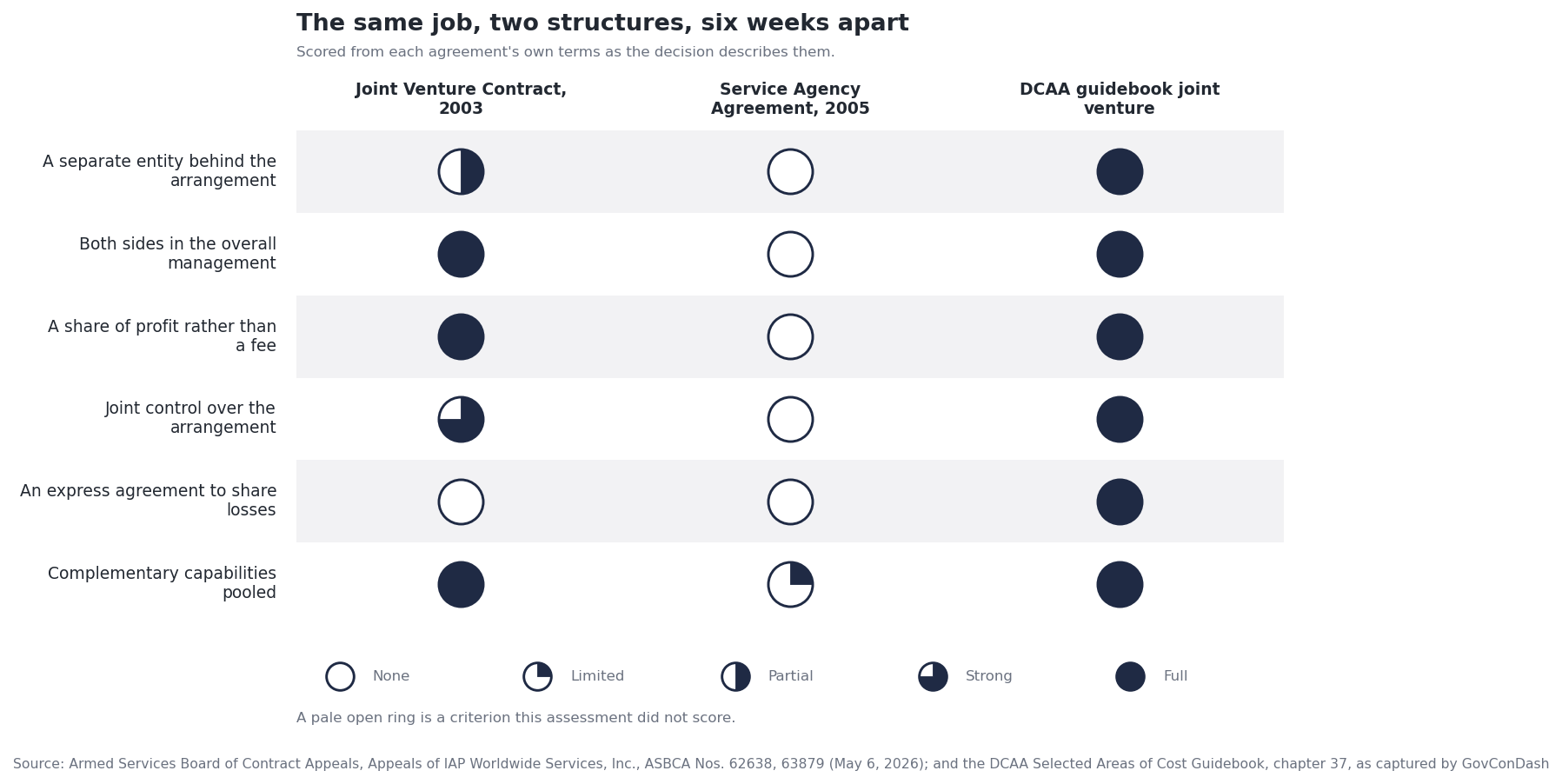
The Board scored the first agreement as it did because the document told it to. But note the one place where the appellant was plainly right on the facts and still lost: the express agreement to share losses. The characteristic is missing from the agreement, the guidebook the government audits from names joint liability for losses as a characteristic of joint control, and the Board held the arrangement a joint venture anyway. Being right about a fact is not the same as being right about the rule.
04The exception is narrower than it reads
The paragraph is not absolute. It carries two exceptions, and IAP argued the first one.
. . . are unallowable, except when (A) Incurred as a result of compliance with specific terms and conditions of the contract or subcontract or written instructions from the contracting officer; or (B) When agreed to in writing by the contracting officer.
The argument had real structure. IAP's contracts required it to obtain the licenses and permits necessary to perform and to comply with local law; FAR 52.236-7 says so in terms, and a host nation requirements clause said it again. Kuwaiti commercial law at the time barred a non-Kuwaiti from carrying on trade without one or more Kuwaiti partners holding at least 51 percent of the capital. Put those together and the sponsorship arrangement looks like compliance with the contract rather than a business venture of IAP's own choosing.
The Board rejected it on three grounds, and the reasoning travels well beyond this paragraph. First, there were no cases construing this exception at all, so it looked at the identical language elsewhere in the regulation. The fines and penalties principle at FAR 31.205-15(a) carries the same compliance-with-specific-terms exception, and the Federal Circuit has read that language narrowly: it reaches penalties resulting from particular work directly required by the contract, not anything within the scope of the work, because a scope-of-work reading would make virtually every penalty recoverable.
Second, none of IAP's clauses required this arrangement. They required licenses, permits and compliance with local law. They did not say how to obtain them, and they certainly did not require a joint venture; the service agency agreement IAP signed six weeks later is the proof that the same obligations could be met another way. Third, the clause IAP leaned on points the other direction on its face, because it requires the contractor to comply with local law without additional expense to the government.
The second exception, a contracting officer's written agreement, is not analyzed in the decision. It is worth pausing on anyway, because IAP had something that looked like it: a 2018 letter from the contracting officer saying these very costs were not expressly unallowable. A letter characterizing a cost is not an agreement to allow it, and it was withdrawn before any claim was filed.
05What it cost, and what it could have cost
The money moved in two tranches. The first certified claim sought $4,610,092 for legal defense costs incurred over four fiscal years. The second, filed more than four years later, sought $8,408,395.82, which was IAP's calculation of the share allocable to its cost-type contracts out of $12,357,732 in total defense costs for the Kuwait and Florida litigation across the later fiscal years.
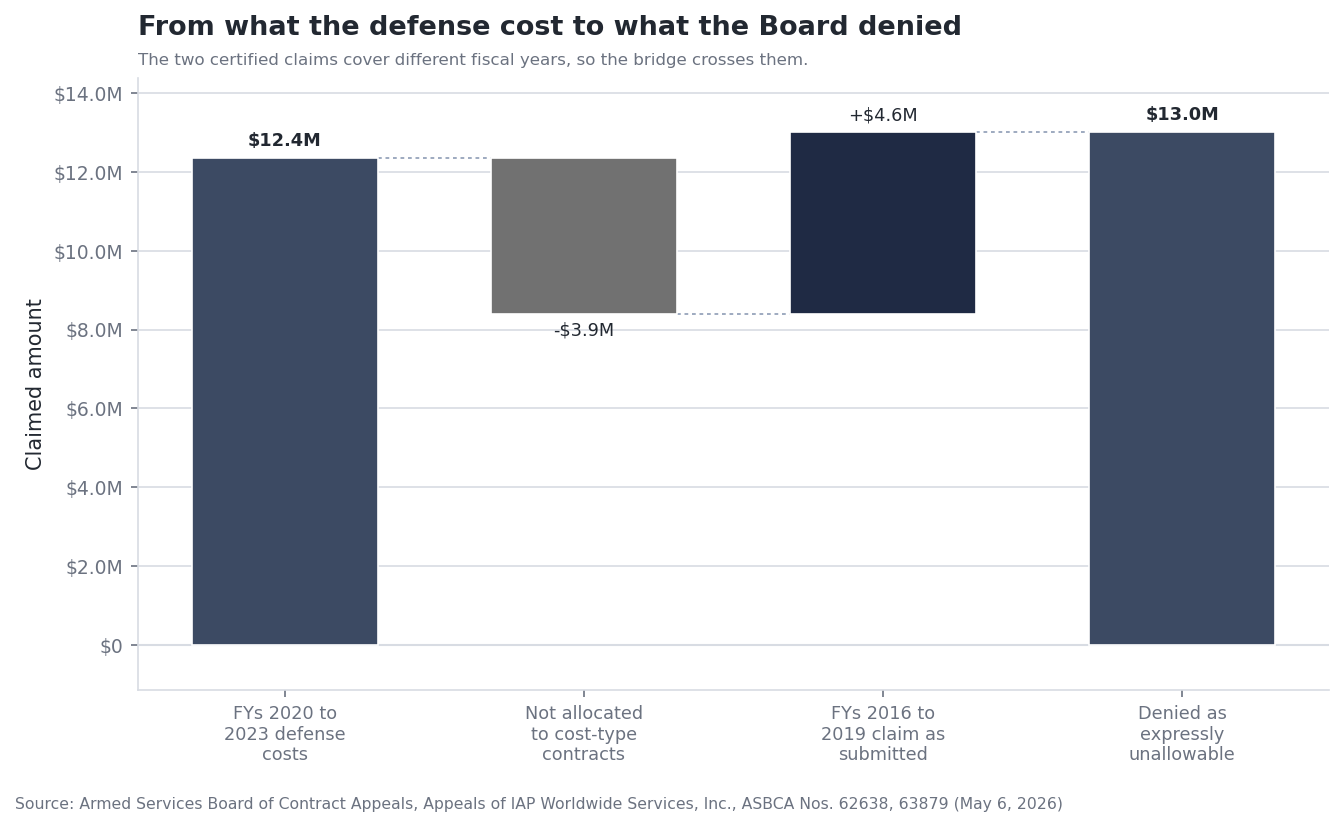
Set that against the underlying exposure and the proportions are worth noting. The Kuwait judgment itself was $78,779,449. The legal costs of resisting it, across both claims, came to $13,018,487.82, all of it denied. The contracting officer had also found the costs unreasonable under FAR 31.201-3 and therefore unallowable under FAR 31.201-2, on the theory that entering the agreement and then breaching it was not the conduct of a prudent business. The Board never reached that, having decided the case on the cost principle.
And there is a fourth number that is not in this decision, which is the one to think hardest about. The Board recorded in a footnote that the government did not seek penalties, because IAP had excluded these costs from its incurred cost submissions and pursued them by claim instead. That is the whole difference between this outcome and a considerably worse one. Claiming a cost that turns out to be expressly unallowable gets the claim denied. Including the same cost in an incurred cost submission exposes the contractor to the penalties at FAR 42.709, which run to the amount of the disallowed cost and, in the aggravated case, to twice that. IAP litigated a rule nobody had litigated before and lost. It did so without a penalty, because it flagged the costs and asked rather than billing and hoping.
06One paragraph, one decision, and a guidebook that leaves out the catchall
The Board said, in passing, that there are no cases on point addressing this exception. That is the kind of statement worth checking rather than accepting, and this platform can check it. Across 5,364 decisions held with their verbatim text, 822 Court of Federal Claims opinions and 4,542 ASBCA decisions, the cost principle on legal proceedings is named in 35. Its paragraph (f) is named in 14. The subparagraph the appeal turns on is named in exactly one, and it is this decision. The operative phrase, similar arrangement of shared interest, returns the same single result.
The narrowing is what makes that meaningful. If the corpus could not find nested citations at all, the count would be zero at every level; instead it falls from 35 to 14 to one, exactly as a real nesting should. This is not an obscure corner of the FAR that nobody reaches. It is the second most litigated cost principle in these two corpora, behind only compensation for personal services.
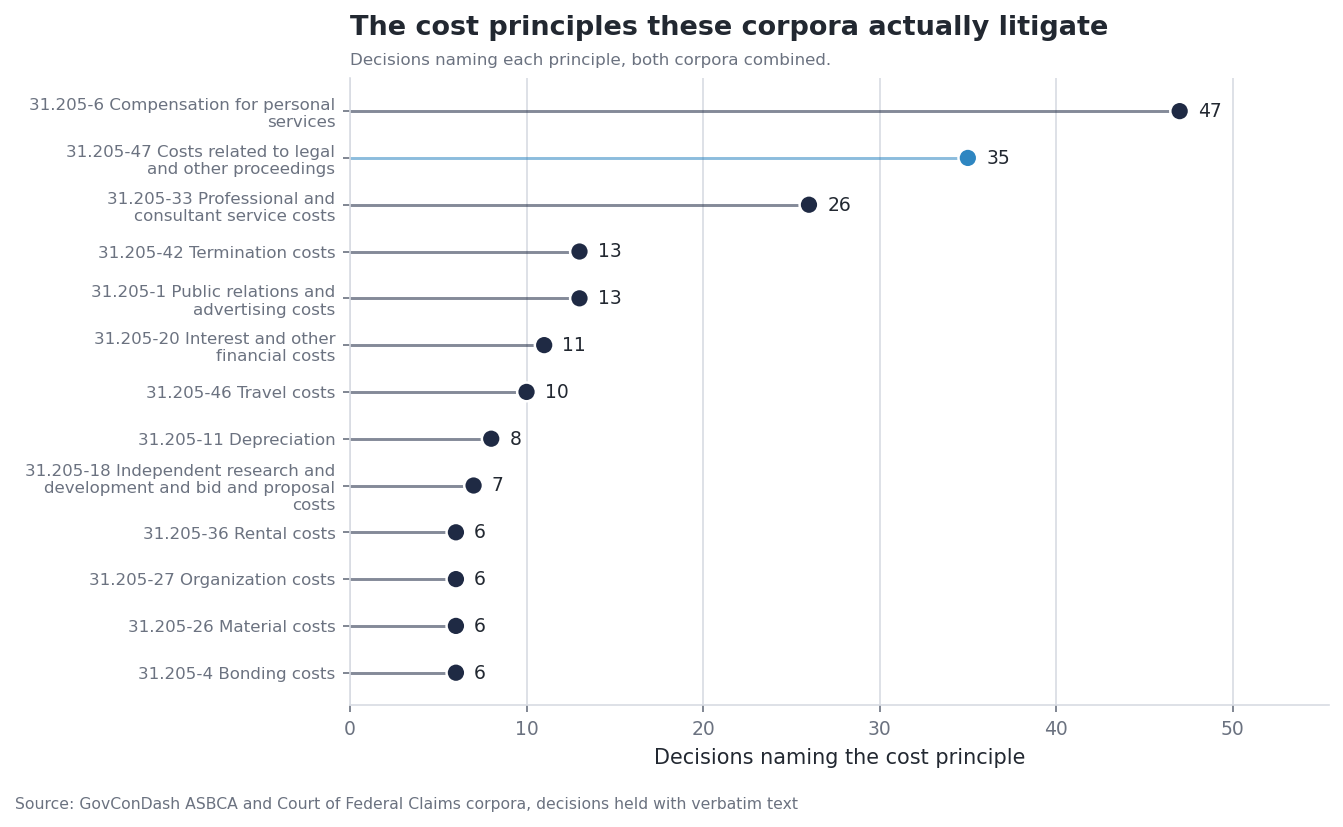
That last point is a nice piece of drafting history the Board walks through. The paragraph was not in the original FAR. Congress directed the councils to clarify several cost principles in the Defense Procurement Improvement Act of 1985, and the proposed rule that followed added this language to FAR 31.205-33 on professional and consultant service costs. The final rule added the compliance exception. The whole paragraph moved to its current home in 1989, and in 2023 the words “or subcontractors” were added. The two sections that have carried this text over its life are the second and third most litigated cost principles in these corpora.
Which brings us to the finding a contractor should actually act on. Both parties briefed from the DCAA Selected Areas of Cost Guidebook, and the Board addressed it at length while noting it is not binding and certainly not dispositive. This platform holds that guidebook, all 75 chapters of it, including chapter 37 on joint ventures and teaming arrangements and chapter 41 on legal and other proceedings. Checking the Board's quotations against our own captured copy rather than against the opinion's transcription of it turns up something the opinion does not comment on.
Chapter 41 restates this exact rule. It lists as unallowable the defense or prosecution of lawsuits between contractors arising from such agreements as a teaming arrangement, joint venture, dual sourcing, coproduction or similar programs, and it cites the subparagraph directly. It cites the section 46 times in all. What it never says, in that chapter or in any of the other 74, is “similar arrangement of shared interest”. The guidebook's paraphrase collapses the two clauses of the rule and drops the catchall between them, which is precisely the language the Board used for its alternative holding.
That is an absence, so it needs a control before it means anything. The guidebook cites this cost principle across 5 of its chapters, and the codified section carries the phrase. So the guidebook is not silent on the section, and the phrase is not a recent addition. An auditor or a contractor working from the guidebook alone would simply never encounter the words that decided this case.
07Takeaways
Read the whole operative phrase, not the words you recognize. The rule catches a teaming arrangement, a joint venture, or a similar arrangement of shared interest. The third clause is the one with no definition and no case law, and it is now the one with a Board holding behind it. Any arrangement where you and another company pool complementary capabilities and divide the return is inside it, whatever the document is called.
Pay a fee, not a share, unless you intend a joint venture. A percentage of profit is a joint venture marker; a percentage of revenue is a price. In this record the same company did it both ways in the same year, and only one of them generated an unallowable cost. If a local sponsor, referral partner or introducer can be paid on revenue for named services as an independent contractor who cannot bind you, that is a materially different regulatory position.
Do not rely on an entity that was never formed, or a clause that was never written. The two facts most in IAP's favor, no company and no loss-sharing provision, both failed. Absence of formality is not absence of arrangement. If you are relying on either to keep costs allowable, you are relying on the two arguments this decision has now rejected.
A favorable contracting officer letter is not the written agreement the exception requires. IAP held a letter saying these costs were not expressly unallowable, and it was withdrawn. The exception in the rule is a contracting officer agreeing in writing to the costs, not characterizing them. If you need that protection, ask for it in those terms and get it before you incur.
Claim a doubtful cost; do not bill it. The reason this decision cost IAP the claim and nothing more is that it excluded these costs from its incurred cost submissions and pursued them by certified claim. That choice, made years before anyone knew how the appeal would come out, is what kept the penalty regime out of the case entirely.
Do not audit yourself against a paraphrase. The guidebook the government audits from restates this rule without the phrase that decided the appeal. Guidance is a finding aid. When real money turns on a cost principle, read the codified text, then read what tribunals have done with it.
How this piece was grounded: every quotation, date and dollar figure above was re-located in the decision's own captured text, all 67,651 characters across 24 pages, with whitespace normalized on both sides because a PDF text layer breaks sentences and numbers mid-line. Every corpus count is a live query over the 822 Court of Federal Claims opinions and 4,542 ASBCA decisions this platform holds with verbatim text, and a decision counts under a cost principle when its own text names it. The guidebook findings were checked against this platform's captured copy of the guidebook rather than against the opinion's transcription of it, and each absence is reported with the control that makes it evidence. Every regulation linked in the prose points at the eCFR URL its seeded section row records, never one constructed here. 165 anchors were verified in total, and a figure that fails that check stops the build. This piece is commentary on a public decision and published rules, not legal advice.

GovConDash.ai
Check the rule against the record, not the paraphrase
GovConDash holds the ASBCA and Court of Federal Claims corpora with each decision's verbatim text, the seeded FAR and DFARS sections, and the DCAA Selected Areas of Cost Guidebook in full. Search a cost principle and see every decision that names it, with the passage it names it in. Every AI answer cites the record it came from. Free to start.