


































01Three thresholds, and how often they come up
A protest can fail in two very different ways. It can fail because the agency acted reasonably, which is a judgment about the procurement. Or it can fail at a threshold: the ground is not legally sufficient, the error caused no prejudice, or the protester is not the right party to raise it. The second kind decides more protests than most contractors expect, and all three decisions in this edition are of the second kind.
These are not exotic doctrines. Across the 5,896 decisions this platform holds with verbatim text, 1,003 name competitive prejudice, 790 name interested party status, and 714 name price realism. The share naming competitive prejudice has moved from 6.3 percent of decisions in 2010 to 25.7 percent in 2025: roughly one decision in four now works through the question. A protest drafted as though proving the error were the whole job is arguing against the corpus, and the second decision in this edition shows exactly how that ends.

02DexteriTech: a price realism argument in a different coat
- Matter of
- DexteriTech Solutions, LLC
- File
- B-424358; B-424358.2
- Decided
- June 16, 2026
- Agency
- Department of Veterans Affairs
- Awardee
- Client First Technologies, Inc.
- Solicitation
- RTEP T4NG-0760
For the protester
Barnes & Thornburg LLP
For the intervenor
Dickinson Wright, PLLC
For the agency
Department of Veterans Affairs
GAO attorneys
Office of the General Counsel, GAO
The Department of Veterans Affairs issued a request for task execution plans as a service-disabled veteran-owned small business set-aside, open to holders of its Transformation Twenty-One Total Technology Next Generation contract, for administrative and operational support services for Department of Veterans Affairs information technology systems and applications. It was a firm-fixed-price task order, competed among ten offerors on a best value tradeoff, with technical significantly more important than price and price slightly more important than past performance. GAO could hear a protest of it at all because a task order under a civilian agency contract of this kind is protestable above ten million dollars under 41 U.S.C. 4106(f)(1)(B), and this one was awarded at $21,952,442.
The evaluation was not close in the direction the protester needed. Client First Technologies was rated Outstanding under the technical factor and DexteriTech Acceptable. On price, DexteriTech proposed $31,650,442 against the awardee's $21,952,442, a gap of $9,698,000. The only column DexteriTech led was past performance, 19.2 points against 18.6, and past performance was the least important factor of the three.
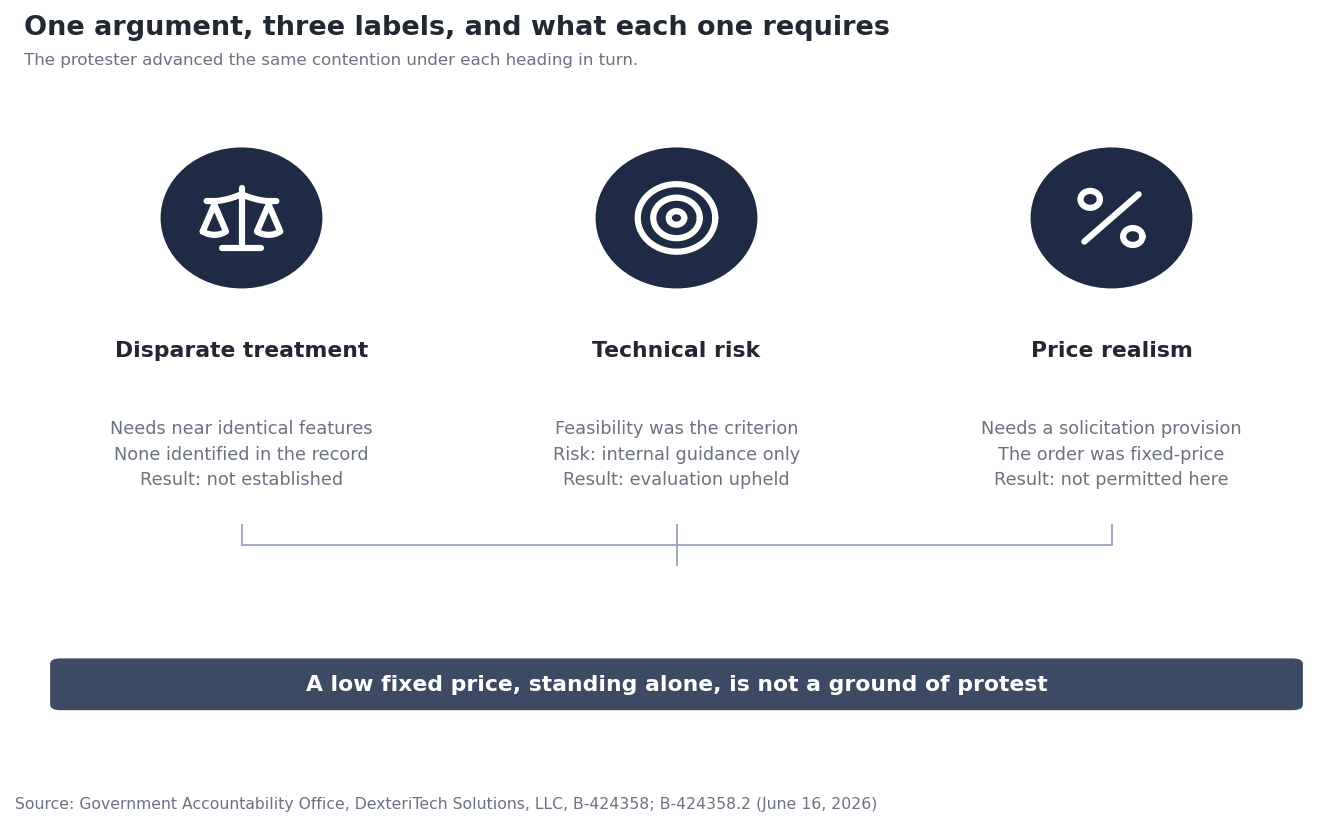
So DexteriTech argued about the gap. Client First's much lower price, it said, made it clear the awardee had understaffed the work or proposed unqualified people, and the agency should have recognized the risk. Anticipating the obvious answer, the protester said expressly that this was not a demand for a price realism analysis; it was a disparate treatment challenge to the technical evaluation.
GAO did not accept the relabeling, and the reason is worth stating precisely, because it is the transferable part. Disparate treatment is a claim about features, not prices: a protester must show that the agency failed to credit aspects of its proposal that were substantively indistinguishable from, or nearly identical to, features in the other proposal. DexteriTech pointed to no such pair. Its allegation rested entirely on an inference drawn from the price. An argument that an agency should have examined whether a price is too low, such that performance is at risk, is a price realism argument, and calling it something else does not change what it asks the agency to do.
The agency would evaluate price by adding the total of all line item prices, and would verify the offeror's calculation of the total proposed price.
That is the whole of it. There is no provision telling offerors that a low price would be examined for realism, and for a fixed-price order that silence is dispositive in both directions: absent such a provision, GAO held, the agency was neither required nor permitted to conduct the analysis DexteriTech wanted. A low price, even a below-cost price, is not objectionable by itself, because in a fixed-price contract the contractor carries that risk. Cost realism, the analysis that does have a home in the regulation at FAR 15.404-1(d), belongs to cost-reimbursement work. Price realism for a fixed-price buy exists only if the solicitation creates it.
With no legally sufficient ground left, the allegation was dismissed rather than denied. GAO's Bid Protest Regulations require a detailed statement of the legal and factual grounds of protest, at 4 C.F.R. 21.1(c)(4), and grounds that are legally sufficient, at 4 C.F.R. 21.1(f); a filing that lacks either is dismissed under 4 C.F.R. 21.5(f).
The technical ground fared no better, and it failed on a point that catches contractors constantly. DexteriTech had read the agency's internal evaluation plan, seen that an Acceptable rating carried a parenthetical describing moderate to high risk, and argued that the agency could not assign that risk without identifying a weakness. GAO answered that the parenthetical describes the rating rather than adding a requirement, that the solicitation itself never mentions risk in its evaluation criteria, and that an evaluation plan not disclosed to offerors gives outside parties no rights at all. A separate ground raised a month into the protest, challenging the tradeoff, was dismissed as untimely under 4 C.F.R. 21.2(a)(2), because the protester had everything it needed to raise it at the start and the regulations do not contemplate piecemeal development of protest issues.
Where it stopped: Legal sufficiency
A ground that depends on an analysis the solicitation never provided for is not a legally sufficient ground.
03Highlight: the agency erred, and it changed nothing
- Matter of
- Highlight Technologies, Inc.
- File
- B-424060.2
- Decided
- May 22, 2026
- Agency
- General Services Administration
- Awardee
- FedTec, LLC
- Solicitation
- RFQ 47HAA025Q0048
For the protester
Miles & Stockbridge P.C
For the intervenor
Maynard Nexsen PC
For the agency
General Services Administration
GAO attorneys
Office of the General Counsel, GAO
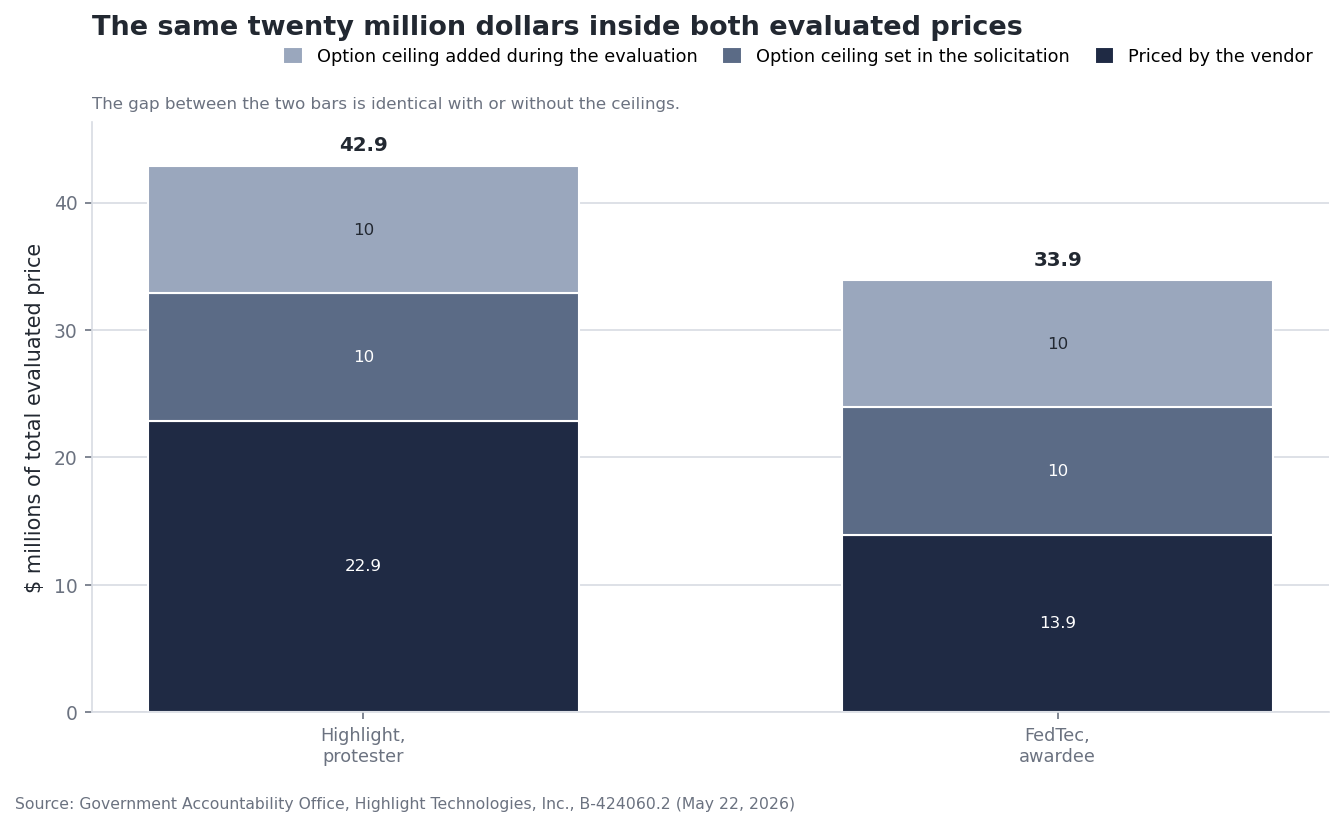
This is the decision to read twice. The General Services Administration sought enterprise data analytics shared services operations and maintenance support for the General Services Administration, competing a call order under a blanket purchase agreement, which puts the procurement under FAR subpart 8.4. Three vendors quoted. Highlight, the incumbent, was rated Excellent on all three non-price factors against FedTec's Good, and priced $42,874,971 against FedTec's $33,924,699. The source selection authority found that nothing in the incumbent's advantages justified the $8,950,272 premium.
The price schedule is where the trouble starts. It carried three optional line items: development, modernization and enhancement work with a ceiling of $2 million per year already filled in by the agency, and two supplemental labor items with no ceiling at all. Highlight asked, during questions and answers, whether the supplemental labor items had their own ceiling. The agency answered that they would fall under the enhancement line item. During the evaluation, GSA then added a ceiling of $2 million per year for those supplemental labor items, $10 million in total, to every vendor's evaluated price.
GAO agreed that was wrong. In its words, the mid-evaluation addition of that ceiling was inconsistent with the solicitation's plain language and evaluation criteria. A vendor reading the schedule and the answers would not have expected it. And that is where most readers would expect a sustain.
It did not come, because competitive prejudice is an essential element of a viable protest, not a consequence of an error. Highlight had to show that but for the mistake it would have had a substantial chance of receiving the award, and GAO found it had not. Highlight said it would have priced its fixed-price operations and maintenance work lower had it known, and named an amount, but never explained how that amount was calculated or how it related to the ceiling the agency added; the decision says the figure appears seemingly out of whole cloth. Nor could Highlight explain why a higher ceiling on optional work would have meant less fixed-price work rather than more, when a ceiling is a not-to-exceed value and not a promise to order anything. Under FAR 8.404(h)(3) a labor-hour order under a blanket purchase agreement must carry a ceiling price precisely because the extent of the work cannot be estimated.
Pause on where that requirement lives, because it is not where a first-time protester will look. The phrase competitive prejudice appears in none of the 15 sections of GAO's Bid Protest Regulations. The part uses the word's stem in three sections doing other work, an agency action prejudicial to a protest position, a late-furnished protest copy that did not prejudice the agency report, the degree of prejudice weighed in choosing a remedy, and none of them is this doctrine. The essential-element rule that decided this protest is case law, restated decision by decision, and it binds as firmly as anything codified.
Where a solicitation provides a common basis on which to submit quotations, vendors' differing pricing strategies that merely reflect the differing business judgments of competing vendors in a best-value procurement do not provide a basis for our Office to object to the agency's evaluation.
That standard is what the incumbent's theory could not survive. Highlight priced on what it knew, or believed it knew: on the incumbent contract, it said, the agency had split enhancement work needing more than 320 hours into smaller tasks and assigned it as ordinary fixed-price operations and maintenance work, so it built labor into its fixed price on the assumption the practice would continue. GAO answered that an expectation about how an agency will behave is not solicitation language, and that the protester unreasonably conflated a ceiling, which caps what may be ordered, with a commitment to order anything at all. The record then made the point concrete: the other two vendors quoted more labor hours for the required work at lower prices than Highlight did. What the protester experienced as being misled, the decision described as post-award regret at having priced more cautiously than its competition.
The arithmetic in the footnotes is the part worth carrying into your next pricing meeting. $20 million of each vendor's total evaluated price consisted of agency-set option ceilings, applied identically to everyone: $10,000,000 that was in the solicitation and $10 million added during the evaluation. Adding the same number to both sides cannot change the distance between them, and it did not: the gap stayed $8,950,272 whichever way you count. What it did change was the ratio. Against the evaluated prices, Highlight was 26 percent more expensive. Against the prices the vendors actually quoted, it was 64 percent more expensive.
Two other grounds are worth a line each, because both are timing failures rather than merits failures. Highlight's challenges to the weaknesses in its own quotation were dismissed as untimely: the same findings had been given to it in a debriefing statement after the first award, months before it raised them, and the ten day clock in 4 C.F.R. 21.2(a)(2) runs from when the basis is known. Its Procurement Integrity Act allegation was dismissed as legally insufficient, because a competitor telling job candidates it expects to win is a private party talking to private parties, which GAO has said may be boasting, a negotiating tactic, or simply a mistake, and nothing in the record connected it to any government official. GAO added that the allegation would have been untimely anyway, since 41 U.S.C. 2106 and 4 C.F.R. 21.5(d) require a report to the agency within fourteen days of discovering a possible violation.
Where it stopped: Competitive prejudice
An agency error the protester cannot connect to its own standing in the competition changes nothing.
A requirement of GAO case law rather than of 4 C.F.R. part 21, which never uses the phrase.
04AVMAC: standing, and the offerors in the way
- Matter of
- AVMAC LLC
- File
- B-424201.3; B-424201.4
- Decided
- June 15, 2026
- Agency
- General Services Administration
- Awardee
- Strategic Technology Institute
- Solicitation
- RFP 47QFSA25R0008
For the protester
Reaves GovCon Group
For the agency
General Services Administration
GAO attorneys
Office of the General Counsel, GAO
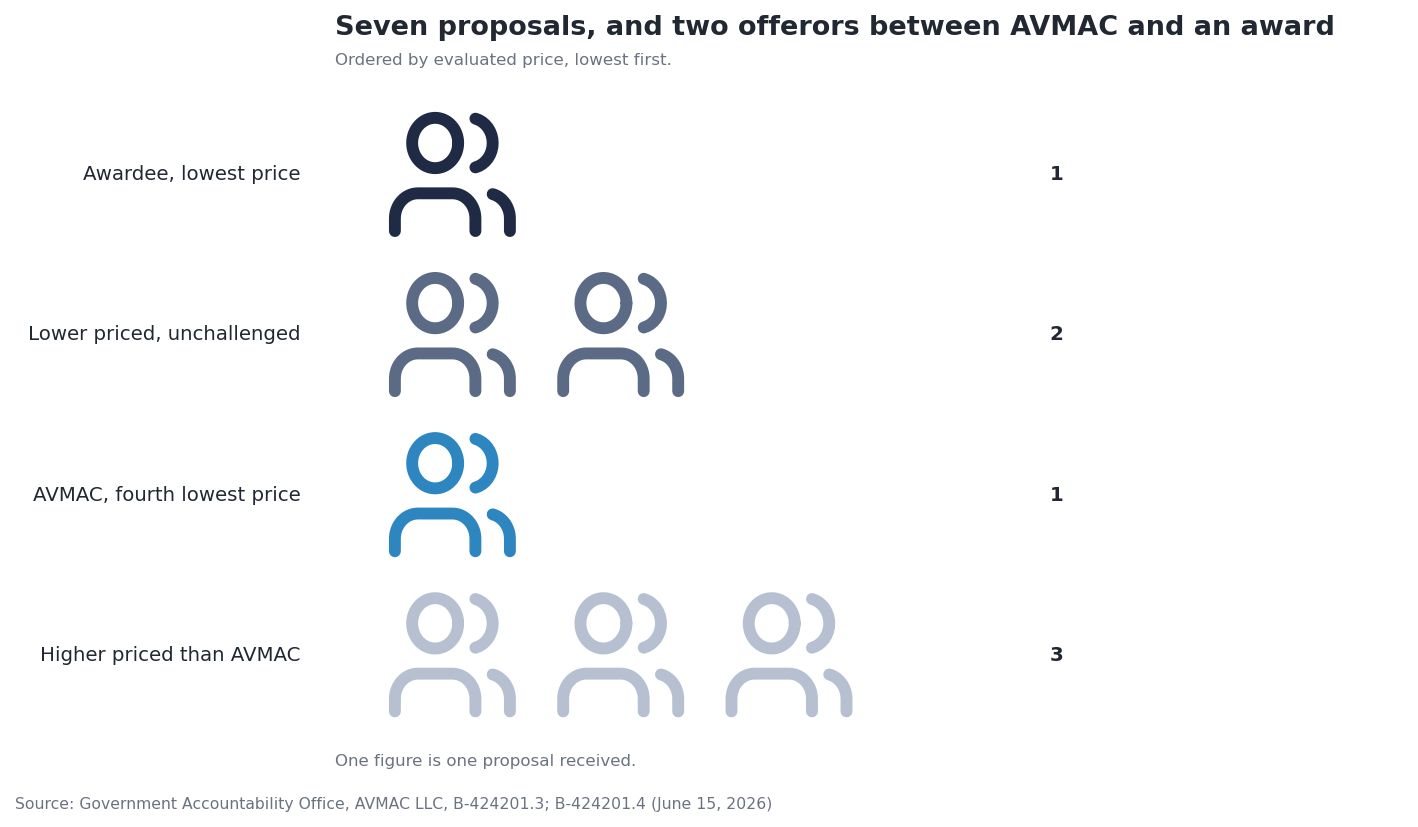
The last decision is the one with the sharpest practical lesson. GSA, buying for the Marine Corps, competed a task order for maintenance of MV-22 tiltrotor aircraft for the United States Marine Corps, ordered through the General Services Administration under a multiple award contract, which makes it a task order competition under FAR subpart 16.5. Award was to be made on a best value tradeoff across technical approach, staffing, corporate experience and price. The agency received seven timely proposals, ran two rounds of discussions, and landed somewhere unusual: every offeror received the same adjectival ratings for technical approach and staffing, and the same overall non-price rating of significant confidence. The only differentiation anywhere was corporate experience, where AVMAC and the eventual awardee were rated very relevant and everyone else merely relevant.
Strategic Technology Institute was selected at $31,444,000.72, the lowest evaluated price. AVMAC came fourth lowest at $35,674,074. The contracting officer wrote something in the award decision document that turned out to matter more than anything else in the record: even if the awardee were set aside, AVMAC's non-price advantages would not justify paying the roughly 12 percent premium over the two offerors that sat between them.
AVMAC went after the awardee on three fronts: negative past performance information it said the agency ignored, a risk assessment it said was never conducted, and a small business status it said was misrepresented. It never challenged the evaluation of the two offerors in between.
Interested party means an actual or prospective bidder or offeror whose direct economic interest would be affected by the award of a contract or by the failure to award a contract.
Direct economic interest is the whole test, and it is measured by where the protester would stand if it won. A protester is interested where there is a reasonable possibility it would be in line for award if the protest were sustained; where intervening offerors would take the award first, those offerors have the greater interest and the protester's is too remote.
GAO refused to apply that as a blanket bar, and the distinction it drew is the useful one. AVMAC was unquestionably an interested party to challenge its own evaluation, and to challenge the tradeoff, because success on either would have changed the relative standing of everyone. So GAO decided those grounds on the merits, and denied them: an agency need not document why a proposal merely met a requirement, no offeror is entitled to the highest rating simply because it drew strengths and no weaknesses, and the solicitation had expressly told offerors that tiltrotor experience would count as more similar than other rotary or fixed-wing work, so rating a non-tiltrotor reference lower was not an unstated criterion. It also upheld the agency's decision to reopen discussions with the awardee alone during corrective action, since FAR 15.306(d) requires meaningful discussions and AVMAC had already received them; the exchange only put the other firm where AVMAC already was.
And then the gate closed. With its own evaluation and the tradeoff intact, two offerors still stood between AVMAC and an award if the awardee were removed, and AVMAC had not laid a glove on either. Its challenges to the awardee were dismissed. Note the sequence, because it is not intuitive: the standing question was answered after the merits of the other grounds, not before, precisely because those other grounds were the only thing that could have moved the line.
Where it stopped: Interested party
A protester who would not be next in line for award cannot be heard on the awardee's evaluation.
05What usually happens
It would be easy to read three losses in one edition as a bad month. It is not. This platform holds 5,917 GAO bid protest decisions issued between 2010 and 2026. Of the 5,399 that carry a recorded outcome, 619 were sustained in whole or in part. That is 11.5 percent.
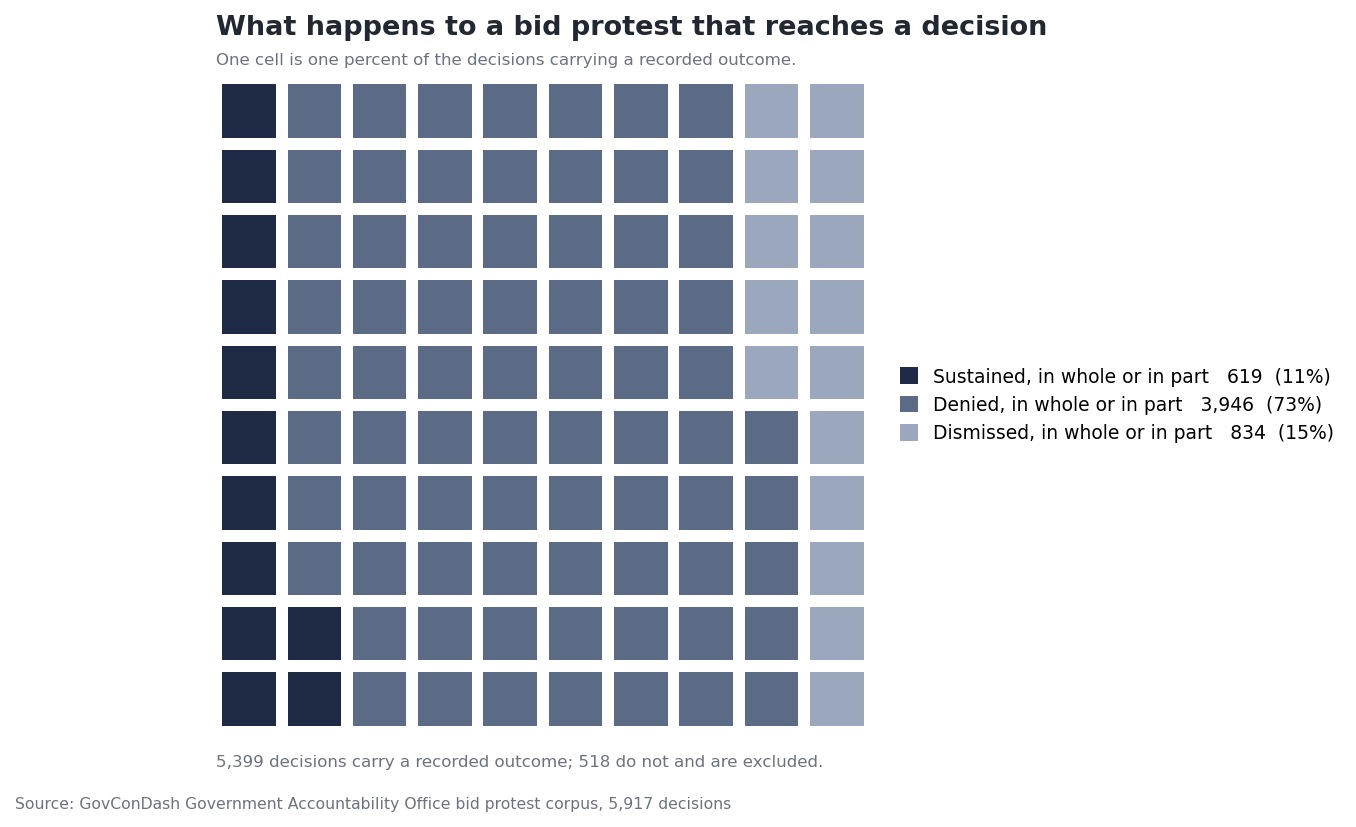
The published sustain rate is a floor rather than a full picture, because it counts only protests that reached a decision. It says nothing about the ones an agency mooted by taking corrective action, which is a real and common form of winning. But for the decision you are actually reading, the base rate is the right frame: three of these three landed in the two largest blocks, and the question a practitioner should ask is not whether the agency erred but whether an error, proved, would move this particular protester into line for award.
Decision
What the protester had
Where it stopped
DexteriTech Solutions, LLC
B-424358; B-424358.2
Legal sufficiency
Dismissed, in whole or in part
Highlight Technologies, Inc.
B-424060.2
Competitive prejudice
Denied, in whole or in part
AVMAC LLC
B-424201.3; B-424201.4
Interested party
Denied, in whole or in part
06Takeaways
Read the price factor before you build a theory about the awardee's price. In a fixed-price competition, the agency may do exactly what the solicitation says it will do with price and nothing more. If the words are add the line items and check the arithmetic, then no price, however low, obliges anyone to look at staffing. If you want that examination, the time to get it is before proposals are due, as a challenge to the solicitation.
Plead prejudice with arithmetic, not adjectives. Highlight proved the agency did something the solicitation did not authorize and still lost, because it could not show what it would have priced instead and why. If your theory is that you would have quoted lower, bring the build-up: the labor, the hours, the assumption you made, the amount it added, and the standing it would have bought you. An unexplained number is worth nothing even when the error is conceded.
Price the solicitation you received, not the agency you know. Highlight's quotation was built on incumbent knowledge of how the agency had historically tasked enhancement work, and GAO treated the result as business judgment, not inequality: every vendor had the same words and the same answers, and the other two read the risk differently at lower prices. When incumbent understanding and solicitation text diverge, the record protects only the text, and an ambiguous answer is not a promise. Price the ambiguity as risk, or challenge it before proposals close; after award, the gap between what you knew and what the words said is your own business judgment.
Challenge everyone ahead of you, or accept that you are challenging nobody. Interested-party status is not a pleading formality; it decides whether a ground gets read at all. Before filing, list the offerors between you and an award, and for each one either plead a ground that displaces it or accept that removing the awardee simply hands the work to the next firm in line.
Raise it when you learn it. Two of the three decisions dismissed a ground for timing. A debriefing or feedback statement starts the ten day clock on everything it discloses, a later protest does not revive it, and a supplemental ground built from facts you already had is piecemeal. The Procurement Integrity Act runs a separate and shorter clock: report to the agency within fourteen days of discovery or the allegation is gone.
Treat an internal evaluation plan as evidence, never as a promise. DexteriTech built an argument on a parenthetical inside the agency's own rating definitions. Those plans are internal instructions, not disclosed to offerors, and they give outside parties no rights. The solicitation is the contract for the competition; everything else is background.
How this edition was grounded: every quotation, date, dollar figure and percentage above was re-located in the deciding document's own captured text. Each decision's parties, agency, outcome label, counsel and protective order status are read off the corpus row rather than typed, and where the capture pipeline recorded no awardee or solicitation number the value comes from the decision text, with its source recorded beside it in the generated module. Every percentage is derived here from two anchored figures, and where a decision states the percentage itself the derivation must round to the same whole number or nothing is published. Corpus counts are live queries over the 5,917 decisions this platform holds, 5,896 of them with verbatim text, and a decision counts under a doctrine when its own text names it. This edition is commentary on public decisions and published rules, not legal advice.

GovConDash.ai
Check the ground before you file it
GovConDash holds 5,917 GAO bid protest decisions with their verbatim text, searchable by ground, agency, outcome and the solicitation each one names, alongside the Armed Services Board and Court of Federal Claims corpora and the seeded FAR and DFARS. Every AI answer cites the record it came from. Free to start.
The Protest Docket appears monthly.