





























01The seven matters
What follows is each matter in the order the money runs. Every slip is built from the corpus row rather than retyped, and each falsity band states what the government was buying against what it was told, because that gap is the whole of a False Claims Act case. Liability under 31 U.S.C. 3729 attaches to a knowing false statement material to payment, and in none of these did the Department have to argue the price was wrong.
1. Tetra Tech EC, $57M
Hunters Point Naval Shipyard, San Francisco
- Paid by
- Tetra Tech EC Inc.
- Announced
- 2026-08-24
- Amount
- $57M
- Conduct period
- 2003 to 2014
- Relator share
- 11,970,000 (21.0 percent)
- Agencies named
- Department of War, Environmental Protection Agency
Announced by
Civil Division, USAO - California, Northern
What the government bought
Radiological survey and remediation at a closed naval shipyard
What was falsely stated
Soil sample results, for samples that had been swapped for clean soil
Under contracts issued by the Navy between 2003 to 2014, the contractor was to investigate soil and buildings at a closed shipyard and remediate anywhere radiation was excessive, so the land could be transferred to a city for redevelopment. The government alleged that field technicians were instructed to throw away samples taken from the places most likely to be contaminated and to submit clean soil in their place, and that scan results in the contractor's database were manipulated to show that scans taken in different locations had been performed by the same technician at the same moment.
instructed field technicians to discard soil samples collected from potentially contaminated locations
The benefit alleged is worth reading closely, because it is not an inflated invoice. The government said the contractor gained by receiving unearned contract award fees and avoiding obligations to perform additional remediation work, which decreased its costs and increased its profit. In other words the fraud paid twice: once in fee it had not earned, and once in work it never had to do. That second half is invisible on any invoice, which is part of why it took a relator to surface it.
This is also the month's deepest investigative file. The release credits the Naval Criminal Investigative Service, the Defense Criminal Investigative Service and the Defense Contract Audit Agency, and it describes the work as protecting the integrity of the procurement process within the Department of War. A separate $40 million was recovered under the Comprehensive Environmental Response, Compensation, and Liability Act, and that figure is deliberately excluded from every total on this page: it is not a False Claims Act recovery.
2. Deloitte, $21.5M
Federal contracts carrying the equal opportunity clause
- Paid by
- Deloitte
- Announced
- 2026-08-25
- Amount
- $21.5M
- Conduct period
- 2017 to the present
- Relator share
- 4,300,000 (20.0 percent)
- Agencies named
- None in the closed vocabulary
Announced by
Office of the Attorney General, Civil Division, Office of the Associate Attorney General, USAO - Texas, Northern
What the government bought
Professional services across five Deloitte partnerships
What was falsely stated
Certified compliance with the equal opportunity clause in its federal contracts
This is the matter every federal contractor should read twice, because the theory is new here and the clause it runs on is in almost every one of their contracts. The government's position is that most federal contracts require the contractor to provide equal opportunity, that the contractor must certify it will not discriminate on the basis of race or sex, and that from 2017 to the present the firm certified compliance while operating to non-public race and sex based workforce composition goals.
The Contractor will take affirmative action to ensure that applicants are employed, and that employees are treated during employment, without regard to their race, color, religion, sex, sexual orientation, gender identity, or national origin.
FAR 52.222-26(c)(1), Equal Opportunity
The clause is FAR 52.222-26, and it has sat in the standard clause set for decades as a compliance obligation enforced administratively. What the Civil Rights Fraud Initiative does is treat it as a condition of payment, so that certifying compliance while not complying becomes a false claim rather than a contract breach. The corpus dates the shift precisely: the initiative is named in two releases in this whole corpus, both of them this matter, and the first is 2026-08-25. The release states the initiative launched in May 2025.
The evidence described is operational rather than rhetorical, and that is the part worth internalizing. Business units received monthly summaries tracking demographic goals, and the release says representation was
highlighted in green, yellow, or red depending on whether the goal was exceeded, met or slightly missed, or significantly below the goal
Roughly 150 of the firm's most senior senior partners, principals and managing directors could see compensation affected if their units missed those goals over a two year period. Candidates for promotion were identified by race and sex on a circulated spreadsheet. Employees available for staffing were named by race and sex to staffing managers. Two named development programs limited eligibility on the same basis.
Read as a compliance problem rather than a political one, the exposure is structural: a dashboard, a scorecard, a compensation link, and a spreadsheet. Any of those artifacts, on any protected characteristic, is now discoverable evidence against a certification the firm signs at every award. Civil rights certification remains the rarest theory in this corpus, with 7 matters against 70 for nonconforming product, and this is its first appearance against a professional services firm on an employment theory.
3. Everlight Electronics, $5.15M
Customs entries subject to Section 301 tariffs
- Paid by
- Taiwan LED Manufacturer
- Announced
- 2026-08-05
- Amount
- $5.15M
- Conduct period
- July 2018 to November 2025
- Relator share
- 876,146 (17.0 percent)
- Agencies named
- Homeland Security
Announced by
USAO - Maryland
What the government bought
Light-emitting diodes imported into the United States
What was falsely stated
Declared country of origin on diodes made in China and shipped through Taiwan
A note on the name before the substance. The Department's headline names no company, only a description, so the corpus row honestly records that description as the payer; the company name in the slip above comes from the release's own first sentence and is verified against it. This is the reverse false claim in the month: money owed to the government rather than claimed from it. From July 2018 to November 2025, diodes manufactured in China were routed through Taiwan and declared as Taiwanese to avoid the tariffs Chinese goods carried, and later shipments mixed Chinese and Taiwanese components without segregating them.
Two things make this worth a procurement reader's attention even though no federal contract is involved. First, the same declaration discipline that governs a customs entry under 19 U.S.C. 1592 governs a country of origin representation in a supply contract, and the theory the corpus records alongside customs duty evasion here is the procurement one, country of origin. Second, the release names a cross-agency task force stood up to pursue exactly this conduct, which the corpus first sees on 2025-12-18 and now counts in eight releases.
4. AiNET Corp., $1.8M
Data center contract with the Securities and Exchange Commission
- Paid by
- AiNET Corp. and Deepak Jain
- Announced
- 2026-08-24
- Amount
- $1.8M
- Conduct period
- Not stated in the release
- Relator share
- No qui tam action stated
- Agencies named
- None in the closed vocabulary
Announced by
Civil Division
What the government bought
Data center services for the Securities and Exchange Commission
What was falsely stated
Certified a data center tier rating, and an inspection that never happened
The cleanest false certification of the month, and the only one naming an individual alongside the company. The allegation is that the contractor fraudulently induced the contract by certifying that its data center met a required tier standard, and then certified that experts from a named council had inspected the facility and rated it a tier higher still.
UpTime Council was not an operating company and never inspected the AiNET data center
A certification that an inspection happened, where no inspection happened and the inspector did not exist as an operating company, is the whole case. There is no measurement dispute to litigate and no question of degree. It is worth noting what the corpus cannot say about this one: the closed agency vocabulary behind this platform carries 21 agencies and the Securities and Exchange Commission is not among them, so a matter about an SEC contract records no agency at all. That is a gap in the vocabulary, not a fact about the matter, and the slip above prints it as an empty state rather than guessing.
5. Judd Wire, $1.014 Million
Wire and cable specifications for the United States Navy
- Paid by
- Judd Wire Inc.
- Announced
- 2026-08-10
- Amount
- $1.014 Million
- Conduct period
- September 2011 to August 2021
- Relator share
- No qui tam action stated
- Agencies named
- Department of War
Announced by
Civil Division
What the government bought
Wire and cable products used by the United States Navy
What was falsely stated
Delivered product against 29 specifications whose required tests were never run
The smallest of the two test matters and by far the most instructive, because of how it ended. From September 2011 to August 2021 the manufacturer produced wire and cable used by the United States and did not perform all the tests required by each of 29 wire and cable specifications the settlement covers. Nothing suggests the product failed. The allegation is that the tests proving it would pass were not run, and the product was tendered anyway.
That is exactly the obligation FAR 52.246-2 places on the contractor rather than on the government, and the clause is worth reading in its own words because the word doing the work is tender.
The Contractor shall provide and maintain an inspection system acceptable to the Government covering supplies under this contract and shall tender to the Government for acceptance only supplies that have been inspected in accordance with the inspection system and have been found by the Contractor to be in conformity with contract requirements.
FAR 52.246-2(b), Inspection of Supplies, Fixed-Price
Delivery is a representation. Handing over the item asserts that the inspection system ran and that the contractor found the item conforming, which is why an untested part is a false claim without anyone alleging it was defective. A quality organization that treats testing as an internal metric, and delivery as a shipping event, has the relationship backwards.
Then the ending. The contractor found the lapses, disclosed them, cooperated and remediated, and the Department said in the release that it took significant steps entitling it to credit for cooperating. The Assistant Attorney General's quoted line is the closest thing to guidance in the month's eight releases: suppliers who fail to comply with required specifications
they can mitigate the consequences by making timely self-disclosures, cooperating with investigations, and taking prompt remedial measures
Ten years of missed testing across 29 wire and cable specifications resolved for $1.014 Million, which is 1.1 percent of the month. Compare it with the matter above it in this ledger, which was litigated. The disclosure was not charity; it was the cheapest available outcome, and FAR 52.203-13 made it something closer to an obligation than a choice.
The Contractor shall timely disclose, in writing, to the agency Office of the Inspector General, with a copy to the Contracting Officer, whenever the Contractor has credible evidence that a principal, employee, agent, or subcontractor of the Contractor has committed ... a violation of the civil False Claims Act (31 U.S.C. 3729-3733).
FAR 52.203-13(b)(3)(i), Contractor Code of Business Ethics and Conduct
The clause names the civil False Claims Act by statute. Credible evidence of a violation is a reportable event, on a timely basis, to the Inspector General with a copy to the contracting officer, and FAR 3.1003 makes the requirement a condition of doing business rather than a courtesy. The practical consequence is that once a compliance function identifies a testing gap of this shape, the choice is not whether to disclose but how fast, and the credit available on the way in is the only variable a contractor still controls.
6. Air Force member, $24,000
Paycheck Protection Program, guaranteed by the Small Business Administration
- Paid by
- Air Force Active Duty Member
- Announced
- 2026-08-03
- Amount
- $24,000
- Conduct period
- April 2021
- Relator share
- No qui tam action stated
- Agencies named
- Small Business Administration, Department of War
Announced by
USAO - Florida, Northern
What the government bought
A Paycheck Protection Program loan taken in a sole proprietor name
What was falsely stated
Represented a business as eligible that did not exist when eligibility closed
The smallest matter of the month, and included rather than dropped because its arithmetic teaches something the large ones cannot. An active duty service member obtained a Paycheck Protection Program loan in April 2021 for a business registered after the eligibility date had passed. The loan, the lender fee and the interest the government paid come to $16,938.09 by the release's own addition. The settlement was $24,000.
That is 1.42 times the loss, on a matter resolved without litigation, and it is a useful reminder of what the statute actually threatens. 31 U.S.C. 3729 sets liability at three times the government's damages plus a civil penalty for each false claim. Treble damages and a per claim penalty are what a settlement negotiates down from, not up to, and a multiple this close to the loss is what a cooperative resolution of a small, unambiguous matter looks like.
02Where the money was
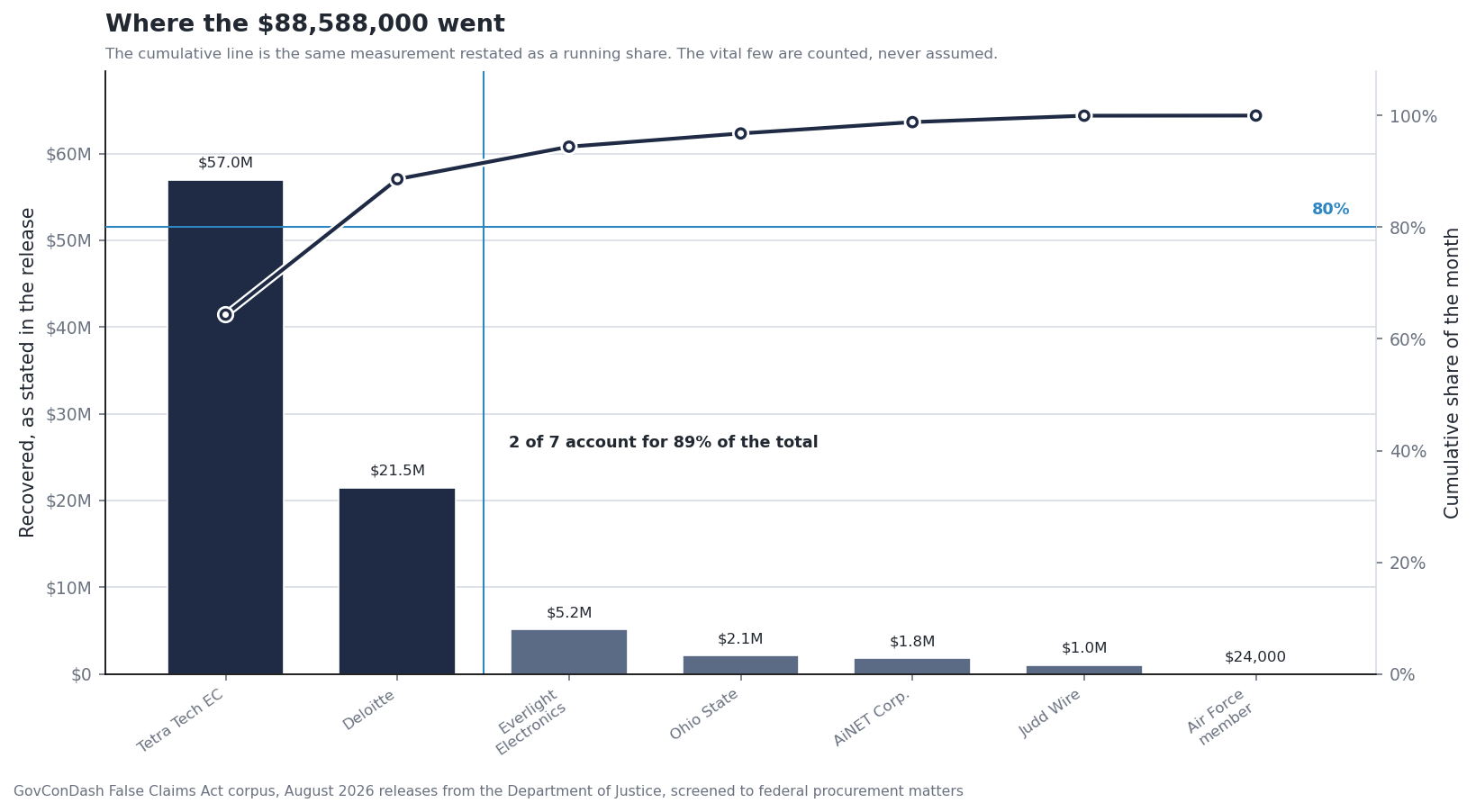
The month is extremely concentrated. Tetra Tech EC alone is 64.3 percent of it, and two of the seven matters carry 88.6 percent of the dollars. The other five share what is left, down to $24,000.
That range matters for how a compliance officer should read a month like this one. The settlement figure tracks the size of the contract and the length of the conduct, not the seriousness of the conduct. Air Force member settled for $24,000 on a single loan application; Tetra Tech EC settled for $57M on eleven years of radiological survey work. Both are the same statutory violation. Only one of them is a rounding error on a chart.
Two thirds of the month is the same failure twice. $58,014,000 of the $88,588,000 came from two settlements about test results, and both carry the same theory, nonconforming product. Another $23,324,000 came from three settlements about a certification, $5,150,000 from the one about a country of origin, and $2,100,000 from the one about a disclosure that was never made at all. The remaining question is who found each of them, and the answer is not the government.
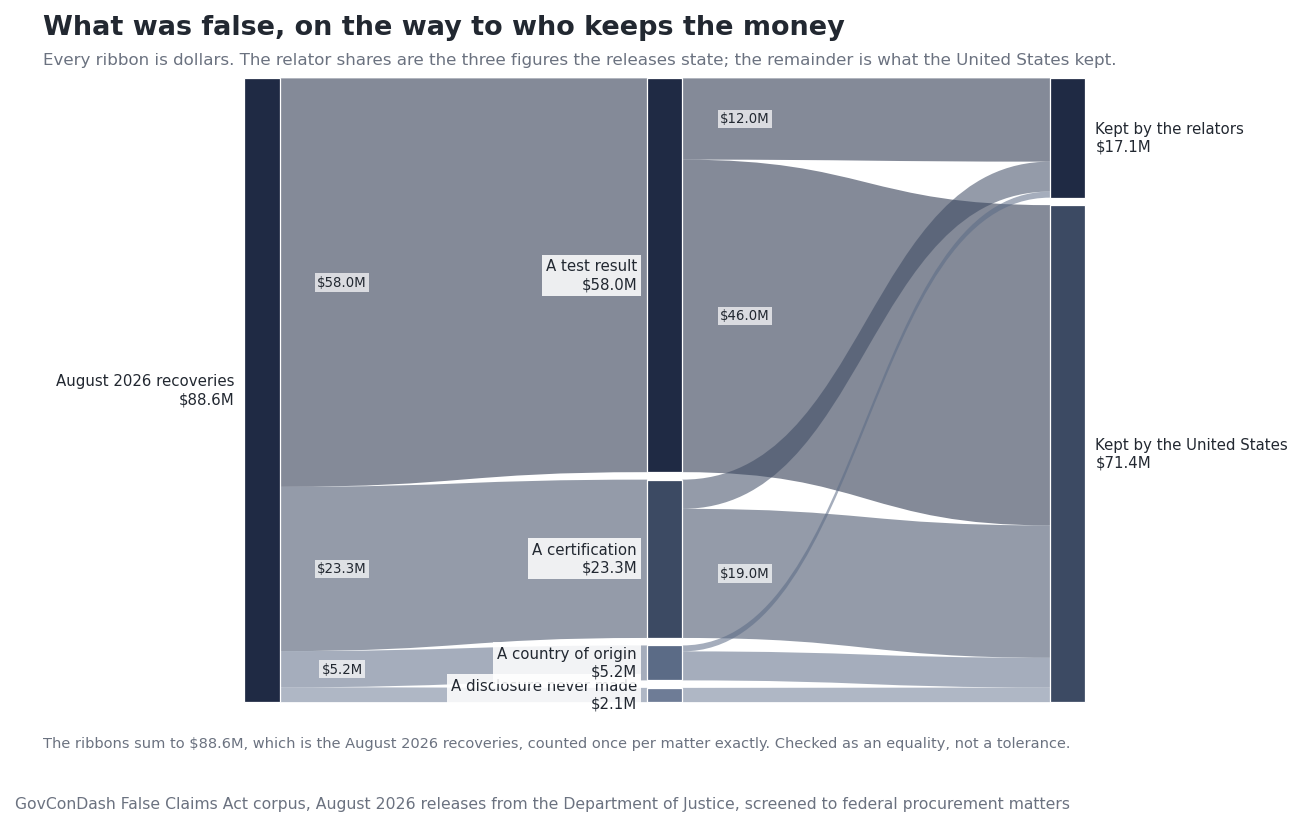
three of the seven matters were filed by a relator under the qui tam provisions of 31 U.S.C. 3730, and those three carry $83,650,000, or 94.4 percent of the month. The four the government brought on its own account for $4,938,000 between them. The relators' combined share is $17,146,146, which is 20.5 percent of what those matters recovered.
The three shares sit close together and close to the statutory band: 21.0 percent in Tetra Tech EC, 20.0 percent in Deloitte, 17.0 percent in Everlight Electronics. The practical reading for a contractor is simpler than the arithmetic. In August 2026, almost every dollar of exposure that materialized began with somebody inside the company, or recently inside it, deciding to file.
03What one month can show
A word on the base this month is measured against. This platform holds 942 screened releases spanning 18 fiscal years, from 2009-01-06 to 2026-09-04, resolving to 800 distinct matters, and it classifies each against a closed vocabulary of 15 fraud theories, of which 14 have at least one matter.
One month is not a trend, and this piece will not claim it is. What one month can do is show a shape, and the shape here is that every dollar the Department recovered turned on the truth of a statement rather than the size of a number: a test result, a certification of compliance, a certification that an inspection occurred, a declaration of origin, a representation of eligibility. None of those is caught by an invoice review. All of them are produced by operations, quality and human resources rather than by billing.
The vocabulary itself makes the point honestly, and its gaps are worth stating. two of the seven matters, AiNET Corp. and Air Force member, are placed by no theory in the closed set at all, because neither a false certification of a technical standard nor a false representation of program eligibility has a key in it. Their slips above say so rather than showing a blank. A vocabulary that acquired civil rights certification and customs duty evasion as the conduct arrived will probably need another key or two, and until it does, the honest reading of a zero is that nothing matched, not that nothing happened.
04The machinery is newer than the conduct
One more measurement, because it changes how the month should be read. The conduct in these settlements is old: 2003 to 2014 in the largest, September 2011 to August 2021 in the testing matter, 2017 to the present in the certification one. The enforcement machinery announcing it is a few months old.
The National Fraud Enforcement Division appears in 16 releases in this entire corpus, the earliest on 2026-05-12, and it is named in six of the seven matters here. The Civil Rights Fraud Initiative appears in two, both of them this month. The task force behind the origin matter first appears on 2025-12-18. A contractor reading only the settlement dates would conclude enforcement is steady. A contractor reading the boilerplate would conclude the Department has just built three new front doors and is telling everyone where they are.
The Department of War remains the center of gravity in the corpus and in the month. three of the seven matters name it, worth $58,038,000 between them, against 405 matters and 480 releases across the whole corpus. The Navy is named in both of the test result matters, the largest settlement of the month and the one that ended in cooperation credit.
05The month on one page
Paid by
What was falsely stated
Amount
Tetra Tech EC
Filed by a whistleblower
$57M
64.3 percent of the month
Deloitte
Filed by a whistleblower
$21.5M
24.3 percent of the month
Everlight Electronics
Filed by a whistleblower
$5.15M
5.8 percent of the month
Ohio State
Brought by the government
$2.1M
2.4 percent of the month
AiNET Corp.
Brought by the government
$1.8M
2.0 percent of the month
Judd Wire
Brought by the government
$1.014 Million
1.1 percent of the month
Air Force member
Brought by the government
$24,000
0.0 percent of the month
06Takeaways
Audit your certifications the way you audit your invoices. Every settlement this month traces to a representation somebody signed or a result somebody recorded, and none to a billing rate. Build an inventory of what your contracts make you certify, name an owner for each one, and require that owner to say what evidence would prove the certification true today. The equal opportunity clause, the inspection clause and any technical standard clause all belong on that list.
Treat a missed test as a claim event, not a quality metric. An untested part tendered to the government is a false claim even when the part is good, because FAR 52.246-2 makes tender itself the representation that the inspection system ran and found the item conforming. Reconcile tests required against tests performed, by specification, and treat any gap as reportable rather than as a corrective action to close quietly.
Know that your disclosure clock has already started. FAR 52.203-13 requires timely written disclosure to the Inspector General once you have credible evidence of a civil False Claims Act violation. The testing matter this month resolved for $1.014 Million on a decade of lapses with cooperation credit named in the release. Deciding to investigate before deciding to disclose is fine. Deciding to investigate instead of disclosing is the exposure.
Assume a demographic dashboard is a discoverable document. The Deloitte allegations are built from ordinary management artifacts: a monthly scorecard with colored statuses, a compensation link for senior leaders, a candidate list annotated by race and sex, and eligibility rules on two named programs. Whatever view you take of the policy, the compliance question is narrow. If your contracts carry FAR 52.222-26 and your operating practice allocates opportunity by a protected characteristic, the certification and the practice do not agree, and one of them is written down.
Remember that a settlement is not the end of the exposure. None of these resolutions determined liability, and each release says so. But the same conduct is a listed cause for debarment under FAR 9.406-2, and FAR 52.209-5 requires an offeror to certify its own recent history on exactly these questions at each award. A paid settlement closes a claim and opens a disclosure obligation that follows the company into every competition that follows.
Disclaimer. All of these resolutions are allegations only, with no determination of liability, exactly as each release states. This edition is commentary on public settlements and published regulations, not legal advice.

GovConDash.ai
Know what the enforcers are actually charging
GovConDash holds 942 False Claims Act enforcement releases screened to federal procurement, from 2009-01-06 forward, searchable by fraud theory, agency, defendant and amount, alongside the Armed Services Board, Court of Federal Claims, Civilian Board, Federal Circuit and Government Accountability Office corpora and the seeded FAR and DFARS. Every AI answer cites the record it came from. Free to start.
The False Claims Report appears monthly.