



























U.S. General Services Administration, news release
October 21, 2026
689 firms
ceiling $5.5 billion
audit run with SBA
GSA Launches Sweeping Fraud Audit of Nearly 700 Federal Contractors in Collaboration with Small Business Administration
SBA's release the same day names the firms' source: every one was removed from the 8(a) program and referred to GSA. Neither release names a firm.
The short version
- 1The audit looks back, not forward. GSA is reviewing the firms' contract awards during their participation in the program. Leaving the program did not close those contracts out; it put them in front of an auditor who refers to the Department of Justice.
- 2Most removals turned on paperwork. SBA suspended 1,091 firms for not answering a records request. In all three appeals of a data call termination that SBA's Office of Hearings and Appeals decided this year, the judge upheld SBA, and a small staff or a retired accountant did not excuse a missed deadline.
- 3The appeal clock is short, and it runs from the termination. A firm has 45 days. Two firms appealed only their suspension and missed the window to appeal the termination that followed.
- 4When an 8(a) review becomes a fraud case, partners pay too. The False Claims Act record holds twelve 8(a) matters resolved for $47.2 million. In five of them the case was about a second company: a joint venture partner, a mentor or a subcontractor that did the work.
The audit at a glance
The releases, the decisions and the enforcement record
Firms referred to GSA
689
removed from the 8(a) program
Collective ceiling
$5.5 billion
the most the contracts can reach, not what was paid
Suspended in January
1,091
about 25 percent of the program
OHA 8(a) decisions, 2026
Nine
every one read in this piece
8(a) fraud matters
Twelve
resolved for $47.2 million
01What the 8(a) program is
SBA certifies small businesses considered to be socially and economically disadvantaged under its nine-year 8(a) Business Development Program. A firm in it gets one-to-one counseling, training workshops and management and technical guidance, and a door to federal contracts that only program participants can compete for or receive. In GSA's words, a firm generally must be small and meet SBA's requirements on personal net worth, adjusted gross income, total assets, good character, potential for success, and other eligibility criteria. SBA sets out the program and its benefits in its own overview of the 8(a) program. SBA's January release says that in June 2025, SBA launched the first-ever audit of the 8(a) Program in its nearly 50-year history.
How the program works, in the FAR as codified
Who holds the contract
SBA does. FAR 19.800 authorizes SBA to enter into all types of contracts with other agencies and award subcontracts for performing those contracts to firms eligible for program participation. The agency awards to SBA, and the participant performs as SBA's subcontractor.
Who decides eligibility
SBA, not the contracting officer. FAR 19.802 points to SBA's own rules: SBA's regulations on eligibility requirements for participation in the 8(a) program are found at 13 CFR 124.101 through 124.112. SBA also shows the designation in SAM.
Sole source or competition
Under FAR 19.805-1, an 8(a) award is competed among participants when at least two are expected to offer and the contract, with options, will exceed $8.5 million in manufacturing or $5.5 million otherwise. Below those lines it can go sole source. Above them, sole source is still allowed when SBA accepts the requirement on behalf of a concern owned by an Indian tribe or an Alaska Native Corporation.
Where it sits in line
Ahead of ordinary small business set-asides. Above the simplified acquisition threshold, FAR 19.800 says the contracting officer shall consider 8(a) set-asides or sole source awards before considering small business set-asides.
What leaving means
Under FAR 19.816, a firm that exits gets no new 8(a) contracts, but "the contractor remains under contractual obligation to complete existing contracts, and any priced options that may be exercised". A suspended firm gets no new award either, unless the head of the contracting agency makes a determination that it is in the best interest of the Government to issue the award and SBA adopts that determination.
Those are the codified sections. The FAR Overhaul's rewrite of Part 19 is in force by class deviation at many agencies, and part 7 says how to tell which text your contract carries.
What it means for you: the program's value is the contracts it reserves, and its rules follow those contracts after a firm leaves. A removed firm keeps performing what it holds, priced options included, while losing the door to new awards. That is why an audit of past awards matters more to it than the removal itself.
02How SBA got to 689 firms
The campaign ran in public, release by release. On December 5, 2025, SBA ordered all 4,300 participants to produce three fiscal years of financial records. On January 28, 2026, it suspended 1,091 firms, about 25 percent of the program, for not producing them. In February it moved to terminate 154 Washington, D.C. firms that an eligibility review found had exceeded statutory net worth limits, adjusted gross income caps, or total asset limits. In March it moved to terminate 628 more, all of them among the January suspensions.
From the data call to the GSA referral
October 21, 2026: 689 firms referred to GSA
GSA will audit the firms' contracts, with a collective ceiling of $5.5 billion, and refer suspected fraud to the Inspector General and the Department of Justice. Read the release
The February and March actions add up to 782 firms, which SBA called nearly 800. On October 21, 2026, SBA said it had removed 689 and referred every one to GSA. Some, it said, exceeded net worth limits, adjusted gross income caps, or total asset limits; others refused the mandatory financial data call requiring all 8(a) contractors to provide three years' worth of financial documents. The release does not say how many fell on each side, and it names no firm.
What it means for you: the two grounds carry different risk. A firm removed for missing a records deadline has a paperwork problem that an audit can show was only that. A firm removed for being over the net worth, income or asset limits while it kept winning set-asides is the case GSA's review is built to find.
03The letters every firm received
SBA's releases give the headline dates. The record of how a firm actually left the program is in the appeals. Decisions of SBA's Office of Hearings and Appeals, the agency's administrative court, lay out the letters to the day for the three firms terminated for never answering the data call, and the sequence is the same in each. From the data call to the termination took 126 days.
What SBA sent a firm that did not answer the data call
- Appeal to OHAWithin 45 days of receiving the termination. After that, SBA's decision is final.
Day 0 · December 5, 2025
Data call
Due January 5, 2026
Three fiscal years of records, including bank statements, financial statements, general ledgers, payroll registers, contracting and subcontracting agreements, and employment records, uploaded to SBA's certification portal.
As the record in BDPT-803 states it. Read the decision
The rule behind the last letter is SBA's, at 13 C.F.R. 124.303(a)(7), which the judges read as a duty to supply data within the response window. As they quote it, good cause to terminate includes a pattern of failing to provide requested financial statements, tax returns "or other requested information or data within 30 days of the date of request".
What it means for you: a firm still in the program should treat any SBA request as running on a 30-day clock and answer inside it, even partially, with a written request for more time if it needs one. A firm that was terminated has 45 days from receiving the notice, and that window is the one that matters.
04What SBA's judges said to firms that fought
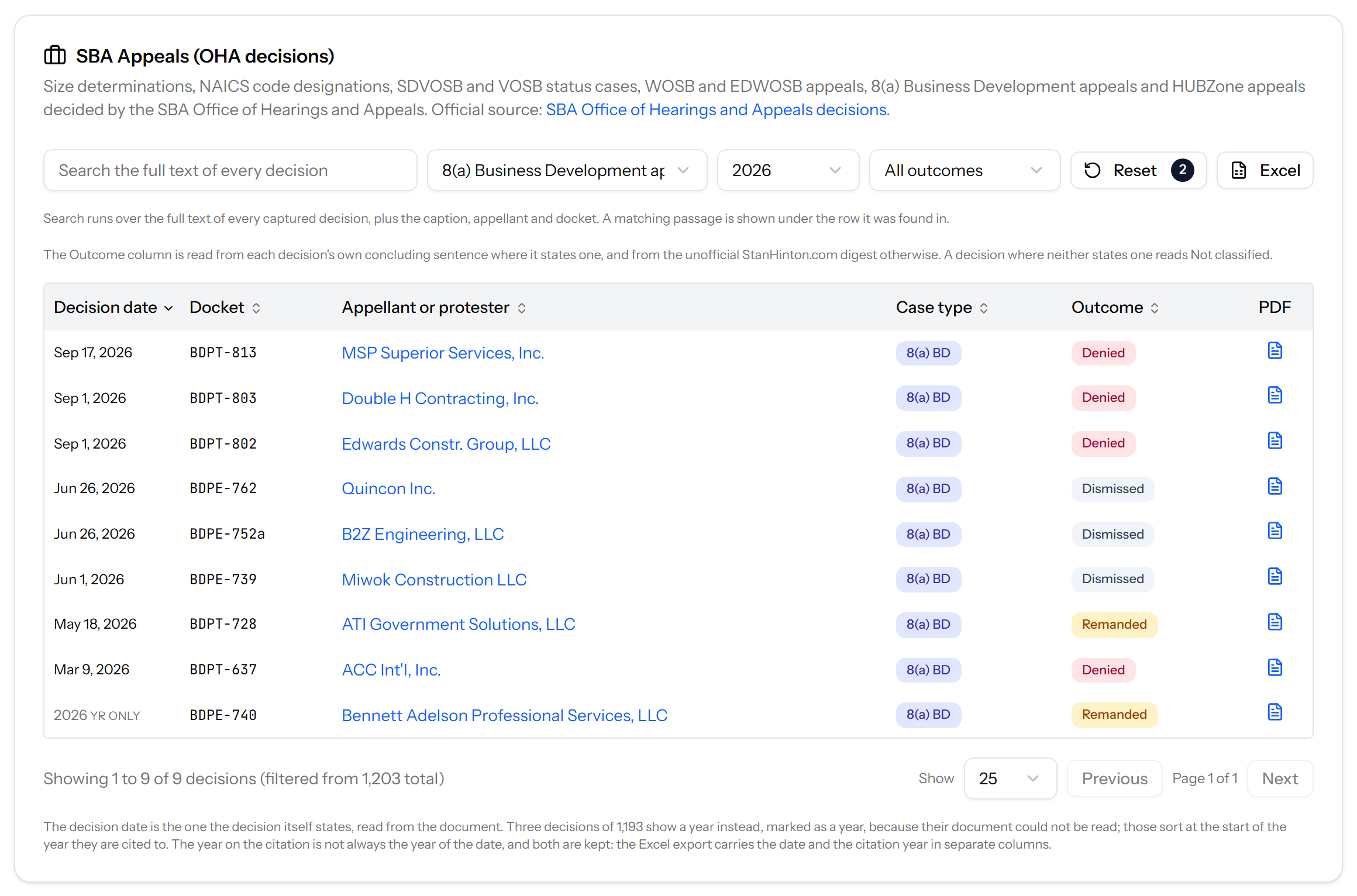
The platform holds nine 8(a) decisions from the Office of Hearings and Appeals for 2026, against two for 2025. Every one is in the ledger below, grouped by what the judge held.
Office of Hearings and Appeals, 8(a) decisions, 2026
BDPT-637 · March 9, 2026
ACC Int'l, Inc.
Over the economic disadvantage limits
"This exceeded the $400,000 AGI limit for continued 8(a)"
From the decision. Read the decision
Missing the data call. All three firms terminated for not answering it lost. One described operating a one-person construction business with limited administrative support; the judge held that the rule "contains no requirement that an 8(a) BD program participant act willfully". Another could not get its records from a retired accountant. A third began uploading documents after the last deadline, and the judge wrote that "Any technical difficulties Petitioner encountered after those deadlines passed are irrelevant".
Appealing the wrong letter. Two firms appealed their suspension and then let the 45 days to appeal their termination run out. A suspension appeal asks one narrow question. OHA's review of a suspension is "limited to the issue of whether the protection of the Government's interest requires suspension pending resolution of the termination action". Once the firm was terminated, there was nothing left to decide, and both appeals were dismissed.
Where firms won something. Two cases went back to SBA. In ATI Government Solutions, LLC, the judge found that there was no submission of the Suspension Letter itself, and rejected the explanation agency counsel offered after the fact. In Bennett Adelson Professional Services, LLC, the corpus digest says the record did not support a suspension based on the owner's income. A remand is not reinstatement: it sends the decision back to be made properly.
What it means for you: the arguments that lost are the ones a small firm reaches for first, hardship, good faith and late compliance. The ones that won were about the record SBA built. You can read every one of these decisions, and the rest of OHA's 8(a) docket back to 2010, in the SBA OHA Appeals tab, which opens as a free preview.
05What GSA says it will look for
Both releases describe the same review. GSA says SBA found that hundreds of 8(a) program participants had not demonstrated compliance yet received federal benefits, procurement priority, and contracts with a collective ceiling of $5.5 billion. SBA says GSA will look at awards made during each firm's time in the program "for potential improper awards, false statements, and pass-through arrangements", and that anything it finds will be referred directly to the DOJ for further enforcement action. In the meantime the firms are barred from participating in or receiving federal contracts under the 8(a) Program.
GSA, announcing the audit
"Federal contracts are a privilege, not a license to defraud the American people."
Three things the releases do not say. They do not name the firms. They do not say how the $5.5 billion figure was built; a ceiling is the most a contract can reach, not what was paid. And GSA's other figure, more than $13 billion in potential fraud identified since August, is the agency's whole fraud effort, not this audit. SBA has said that the Department of War and the Treasury have also each launched their own independent audits of the 8(a) Program.
What it means for you: assemble the file an auditor will ask for before the request arrives: the eligibility submissions behind each annual review, the work share on every 8(a) award, and the agreements with every joint venture partner and subcontractor.
06What an 8(a) fraud case has looked like
GSA cannot settle a fraud case; it refers one. Where a referral goes is the False Claims Act, and the platform's corpus of Department of Justice releases holds twelve matters, from 2014 to 2023, that turned on the 8(a) program. Every one settled. Together they paid $47.2 million, and five began as whistleblower suits.
False Claims Act matters that turned on the 8(a) program
August 10, 2017 · $16 million
ADS Inc.
"knowingly made misrepresentations concerning the size of the businesses and their eligibility as service-disabled or 8(a) qualified businesses"Read the release
Seven of the matters were about eligibility or control: a figurehead owner, an alter ego, or financial information that would have ended the firm's participation. The largest, ADS Inc. at $16 million, involved affiliates that claimed 8(a) and service-disabled veteran status. HX5 LLC and HX5 Sierra LLC paid $7.7 million over distributions and assets the government alleged were misreported to SBA, the same kind of financial question the data call asked.
In three matters, the release says the firm kept reaching 8(a) work after it was no longer eligible, through a new front company, an alter ego or a joint venture. That is the pattern a review of firms that have just left the program will look for first.
The rest involved a second company. Three were joint ventures or mentor arrangements in which the larger partner ran the work. Two were pass-throughs, where an 8(a) firm took the award and a company that could not bid did the work for a fee. The rule they ran into is the limitation on subcontracting: on a services contract the 8(a) firm must perform "at least 50 percent of the cost incurred for personnel with its own employees", under FAR 19.809-2.
What it means for you: if you were the partner, the mentor, the subcontractor or the surety, your records are part of the same review. The companies that paid in the record above include a surety that kept bonding an ineligible firm, a large business that took on an 8(a) protege, and a company that could not bid on the contract and did the work on another firm's award.
07The contracts still running
A removed firm is barred from new 8(a) awards. Its existing awards raise a separate question at each option. Under FAR 19.812, on an 8(a) contract that runs past five years with options, the contracting officer checks the firm's certification no more than 120 days before the fifth year ends. If the firm is no longer certified:
FAR 19.812(d), when the firm is no longer certified
"If the concern is not an SBA-certified 8(a) participant, the contracting officer shall not exercise the option"
That is the codified FAR. The FAR Overhaul's rewrite of Part 19 is in force by class deviation at many agencies: the Department of War adopted it in Class Deviation 2026-O0037 on July 24, 2026, and the platform tracks 31 other agencies with a Part 19 deviation in force. Check which Part 19 your contract carries before you rely on either text.
What it means for you: a prime or an agency program office with a removed firm on the team should map every option date and every 8(a) order now, because the decision not to exercise an option lands on a schedule, not on the audit's timeline.
Where GovConDash fits
Two tabs in the dashboard carry the work this piece describes: the decisions a removed firm is judged against, and the lawyers who have argued 8(a) appeals.
Case Law / SBA OHA Appeals / Browse
Read every 8(a) appeal OHA has decided
The SBA OHA Appeals tab holds the Office of Hearings and Appeals decisions, with Browse for the full text of each and Insights for outcomes across the docket. Pick the 8(a) case type and a year, and the list is the docket this piece read in part 4. It opens as a free preview.
Case Law / Law Firms / Firm Finder
Find the lawyers who have argued 8(a) appeals
The Law Firms tab reads the counsel of record out of the decisions of six tribunals, SBA's Office of Hearings and Appeals among them, and the Firm Finder searches it. Of the 110 8(a) decisions in the platform's OHA corpus, 18 name counsel or a representative; the other 92 do not. These are the eleven law firms those decisions name, leaving out two representatives that are not outside law firms. Each firm opens its page in the dashboard, and each docket opens the decision.
Law firm
8(a) appeals it appeared in, and the client
- PilieroMazza PLLCDCBDPT-637 · 2026 · ACC International IncorporatedIn part 4BDPE-507 · 2013 · Y & S Technologies, Inc.BDP-434 · 2012 · Loyal Source Government Services, LLC
- Koprince McCall Pottroff LLCKSBDPT-598 · 2022 · Geotechnical Innovation, PLLCBDPE-572 · 2019 · 7Skyline, LLC
- Theodore P. Watson & Associates, LLCCOBDPE-518 · 2014 · United Global Technologies, Inc.BDP-421 · 2011 · Accent Services Co., Inc.
- Peebles Bergin Schulte & Robinson LLPDCBDPE-739 · 2026 · Miwok Construction LLCIn part 4
- Howell & BertmanNJBDPE-597 · 2022 · M Patterson Services, LLC
- Riggs, Abney, Neal, Turpen, Orbison & Lewis, P.C.OKBDPT-599 · 2022 · SJ Innovations, LLC
- Newland & Associates, PLLCARBDPE-593 · 2021 · United Systems of Arkansas, Inc.
- Schoonover & Moriarty LLCKSBDPE-590 · 2021 · American Power, LLC
- Bean Kinney & Korman, PCVABDPE-478 · 2013 · Harris Grant, LLC
- Halpern & Levy, P.C.PABDPT-464 · 2013 · NOVA Training & Technology Solutions, LLC
- Neel, Hooper & Banes, P.C.BDP-435 · 2012 · Best Technology Services, Inc.
A firm's name here is a fact about the record, not a recommendation. The list shows where a firm appeared, not how the appeal came out; read the decision for that.
Documents and data used in this piece
The program
- U.S. Small Business Administration, 8(a) Business Development program
SBA's own overview of the program and its benefits.
The releases
- U.S. Small Business Administration, SBA Orders All 8(a) Participants to Provide Financial Records, December 5, 2025
A step in the campaign that produced the referral.
- U.S. Small Business Administration, SBA Suspends Over 1,000 8(a) Firms from Program Following December Document Request, January 28, 2026
A step in the campaign that produced the referral.
- U.S. Small Business Administration, SBA Moves to Terminate Over 150 8(a) Firms in Washington, D.C. Following Eligibility Review, February 11, 2026
A step in the campaign that produced the referral.
- U.S. Small Business Administration, SBA Moves to Terminate Over 620 Firms in 8(a) Federal Contracting Program That Refused to Turn Over Financial Data, March 4, 2026
A step in the campaign that produced the referral.
- U.S. Small Business Administration, SBA Refers Nearly 700 Noncompliant 8(a) Firms to GSA to Conduct Contract Audits, October 21, 2026
The announcement this piece reads.
- U.S. General Services Administration, GSA Launches Sweeping Fraud Audit of Nearly 700 Federal Contractors in Collaboration with Small Business Administration, October 21, 2026
The announcement this piece reads.
Office of Hearings and Appeals decisions
- In The Matter Of: ACC Int'l, Inc., SBA No. BDPT-637 (2026)
Over the economic disadvantage limits. Decided March 9, 2026.
- Matter of ATI Government Solutions, LLC, SBA No. BDPT-728 (2026)
Sent back for an incomplete record. Decided May 18, 2026.
- Matter of Miwok Construction LLC, SBA No. BDPE-739 (2026)
Ownership the program requires. Decided June 1, 2026.
- Matter of Bennett Adelson Professional Services, LLC, SBA No. BDPE-740 (2026)
Over the economic disadvantage limits. Decided 2026.
- Matter of B2Z Eng'g., LLC, SBA No. BDPE-752 (2026)
Appealed the suspension, not the termination. Decided June 26, 2026.
- Matter of Quincon Inc., SBA No. BDPE-762 (2026)
Appealed the suspension, not the termination. Decided June 26, 2026.
- In the Matter of Edwards Constr. Group, LLC, SBA No. BDPT-802 (2026)
Terminated for not answering the data call. Decided September 1, 2026.
- In the Matter of Double H Contracting, Inc., SBA No. BDPT-803 (2026)
Terminated for not answering the data call. Decided September 1, 2026.
- In the Matter of MSP Superior Services, Inc., SBA No. BDPT-813 (2026)
Terminated for not answering the data call. Decided September 17, 2026.
False Claims Act releases
- Utah Construction Company to Pay Government to Settle Alleged False Claims in Connection with Program for Small and Disadvantaged Businesses, March 21, 2014
Joint venture or mentor-protege misused. $928,000.
- Former Security Contractor CEO Agrees to pay $4.5 Million to Settle Civil Claims, December 22, 2014
Eligibility or control misstated. $4.5 million.
- Former Security Contractor and Owner Agree to Pay $300,000 to Settle Civil Fraud Claims, February 23, 2015
Eligibility or control misstated. $300,000.
- East Grand Forks Construction Company Pays $1.85 Million To Resolve False Claims Allegations, April 21, 2015
Joint venture or mentor-protege misused. $1.85 million.
- LB&B Associates Inc. Agrees to Pay $7.8 Million for Alleged False Claims Related to Small Business Administration Set Aside Contracts, July 6, 2015
Eligibility or control misstated. $7.8 million.
- Defense Contractor ADS Inc. Agrees to Pay $16 Million to Settle False Claims Act Allegations, August 10, 2017
Eligibility or control misstated. $16 million.
- North American Specialty Insurance Company To Pay Over $1 Million To Settle False Claims Allegations For Bonding Contractor In Small Business Administration 8(a) Program Fraud Scheme, September 4, 2019
Eligibility or control misstated. $1 million.
- O'Fallon Building Co. Settles Fraud Claims, February 25, 2021
Joint venture or mentor-protege misused. $400,000.
- Sage Consulting Group, Inc. Agrees to Pay $4.8 Million to Settle Civil False Claims Act and Anti-Kickback Act Allegations, July 20, 2021
Work passed through for a fee. $4.8 million.
- Government Contracting Companies Agree to Settle Civil False Claims Act and Anti-Kickback Act Allegations, September 23, 2021
Work passed through for a fee. $1.17 million.
- Government Contractor Pays $742,500 to Settle False Claims Act Allegations in Obtaining Contracts Reserved for Eligible Small Businesses, March 23, 2023
Eligibility or control misstated. $742,500.
- Florida Contractors and Owner to Pay More than $7.7 Million to Resolve False Claims Act Allegations Relating to Procurement of Small Business Contracts, June 29, 2023
Eligibility or control misstated. $7.7 million.
- Department of Justice Civil Division, False Claims Act
The Civil Division's own page on the Act.
Regulations as codified
- FAR 19.800, General
The section as the eCFR prints it today.
- FAR 19.802, Determining eligibility for the 8(a) program
The section as the eCFR prints it today.
- FAR 19.805-1, General
The section as the eCFR prints it today.
- FAR 19.809-2, Limitations on subcontracting and nonmanufacturer rule
The section as the eCFR prints it today.
- FAR 19.812, Contract administration
The section as the eCFR prints it today.
- FAR 19.816, Exiting the 8(a) program
The section as the eCFR prints it today.
- Class Deviation 2026-O0037, DFARS Part 219 and FAR Part 19
The Department of War deviation that puts the FAR Overhaul's Part 19 in force for its contracts.
Disclaimer. This piece is commentary on public agency releases and published decisions. It is not legal advice, and it says nothing about any firm GSA is reviewing, which the agencies have not named. The False Claims Act matters were resolved by settlement, and their allegations were not proven. The law firms listed are the counsel the decisions name; the list is not a recommendation. Confirm how any of this applies to you with counsel or a government contracts professional.

GovConDash.ai
Read the decisions and the enforcement record behind your program
Start a 14-day free trial of Pro and search the SBA OHA Appeals, False Claims Act and Law Firms tabs beside the FAR, the case law and your own contracts. Checkout takes a card and charges nothing for 14 days. Cancel before then and you pay nothing; keep going and it becomes $99 / month. One trial per account.
Keep reading
DOJ Put Government Contracts on Its Fraud Priority ListThe Department of Justice put procurement fraud on its priority list this month. Where a GSA referral would land.