



































GSAR 552.239-7001 (GSAR Deviation)
Basic Safeguarding of Data within Large Language Model Artificial Intelligence Systems
- Where it is printed: GSAR pages 129 to 144 of GSA's RGO-2026-01 deviation text, prescribed at 539.71 on page 47.
- When it takes effect: the clause is dated September 2026, and the deviation's table of effective dates lists Part 552, where it sits, as effective October 19, 2026. A contracting officer may apply a change sooner (the memorandum).
- Under what authority: the class deviation memorandum of January 15, 2026, signed by Jeffrey A. Koses, Senior Procurement Executive, in response to Executive Order 14275.
- When MAS gets it: Refresh #34, which GSA posted on SAM.gov on November 12, 2026 as part of the GSAR Overhaul Wave 4 updates. Existing contractors accept the mass modification within 90 days of its issue, and its changes apply to orders issued after its effective date (GSA's summary of changes).
The short version
- 1It applies by what an order buys. An order for an LLM, chatbot, agentic system or LLM-enabled tool where the LLM is a material feature and Government Data goes in or comes out. It deletes itself when the LLM only runs your own back office or is incidental to a product that is not AI.
- 2The data is the Government's. No training or fine-tuning on it, no use for your own business decisions, no sale, and deletion at the end of the order, weights, embeddings, indexes and caches included.
- 3Nine clocks, the shortest 72 hours. Incidents, model changes, provider retirements, safety drops and the disclosure of the LLMs you use each carry a deadline.
- 4A model that falls short can be pulled, at your cost. The Government may benchmark the model at any time and suspend it, and after a termination for cause you owe decommissioning costs of up to 25% of the affected order.
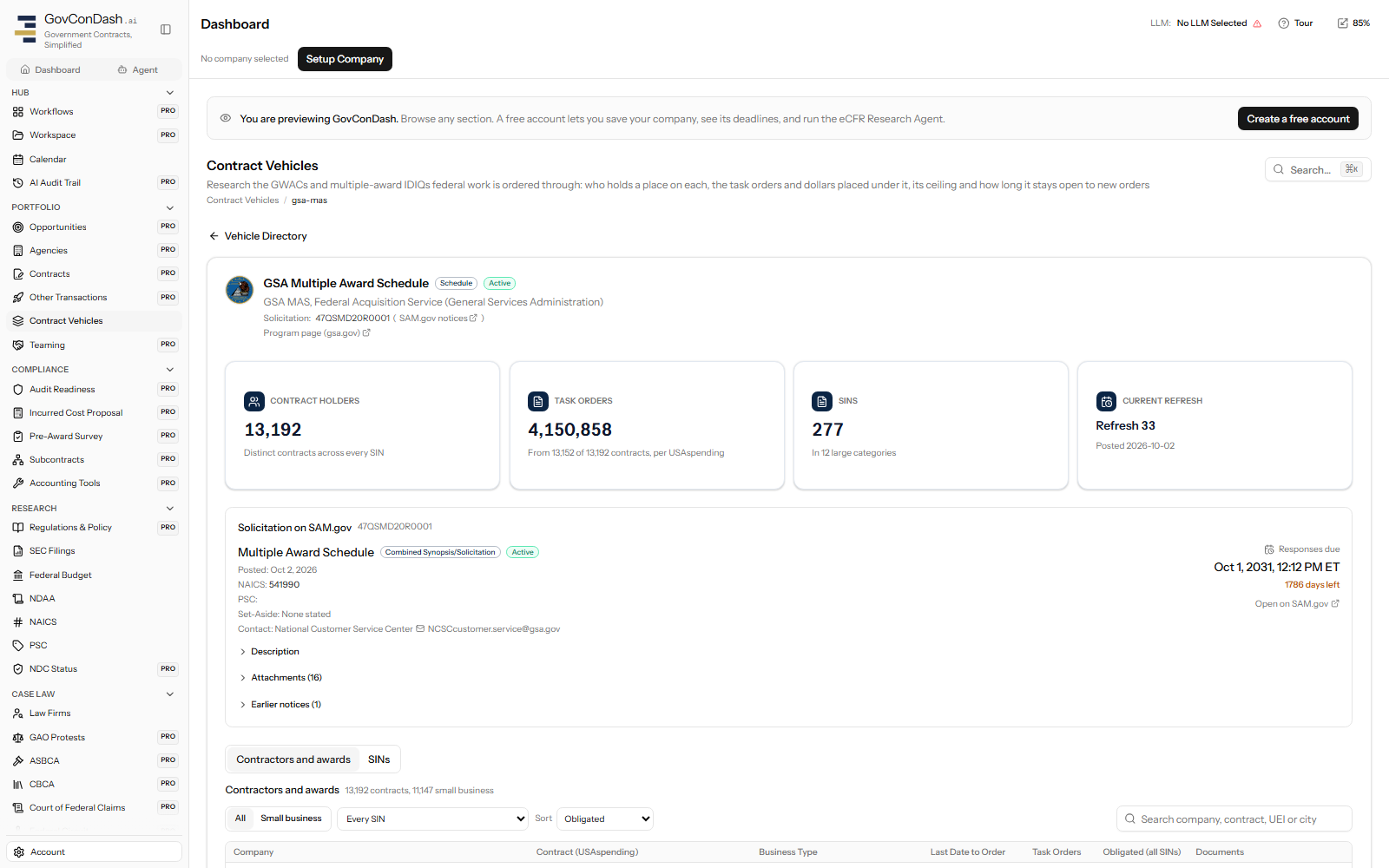
- 5The sellers it reaches first are small. Eleven MAS contracts carry 20 roles their own price lists describe as LLM work, every one held by a small business. The GSA MAS page in Contract Vehicles lists every schedule contract.
1539.71 and paragraphs (a) and (b)When the clause applies, and when it deletes itself
One term before the rules. The clause defines the thing it governs broadly:
- Large Language Model Artificial Intelligence System (LLM)
- "a generative artificial intelligence model trained on vast, diverse datasets that enable the model to generate natural-language responses to user prompts".
- "The LLM includes the Information System in which the model is configured, deployed, operated, monitored or made available for the processing of Government Data", from hosting and system prompts to retrieval and guardrails.
- 552.239-7001(b), GSAR page 131. The clause takes the definition from Executive Order 14319, section 2.
Government Data is the Data Inputs and Data Outputs together, and the inputs include user prompts, system prompts, documents, knowledge bases, Government email addresses and user account information (552.239-7001(b)).
The prescription at 539.71 tells contracting officers to insert the clause in solicitations and contracts, commercial ones included, when they are procuring an LLM, generative assistant, chatbot, agentic system or LLM-enabled tool where the LLM is a material feature and Government Data goes to it or comes from it. The clause narrows itself further:
"This clause applies only to the extent that, in performance of this task/delivery order, BPA or contract the Government is procuring an LLM ..."
Unless the contracting officer says otherwise, it says, "this clause is self-deleting and imposes no obligation when" the LLM only runs the contractor's own internal, back-office or performance-support systems, or when the LLM is incidental to a commercial product whose primary purpose is not AI (552.239-7001(a)(1)(ii)).
Our reading, not GSA's words: nothing in that trigger names a SIN. GSA's Refresh #34 notes describe the change as "Creating a new AI-related clause for use in GSA contracts, including Schedules, to protect Government Data and to mitigate other risks presented by LLM systems". A cloud, contact center or professional services order that buys an LLM feature can bring it in, and an AI consulting order that buys no LLM may not.
2Paragraph (e), rights and usesThe Government owns the data, and you may not train on it
"The Government retains full ownership of, and will own, all Government Data provided to the Contractor or otherwise made available to the Contractor under the contract, task/delivery order, or BPA, and all Custom Developments"
You may use Government Data and Custom Developments only for the order: to perform its requirements, for de-identified, aggregated security telemetry, for technical support and maintenance, and for any other use the contracting officer authorizes in writing (552.239-7001(e)(1)(iv)). You keep the underlying LLM, your base models and your Background Data (552.239-7001(e)(1)(vi)).
The first prohibited use the clause lists is "Training, fine-tuning, or otherwise improving an LLM, including those operated by third parties, or to develop or improve the LLM(s) for any other customers or any commercial or non-commercial purposes". It also bars using Government Data to inform your advertising, sales or other business decisions, and selling or licensing it to anyone (552.239-7001(e)(3)(v)).
3Paragraph (e)(4), handlingHow you hold the data, and what you delete at the end
Access to Government Data is limited to personnel the contracting officer authorizes (552.239-7001(e)(4)(ii)), and the clause says which architectures already satisfy its handling measures: "non-persistent (zero-persistence) architectures that do not retain Government Data satisfy them". When someone does open the data, for troubleshooting or an incident, the access must be logged, minimized and provided to the Government on request (552.239-7001(e)(4)(ii)).
The data stays on the agreed premises or FedRAMP-authorized services unless the contracting officer consents in writing (552.239-7001(e)(4)(v)), and it is logically segregated from other customers' data, which does not require a dedicated instance (552.239-7001(e)(4)(vi)). At the end of the order:
"securely and permanently delete, destroy (e.g., cryptographically erase) all such Government Data, and any Custom Developments including fine-tuned model weights, embeddings, indexes, and caches ..."
4Paragraphs (f)(2) and (f)(3)Where the model comes from
The clause asks you to maximize the use of LLMs developed, managed and operated in the United States and subject to U.S. law (552.239-7001(f)(2)(i)). The firm line is narrower: an LLM, and any component doing core model, storage, output or security work, may not be developed, managed or operated by an entity under the direction, influence or control of an adversary foreign government, as 15 CFR 791.4 defines them (552.239-7001(f)(2)(ii)). Foreign-developed components that do not provide core functionality are allowed when they add no material risk (552.239-7001(f)(2)(iii)).
You disclose, within 30 days after award, whether the LLM was modified or configured at a non-U.S. government's request or to comply with non-U.S. law (552.239-7001(f)(3)), or within the same period after you learn of such a change. The origin paragraphs do not flow down to an Open-LLM Component or a Fully Open Model, the clause's terms for openly licensed components and models (552.239-7001(a)(2)(ii)).
5Paragraphs (f)(4) and (h)Show the steps, and let the data leave
Where the LLM reasons, retrieves or takes agentic steps, it must make a summary of the steps it records available, from Data Input to Data Output (552.239-7001(f)(4)(i)), including retrieval methods with source attribution and any human-reviewer access to Government Data (552.239-7001(f)(4)(ii)). The clause is careful about how far that goes: "This requires only a summary of recorded steps, not a faithful explanation of the model's internal reasoning".
Portability is the other half. Government Data, interaction history and knowledge bases must export in open or standard machine-readable formats with their metadata (552.239-7001(h)(1)), and you may "Not impose proprietary formats, technical restrictions, additional costs, or additional licensing conditions that materially impair the Government's ability to retrieve, use, or migrate Government Data to another service".
6Paragraphs (d), (f) and (i)The clocks the clause starts
The clause runs on deadlines, and the shortest is 72 hours. An incident notice is followed by daily status updates until it is resolved (552.239-7001(f)(5)), and you also complete CISA's incident reporting form (552.239-7001(f)(5)(iii)).
Nine deadlines in GSAR 552.239-7001
72 hours
Material violation
Tell the contracting officer after you learn of a material violation of the clause.
552.239-7001(d)(2), GSAR page 132
72 hours
Security incident
Tell the contracting officer and the security contacts of an incident that may affect Government Data, send daily updates until it is resolved, and file CISA's incident reporting form.
552.239-7001(f)(5), GSAR page 139
90 calendar days
Preserve the evidence
Keep the logs, forensic images and incident artifacts after a security incident involving Government Data.
552.239-7001(f)(5)(ii), GSAR page 140
5 business days
A provider retires a model
When a third-party provider you do not control retires a model, tell the contracting officer and make best efforts to provide access to its successor.
552.239-7001(i)(2), GSAR page 142
7 calendar days
Safety or quality drops
Report a change that materially increases output bias, weakens guardrails or degrades performance or truthfulness.
552.239-7001(i)(3), GSAR page 142
30 calendar days
Advance notice of a change
Give written notice before you add or change an LLM or its developer, operator, integrator or provider, or change the services handling Government Data.
552.239-7001(i)(1), GSAR page 142
30 or 15 calendar days
A new model version
Before you replace a model, use reasonable efforts to give concurrent access to its successor for evaluation: the longer period for a major version, the shorter for a minor one.
552.239-7001(i)(2), GSAR page 142
30 days after award
A foreign government's change
Disclose whether the LLM was modified or configured at a non-U.S. government's request or to comply with non-U.S. law, or do so within the same period after you learn of it.
552.239-7001(f)(3), GSAR page 138
120 days after work starts
Disclose the LLMs
Disclose the LLMs that process Government Data, by the date the order sets or, if it sets none, after work starts.
552.239-7001(f)(1), GSAR page 138
7Paragraph (j)The Government can test it, suspend it and send you the bill
The clause closes on the Government's remedies. It first asks for reasonable efforts to configure the LLM, on factual prompts, to "prioritize accuracy, scientific inquiry, and objectivity", and to say so when the reliable information runs out or conflicts (552.239-7001(j)(1)). Then:
"The Government reserves the right to conduct automated assessments of the LLM, as deployed and configured for government users, at any time using its own benchmarks"
Those evaluations may cover bias, truthfulness, safety and unsolicited ideological content (552.239-7001(j)(2)(i)), and you make best efforts to give the Government tools to run its benchmarks automatically (552.239-7001(j)(2)(ii)). The non-compliance paragraph opens bluntly: "The Government retains the right to suspend use of the LLM at any time".
If the contracting officer terminates for cause after written notice of non-compliance and a failure to remediate, you are liable for reasonable decommissioning costs, capped at 25% of the value of the affected order and excluding re-procurement and replacement-system costs (552.239-7001(j)(3)(ii)).
8Paragraphs (a)(2), (c) and (d)(3)Flowdown, proof and what the clause overrides
You flow the clause's paragraphs to any subcontractor doing AI Design, AI Development, AI Deployment, or Operation and Monitoring as the NIST AI Risk Management Framework 1.0 describes them, when it handles Government Data (552.239-7001(a)(2)(i)). Proof can come from what you already hold: license addendums, model and system cards, FedRAMP packages, SOC 2 reports and ISO/IEC 27001 certifications (552.239-7001(d)(3)(v)). "The Contractor is not required to create duplicative documentation where existing artifacts reasonably demonstrate the relevant due diligence measures".
The clause supplements FAR 52.212-4 and GSAR 552.212-4 rather than replacing them, and where it meets your own paper it wins:
"To the extent there is any conflict between this clause and the Contractor's policies, requirements, terms, conditions, commercial supplier agreements, license agreements, terms of service, click-wrap, browse-wrap, or other commercial agreements, this clause takes precedence"
9GSA CALC+ ceiling ratesWho on MAS already sells LLM work
GSA's CALC+ index, as of November 8, 2026, lists 164 MAS contracts (136 of them small businesses) carrying a labor category whose title names an AI or machine learning role. Most of those roles are AI work in general, which the clause does not reach by itself.
The roles nearest the trigger are the ones a contractor's own price list describes as LLM, generative, agentic, prompt engineering or chatbot work: 20 roles on 11 contracts, every one a small business, with ceilings from $96.77 to $211.69 an hour and a median of $155.36.
A labor category is a role a contractor can sell at that ceiling, not a role an agency has bought. Three of the eleven contracts report any orders in USAspending at all, counted across the whole contract rather than these roles.
MAS contracts selling LLM work
CALC+, indexed November 8, 2026
DIGICLOUD SERVICES LLC47QTCA22D006FSMALL
LionFederal - Generative AI Engineer I
Develops and deploys Generative AI models using deep learning frameworks, large language models (LLMs), and NLP pipelines. Fine-tunes foundation models for specific domains, develops APIs for inference, and integrates models into cloud or on-prem environments. Collaborate with data scientists and DevOps teams to deploy scalable, secure AI pipelines. Participates in model evaluation and documentation of ethical/accuracy considerations. Supports prompt engineering and experimentation workflows in support of production readiness.
LionFederal - Generative AI Engineer II
Designs end-to-end Generative AI systems for real-world applications, leading to the development of reusable model pipelines, embeddings, and retrieval-augmented generation (RAG) systems. Guides teams on selection and adaptation of transformer models, oversees data preparation and prompt engineering strategies, and ensures models comply with privacy and fairness constraints. Works across cloud and hybrid environments to integrate AI services into mission-critical systems. Collaborates with security, UX, and compliance leads to responsible AI implementation.
LionFederal - Generative AI Engineer III
Serves as technical lead for enterprise GenAI initiatives. Oversee architecture of multi-modal models, including text, image, and code generation. Establishes scalable model governance, monitoring, and retraining strategies. Defines standard practices for evaluation metrics, hallucination reduction, and bias mitigation. Partners with product, legal, and infrastructure teams to operationalize GenAI across departments or programs. Contributes to an internal knowledge base and mentors GenAI developers across multiple teams.
LionFederal - Generative AI Engineer IV
Acts as the principal technical strategist for GenAI across the enterprise. Defines long-term roadmaps for LLM integration, tooling, and infrastructure investment. Evaluates open-source and proprietary model ecosystems, leads cross-functional advisory groups, and influences AI policy and risk governance at the executive level. Authors reference architecture, white papers, and innovation strategies. Provides directions to technical and executive teams on AI capabilities, limitations, and operational impact on scale.
EPITOME RESEARCH AND INNOVATIONS INC.47QRAA26D005YSMALL
AI/ML Engineer / Data Scientist
Develops and integrates artificial intelligence, machine learning, and data-science capabilities for analytical and operational applications. May perform supervised/unsupervised learning, NLP, large-language-model integration, retrieval-augmented generation, agentic workflows, computer vision, anomaly detection, predictive analytics, statistical modeling, feature engineering, data preparation, model evaluation, inference integration, prompt/knowledge engineering, and MLOps.
Agentic AI / Generative AI Engineer
Designs, develops, integrates, evaluates, deploys, and maintains generative-AI and agentic-AI applications and workflows. Develops LLM-powered applications, AI agents, retrieval-augmented generation (RAG) solutions, tool/function-calling workflows, multi-agent systems, autonomous and human-in-the-loop workflows, memory and context-management mechanisms, and integrations with enterprise applications, APIs, databases, and external tools. Implements agent orchestration, planning, task decomposition, prompt and knowledge engineering, guardrails, security controls, evaluation frameworks, observability, monitoring, and performance optimization. May use technologies and protocols such as MCP, A2A, LangChain, LangGraph, CrewAI, or equivalent frameworks.
MLOps / LLMOps / Agentic AI Platform Engineer
Designs, builds, deploys, and operates platforms and pipelines that productionize AI/ML, generative-AI, LLM, and agentic-AI capabilities. Implements model, agent, and data pipelines; model/agent registries; prompt and agent versioning; CI/CD/CT; containerization; orchestration; inference and agent services; GPU/cloud infrastructure; evaluation datasets; tracing; observability; monitoring; drift and performance tracking; access controls; guardrails; and reproducible environments. Integrates models and agents into applications and supports secure, scalable lifecycle management for models, prompts, RAG pipelines, agents, tools, and multi-agent applications from experimentation through production.
Senior Agentic AI / Generative AI Engineer
Leads the architecture, development, integration, evaluation, deployment, and operationalization of complex generative-AI and agentic-AI solutions. Defines agent and system architectures, model and tool selection, orchestration patterns, RAG and memory strategies, multi-agent coordination, human-oversight workflows, evaluation and red-team approaches, security and guardrails, observability, deployment, and scaling. Integrates agents with enterprise systems, cloud platforms, APIs, databases, and mission data sources; establishes engineering, reliability, and governance practices; leads technical reviews; resolves complex production issues; and provides technical direction to multidisciplinary AI, software, data, and platform teams.
SAVANT FINANCIAL TECHNOLOGIES INC.GS35F178CASMALL
Software / Generative AI Developer I
Provides entry-level support in developing software and generative AI applications. Assists with coding, testing, and integrating features and AI models under supervision. Supports debugging, documentation, and deployment tasks within development environments.
Software / Generative AI Developer II
Supports development of software and generative AI applications with limited supervision. Writes and tests code, integrates AI models and APIs, and assists with debugging, optimization, and deployment. Contributes to development standards and continuous improvement efforts.
Software / Generative AI Developer III
Designs and develops software and generative AI applications. Builds and integrates features, models, and APIs, optimizes performance, and ensures code quality and security. Leads development efforts and provides guidance to junior developers.
8 CONSULTING LLC47QTCA24D00CDSMALL
Qualified Prompt Engineer
Develops and utilizes simulations and models. Evaluates tools, technologies, architectures, models, and test results. Heads meetings regarding AI with external parties and internal business-embedded innovation teams. Collaborates with lead engineers to define subsystem requirements and acceptance criteria.
Mid Career Prompt Engineer
Develops and utilizes simulations and models. Evaluates tools, technologies, architectures, models, and test results. Heads meetings regarding AI with external parties and internal business-embedded innovation teams. Collaborates with lead engineers to define subsystem requirements and acceptance criteria.
BLU OMEGA LLC47QTCA25D004MSMALL
Prompt Engineer
Designs, tests, and optimizes prompts and workflows for generative AI and large language model applications. Collaborates with technical and business stakeholders to improve AI output quality, accuracy, and usability.
CYNTELLIGENT SOLUTIONS, LLC47QTCA20D0078SMALL
Prompt Engineering Specialist
Designs, tests, and optimizes prompts and interaction patterns for generative AI tools used in training content development and delivery.
ENDYNA, INC.GS00F0017YSMALL
Large Language Model AI Engineer
Role: Designs, develops, deploys, and optimizes large language model solutions supporting mission needs. Responsibilities: Fine-tunes and evaluates models; develops data pipelines; ensures scalability and reliability; documents solutions; supports responsible AI practices; and advises stakeholders on AI implementation.
INTEGRATED TECHNOLOGY SOLUTION GROUP LLC47QTCA25D00FHSMALL
Cloud Conversational AI Specialist
Designs Cloud, builds, and trains conversational agents, chatbots, and NLP-driven interaction systems. Develops conversation flows, intent models, and integrated multi-channel experiences.
NU INFO SYSTEMS INC47QTCA26D001NSMALL
IT Large Language Model (LLM) Specialist
The IT Large Language Model (LLM) Specialist is a cutting-edge AI engineer focused on the development, refinement, and application of generative pre-trained transformers (GPTs) and other large language models that exhibit human-like text understanding and generation capabilities. Their core responsibility involves the creation and refinement of LLMs tailored to perform specific and complex natural language tasks, often through fine-tuning on domain-specific datasets or specialized training regimes. They are adept at employing advanced model optimization techniques such as quantization, pruning, knowledge distillation, and regularization strategies to enhance model accuracy, reduce computational overhead, and improve inference performance. A significant aspect of their role involves continuous research and exploration of novel approaches to language understanding and generation, often contributing to the advancement of the field. They are instrumental in applying LLMs to a diverse array of real-world applications, including sophisticated content generation (e.g., creative writing, code generation), nuanced sentiment analysis, highly accurate machine translation, intelligent conversational agents, and robust text summarization. Close collaboration with cross-functional teams is vital for the seamless integration of LLMs into existing systems, applications, and workflows, often requiring the development of robust APIs and deployment strategies. Staying at the forefront of the rapidly evolving language modeling landscape and incorporating cutting-edge research findings into their work is paramount. Furthermore, meticulous documentation of model development, experimental setups, and performance benchmarks is maintained for version control, reproducibility, and compliance.
REDD SOLUTIONS LLC47QTCA26D005TSMALL
Cloud Generative AI Specialist
Develops and tunes generative AI models deployed on cloud platforms for intelligent automation.
SYSTEMDOMAIN, INC.47QTCA26D001TSMALL
Chatbot Full Stack Developer
Create the Business Specification Documents after gathering the business requirements and understanding the existing chatbot code. Create different JIRA items for the implementation of the application using Agile Software Development methodology. Deploy applications in various environments such as Dev (Development), UAT (User Acceptance Testing), SIT (System Integration Testing) and PROD (Production). Protecting sensitive information by implementing code that mask Personally Identifiable Information (PII).
Widen to every AI family and the shape holds. The three families nearest the trigger are thin, 6 contracts at most, while machine learning engineering reaches 73 contracts and AI engineering and development 92.
The AI bench on MAS, family by family
Nearest the trigger
AI roles in general
Roles listed as LLM work
MAS contracts
11
Small business contracts
11
Role titles
20
Median ceiling, per hour
$155.36
10On the platformWhere GovConDash fits
Two places on GovConDash follow this piece's argument.
Dashboard, Portfolio, Contract Vehicles
The GSA MAS vehicle page
Public page
GSA MAS and Refresh #34
Key takeaways
- Read the order, not the schedule. The clause attaches when an order buys an LLM feature that Government Data passes through, under any SIN, and deletes itself when the LLM only runs your own back office.
- Fix your data terms before the order lands. No training or business use, data kept on agreed premises or FedRAMP-authorized services, and deletion of weights, embeddings, indexes and caches at the end, documented in writing.
- Put the nine deadlines in your plans. The shortest is 72 hours, and the model retirement clock starts with your provider's notice, so your provider agreements need to carry it too.
- Price the remedy. The Government may benchmark and suspend the model, and after a termination for cause you owe decommissioning costs of up to 25% of the affected order.
- Flow it down and prove it with what you hold. Subcontractors who build, deploy or operate the model carry the clause, your existing FedRAMP, SOC 2, ISO/IEC 27001 and model card artifacts count as proof, and your commercial terms give way to it.
Documents and data used in this piece
The clause and the refresh
- GSA RGO-2026-01, GSA Acquisition Regulation (GSAR) Class Deviations, with the Revolutionary GSAR Overhaul text
The memorandum of January 15, 2026 and the deviation text, which carries 539.71 and the clause at 552.239-7001. GSA updates this PDF as parts take effect; this piece reads the copy served on November 9, 2026.
- SF30 Attachment for Refresh Mod 47QSMD20R0001, MAS Refresh #34 (November 12, 2026)
The refresh as posted on SAM.gov (https://sam.gov/opp/9e966a416a40493b9ece3952de8241d0/view): the clauses it adds, including 552.239-7001, and the 90 day window to accept the mass modification.
The executive orders behind it
- Executive Order 14275, Restoring Common Sense to Federal Procurement (April 15, 2025), 90 FR 16447
The order GSA's RGO-2026-01 class deviations respond to, as the memorandum's subject line states.
- Executive Order 14319, Preventing Woke AI in the Federal Government (July 23, 2025), 90 FR 35389
The order whose section 2 the clause cites for its definition of a large language model.
The references the clause names
- CISA incident reporting form
The form paragraph (f)(5)(iii) tells a contractor to complete after an incident.
- FAR 52.212-4, Contract Terms and Conditions, Commercial Products and Commercial Services
The commercial terms clause the AI clause supplements.
- GSAR 552.212-4, Contract Terms and Conditions, Commercial Products and Commercial Services
GSA's deviated version of the commercial terms clause, which the AI clause also supplements.
The MAS data
- GSA CALC+ (Contract-Awarded Labor Category) ceiling rates
The labor categories and ceiling rates awarded on schedule contracts, read weekly. CALC+ answers at most 10,000 results a search, so the counts are a floor.
- GSA GSA Multiple Award Schedule
GSA's program page for the schedule, solicitation 47QSMD20R0001.
Disclaimer. This piece is commentary on a GSA deviation clause and the solicitation refresh that brings it to MAS. It is not legal advice, and it is not a determination about any contractor, contract or order. Confirm how the clause applies to you with counsel or a government contracts professional. Read the clause in full.

GovConDash.ai
See who holds the schedule before the order lands
Start a 14-day free trial of Pro and keep the GSA MAS vehicle page beside your own portfolio, matched opportunities and the research agents. Checkout takes a card and charges nothing for 14 days. Cancel before then and you pay nothing; keep going and it becomes $99 / month. One trial per account.
Keep reading
The Pentagon Put AI on Every Computer. Your DCAA Auditor Is on It Too.The other side of the same tools: what generative AI on every Department computer means for the auditor reading your books.