- Explore the whole platform
Find and win work
- OpportunitiesSAM.gov notices and DoW SBIR/STTR topics, matched to your NAICS codes and set-asides.
- AgenciesFind the departments, commands and offices buying what you sell, and who wins there.
- TeamingFind partners by code, size and award record, and the role you can play beside each.
- Contracts and VehiclesYour award portfolio, plus the GWACs, multiple-award IDIQs and GSA schedules and who holds them.GSA MAS
- Other TransactionsOT agreements, the consortia that award them, and the prototype OT guide.
- NDC StatusCheck nontraditional defense contractor status under 10 U.S.C. 3014.
- NAICSFind your code, its SBA size standard and the market under it: who buys it and who wins it.
Stay compliant
- Audit ReadinessDCAA audit programs, the Contract Audit Manual and selected costs under FAR 31.205.
- Incurred Cost ProposalBuild Schedules A to O, model indirect rates and roll forward each fiscal year.
- Pre-Award SurveyPrepare your accounting system for DCAA's pre-award survey.
- CAS Disclosure StatementDetermine whether you must file, then prepare Form CASB DS-1 on the official form.
- Subcontracting and Flow-DownThe FAR clause library, the flow-down matrix and a clause scan of your documents.
- CMMCThe C3PAO directory and the CMMC enforcement record.
- Accounting ToolsScan a ledger for unallowable costs and map a chart of accounts.
Research and case law
- Regulations and PolicyFAR, DFARS and CAS with a research agent that cites every section it uses.
- Federal Budget and NDAADoW budget lines and NDAA bill text, read against your NAICS codes.
- SEC Filings10-K, 10-Q and 8-K analysis for the public companies you compete and team with.
- GAO ProtestsBid protest decisions, searchable in full text, with outcome insights.
- ASBCABoard decisions on contract disputes and cost allowability.
- Courts and BoardsCourt of Federal Claims, Federal Circuit, CBCA and SBA OHA decisions.
- False Claims ActJustice Department False Claims Act releases on federal procurement, with enforcement insights.
- Law FirmsThe counsel who appear before the six tribunals, and the cases they argued.
Agents and integrations
- Dashboard AgentAsk one question across the regulations, DCAA guidance, the case law and your own company, and open every source it cites.
- WorkflowsMulti-step drafts, from a DCAA audit response to a GAO protest, each with its sources cited.
- MCP serverBring the same grounded data into Claude, ChatGPT and the other assistants that connect over MCP.











- Word, Excel and OneDriveExport drafts to Word and Excel, and keep your Workspace in sync with OneDrive.


- See the data coverage
Regulations and policy
Contracts and spending
Audit and compliance
- Security
- Pricing
















Your Disclosure Statement,with an agent beside you
Find out whether your business unit must file, then prepare Form CASB DS-1 on the official form. An agent beside you explains each item and drafts entries only from what you tell it about your practices.
GovConDash for the fictitious XYZ, Inc., in three steps. First, awards drop onto a dollar track and the CAS-covered ones push the total past the Disclosure Statement line, so a statement is required. Then the pages of Form CASB DS-1 fan in, one comes forward and its fields light up. Then the reader describes a practice, the agent proposes three entries, each is checked against the reader's own words, the one that rests on words the reader never wrote is dropped, and the reader applies the two that remain. It ends on the GovConDash logo and name.
Pages of the official form
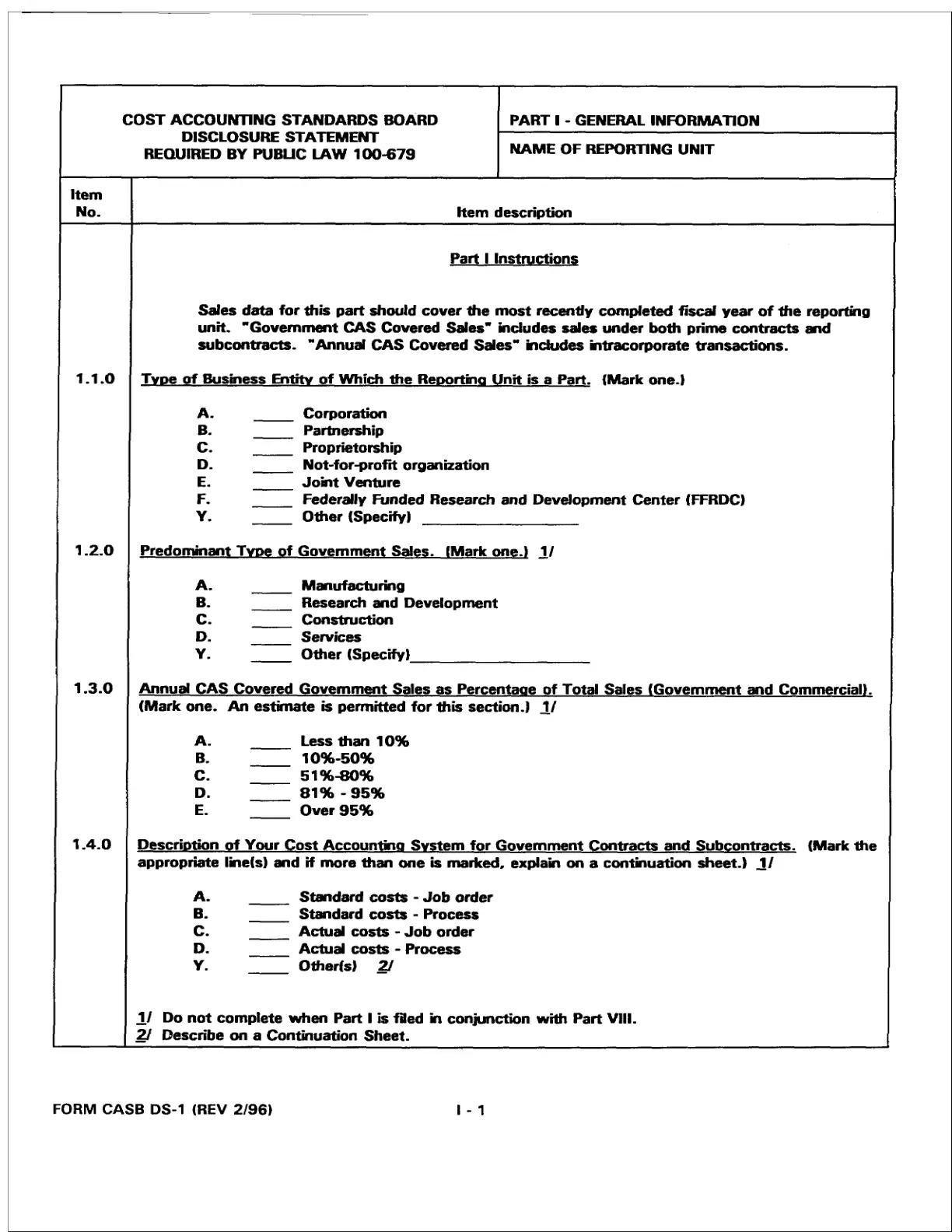
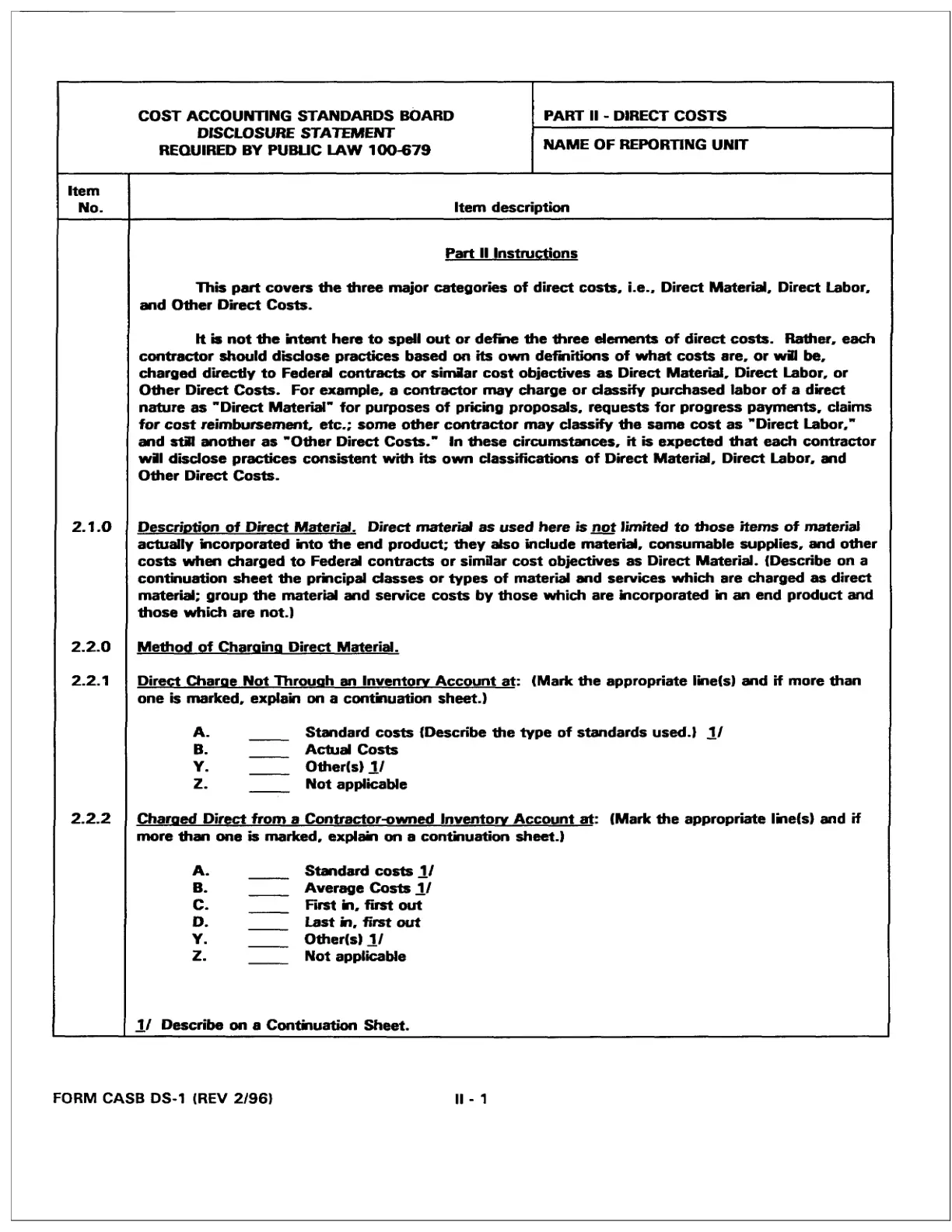
FORM CASB DS-1 (REV 2/96)
Fields, each editable in place
THE FORM'S OWN FIELDS
Parts, I to VIII
PLUS THE COVER SHEET
Item interrelationships checked
FOR INTERNAL CONSISTENCY
What is a CAS Disclosure Statement?
It is a written description of a contractor's cost accounting practices and procedures, filed on Form CASB DS-1 under the Disclosure Regulation of the Cost Accounting Standards Board, 48 CFR 9903.202. In 8 Parts it sets out how the business unit charges direct material and labor, what it treats as direct and what as indirect, how its indirect pools are built and allocated, and how it handles depreciation, other costs and credits, deferred compensation and insurance, and home office expenses.
It matters because it binds. Once the statement is found adequate, the practices it discloses are the ones the contractor must follow consistently on every CAS-covered contract, and keeping the statement accurate as those practices change stays the contractor's responsibility. An officer signs it under this certification:
“I certify that to the best of my knowledge and belief this Statement, as amended in the case of a revision, is the complete and accurate disclosure as of the above date by the above-named organization of its cost accounting practices, as required by the Disclosure Regulation (48 CFR 9903.202) of the Cost Accounting Standards Board under P.L. 100-679.”
Who must file
A business unit selected for a CAS-covered award of $100 million or more, or whose net CAS-covered awards reached $100 million in its most recent cost accounting period. It is not required from a small business concern.
48 CFR 9903.202-1(b)When it is due
Before award of the contract that triggers it. Where last period's awards are the trigger and the first covered award comes within 90 days of the new period's start, at the end of those 90 days.
48 CFR 9903.202-1(b)(2)Where it goes
The original and one copy to the cognizant administrative contracting officer, or the agency official acting in that capacity, and one copy to the cognizant Federal auditor.
48 CFR 9903.202-5(b)What happens next
The cognizant Federal agency determines whether the statement adequately discloses your practices, after the auditor reviews whether it is current, accurate and complete. Under FAR 30.202-6(b) the covered contract is not awarded until that determination is made in writing.
48 CFR 9903.202-6When practices change
Keeping the statement accurate and following what it discloses is your responsibility. Amendments and revisions may be submitted at any time, and resubmitting the whole statement is discouraged unless the changes are extensive.
48 CFR 9903.202-3Who sees it
Say when you submit it that the statement holds privileged and confidential information, and the Government protects it and does not release it outside the Government.
48 CFR 9903.202-4The rules, section by section
The Disclosure Regulation of the Cost Accounting Standards Board, as the platform's copy of the eCFR holds it, and the class deviation that set the same thresholds for a business unit whose contracts are all with the Department of War.
The Disclosure Regulation
Who files, when, where, and what happens to the statement.
- 48 CFR 9903.202-1 General requirements.
- 48 CFR 9903.202-2 Impracticality of submission.
- 48 CFR 9903.202-3 Amendments and revisions.
- 48 CFR 9903.202-4 Privileged and confidential information.
- 48 CFR 9903.202-5 Filing Disclosure Statements.
- 48 CFR 9903.202-6 Adequacy of Disclosure Statement.
- 48 CFR 9903.202-8 Subcontractor Disclosure Statements.
- 48 CFR 9903.202-9 Illustration of Disclosure Statement Form, CASB-DS-1.
A Department of War only business unit
DFARS Class Deviation 2026-O0006, Revision 1 (30 July 2026) sets the Disclosure Statement trigger at $100 million for a business unit whose contracts and subcontracts are all with the Department of War. It is labeled as a deviation wherever the platform shows it, and never overwrites the codified figure.
The CAS clause in the contract
The regulation decides who must disclose; the contract clause is what binds the contractor to it. A CAS-covered contract carries FAR 52.230-2, Cost Accounting Standards, under full coverage, or FAR 52.230-3 under modified coverage (48 CFR 9903.201-4). Under FAR 52.230-2 the contractor:
- discloses its cost accounting practices in a Disclosure Statement, the same practices it applies on every other contract with a CAS clause ((a)(1));
- follows them consistently, applies a change going forward and amends the statement to match ((a)(2));
- complies with every Standard in 48 CFR part 9904 in effect at award ((a)(3));
- agrees to a price adjustment, with interest, when a noncompliance increases the Government's costs ((a)(5));
- flows the clause down to negotiated subcontracts that are not themselves exempt ((d)).
For a business unit with only DoD contracts and subcontracts, the contract carries FAR 52.230-2 with DFARS 252.230-7995, Alternate A, which substitutes the DoD-only coverage thresholds (DFARS 230.205-70(a), DFARS Class Deviation 2026-O0006, Revision 1 (30 July 2026)). For a business unit with only DoD contracts and subcontracts, the contract carries FAR 52.230-3 with DFARS 252.230-7996, Alternate A (DFARS 230.205-70(b), DFARS Class Deviation 2026-O0006, Revision 1 (30 July 2026)).
DCAA's review
- Audit Program for Compliance of Initial Disclosure Statement (version 7.3, Dec 2025)
- Audit Program for Compliance of Revised Disclosure Statement (version 8.3, Dec 2025)
- Contract Audit Manual 8-400, DCAA Audits and CAS-related testing (chapter 8, revision of September 17, 2026)
- Step 1
Determine
Whether the business unit is subject to CAS, which coverage applies, and whether it must file.
- Step 2
Fill
The official form, field by field, with continuation sheets where it asks for them.
- Step 3
Ask
An agent beside each item that explains it and drafts entries only from your words.
- Step 4
Check
The form's instructions and its item interrelationships, before you file.
Do you need to file at all?
Before any statement is started, the tab works out where your business unit stands under 48 CFR 9903.201 and 9903.202-1. It lists the awards the public record holds for your company, says what each award's own record signals about an exemption, and pre-fills a decision you confirm. Only the decisions you confirm count.
The coverage determination for the fictitious XYZ, Inc.: five awards from the public record, each with the decision its record suggests, are confirmed one by one, and the determination answers whether the business unit is subject to CAS (Subject to CAS), which coverage applies (Full coverage) and whether a Disclosure Statement is required (Required before the next covered award), then downloads as a Word memo.
What it answers
- 1Is the business unit subject to CAS?
- 2Which type of CAS coverage applies?
- 3Must it file a Disclosure Statement, and when?
- 4Does it file Part VIII as a home office?
- 5When do the Standards begin to apply?
$35 million
A negotiated award over this is covered unless exempt
$100 million
Full coverage begins
$100 million
A Disclosure Statement is required
Each conclusion quotes the rule it rests on, downloads as a Word memo and an Excel workbook, and is saved with the statement you start next. It documents the first thing DCAA establishes when it audits a Disclosure Statement: that the contractor is required to submit one (audit program 19100, step B-1.1).
The exemptions it recognizes
- 48 CFR 9903.201-1(b)(1) Sealed bid contract
- 48 CFR 9903.201-1(b)(2) Negotiated, not in excess of $35 million
- 48 CFR 9903.201-1(b)(3) Awarded to a small business
- 48 CFR 9903.201-1(b)(4) With a foreign government, or a foreign concern
- 48 CFR 9903.201-1(b)(5) Price set by law or regulation
- 48 CFR 9903.201-1(b)(6) Commercial products or commercial services
- 48 CFR 9903.201-1(b)(7) NATO PHM Ship program, performed abroad by a foreign concern
- 48 CFR 9903.201-1(b)(8) Firm-fixed-price, adequate price competition, no certified cost or pricing data
- 48 CFR 9903.201-1 former (b)(7)Under the former $7.5 million trigger (signed before October 1, 2026)
- 48 CFR 9903.201-5 Waived in writing by the head of the agency
- FPDS CAS clause code X, Not applicable exempt from CASCoded exempt from CAS by the contracting officer in FPDS (paragraph not stated)
- FPDS CAS clause code N, No CAS clause includedRecorded by the contracting officer in FPDS as including no CAS clause (paragraph not stated)
- DCAA CAM 8-103.2jSubcontract under a CAS-exempt prime contract
Fill the form the Government publishes
The statement opens on the official pages with every field editable in place, beside a fields panel that lays each item out as the form prints it. Start blank, roll forward a statement you saved, or explore a complete sample statement for XYZ Corporation, a fictitious services contractor.
A CAS specialist docked beside the form
Ask which overhead pools item 4.1.0 wants listed, what marking a code in Part III commits you to, or what DCAA checks in Part VII. The agent answers from the sources a CAS practitioner reaches for and numbers every one under its answer.
The Disclosure Statement workspace for the fictitious XYZ, Inc.: item 2.2.1 of Form CASB DS-1, Direct Charge Not Through an Inventory Account at, is in focus on the official page; the reader describes how material is charged, the agent explains the item with two numbered sources and proposes line B, Actual Costs, quoting the reader's own words as its basis, and the reader applies it to the form.
Beside the item in focus
Click into any field and the agent's starter questions follow the item: what it asks, what a code commits you to, and what DCAA tests.
Entries from your own words
Describe how your company actually accounts for a cost, and the agent proposes the marks and wording. Each proposal must quote what you said or already entered, or it is dropped.
Nothing applied without you
Each surviving proposal is a card with the item, the entry, the words it rests on and its sources. You press Apply or Dismiss, one at a time, and an applied entry can be undone.
Shared only when you say so
The agent reads what your statement already says only when you tick Share, and company names, UEIs, CAGE codes and contract numbers are masked before a question leaves for the model.
What the agent searches
The form
- Every item of Form CASB DS-1 in its printed wording, with its codes and its instructions
- The form's General Instructions, verbatim
- Your statement's entries and its review, when you choose to share them
DCAA

- The Contract Audit Manual, chapter 8 (Cost Accounting Standards) first
- The steps of the 19100 audit programs for an initial and a revised Disclosure Statement
The regulations


- The Disclosure Regulation, 48 CFR 9903.202, and its thresholds
- The Cost Accounting Standards, FAR part 30 and the DFARS
The case law



- Decisions of the ASBCA, the Court of Federal Claims and the CBCA
AI that works only from your words
An officer of your company certifies that the statement is the complete and accurate disclosure of its cost accounting practices, and the form itself prints the penalty for a false statement, 18 U.S.C. 1001. Once adequate, the disclosed practices bind you on every CAS-covered contract.
So the agent explains and proposes, and you decide. Every agent run is recorded in your AI Audit Trail.
Your practices, in your words
A Disclosure Statement describes practices only you know. An entry the agent cannot tie to your own words is dropped and counted, and is not shown as a suggestion.
Checked by rule
The review and the adequacy self-assessment are computed from the form's instructions and its item interrelationships. No model decides what is missing.
Sources from the tools, not the prose
Citations come from what the agent actually retrieved, numbered to the answer, each linking to the regulation, the DCAA document or the decision.
The official form, not a lookalike
The download is the Government's own fillable file with its own fields filled, not a redrawn copy of it.
What DCAA will check, checked first
Two checks run by rule, with no model involved, and both inform without ever blocking a download.
The review
Which Parts your reporting unit must complete, items left empty, a Mark one item with two lines marked, an answer that calls for a continuation sheet with none written, a code the form does not list for its box. Each finding quotes the form's own instruction.
The adequacy self-assessment
On the shape of DCAA audit program 19100, Compliance of Initial Disclosure Statement (Version 7.3, dated Dec 2025), B-1 Preliminary Steps, step 3: conformity with the General Instructions, internal consistency across the 25 item interrelationships, and your confirmation that each practice is current, accurate and complete. It downloads as an Excel workbook.
The adequacy self-assessment on the sample statement for the fictitious XYZ Corporation: the checks against the form's General Instructions run, one finding appears (Item 1.7.1: Cost Accounting Period is marked, and the line asks for a description on a continuation sheet. None is written.), the reader writes the continuation sheet, the finding clears, 10 of the 25 item interrelationships apply and are met, the conclusion reads "No exception by rule; your confirmation is open", and the filled form downloads.
“A disclosure statement is "adequate" if the disclosed cost accounting practices are current, accurate and complete. (FAR 30.202-7(a))”
Current
A disclosure statement is current if it describes the cost accounting practices the contractor intends to use for estimating, accumulating, and reporting costs on Federal contracts and similar cost objectives. Existing audit files, if available, should be reviewed to determine if the cost accounting practices described in the disclosure statement are, in fact, the contractor's current practices.
Accurate
A disclosure statement is accurate if the described cost accounting practices are consistent with the policies and procedures the contractor uses to estimate, accumulate, and report costs on Federal contracts and similar cost objectives. Vague, ambiguous, and contradictory descriptions of the contractor's cost accounting practices may hinder subsequent compliance audits.
Complete
A disclosure statement is complete if it describes all significant cost accounting practices that the contractor uses, and provides enough information for the Government to fully understand those cost accounting practices.
The 25 item interrelationships
On Form CASB DS-1, code Z marks a line as not applicable to the reporting unit. A rule that says an item “cannot be marked Z” means the item has to be answered, because another answer shows the practice exists. Each rule is followed by what it means in practice.
- 1
If item 1.4.0 is marked A or B, item 2.2.1 or 2.2.2 should be marked A, and/or item 2.5.0 should be coded D in at least one column.
Item 1.4.0 describes the cost accounting system as a whole, and lines A and B say it runs on standard costs. If it does, standards should show up where costs are charged: direct material at standard costs (line A of item 2.2.1 or 2.2.2), direct labor at standard costs or rates (code D in a column of item 2.5.0), or both. A standard cost system with every direct cost charged at actual is a contradiction the auditor will ask about.
- 2
Section 2.4.0 should be completed, only if line A of item 2.2.1 or 2.2.2 is marked.
Item 2.4.0 asks how variances from standard costs for direct material are handled. A variance exists only when material is charged at standard, so the item is answered only when line A, Standard costs, is marked in item 2.2.1 or 2.2.2. Completing it otherwise describes a practice the statement says you do not use.
- 3
Section 2.6.0 should be completed, only if one or more columns in item 2.5.0 were marked D.
Item 2.6.0 is the labor counterpart: how variances from standard labor costs or rates are handled. It applies only when at least one labor category in item 2.5.0 (Manufacturing, Engineering or Other Direct) is charged at standard costs or rates, code D.
- 4
If item 2.2.2 is marked A, B, C, D, or Y, item 3.2.1(f) must be marked with a code other than Z.
Item 2.2.2 says how material charged from a contractor-owned inventory account is costed: standard, average, first in first out, last in first out, or another method. Keeping such an inventory means inventory adjustments happen, so line (f), Inventory adjustment, in item 3.2.1 must say how they are treated. Code Z, Not applicable, would deny the inventory the statement just described.
- 5
If item 2.7.1 is marked with a code other than Z, item 3.2.3(v) should be marked D or E.
Item 2.7.1 says how employee travel for lodging and subsistence is charged direct to Federal contracts. If a method is marked rather than Z, Not Applicable, travel is at least sometimes a direct cost, so line (v), Travel and Subsistence, in item 3.2.3 should carry treatment code D, Other direct costs, or E, Sometimes direct/Sometimes indirect.
- 6
If item 3.2.1(b) is marked other than Z, item 5.5.0(a) must be completed.
Line (b) of item 3.2.1 is Freight in. If freight in is a cost you incur (any treatment code but Z, Not applicable), the statement must also say whether freight in on capital assets is expensed or capitalized, which is line (a), Freight-in, of item 5.5.0 in Part V.
- 7
If item 4.5.0(b) is marked A, B, C or D then item 3.2.3(l) or (m), or both (l) and (m) must be marked other than F or Z.
Line (b) of item 4.5.0 is Purchased Labor, and codes A through D say what overhead or G&A rate is applied to it: the full rate, a special rate below or above it, or none. Marking one says purchased labor is a contract cost, so item 3.2.3 must treat purchased labor of a direct nature, on premises (l), off premises (m) or both, as something other than F, Indirect only, or Z, Not applicable.
- 8
If item 3.2.3(w) is marked with a code other than Z, item 6.3.0 cannot be marked Z.
Line (w) of item 3.2.3 is Employee Severance Pay. If severance carries a treatment code other than Z, Not applicable, you pay it, so item 6.3.0, Severance Pay and Early Retirement, must say how it is costed (actual payments, accrued amounts, not charged, or another method) rather than say Not applicable.
- 9
If item 4.3.0, column (3), is marked with a rate code A, item 4.4.0 cannot be marked Z.
Item 4.3.0 lists service centers and expense pools, and rate code A in column (3) means a pool charges its users at predetermined billing or costing rates. A predetermined rate leaves a difference from actual cost, so item 4.4.0, Treatment of Variances from Actual Cost, must say how that underabsorption or overabsorption is handled: line A, prorated to users on the basis of charges made, line B, charged or credited to indirect cost pools, or Y, Other. It cannot be marked Z, which says the service center is not applicable to the reporting unit when column (3) has just described one.
- 10
If item 4.6.0 is marked A, the G&A pool described in item 4.2.0 must include IR&D/B&P functions and activities.
Line A of item 4.6.0 says IR&D and B&P costs are allocated through a composite pool with G&A expenses. If so, the G&A pool described in item 4.2.0 must list IR&D and B&P among its functions and activities, or the two items describe different pools.
- 11
If item 4.6.0 is marked B, one of the pools listed in item 4.1.0 must include the IR&D/B&P pool.
Line B of item 4.6.0 says IR&D and B&P costs are allocated through a separate pool. That pool then has to appear among the overhead pools listed in item 4.1.0, with its own description and allocation base.
- 12
If item 3.2.2(f) is marked other than Z, item 7.1.0 cannot be marked Z.
Line (f) of item 3.2.2 is Pension Costs. If pension cost carries a treatment code other than Z, Not applicable, a pension plan charges cost to contracts, so item 7.1.0 must identify the type of plan rather than say Not Applicable.
- 13
If item 3.2.2(g) is marked other than Z, item 7.2.0 cannot be marked Z unless the plan is reportable under item 7.3.0.
Line (g) of item 3.2.2 is Post Retirement Benefits Other Than Pensions. If it carries a treatment code other than Z, Not applicable, item 7.2.0 must say how those benefit costs are accounted for, unless the benefit is a group insurance program reported in item 7.3.0 instead.
- 14
If item 3.2.2(h) and/or (i) are marked other than Z, item 7.3.0 must be marked A.
Lines (h), Health Insurance, and (i), Life Insurance, of item 3.2.2 are employee group insurance. If either carries a treatment code other than Z, Not applicable, item 7.3.0 must answer A, Yes, that group insurance is charged to Federal contracts, which in turn opens item 7.3.1.
- 15
If item 3.2.2(j) is marked other than Z, item 7.4.0 and/or 7.5.0 must be marked A.
Line (j) of item 3.2.2 is Other Deferred Compensation. If it carries a treatment code other than Z, Not applicable, item 7.4.0 (deferred compensation as defined in CAS 9904.415), item 7.5.0 (Employee Stock Ownership Plans), or both, must answer A, Yes.
- 16
If one of the lines in 7.1.0.A is marked, item 7.1.2 cannot be marked Z.
Lines A.1 and A.2 of item 7.1.0 count defined-contribution plans, non-qualified and qualified. If either is marked, item 7.1.2, which describes the defined-contribution plans, must be completed rather than marked Not applicable.
- 17
If one of the lines in 7.1.0.B is marked except 7.1.0.B.2.b or 7.1.0.B.2.c, item 7.1.3 cannot be marked Z.
The B lines of item 7.1.0 count defined-benefit plans. Apart from B.2.b and B.2.c, which the form treats as defined-contribution plans, a marked B line means item 7.1.3, Defined-Benefit Plan(s), must be completed.
- 18
If item 7.1.0.B.2.b or 7.1.0.B.2.c is marked, item 7.1.2 cannot be marked Z.
Lines B.2.b (a fully-insured plan) and B.2.c (a collectively bargained plan) of item 7.1.0 are defined-benefit plans the form treats as defined-contribution plans. They are described in item 7.1.2, which then cannot be marked Not applicable.
- 19
If item 7.2.0 is marked other than Z, items 7.2.1 and 7.2.2 must be completed.
Item 7.2.0 says how post-retirement benefits other than pensions are accounted for. Any answer other than Z, Not Applicable, means such plans exist, so item 7.2.1, General PRB Plan Information, and item 7.2.2, PRB Plan(s), must be completed.
- 20
If item 7.3.0 is marked A, item 7.3.1 must be completed.
Item 7.3.0 asks whether employee group insurance is charged to Federal contracts. A, Yes, sends you to item 7.3.1, Employee Group Insurance Programs, which must then describe the programs.
- 21
If item 7.4.0 is marked A, items 7.4.1 and 7.4.2 must be completed.
Item 7.4.0 asks whether you have deferred compensation as defined in CAS 9904.415. A, Yes, means item 7.4.1, General Plan Information, and item 7.4.2, Deferred Compensation Plans, must be completed.
- 22
If item 7.5.0 is marked A, item 7.5.1 must be completed.
Item 7.5.0 asks whether you have Employee Stock Ownership Plans. A, Yes, means item 7.5.1, General Plan Information, must describe them.
- 23
If item 7.6.0 is marked A, item 7.6.1 must be completed.
Item 7.6.0 asks about worker's compensation, liability and property insurance. A, Yes, means item 7.6.1 must describe the coverage.
- 24
At least one of items, 8.3.1, 8.3.2, or 8.3.3 must be completed if this part is being completed by corporate, group, or home office.
Part VIII is completed by a corporate, group or other home office to show how it allocates its expenses to its segments: item 8.3.1 covers expenses allocated directly, 8.3.2 homogeneous expense pools, and 8.3.3 residual expenses. A home office allocates in at least one of those ways, so at least one of the three must be completed.
- 25
If item 8.2.0 is marked other than Z, the corresponding part(s) (i.e., Parts V, VI or VII) of the disclosure statement must be completed.
Item 8.2.0 says which of Parts V, VI and VII the home office completes for its segments, as General Instruction 4 allows. Any line other than Z, Not Applicable, means the Parts it names must actually be completed in the statement.
Every Part of the form
A business unit completes the cover sheet and Parts I through VII. A home office that allocates costs to disclosing segments completes Part VIII with the cover sheet and Part I, and the review knows which applies from the reporting unit you mark on the cover.
The regulations print the CASB DS-1 (REV 2/96) form at 48 CFR 9903.202-9.
- 0Cover Sheet and Certification18 fields
- IGeneral Information33 fields
- IIDirect Costs92 fields
- IIIDirect vs. Indirect88 fields
- IVIndirect Costs75 fields
- VDepreciation and Capitalization Practices87 fields
- VIOther Costs and Credits64 fields
- VIIDeferred Compensation and Insurance Cost31 fields
- VIIIHome Office Expenses28 fields
When the Disclosure Statement reaches a tribunal
41 decisions GovConDash holds discuss a CAS Disclosure Statement. They turn on what a contractor disclosed, whether a revision was adequate, and what the Government could rely on. Each one opens in full.
ASBCA
24ARMED SERVICES BOARD OF CONTRACT APPEALS, 2011 TO 2026
The Boeing Company
ASBCA No. 58660, November 6, 2014
Other“Boeing submitted revisions to the disclosure statement and DCAA issued audit reports on 15 May 2007, 28 September 2007, and 3 February 2009, each of which stated that Boeing's disclosure statement adequately reflected the company's accounting practices”
Northrop Grumman Corporation
ASBCA No. 57625, January 16, 2014
Denied / Government Prevailed“First, none of the DCE responses to appellant's disclosure statements cited by appellant specifically represented, without qualification, that DEFRA was FAR compliant.”
Pratt & Whitney, a division of Raytheon Technologies Company
ASBCA No. 59222, November 22, 2021
Partially Sustained“Ultimately, in its audit report of May 24, 2006, DCAA determined that Pratt’s revision to its disclosure statement adequately described its accounting practice but that its proposed procedure for determining the cost of the collaboration parts as MTC did not comply with CAS 418 and Rumsfeld”
The 3 that discuss it most, of 24.
Court of Federal Claims
13U.S. COURT OF FEDERAL CLAIMS, 2006 TO 2022
Sikorsky Aircraft Corp.
No. 09-844
Motion denied“Those contractual obligations include the requirements to submit a Disclosure Statement, FAR § 52.230-2(a)(1), to correct a practice found noncompliant, FAR § 52.230-6(b)(4), and to submit a cost-impact estimate when asked by the CFAO, FAR § 52.230-6(c).”
Sikorsky Aircraft Corp.
No. 21-2327, August 19, 2022
Motion denied“Disclosure Statements are reviewed by the auditor for “adequacy and compliance,” but the CFAO makes the ultimate determination on those topics.”
Sikorsky Aircraft Corp.
No. 09-844, March 27, 2013
For plaintiff“On April 22, 1999, DCAA submitted to Sikorsky a draft audit of the company’s revised Disclosure Statement.”
The 3 that discuss it most, of 13.
Federal Circuit
3U.S. COURT OF APPEALS FOR THE FEDERAL CIRCUIT, 2010 TO 2023
Sec'y of Defense v. Raytheon Co, Raytheon Missile Systems
No. 2021-2304, January 3, 2023
“But as Raytheon admits, its CAS disclosure statements were not in evidence.”
Secretary of Defense v. Northrop Grumman Corp.
No. 2018-1945, November 15, 2019
“Between 1995 and 2006, Northrop filed disclosure statements with the government on numerous occasions, disclosing its continued use of the DEFRA method.”
Donley v. Lockheed Martin Corp.
No. 2009-1261, June 10, 2010
“Lockheed sought to amend its disclosure statement to reflect the changed practices.”
CBCA
1CIVILIAN BOARD OF CONTRACT APPEALS, 2017
New, and first on Max
Max
$199 / month, with 250 AI agent runs per month.
- The coverage determination, with its Word memo and Excel workbook
- Saved statements on the official form, with versions and roll forward to a revision
- The Disclosure Statement agent, docked beside the form
- The review and the adequacy self-assessment
- The filled PDF, a flattened copy and the continuation sheets in Word
Every plan
Open the tab's free introduction in the dashboard.
- Who files, and the thresholds read from the regulation
- The class deviation for a Department of War only business unit
- DCAA's 19100 audit programs and the Contract Audit Manual
Common
questions.
What a Disclosure Statement is, who files one, and how GovConDash helps you prepare it.
It is the contractor's written description of its cost accounting practices, filed on Form CASB DS-1 under 48 CFR 9903.202. It covers how the business unit charges direct material and labor, what it treats as direct and indirect, how its indirect pools are built and allocated, depreciation and capitalization, other costs and credits, deferred compensation and insurance, and, for a home office, how it allocates its expenses. Once adequate, the practices it discloses are the ones the contractor must follow consistently on its CAS-covered contracts.
A business unit that is not a small business must file before award when it is selected for a CAS-covered contract of $100 million or more, or after a cost accounting period in which its net CAS-covered awards totaled $100 million or more (48 CFR 9903.202-1(b)). In the second case, if the first CAS-covered award of the new period comes within its first 90 days, the statement is due at the end of those 90 days. A home office that allocates costs to a disclosing segment files Part VIII.
It reads the award record the public data holds for your company, says what each award's own record signals about a CAS exemption, and pre-fills a decision per award for you to confirm. The conclusions are computed only from the decisions you confirm, plus four questions only you can answer, and each one quotes the rule it rests on. If the regulation text the platform holds ever states a different amount than the screen uses, the screen declines to conclude.
No. The agent explains items and proposes entries, but a proposal survives only when it quotes what you told it or already entered, and nothing is written to your statement until you press Apply on it. Your company's SAM.gov registration can support an entry only on the identification items, such as the type of business entity.
That determination belongs to the cognizant Federal agency official after DCAA's review (FAR 30.202-7). GovConDash helps you get there: a rule-computed review of the form's own instructions, and an adequacy self-assessment on the shape of DCAA audit program 19100 that checks the 25 item interrelationships and records your confirmations that each disclosed practice is current, accurate and complete.
Saved statements and their versions are sealed at rest and readable only from your account. The agent sees your entries only when you share them, and identifying details are masked before any question reaches the model. When you file, 48 CFR 9903.202-4 lets you mark the statement as privileged and confidential, and the Government then protects it.
The CAS Disclosure Statement tool is new and released first on the Max plan ($199 / month). Agent questions count toward the plan's allowance of 250 AI agent runs per month. On any plan you can open the tab's free introduction: who files, the thresholds, and what DCAA reviews.
Authoritative sources
Form CASB DS-1
The official fillable copy published by OMB, the file the download is filled into.
48 CFR 9903.202-9, the form in the regulation
Form CASB DS-1 as the Disclosure Regulation prints it, page by page, on the eCFR.
48 CFR 9903.202, Disclosure requirements
Who files, when, where, and how the statement is reviewed.
48 CFR 9903.201, Contract coverage
Which contracts are covered, the exemptions, and full versus modified coverage.
DFARS Class Deviation 2026-O0006, Revision 1 (30 July 2026)
The DFARS class deviation on the CAS thresholds for a business unit whose work is all with the Department of War.
Audit Program for Compliance of Initial Disclosure Statement
DCAA audit program 19100, version 7.3, Dec 2025.
Audit Program for Compliance of Revised Disclosure Statement
DCAA audit program 19100, version 8.3, Dec 2025.
The rest of your CAS and DCAA work
Incurred Cost Proposal
Schedules A through O, DCAA's adequacy checklist and a research agent beside every step.
Pre-Award Survey
The DCAA accounting system checklist behind SF 1408, with the filled PDF.
Audit Readiness
DCAA's audit programs, the Contract Audit Manual and the selected costs of FAR 31.205.
Regulations and CAS
The FAR, DFARS and the Cost Accounting Standards, with a research agent that cites each section.
 GovConDash.ai
Disclose your practices.File it adequate the first time.
Prepare your Disclosure Statement on the official form, with the agent beside each item and your contracts, your incurred cost proposal and the regulations next to it in GovConDash. Already on Max? Open the Disclosure Statement tab under Compliance.