
The short version
- 1The eCFR is no longer the whole FAR. Across 41 agencies, 1,545 class deviations now adopt the FAR Council's rewritten text, and the Department of War has 48 of its own in effect. None of it is in the codified text.
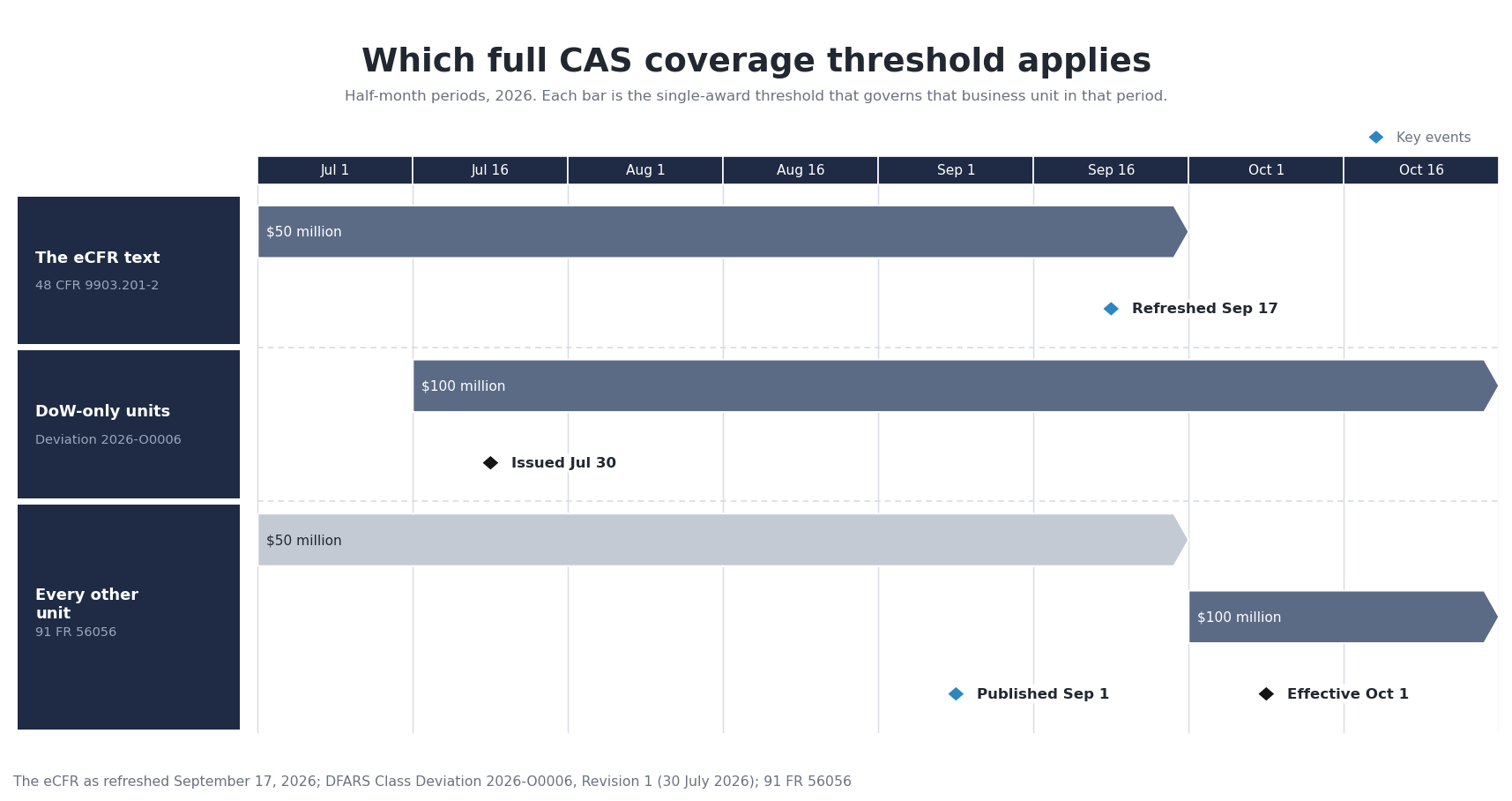
- 2Your CAS threshold depends on who you sell to, and on the date. The codified figure is $50 million. A business unit with only Department of War contracts has been at $100 million since July 30, 2026, and everyone moves to $100 million on October 1, 2026. A business unit with mixed work stays on the codified rule until then.
- 3The research agent reads the deviation, not just the eCFR. Asked about a business unit with only Department of War contracts, it answered with the deviated threshold and said what the codified rule alone would have produced.
- 4It cannot yet see a rule that is signed but not in force. The Board's final rule was published September 1, 2026. Until the eCFR carries it, neither the codified text nor the proposed rules list shows it, and part 06 says what to do about that.
- 5All of it opens on a free account. The research agent is the one AI feature a free plan includes, at one run a week. CAS, FAR Overhaul and Proposed Rules need only an account.
01Three places a FAR rule can be
Most regulatory research starts and ends in the eCFR, and for a long time that was enough. It is not any more, because the Revolutionary FAR Overhaul does not change the codified FAR. It publishes rewritten model text, part by part, and each agency puts it into effect by class deviation. The FAR Council says so plainly: "The model deviation text for a particular FAR part is not applicable to an agency until the agency has issued a class deviation."
Once model deviation text has been issued for all FAR parts, the FAR Council will initiate the formal rulemaking process to incorporate the deviation text into the FAR, which could be modified after consideration of feedback received.
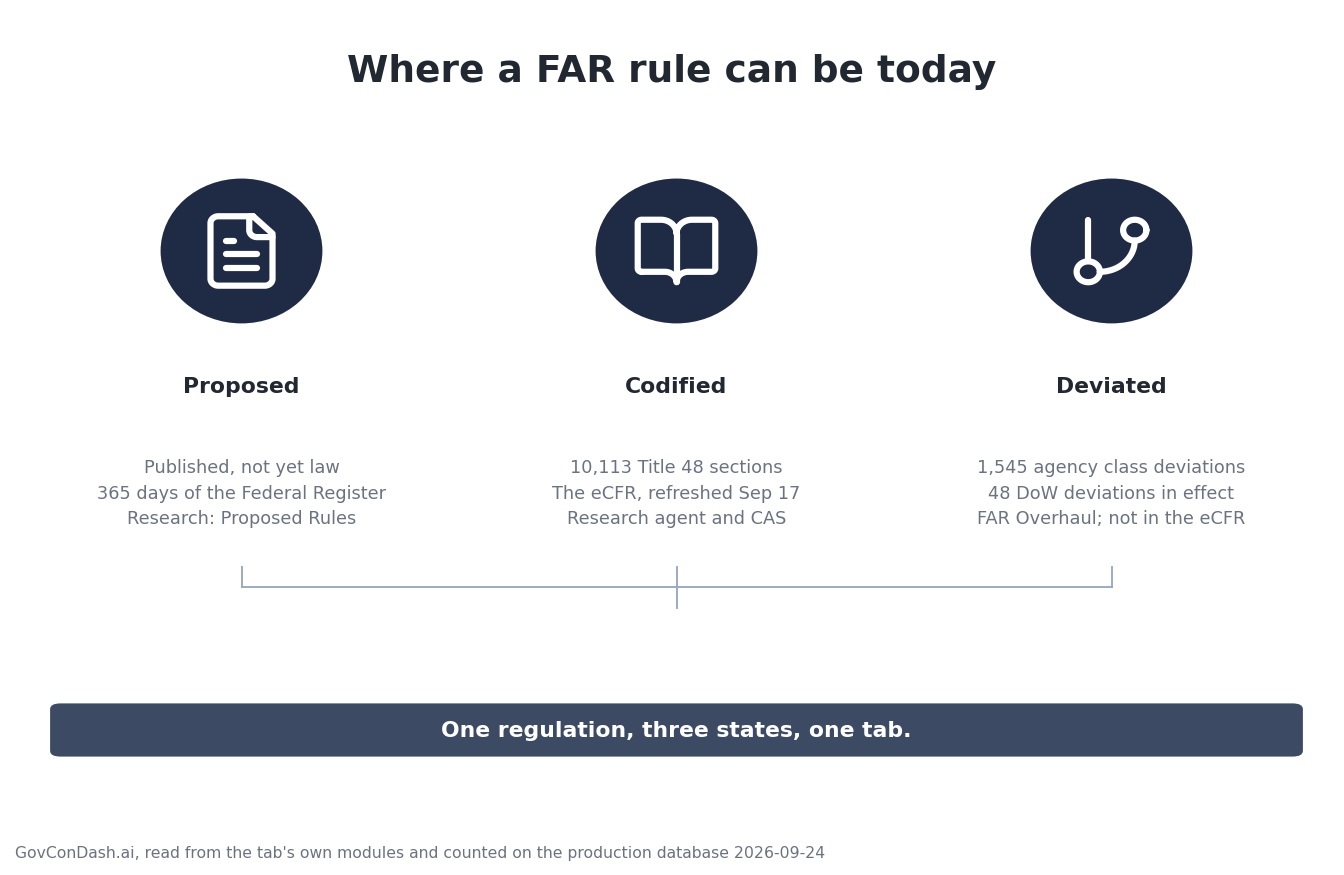
So a rule can be in one of three places. It can be proposed, published for comment and not yet law. It can be codified, the text the eCFR prints. Or it can be deviated, in effect at one agency and absent from the eCFR altogether. The eCFR Research tab has a place for each, and the rest of this piece walks them in the order the tab does.
02Research: one question, answered from the deviation
The Research sub-tab opens on the eCFR Research Agent. It answers from 10,113 codified Title 48 sections, including 3,119 in the FAR, 1,699 in the DFARS and 188 in the Cost Accounting Standards chapter. It has six tools, every one a lookup in that text, and it works in at most four passes, with its instructions holding it to three lookups before it writes:
- search_regulations
- get_regulation_by_code
- get_cas_standard
- get_regulations_by_tag
- list_regulation_chapters
- get_database_stats
What the tool list does not show is the step after the first lookup. The agent checks what it found against the class deviation catalog, the same one the FAR Overhaul sub-tab displays. A section a deviation has displaced comes back with the deviation beside it, which is the difference between a search of the eCFR and an answer about the FAR as it applies.
The run this piece reads
- Where
- Research / eCFR Research / Research
- What was asked
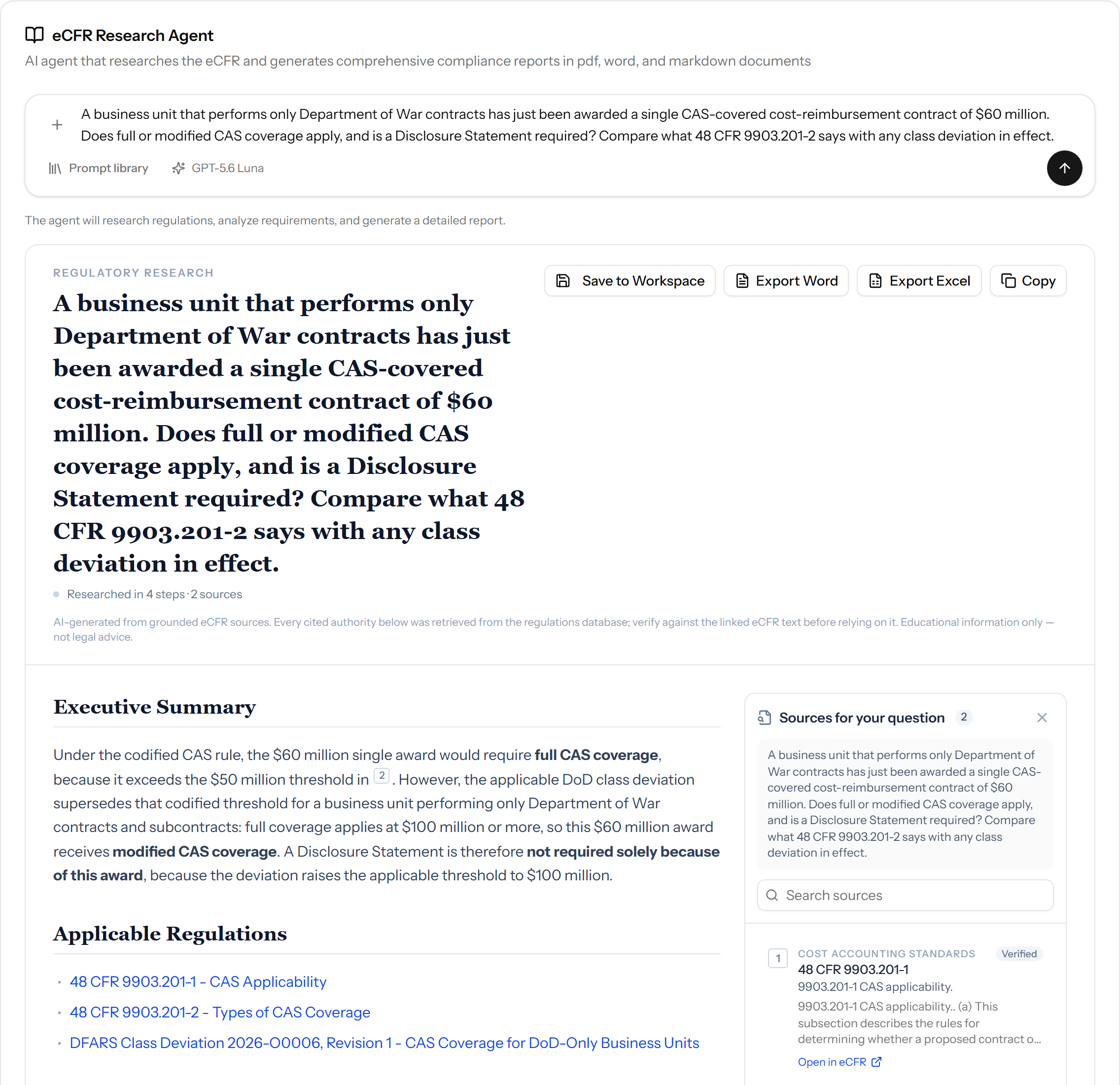
- A business unit that performs only Department of War contracts has just been awarded a single CAS-covered cost-reimbursement contract of $60 million. Does full or modified CAS coverage apply, and is a Disclosure Statement required? Compare what 48 CFR 9903.201-2 says with any class deviation in effect.
- How it worked
- Four research steps, two codified sections cited, and the class deviation beside them
- When
- September 24, 2026
The question was built to sit in the gap. The award is above the codified line and below the deviated one, and the business unit's contracts are all with the Department of War. The answer opens on the codified result, "Under the codified CAS rule, the $60 million single award would require full CAS coverage", and then turns to the deviation, "so this $60 million award receives modified CAS coverage".
1Ask the question the way you would ask counsel
Type the question, or start from the prompt library, which carries eight scenarios written for the questions contractors actually bring. A switch labeled Include relevant ASBCA cases adds the Board decisions closest to the question.
The report can be saved to the Workspace or exported, and every section it cites links to its own eCFR page.
- DCAA audit prep: unallowable costs
- Does CAS apply to my company?
- New cost-type DoD award: what changes?
- REA or certified claim?
- Limitation of funds notice
- Termination for convenience settlement
- Small business size and recertification
- Provisional billing and final indirect rates
The answer also kept the limit a careless reading drops, for a business unit with work outside the Department: "The deviation does not apply the $100 million thresholds to a business unit with mixed DoD and other Federal contracts or subcontracts; such a business unit remains subject to the codified CAS framework." Its first recommendation is the document you would want in the file anyway: "Prepare a written CAS coverage memorandum concluding that the $60 million award receives modified CAS coverage under the DoD class deviation, while noting that the codified rule alone would produce full coverage."
03Proposed Rules: the window before a rule is law
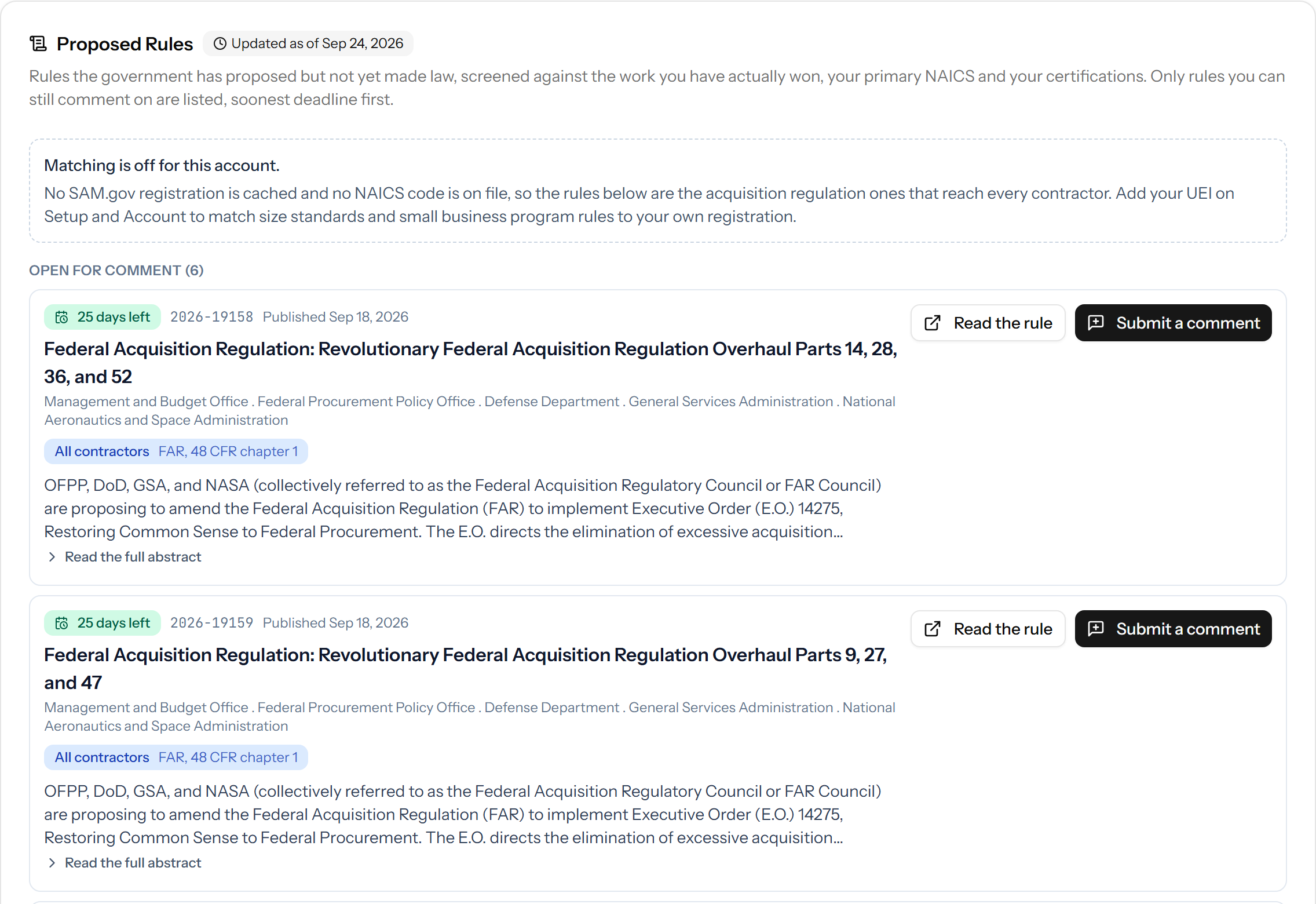
Beneath the agent sits the panel the codified text cannot supply. A proposed rule is not in the eCFR, so an agent answering from the eCFR cannot see it. The comment period is the only moment a contractor can change what the rule says. The panel reads the Federal Register's proposed rules for the last 365 days under two searches, 48 CFR (acquisition regulation) and Small Business Administration. It lists only the rules still open for comment, soonest deadline first.
Each rule carries the reason it is on your list, from a fixed set of five, matched against your SAM.gov registration or your own profile with no model involved:
- All contractors
- Your line of business
- Names your NAICS
- Your program
- SBA rulemaking
2See what you can still comment on
Each row links the rule on the Federal Register and the place to comment on it. On the day this was captured, the list opened on the FAR Council's own proposed rules for Overhaul parts. That is the formal rulemaking that will one day put the deviated text into the eCFR.
04CAS: one standard, three thresholds
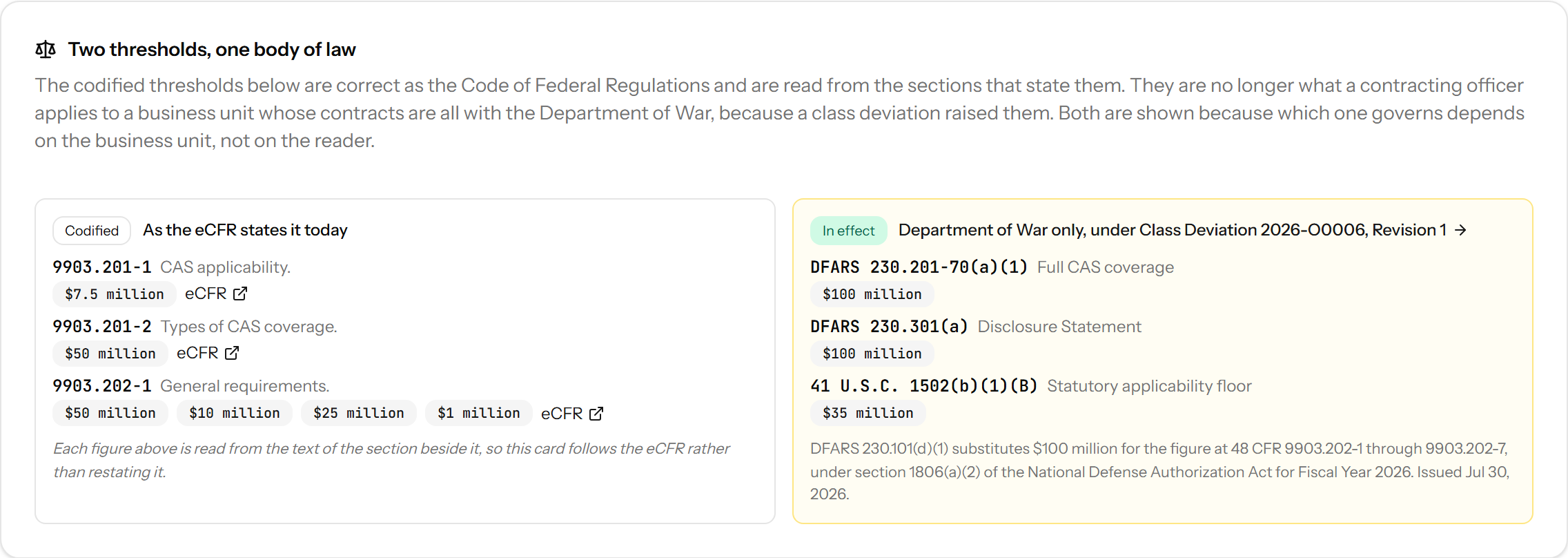
The CAS sub-tab is where the three answers from the top of this piece sit side by side. The codified rule at 48 CFR 9903.201-2 applies full coverage to a business unit that meets either of two tests. The first:
Receive a single CAS-covered contract award of $50 million or more
The class deviation replaces that line for one kind of contractor. Its signed memo says "full Cost Accounting Standards (CAS) coverage applies to contractor business units that have only DoD contracts and subcontracts" that receive a single award of $100 million or more. Then it draws the edge of that group in one sentence: "If a business unit has mixed DoD and other Federal contracts or subcontracts, then FAR 30.201(b) continues to apply."
One question, three answers: when does CAS apply in full?
As refreshed September 17, 2026
What the eCFR prints
- Full CAS coverage
- $50 million single award
- Disclosure Statement
- $50 million
Since July 30, 2026
A business unit with only DoW contracts
- Full CAS coverage
- $100 million single award
- Disclosure Statement
- $100 million
From October 1, 2026
Every business unit
- Full CAS coverage
- $100 million single award
- Disclosure Statement
- $100 million
Then the CAS Board moved. Its final rule, 91 FR 56056, published September 1, 2026, raises the codified figure to $100 million for every agency from October 1, 2026. For a business unit with only Department of War contracts, the deviation got there first. For everyone else, including the unit with mixed work, the codified $50 million governs until that date.
GovConDash.ai
Check which threshold covers your business unit, free
The CAS sub-tab opens on a free account. It sets the codified figures beside the class deviation's, links the signed memo, and opens its full text on FAR Overhaul. Put your own facts to the research agent on Research: a free account includes one research run a week.
3Start from the standards the tab holds
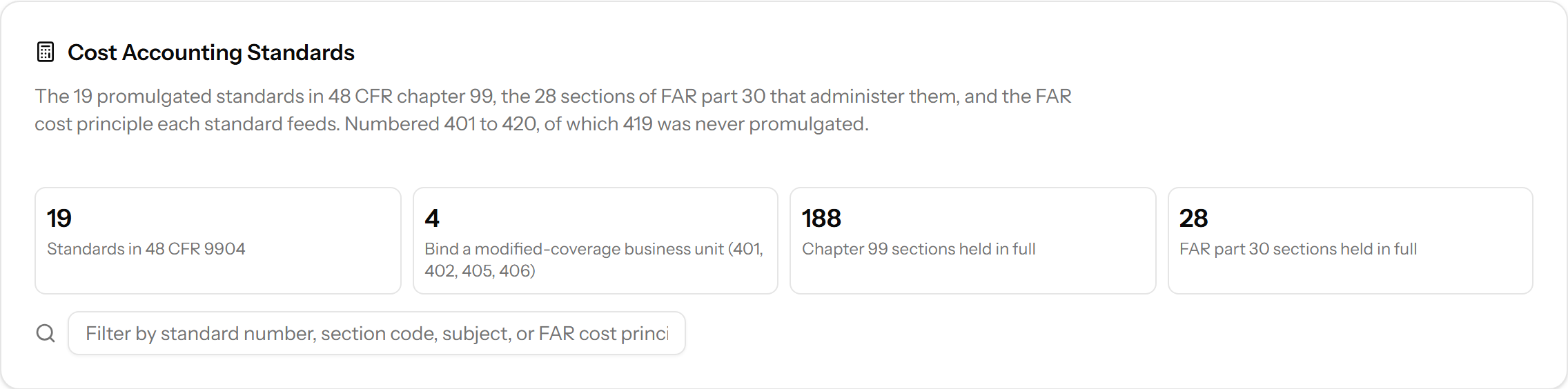
The 19 promulgated standards, numbered 401 to 420 with 419 never promulgated, grouped into six families. A modified-coverage business unit answers to four of them: CAS 401, 402, 405 and 406.
4Read the two regimes side by side
The left column is read out of 48 CFR 9903.201-1, 48 CFR 9903.201-2 and 48 CFR 9903.202-1 as the eCFR states them. The right column is the deviation, with the DFARS paragraph each figure comes from, and one click takes you to its signed memo on FAR Overhaul.
5See which cost principle each standard feeds, and what the Board has done to it
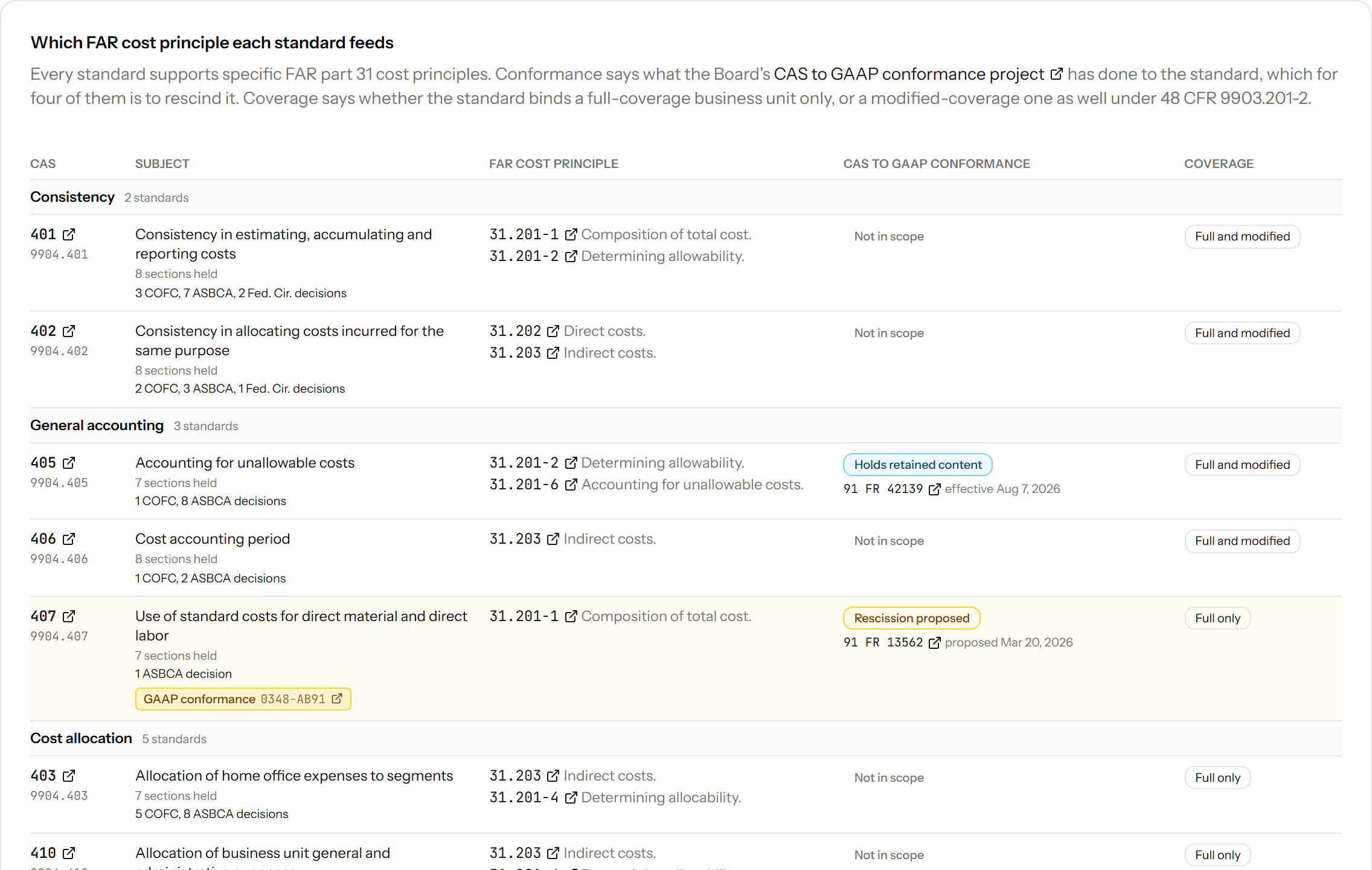
Each standard sits beside the FAR part 31 cost principles it supports, the decisions that cite it, and what the Board's conformance project has done to it. Four are rescinded by final rule: CAS 404, 408, 409 and 411.
One status in the capture is already behind the Board. The crosswalk marks CAS 407 as a proposed rescission; the final rule, 91 FR 56061, was published September 1, 2026 and takes effect October 1, 2026. The tab also tracks the Board's seven open cases among the twelve rules open under the Office of Management and Budget. It links six of the nine lessons in the Board's practitioner album.
6Find the decisions that turned on a standard
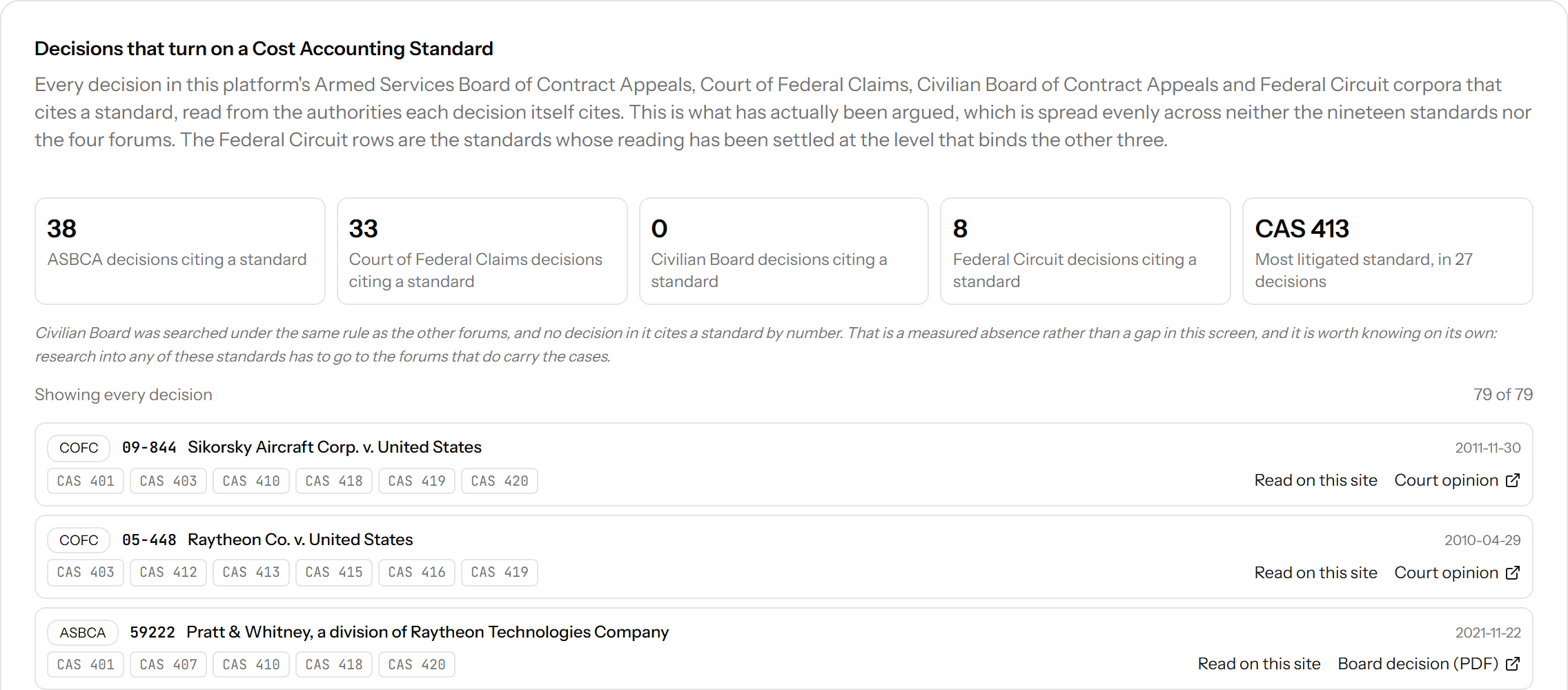
Every decision that cites a standard, drawn from the platform's Armed Services Board, Court of Federal Claims, Civilian Board and Federal Circuit collections. Each is tagged with the standards it cites and opens in the site's own reader.
05FAR Overhaul: what the eCFR cannot see
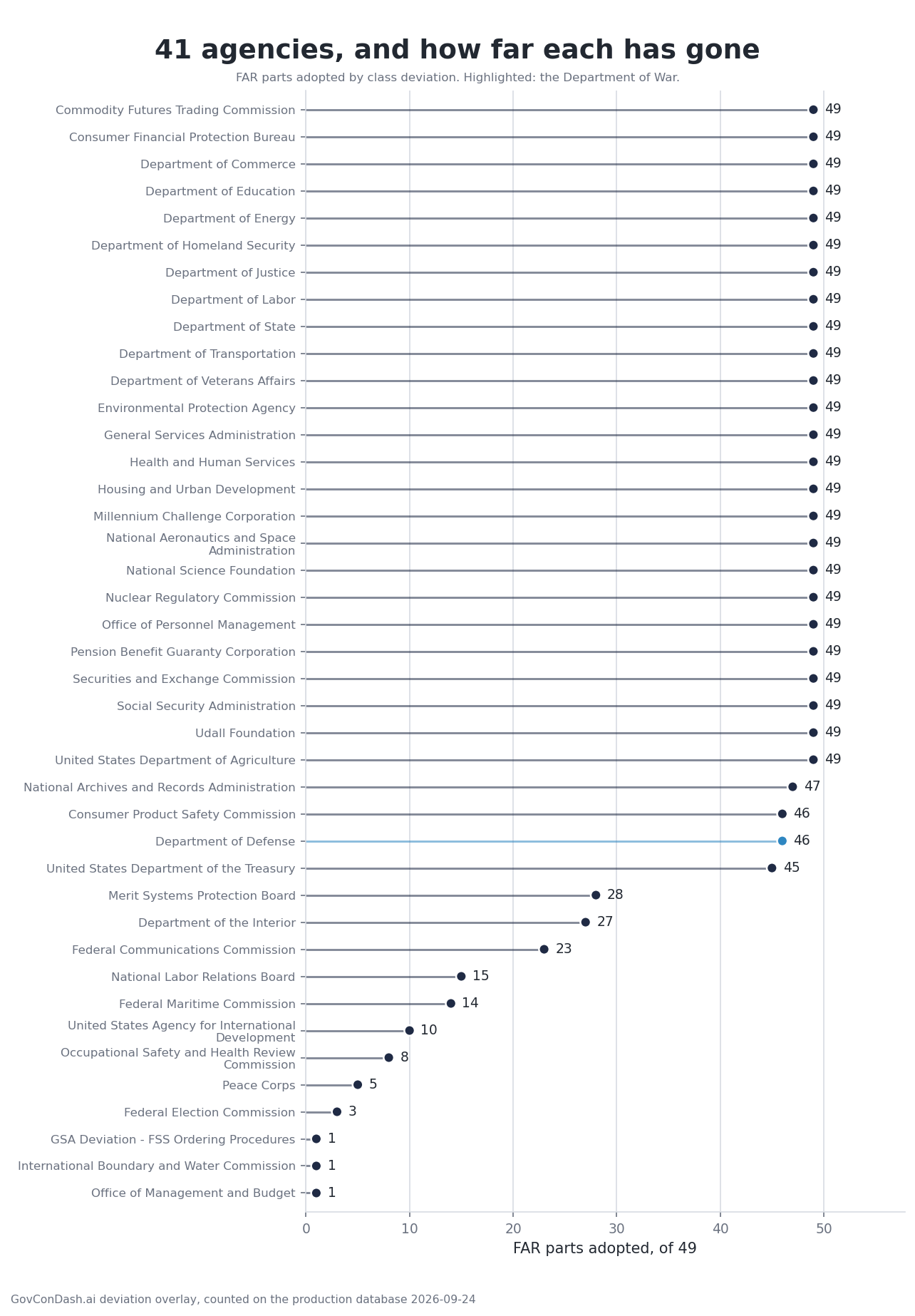
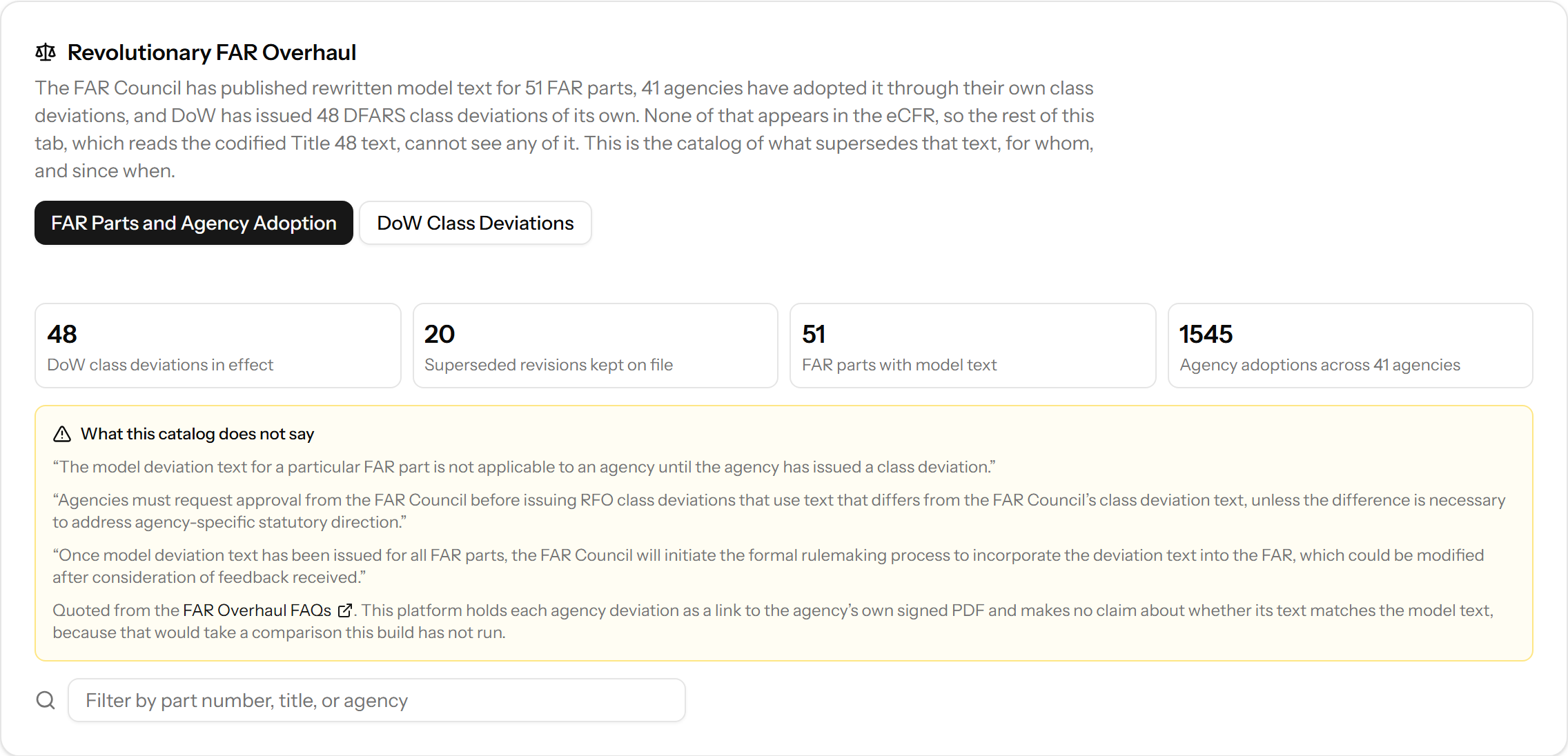
The FAR Overhaul sub-tab is the catalog of what supersedes the codified text, for whom and since when. The FAR Council has published model text for 51 FAR parts, and 41 agencies have issued 1,545 class deviations adopting it. The Department of War has 48 DFARS class deviations of its own in effect, with 20 superseded revisions kept on file. A dispute is governed by the revision in force when it arose, so a superseded one stays readable.
Adoption is not uniform, and that is the practical point. Of the 41 agencies, 25 have adopted every part any agency has, while six have adopted fewer than ten. The same FAR part can be deviated at one agency and codified at the next, so the question is never only what the FAR says, but whose FAR. The Department of War itself has adopted 46 of the 49, on top of its 48 DFARS deviations.
7Open the catalog, and read what it does not claim
Two views: FAR parts and agency adoption, and the Department of War's own class deviations. Above both, the tab prints the FAR Council's caveats in its own words rather than a paraphrase of them.
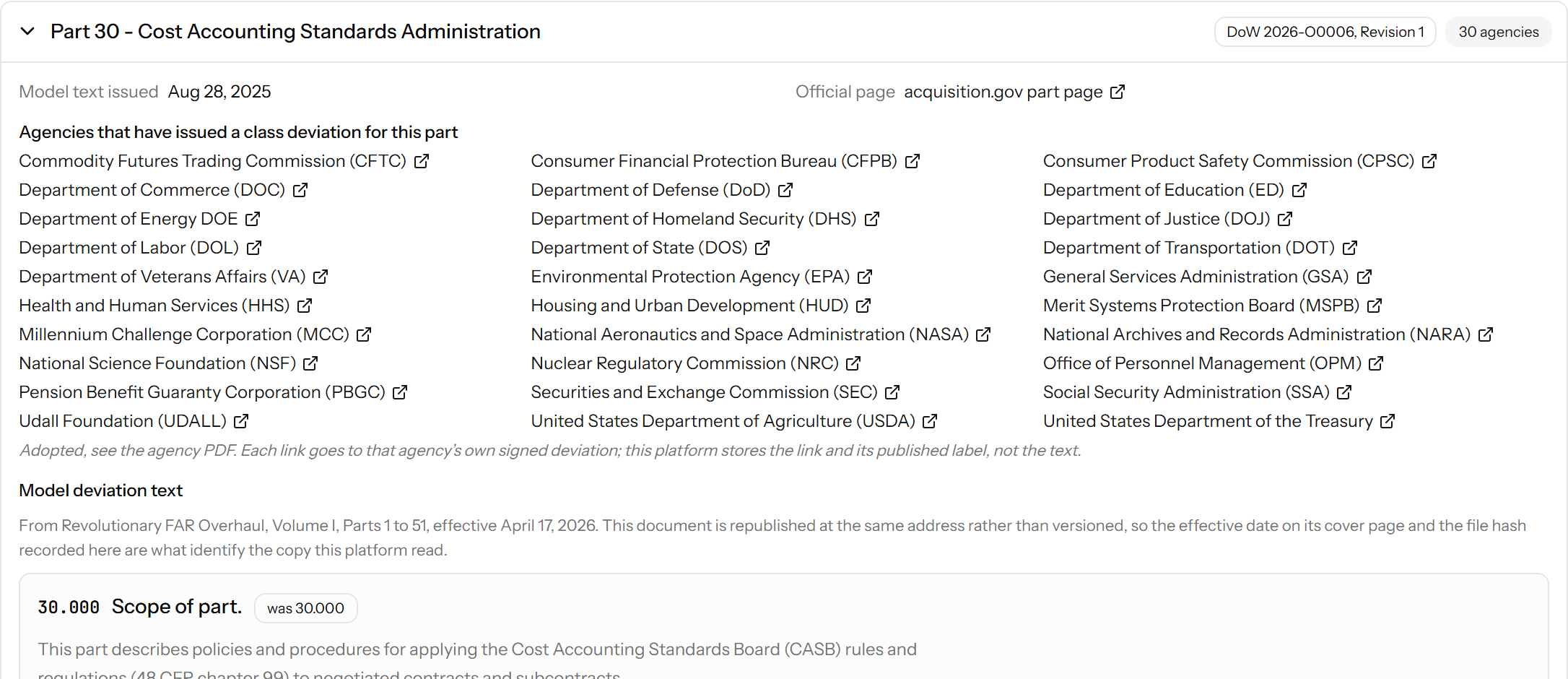
8Open a part and see who has adopted it
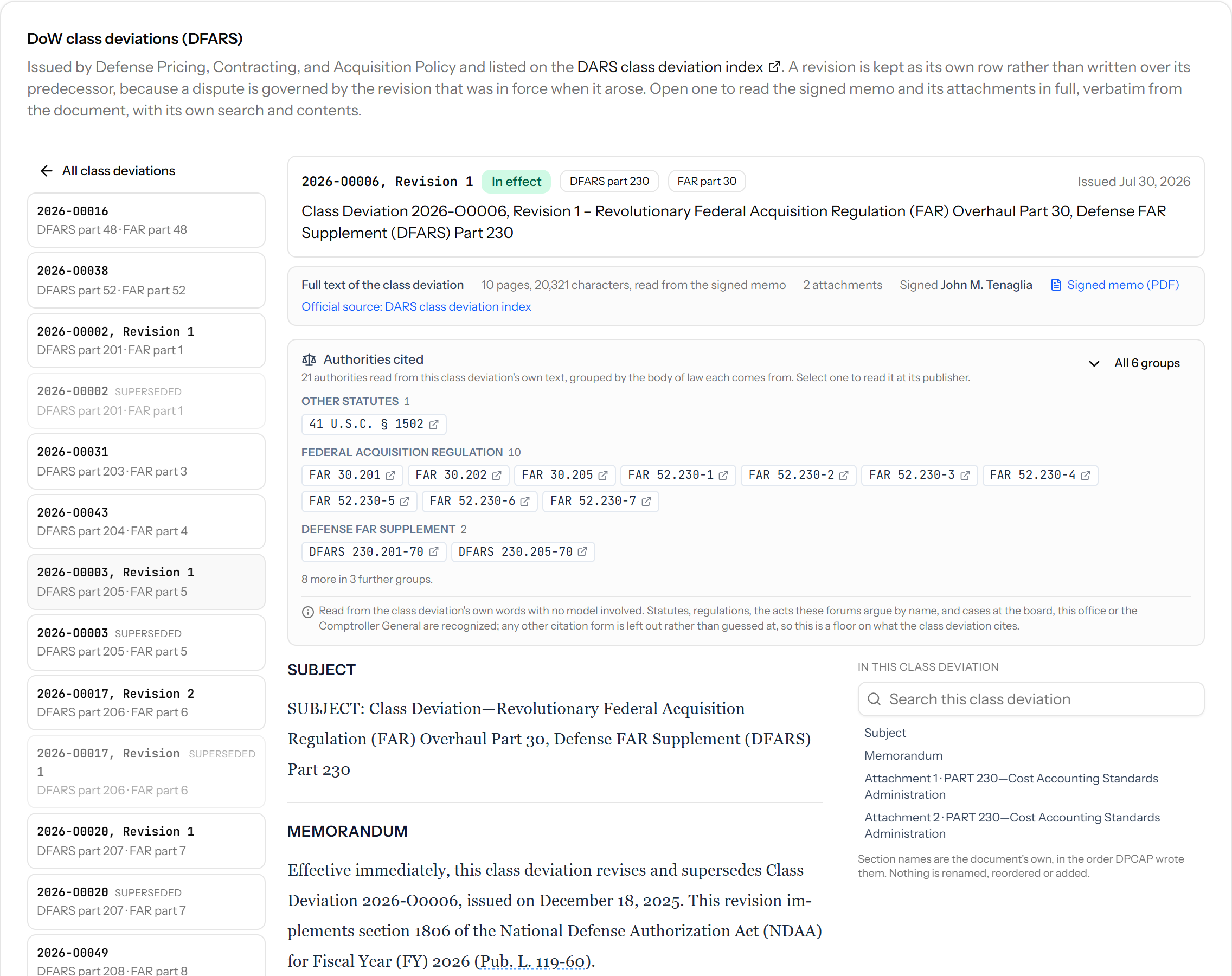
Opening a part shows when its model text issued, which agencies have adopted it, and the Department of War deviation that governs it for DoW contracts. For part 30, that is the class deviation this piece started with.
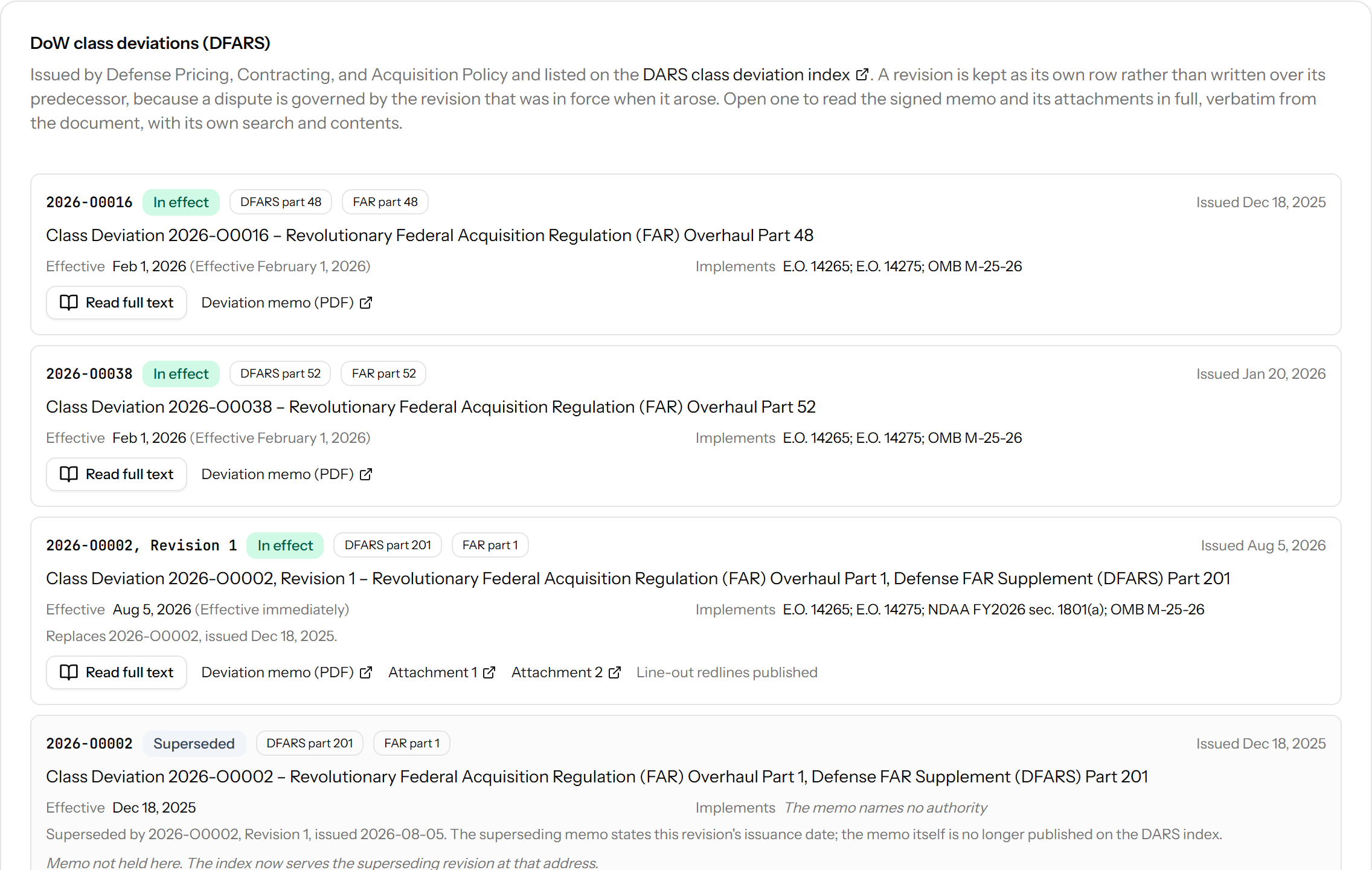
9List the Department of War deviations, revisions and all
Every DFARS class deviation read from the Department's own index, with the parts it covers, when it took effect and what it implements. Search runs across the full text of every memo, not only the titles.
10Read the signed memo, not a summary of it
The memo in full, all ten pages, with a contents rail, a search of its own text and the authorities it cites, each linked to its publisher. The sentence that matters most for a contractor is near the top. The memo tells contracting officers to use the deviated text "in lieu of the text codified at 48 CFR chapter 1".
06What the tab cannot see yet
Every surface on this tab is honest about its source, and that is also where the gap is. The Board's thresholds rule was published September 1, 2026 and takes effect October 1, 2026. It is not a proposed rule, so the Proposed Rules panel does not list it. It is not yet codified, so the eCFR, refreshed September 17, 2026, still prints $50 million. And it is not a class deviation, so the catalog does not carry it.
The research agent's answer named the deviation and said nothing about the rule. For a signed rule waiting on its effective date, then, the tab shows the law as it applies today and not the change already scheduled. The practical step is the one the agent itself recommended: a written coverage determination, dated, that names the rule taking effect next. This piece links that rule in its sources for the same reason.
07Where this lives in GovConDash
The tab sits in Research / eCFR Research. It has six sub-tabs, in the order a reader works through a regulation: Research, CAS, FAR Overhaul, FAR Cases, Executive Orders and Alerts. This edition walked the first three.
eCFR Research / Research
The research agent and Proposed Rules
The agent answers from the codified text and checks it against the class deviation catalog. The panel beneath it lists the proposed rules you can still comment on. The agent is the one AI feature on the free plan.
eCFR Research / CAS
The standards, the thresholds, the cases
The standards in full, the two threshold regimes side by side, the crosswalk to the cost principles, and the decisions that cite a standard. Free with an account.
eCFR Research / FAR Overhaul
What supersedes the codified text
The FAR Council's model text part by part, every agency's adoption, and every Department of War class deviation in a reader of its own. Free with an account.
eCFR Research / Alerts
What changed this week
Changes to the codified text since you last looked, and a watchlist of the sections you follow. Not walked in this edition.
Documents and data used in this piece
Every quotation above was checked against a stored copy of its source before this page was written, 8 checks in all. Every product fact was read from the part of the product that decides it rather than typed, the three thresholds were checked against the codified text, the signed memo and the Board's rule, and every count was measured on the production database, with the codified text last refreshed September 17, 2026. If a single check fails, nothing is written.
The rule and the deviation
- 48 CFR 9903.201-2, Types of CAS coverage
eCFR. The codified full and modified coverage thresholds, as the eCFR prints them.
- DFARS Class Deviation 2026-O0006, Revision 1 (30 July 2026)
Defense Pricing, Contracting, and Acquisition Policy. The signed memo that sets the Department of War only thresholds, read in full on the FAR Overhaul tab.
- DFARS class deviations for the Revolutionary FAR Overhaul
Defense Pricing, Contracting, and Acquisition Policy. The index every DoW class deviation on the FAR Overhaul tab is read from.
The CAS Board's rulemaking
- 91 FR 56056, Increase of Monetary Thresholds and Other Matters Related to Cost Accounting Standards Program Requirements
Federal Register. The final rule that raises the codified thresholds for every agency, effective October 1, 2026.
- 91 FR 42139, Conformance of Cost Accounting Standards to Generally Accepted Accounting Principles for Cost Accounting Standards 404, 408, 409, and 411
Federal Register. The final rule that rescinded four standards.
- 91 FR 56061, Conformance of Cost Accounting Standards to Generally Accepted Accounting Principles for CAS 407 Use of Standard Costs for Direct Material and Direct Labor
Federal Register. The final rule that rescinds CAS 407, effective October 1, 2026.
- Unified Agenda, Cost Accounting Standards Board
reginfo.gov. The open CAS cases the CAS tab lists with their published timetables.
- Practitioner Album: Cost Accounting Standards (CAS) Conformance to GAAP
acquisition.gov. The practitioner lessons the CAS tab links beside each standard.
The FAR Overhaul
- Revolutionary FAR Overhaul, Frequently Asked Questions
acquisition.gov. Where the two sentences quoted on the model text come from.
- FAR Part Deviation Guide
acquisition.gov. The FAR Council's model deviation text, part by part, and each agency's adoption.
- Revolutionary FAR Overhaul, Volume I, Parts 1 to 51
acquisition.gov. The consolidated model text, effective April 17, 2026 on its cover page.
This platform
- GovConDash.ai corpora and one research agent run
GovConDash.ai. The codified Title 48 corpus and the deviation overlay, counted on the production database on September 24, 2026, and the answer one eCFR Research Agent run gave the same day.
Disclaimer. This piece is commentary on published regulations, class deviations and rules. It is not legal advice, and it is not a determination about any contractor, business unit or contract. Confirm which regime governs a business unit with counsel or a government contracts professional.

Inside GovConDash takes one surface of this platform per edition and walks it end to end: what it reads before it acts, what it produces, and what it cannot see. This one is eCFR Research.
Keep reading
CAS Is on the Way Out. Your Outside Auditor Is on the Way In.The Deputy Secretary's memorandum that moves contract cost accounting toward the rules every company already keeps, and who already has the outside auditor it asks for.