
The short version
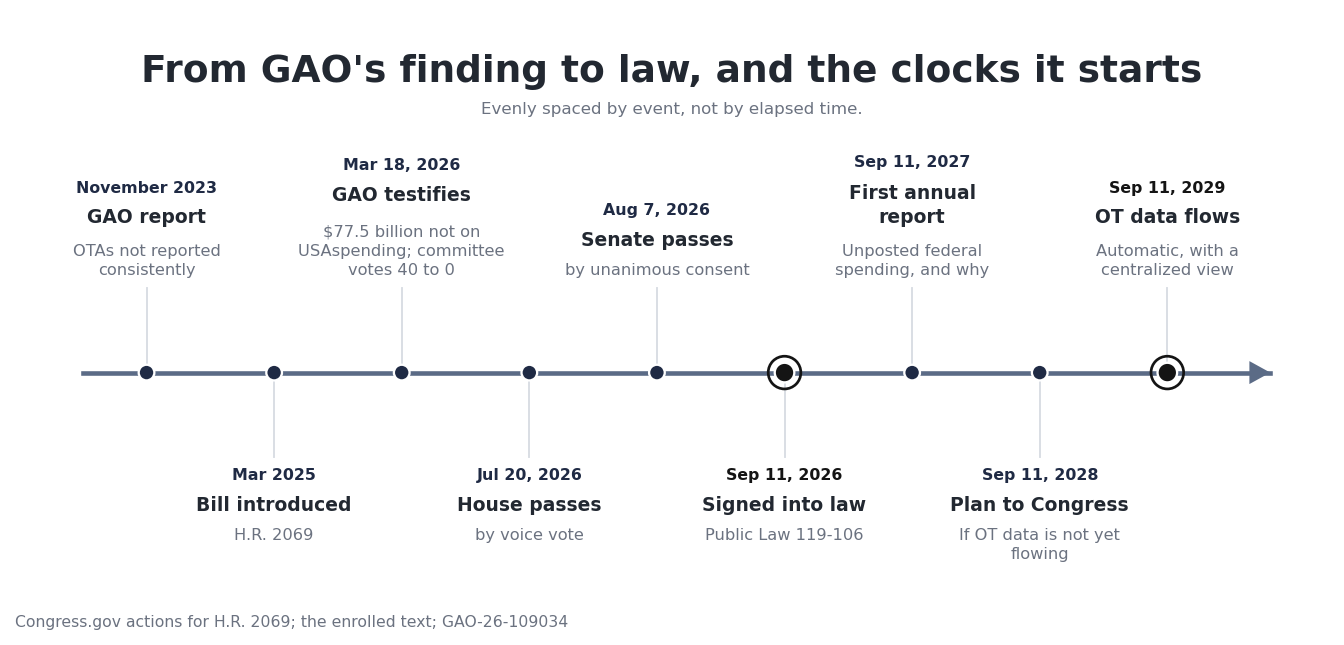
- 1OTAs are now federal awards for USAspending. The Act writes them into the definition every agency reports against. Treasury has until September 11, 2029 to make the data flow automatically, and until September 11, 2027 to post the first yearly report of spending that is still not on the site, and why.
- 2The gap was real, and GAO measured it. GAO found $77.5 billion in Department of War OTAs that sat in SAM.gov and not on USAspending across fiscal 2021 to 2025. The law neither included nor excluded them, and Treasury decided they did not belong.
- 3The data already exists, and you can read it. The Other Transactions tab reads the SAM.gov Other Transaction module. For Homeland Security and Interior, its figures agree with the Senator's release at the release's own rounding.
- 4A consortium member is the easiest OT holder to miss. In the SAM.gov data, 4,539 reported actions name the company doing the work in a separate field, while one of 95 firms is the awardee of record. Active Agreements matches on both.
- 5All of it opens on a free account. The tab has no paid tier: Active Agreements, Overview, Consortia and Guide need only an account.
01What the Act changes, and when
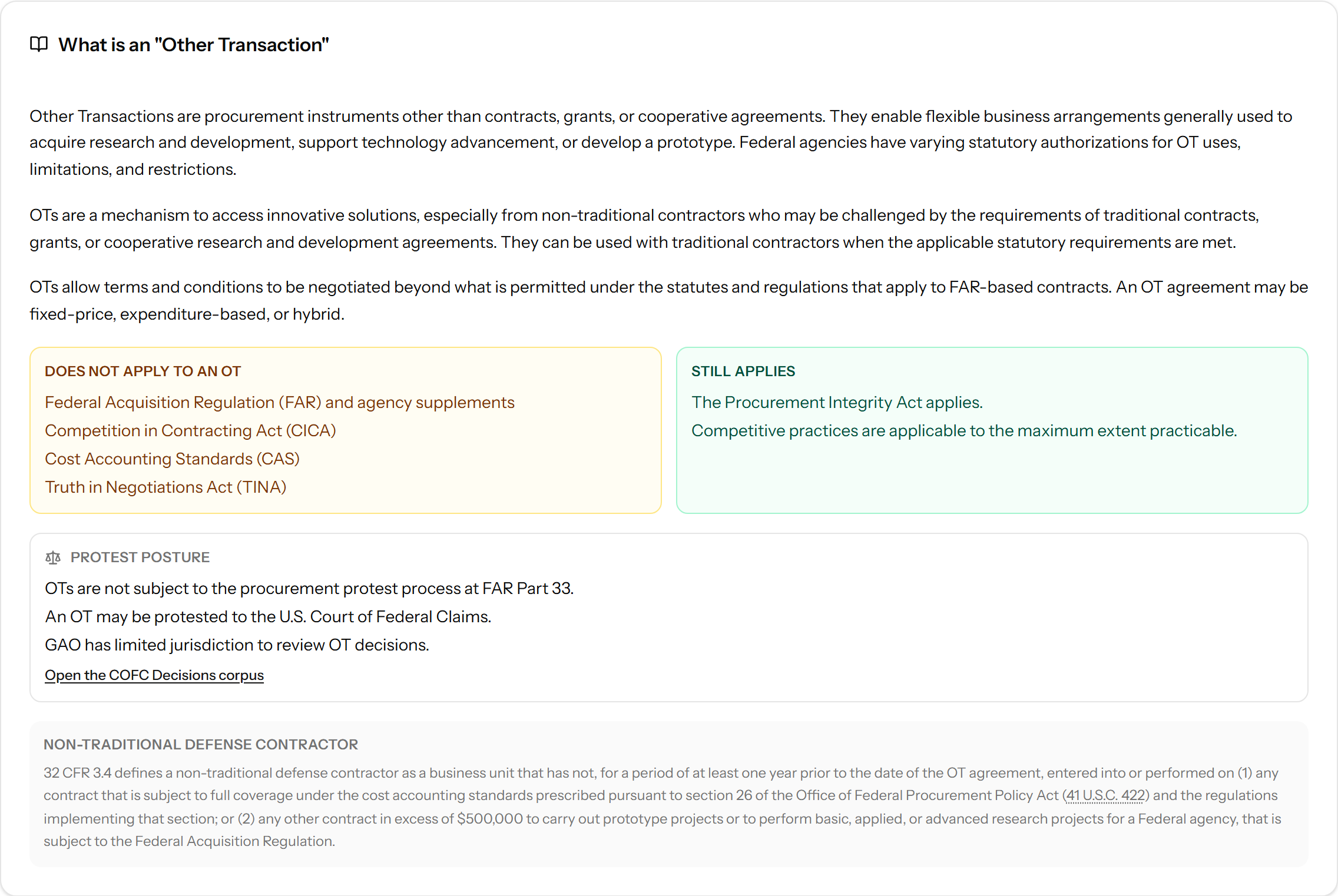
One term first. In the words of the tab's own Guide: Other Transactions are procurement instruments other than contracts, grants, or cooperative agreements. An OT is how an agency with the authority buys research and prototypes outside the usual rules. Four bodies of rules that govern a contract do not apply to one: the Federal Acquisition Regulation (FAR), Competition in Contracting Act (CICA), Cost Accounting Standards (CAS) and Truth in Negotiations Act (TINA).
USAspending is built on the Federal Funding Accountability and Transparency Act, or FFATA, which lists the kinds of award an agency must report. The Stop Secret Spending Act of 2025 adds one line to that list, so that a federal award now:
(iii) includes other transaction agreements;
The bill moved quickly once GAO had testified. Rep. Barry Moore introduced it on March 11, 2025. The House Committee on Oversight and Government Reform reported it 40 to 0 on March 18, 2026, the same day GAO testified before the Senate. The House passed it by voice vote on July 20, 2026, the Senate by unanimous consent on August 7, 2026, and it was signed on September 11, 2026.
The Act's clocks, from September 11, 2026
- BySeptember 11, 2027
- Treasury posts a yearly report of federal award spending not on the site.In the Act's words: "the total amount of Federal spending on Federal awards for which data has not been posted to the website"
- BySeptember 11, 2027
- If OT data is not flowing yet, Treasury publishes a list of the prior year's OTAs.In the Act's words: "shall publish on USAspending.gov a report that lists and includes a detailed description of all other transaction agreements entered into by the relevant agencies"
- BySeptember 11, 2028
- If it is still not flowing, Treasury sends Congress a plan to finish.
- BySeptember 11, 2029
- OT data reaches USAspending on its own, with one place to read it.In the Act's words: "data relating to other transaction agreements is automatically transmitted to the website", and "a centralized view of the data described in paragraph (1) is available on the website"
The yearly report has to give a reason for each dollar left off the site, and the Act names national security or classification among them. So even after September 11, 2029, OT spending kept off the site for those reasons is meant to appear only as a total and a reason. The Act also gives GAO a year to recommend any updates to the FAR clause that carries these reporting requirements into contracts.
02The gap GAO measured, and three counts of it
Jeff Arkin, GAO's Director, Strategic Issues, told the Senate Committee on Small Business and Entrepreneurship on March 18, 2026, that GAO had first reported the problem in November 2023. For the testimony, GAO counted it:
... identified $77.5 billion in OTAs that were reported by the Department of Defense in SAM.gov from fiscal year 2021 through 2025 but were not reported to USAspending.gov.
The reason was a gap in the statute, not a secret. GAO wrote that "FFATA does not explicitly include OTAs in the list of federal awards agencies must report to USAspending.gov, nor does it exclude OTAs from being reported".
Two agencies read the silence differently, and the one that runs the site decided OTAs did not belong on it: "Treasury told us that it did not believe agencies should report OTA spending to USAspending.gov", because OTAs fall outside the statute's express definition of a federal award.
So GAO asked Congress to close it, naming the DATA Act, the 2014 law that expanded FFATA, and in so many words: "we suggested that Congress consider amending the DATA Act to include OTAs in the list of federal awards that agencies must report to USAspending.gov". The Act does that. Senator Maggie Hassan's office, announcing the signature, put the stakes more bluntly: "billions of dollars in spending are hidden from public disclosure".
Hidden from USAspending is not the same as unpublished. The same release counts each department's OTAs over a window it states, and the Other Transactions tab can count the same window from the same SAM.gov data. Here are both, side by side:
One window, two counts: the Senator's release and the tab
Department of War
- The release
- $85 billion, more than 30,000 OTAs
- The tab, net obligated
- $72.53 billion, 28,227 actions
Does not agree: the tab rounds to $73 billion.
Department of Homeland Security
- The release
- $52.2 million, more than 700 OTAs
- The tab, net obligated
- $52.19 million, 706 actions
Agrees at the release's own rounding, $52.2 million.
Department of the Interior
- The release
- $858.8 million, more than 220 OTAs
- The tab, net obligated
- $858.77 million, 220 actions
Agrees at the release's own rounding, $858.8 million.
For Homeland Security and Interior, the dollars agree to the release's rounding. For the Department of War, the release says "The Department of Defense has obligated $85 billion through more than 30,000 hard-to-track OTA contracts", and the tab counts $72.53 billion across 28,227 actions. The release does not say what else it counted, so this is not a reconciliation.
What the tab can do is state its own basis. Its dollars are net, so a deobligation subtracts. It reads the SAM.gov feed for prototype and production OTs, and the Guide says plainly what that leaves out: "This corpus is the Other Transaction module as published by SAM.gov. It is not reconciled against actions deleted or voided after the fact, and Research OTs reported through FAADC are not part of it."
Over GAO's own window, fiscal 2021 to 2025, the tab counts $71.2 billion of Department of War OTAs against GAO's $77.5 billion. The testimony does not say how GAO counted, so that difference is not a reconciliation either.
03Active Agreements and Overview: your OTs, and the market
Two views of the same 9,290 agreements. Active Agreements answers what your company holds. Overview answers what is happening across Other Transactions. Both read the same download, so they can never disagree about a number.
1Match your company on both fields that can name it
This view exists because of how consortium work is reported. When the government awards a project through a consortium, the awardee of record is usually the consortium's manager. The company actually doing the work is named in a separate field, if it is named at all.
As of September 24, 2026, 4,539 actions across 1,031 agreements name 621 performing members this way, while the awardee of record on those actions is one of 95 firms. Search the awardee column alone and those 621 companies hold nothing. Active Agreements matches your UEI on both fields.
GovConDash.ai
See the OTs your company holds before USAspending does, free
Create a free account and add your company's UEI in Setup. Active Agreements then lists every Other Transaction that names your UEI, as the awardee or as the performing consortium member, and labels each one Direct OTA award or Via consortium.
2Start from the whole market
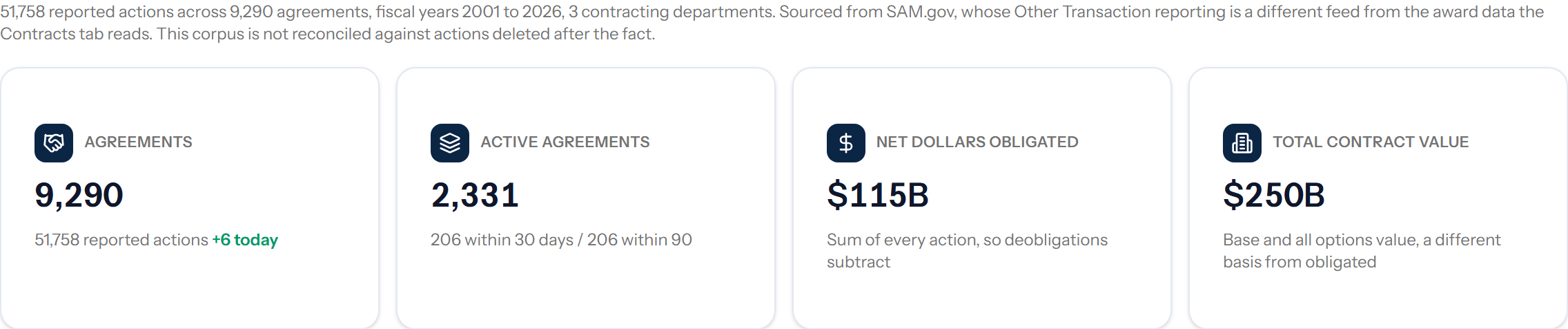
The header counts 9,290 agreements, 2,331 of them active, $114.7 billion net obligated and $250 billion in base and all options value. Of the agreements, 8,704 are prototype OTs and 585 are production awards. The newest action was signed September 23, 2026.
3See how fast OT spending grew
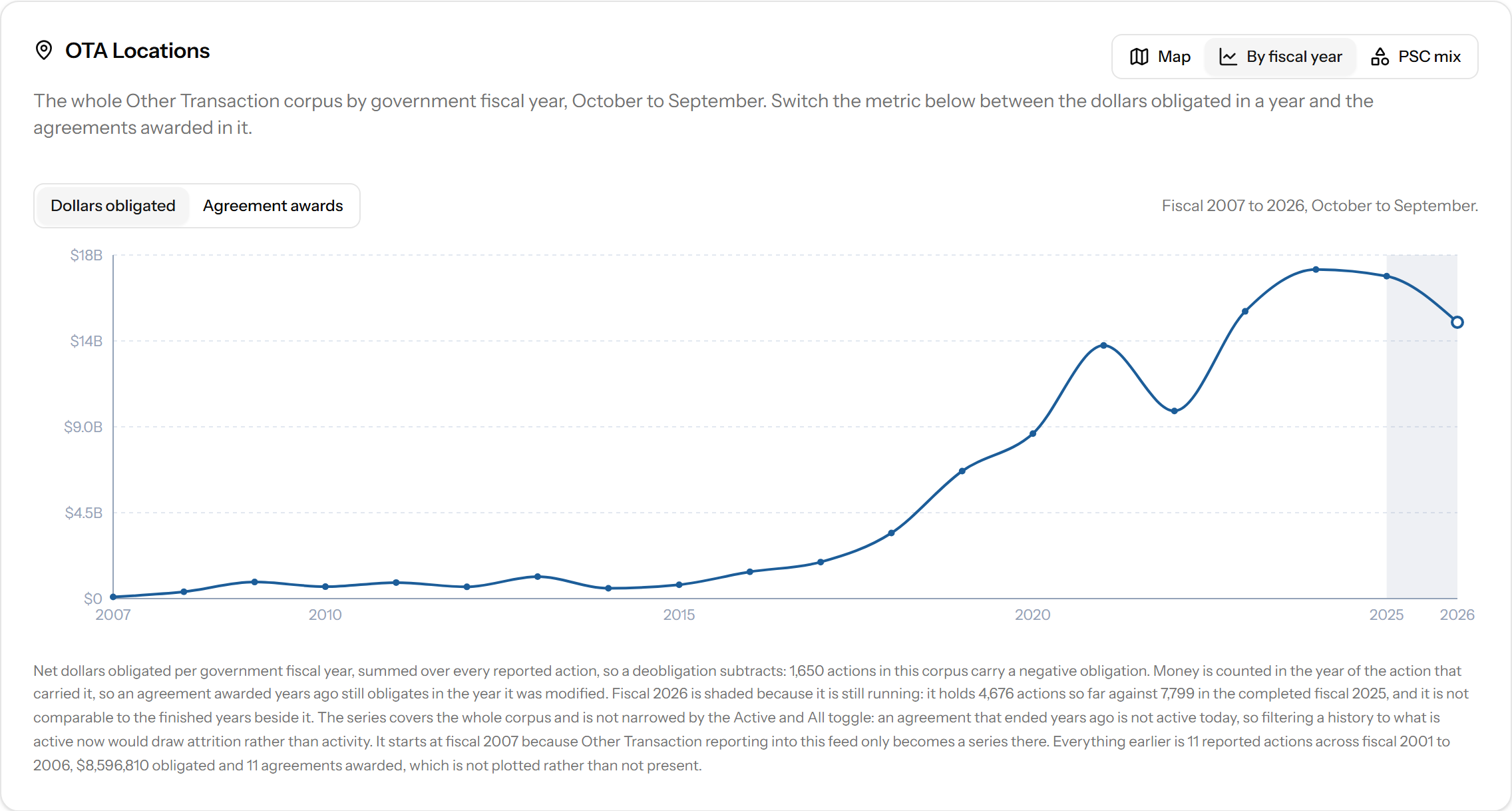
The same card that maps agreements by state switches to a fiscal year series. Across all three departments the tab counts $72.3 billion obligated in fiscal 2021 through 2025, and $16.9 billion in fiscal 2025 alone. Of all the actions, 1,650 carry a negative obligation, which is why a year can fall as it fills.
4Notice who the awardee really is
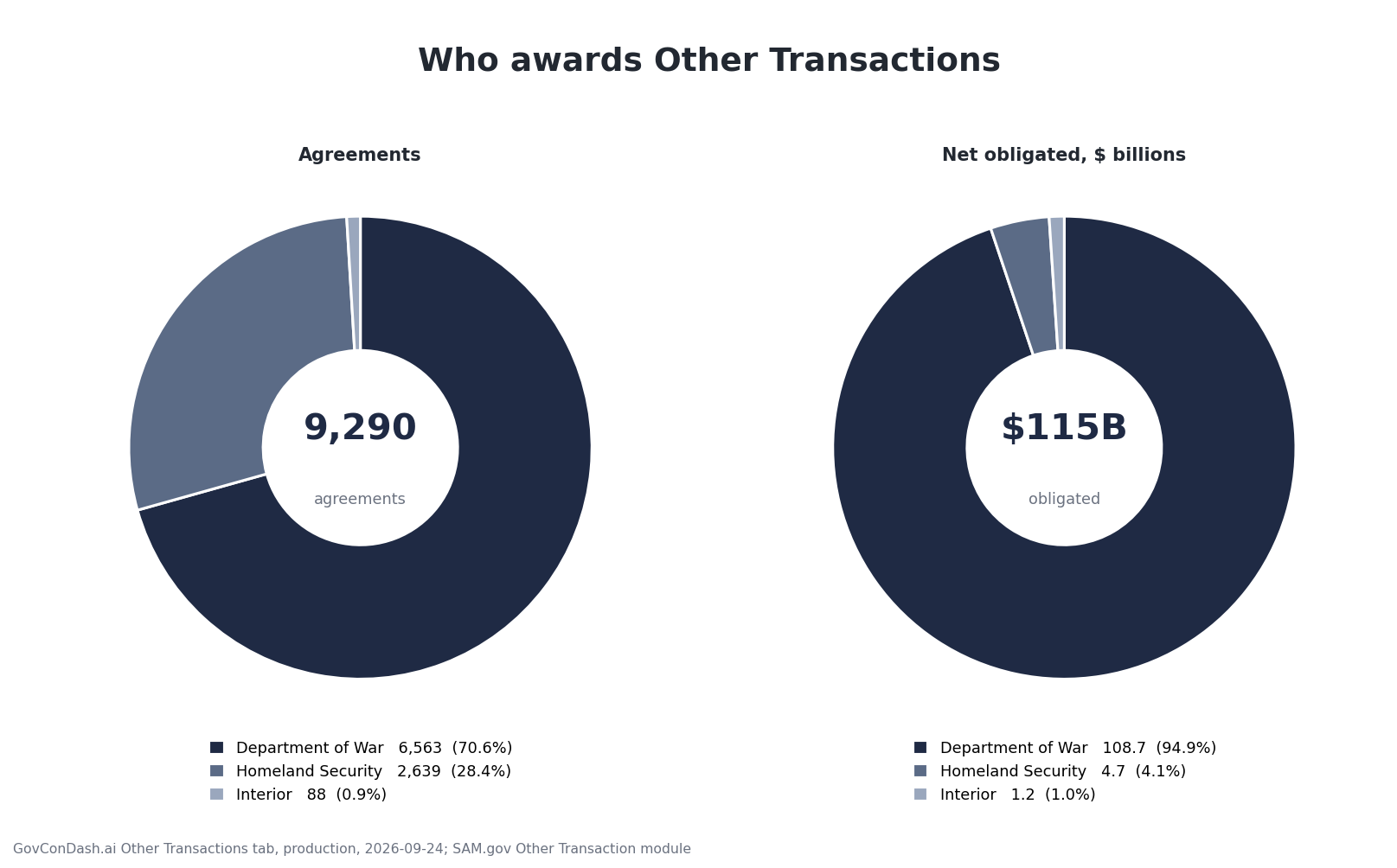
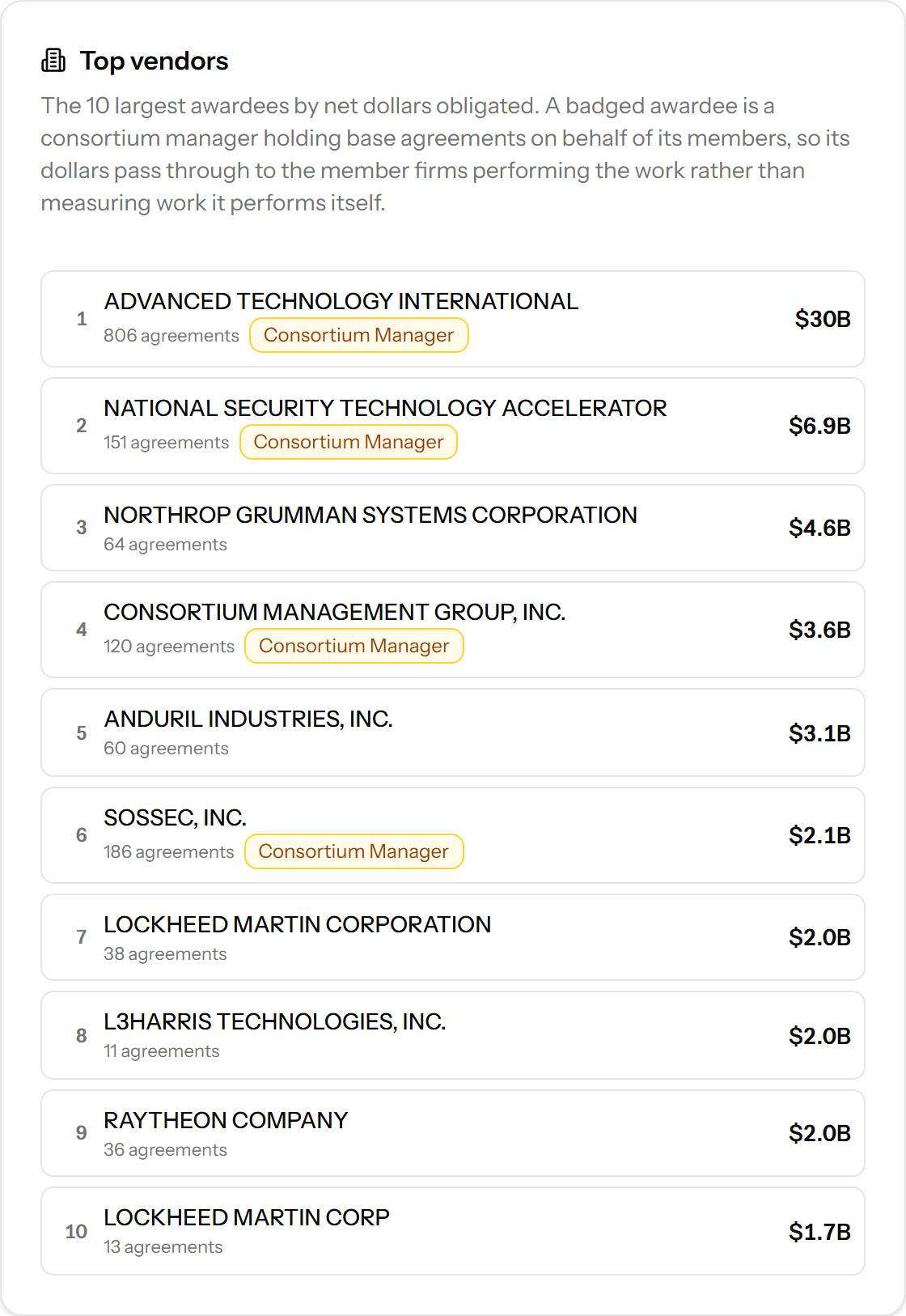
The largest awardee of record is a consortium manager, and so are three more of the top ten. That is the same pattern the member field shows: a large share of OT dollars is reported under a firm that manages the work rather than performs it.
04Consortia: who you go through
Consortia are where most contractors meet the OT world, and where the criticism lands. Jason Miller's column at Federal News Network listed the two complaints: "First, DoD too often goes through consortiums to seek proposals and many times these consortiums cost money to belong to." And: "Second, details of OTAs from the initial request to the award are often unavailable to the general public."
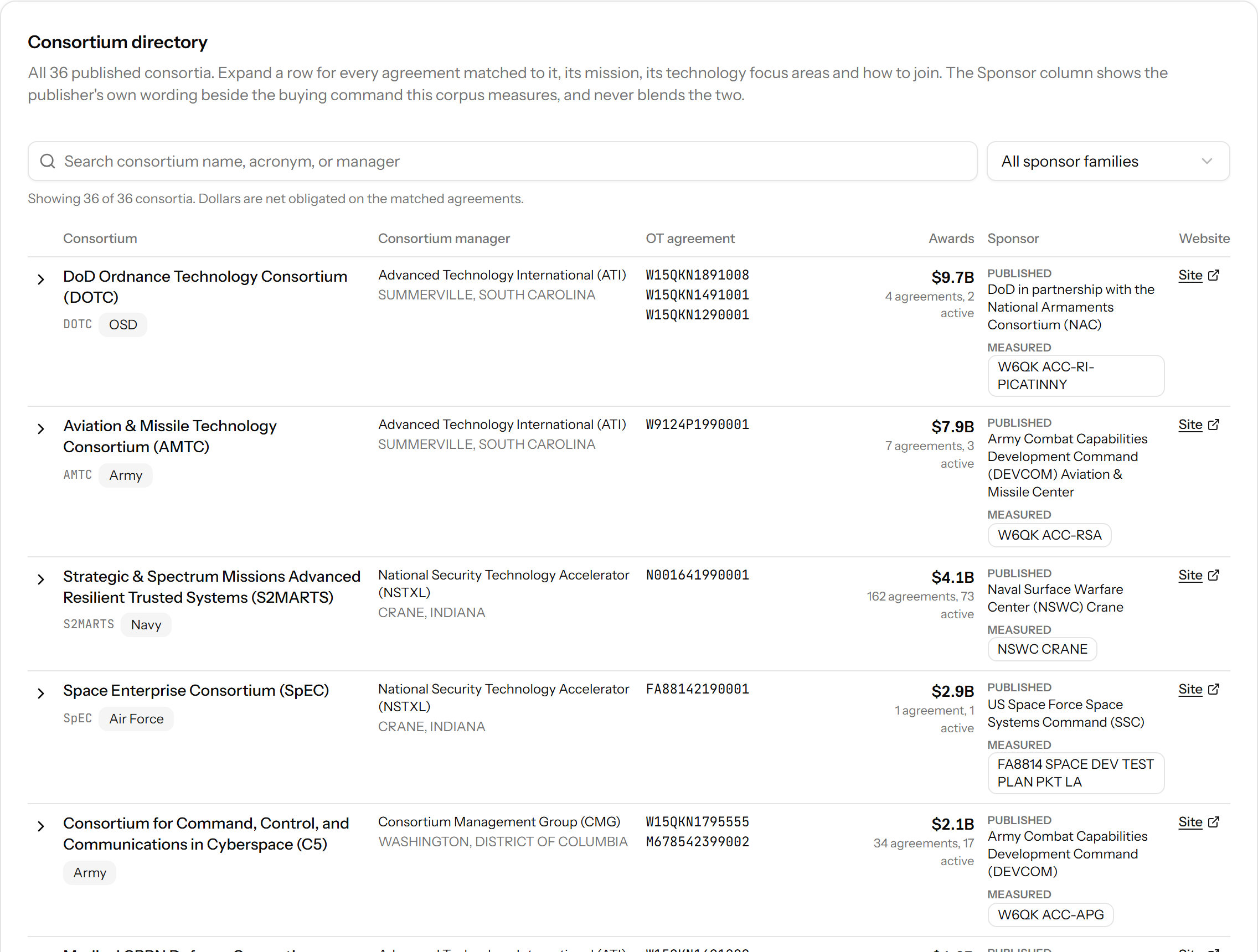
The Consortia sub-tab answers the first complaint with the published directory: 36 consortia from MITRE AiDA, last revised by the publisher on September 22, 2025. Each carries its manager, its sponsor and how to join. It answers the second by joining each consortium to the agreements reported under it, so you can see what has actually gone through it.
5See how much work runs through consortia
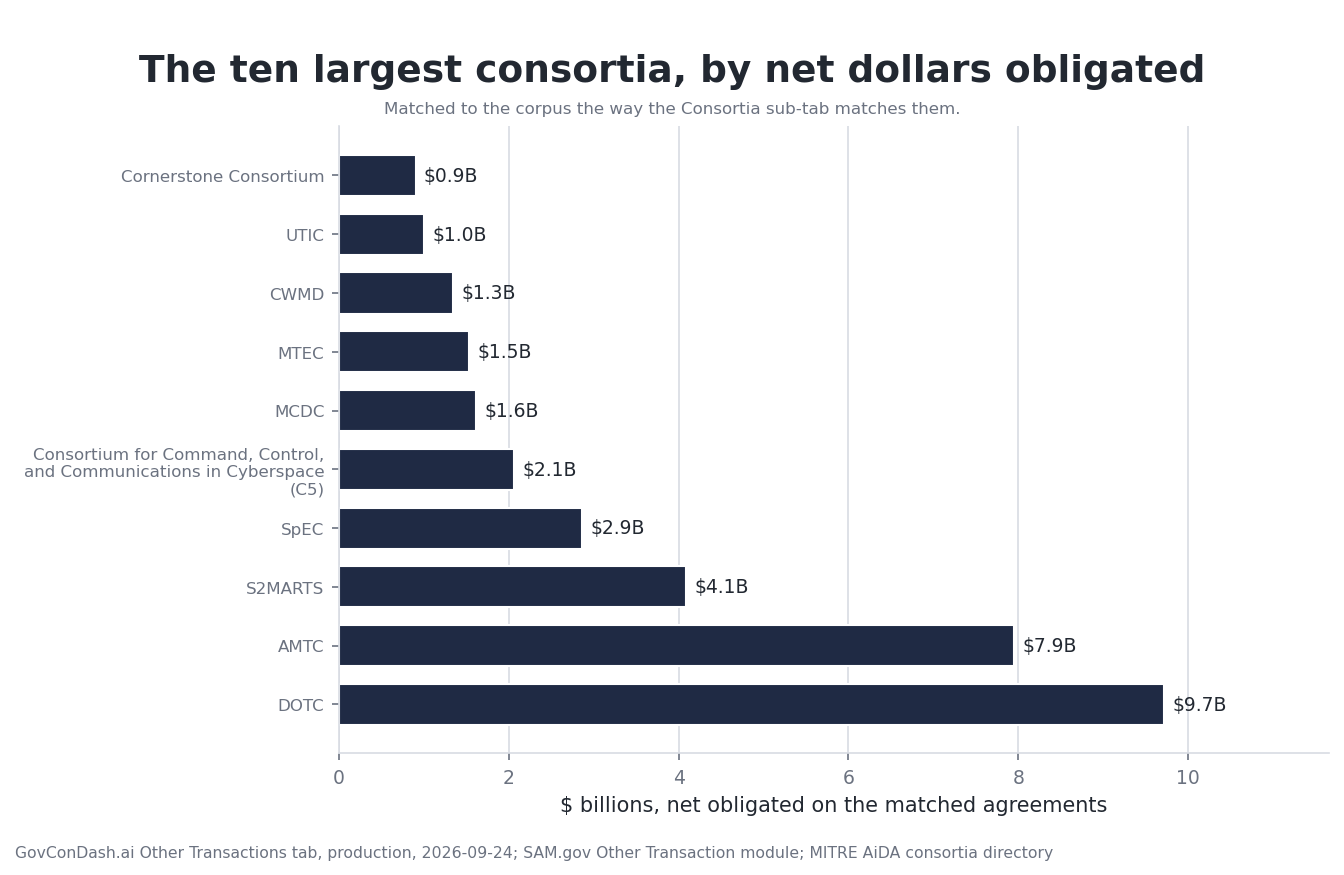
Of the 36 consortia, 31 match at least one agreement here: 1,176 agreements, $37.1 billion net obligated, and 449 distinct member companies named on them.

6Find the consortium that buys what you build
Search by name, acronym or manager, or filter by sponsor family. Expand a row to see every agreement matched to that consortium, its mission, its technology focus and how to join. The sponsor the publisher names sits beside the buying command the data shows, because the two are not always the same office.
05Guide: the rules an OT runs on
The same column noted "the fact OTAs are basically protest proof". The Guide sub-tab is more careful, and it is worth knowing why. On protests it says:
- OTs are not subject to the procurement protest process at FAR Part 33.
- An OT may be protested to the U.S. Court of Federal Claims.
- GAO has limited jurisdiction to review OT decisions.
Harder to protest is not the same as protest proof, and a contractor weighing an OT should know which forum is open before the award, not after it.
7Know which rules do not follow you into an OT
The card says what does not apply, what still does, and where a protest can go. It also defines the non-traditional defense contractor, the status behind the first condition the Guide lists for awarding a prototype OT.
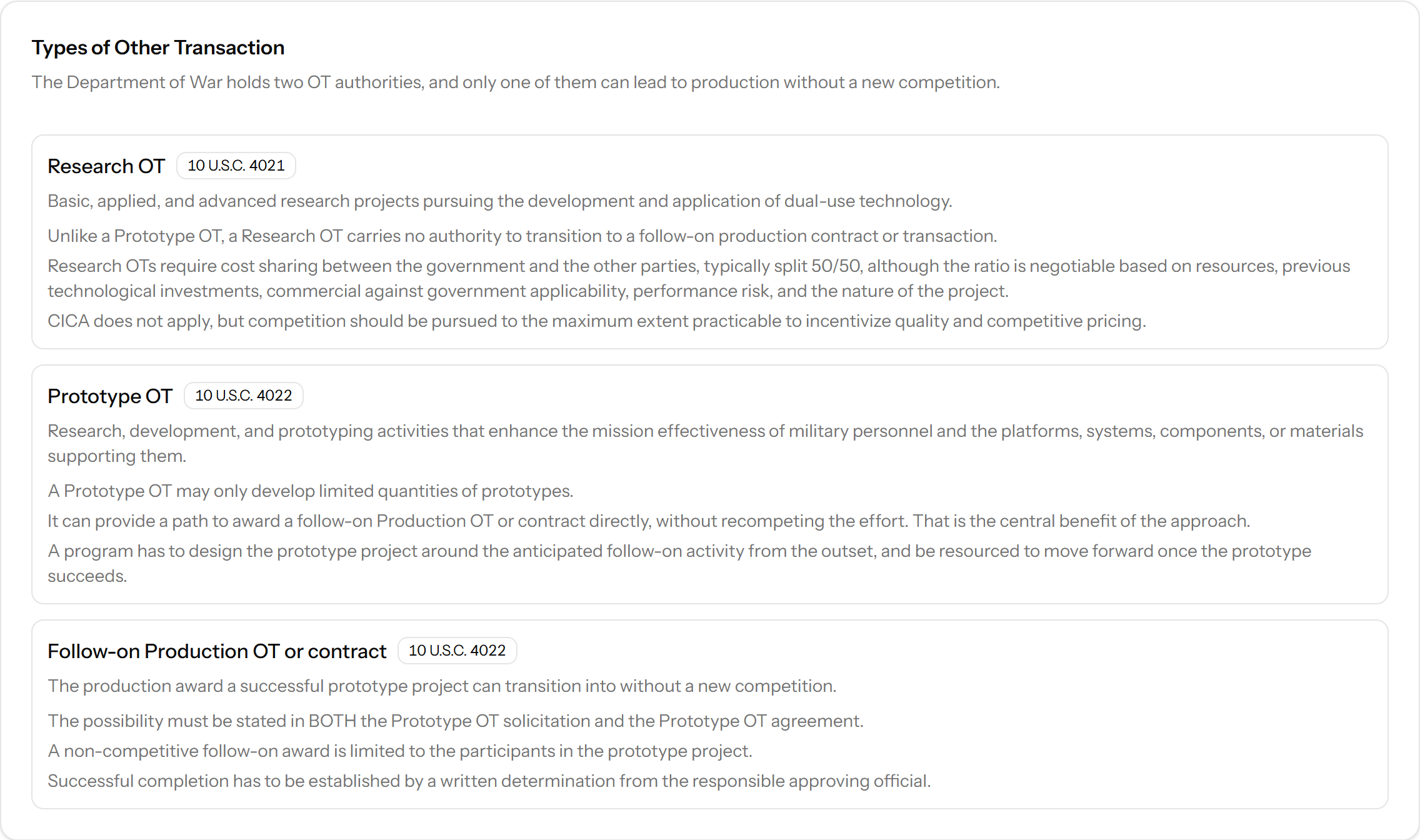
8Tell the three kinds of OT apart
The three are the Research OT (10 U.S.C. 4021), Prototype OT (10 U.S.C. 4022) and Follow-on Production OT or contract (10 U.S.C. 4022). Only the prototype path can lead to production without a new competition. Further down, the Guide lists the 19 agencies Congress has given OT authority, under 23 separate grants of it, and the approval thresholds for prototype and production awards. It closes with 14 primary documents, including the Department's OT guide and DARPA's guide to research OTs.
06Where this lives in GovConDash
The tab sits in Portfolio / Other Transactions, directly under Contracts. That placement is deliberate. The Contracts tab reads a company's awards from USAspending, which is where GAO found OTs were not being reported, so a company holding a prototype OT may see nothing of it there.
Other Transactions / Active Agreements
The OTs your company holds
Matched on your UEI as the awardee or as the performing consortium member, each match labeled. Free with an account.
Other Transactions / Overview
The whole OT market
Totals, a map, the fiscal year series, the top organizations and awardees, and every agreement with its full modification history. Free with an account.
Other Transactions / Consortia
Who you could go through
The published consortia, each joined to the agreements it has actually won. Free with an account.
Other Transactions / Guide
The rules an OT runs on
Definitions, authorities by agency, the three types, approval thresholds and the primary documents. Free with an account.
What it cannot see yet: research OTs, which are reported to a different system, and anything deleted or voided after it was reported. When USAspending starts carrying OT data, this tab will be one more way to read it rather than the only one.
Documents and data used in this piece
Every quotation above was checked against a stored copy of its source before this page was written, 30 checks in all. The figures taken from a quotation were read out of its own words. Every figure about the tab is what it served on the production site on September 24, 2026, and every product fact was read from the part of the product that decides it. If a single check fails, nothing is written.
The law
- H.R. 2069, Stop Secret Spending Act of 2025, enrolled text
U.S. Government Publishing Office. The Act as passed by both chambers and signed, Public Law 119-106.
- H.R. 2069, all actions
Congress.gov. The bill's path from introduction to signature, and its Senate companion.
The record behind it
- GAO-26-109034, Federal Information Transparency: Action Needed to Improve Efficiency and Effectiveness and Enhance Program Integrity
U.S. Government Accountability Office. Testimony before the Senate Committee on Small Business and Entrepreneurship, March 18, 2026.
- Signed into law: Hassan-backed bill to increase transparency of government spending
Office of Senator Maggie Hassan. The release announcing the Act, with each department's figures.
- Transparency coming to OTAs, value of VARs
Federal News Network. Jason Miller's column on the Senate bill and the case for it.
What the tab is built on
- Other Transaction Authority
MITRE AiDA. The reference the Guide sub-tab is adapted from, with attribution.
- Existing OT Consortia
MITRE AiDA. The published directory the Consortia sub-tab is built from.
- DoD Other Transactions Guide (July 2023, 508 update July 2025)
Office of the Under Secretary of Defense for Acquisition and Sustainment. The Department's guide to prototype and follow-on production OTs.
- Guide to Research Other Transactions Under 10 U.S.C. 4021 (12 February 2026)
DARPA. The guide to research OTs.
This platform
- GovConDash.ai Other Transaction corpus
GovConDash.ai. The SAM.gov Other Transaction module as the tab served it on the production site on September 24, 2026.
Disclaimer. This piece is commentary on a public law, a GAO testimony, public statements and published award data. It is not legal advice, and it is not a determination about any contractor, agreement or consortium. Confirm how the Act affects your reporting with counsel or a government contracts professional.

Inside GovConDash takes one surface of this platform per edition and walks it end to end: what it reads before it acts, what it produces, and what it cannot see. This one is Other Transactions.
Keep reading
Reading the FAR the Way It Applies TodayThe previous edition of Inside GovConDash: the eCFR Research tab, and the FAR as it applies once the class deviations are read beside it.