































Proposed rule · U.S. Small Business Administration
Published August 20, 2026
Small Business Size Standards
91 FR 53741 · FR Doc. 2026-17042 · RIN 3245-AI67 · Docket SBA-2026-0199
- Comments due
- November 20, 2026, extended from September 21, 2026 by 91 FR 60524
- Comments posted so far
- 3,159 on SBA-2026-0199, as of November 12, 2026
- What it replaces
- The table of size standards at 13 C.F.R. 121.201
- Status
- Proposed. Size is measured against the table in force until SBA publishes a final rule.
The brief
- 1Most size standards would go up. Of the 974 industries in 13 C.F.R. 121.201, the proposal raises 739, leaves 59 where they are, lowers one, and moves 173 from a receipts standard to an employee standard. Receipts standards rise the most: Independent Artists, Writers, and Performers goes from $9.0M annual receipts to $651.0M annual receipts.
- 2SBA expects tens of thousands of contractors to become small. It estimates 37,002 firms holding FY 2025 contracts, worth more than $71 billion, would be newly small, with Engineering Services (541330) leading at 5,314 firms.
- 3Every exception would end. Nine industries lose their carve-outs, among them the military and aerospace exception in 541330 and the IT value added reseller exception in 541519, which today caps resellers at 150 employees.
- 4Comments are due November 20, 2026, and they are public. 3,159 have been posted to the docket so far. GovConDash's free NAICS code pages put any code's standard today beside SBA's proposal, with the comment link.
Look up your code first
Every six-digit NAICS code has a public page on GovConDash, with no account needed: the size standard in force, the standard SBA proposed for it, any exception it would lose, and a link to the comment docket while comments are open. Start with NAICS 336411, Aircraft Manufacturing, or browse every code from the NAICS page.
1The ruleWhat SBA proposed
Today, SBA sets a size standard for each six-digit NAICS industry, with exceptions for particular kinds of work. SBA is now "proposing new size standards for 338 industry groups and industries", 276 of them at the four-digit industry group and 62 at the five-digit industry, and every six-digit code takes the standard of the group it sits in. SBA says the new standards are "designed to better reflect the nature of the markets in which small businesses compete".
SBA names five changes to how it calculates them. Beyond the move to four-digit and five-digit groups, "SBA has also proposed to remove all size standard exceptions". The new method "defaults to employment-based size standards for all industry groups or industries where SBA has discretion", which is why 173 industries move from receipts to employees.
It rests a standard on the size of the market an industry competes in, and for receipts standards it "adds in an adjustment for general productivity increases in the U.S. economy as well", on top of inflation. There is also no ceiling: "The Revised Methodology has no explicit maximum size standard but does have a minimum size standard". That is how some receipts standards climb into the hundreds of millions of dollars.
"there is currently a different size standard for Ship Building (1,300 employees) than there is for Boat Building (1,000 employees)"
None of this is in force. A firm's size is still measured against 13 C.F.R. 121.201 until SBA publishes a final rule, and the final rule can differ from the proposal in any code that comments persuade SBA to change.
2Where the money isThe codes that carry the most federal dollars
Measured by federal contract dollars, the codes that matter most are mostly raised. Aircraft Manufacturing (336411), the largest code by obligations in fiscal year 2026, would go from 1,500 employees to 2,800 employees. Engineering Services would go from $25.5M annual receipts to $252.0M annual receipts, and Computer Systems Design Services and Other Computer Related Services each from $34.0M annual receipts to $531.0M annual receipts.
The 10 NAICS codes with the most federal contract dollars, fiscal year 2026
NAICS 336411
Aircraft Manufacturing
- Size standard today
- 1,500 employees
- Proposed by SBA
- 2,800 employees
Raised 87%
Open the page for NAICS 336411Commercial and Institutional Building Construction (236220) is the one code in that list that switches measure, from annual receipts to employee count: $45.0M annual receipts to 600 employees. A builder whose receipts sit above today's standard can be small under the proposal if its headcount sits below the new one, and the reverse is true as well, so the question to answer before you comment is what your own employee count is.
3Who becomes smallWhere SBA counts the most contractors turning small
SBA estimates the proposal would take the count of small businesses from 6,344,967 to 6,459,508, a net increase of 114,541. Of those, 37,002 firms already held federal contracts in FY 2025: 105,655 contracts worth more than $71 billion. SBA estimates that fewer than 200 businesses would lose small status.
How far the standard moves in SBA's top 20 codes for newly small contractors
NAICS 541330
Engineering Services
5,314
Marker size: contractors SBA says would become small
- Size standard today
- $25.5M annual receipts
- Proposed by SBA
- $252.0M annual receipts Raised 9.9x
The list is professional services and IT. Engineering Services leads with 5,314 firms, followed by Other Computer Related Services with 2,247 and Custom Computer Programming Services with 2,171. If you are a small business in one of those codes today, the firms joining you are the ones just above your current standard. SBA says so itself:
"Increased competition is likely to have the greatest impact on businesses most similar in size to the businesses that would be newly classified as small"
That is the comment a small incumbent can make that a larger firm cannot: what the change would do to the set-asides in your code, with your own numbers.
4ExceptionsThe exceptions that would end
Today nine industries carry exceptions in 13 C.F.R. 121.201, a separate standard for a particular kind of work. The proposal ends all of them, and each industry takes its group's single standard. For defense work, these are the ones to read first. Engineering Services, NAICS 541330, carries three exceptions at $47.0M annual receipts, among them Military and Aerospace Equipment and Military Weapons; the whole industry would be $252.0M annual receipts. Research and Development in the Physical, Engineering, and Life Sciences (except Nanotechnology and Biotechnology), NAICS 541715, carries three for aircraft and missile work; the industry would be 2,800 employees.
The largest single swing is the reseller exception in 541519: Information Technology Value Added Resellers is held to 150 employees today and would fall under the industry's proposed $531.0M annual receipts. Resellers that count employees today would count receipts.
115310Support Activities for Forestry
Exceptions today
- Forest Fire Suppression: $34.0M annual receipts
- Fuels Management Services: $34.0M annual receipts
Industry standard today: $11.5M annual receipts
Proposed, for the whole industry
$191.0M annual receipts
237990Other Heavy and Civil Engineering Construction
Exceptions today
- Dredging and Surface Cleanup Activities: $37.0M annual receipts
Industry standard today: $45.0M annual receipts
Proposed, for the whole industry
900 employees
238990All Other Specialty Trade Contractors
Exceptions today
- Building and Property Specialty Trade Services: $19.0M annual receipts
Industry standard today: $19.0M annual receipts
Proposed, for the whole industry
550 employees
488510Freight Transportation Arrangement
Exceptions today
- Non-Vessel Owning Common Carriers and Household Goods Forwarders: $34.0M annual receipts
Industry standard today: $20.0M annual receipts
Proposed, for the whole industry
$259.0M annual receipts
541330Engineering Services
Exceptions today
- Military and Aerospace Equipment and Military Weapons: $47.0M annual receipts
- Contracts and Subcontracts for Engineering Services Awarded Under the National Energy Policy Act of 1992: $47.0M annual receipts
- Marine Engineering and Naval Architecture: $47.0M annual receipts
Industry standard today: $25.5M annual receipts
Proposed, for the whole industry
$252.0M annual receipts
541519Other Computer Related Services
Exceptions today
- Information Technology Value Added Resellers: 150 employees
Industry standard today: $34.0M annual receipts
Proposed, for the whole industry
$531.0M annual receipts
541715Research and Development in the Physical, Engineering, and Life Sciences (except Nanotechnology and Biotechnology)
Exceptions today
- Aircraft, Aircraft Engine and Engine Parts: 1,500 employees
- Other Aircraft Parts and Auxiliary Equipment: 1,250 employees
- Guided Missiles and Space Vehicles, Their Propulsion Units and Propulsion Parts: 1,300 employees
Industry standard today: 1,000 employees
Proposed, for the whole industry
2,800 employees
562910Remediation Services
Exceptions today
- Environmental Remediation Services: 1,000 employees
Industry standard today: $25.0M annual receipts
Proposed, for the whole industry
$113.0M annual receipts
611519Other Technical and Trade Schools
Exceptions today
- Job Corps Centers: $47.0M annual receipts
Industry standard today: $21.0M annual receipts
Proposed, for the whole industry
$56.0M annual receipts
5CommentsHow to comment, and when
SBA first set the deadline at September 21, 2026, then extended it 60 days by 91 FR 60524: "Comments must be received on or before November 20, 2026". Comments go to docket SBA-2026-0199 on Regulations.gov, identified by RIN 3245-AI67. As of November 12, 2026, 3,159 public comments had been posted there, 209 of them in the last month. The methodology the standards were calculated with has its own docket, SBA-2026-0265, with 997 comments.
"SBA will post all comments on this proposed rule on www.regulations.gov", so write for a public record. A comment SBA can use names the code, says what the proposed standard would do to your firm and to the competition in that code, and gives the receipts or headcount behind it. If a figure is confidential business information, follow the instructions in the extension notice rather than posting it.
Key takeaways
- Check every code you register, not just your primary. Each takes its group's standard, and a switch from receipts to employees can move you either way.
- If you hold an exception today, plan for losing it. Military and aerospace engineering, aircraft research and IT resale would each be measured by their industry's single standard.
- Small incumbents should expect more competition for set-asides. SBA says the firms just above today's standards are the ones that join you.
- Comment with your own numbers. Name the code, the effect on your firm and its competition, and the figures behind it.
- The deadline is November 20, 2026. Until a final rule is published, size is still measured against the table in force.
Check your own codes on GovConDash
Before you write a comment, find out what the proposal does to the codes you actually bid under. The screens below show it for XYZ, Inc., the fictitious company of the GovConDash demo account.
1Start from the public page for a code
Every six-digit code has a page on GovConDash that anyone can open, no account needed. It shows the standard in force, any exceptions the code carries today, the standard SBA proposes in their place, and a button to the comment docket while comments are open. Here is NAICS 541330, Engineering Services: $25.5M annual receipts today with three exceptions, and $252.0M annual receipts for the whole industry under the proposal.
2See every code you are registered under at once
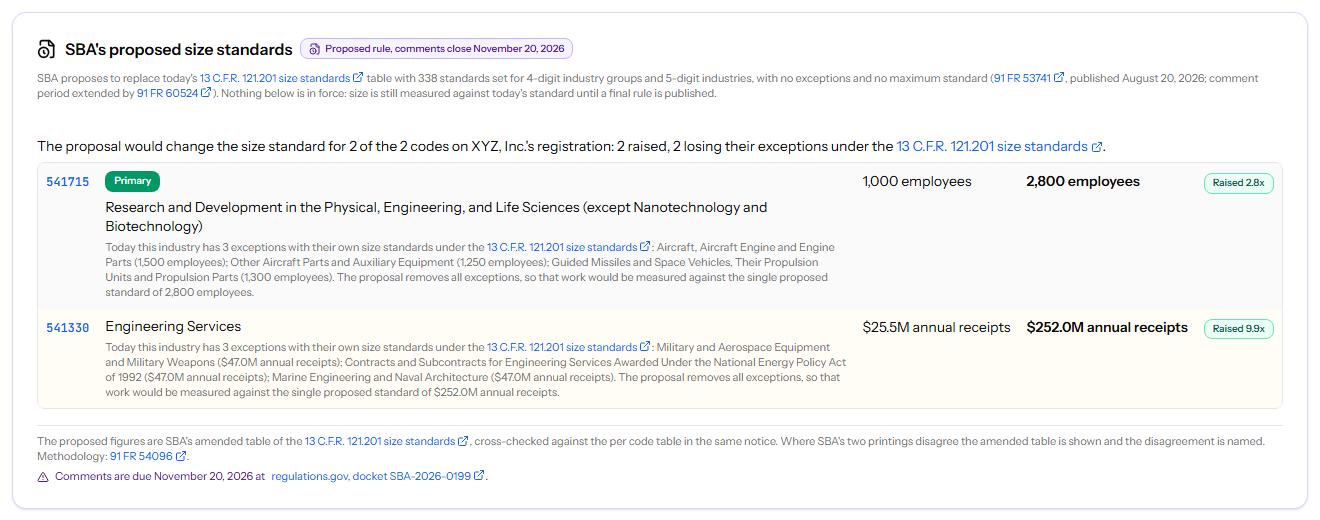
In the dashboard, the NAICS tab reads the codes in your SAM.gov registration and sets SBA's proposal beside today's standard for each one, with the exceptions each code would lose written out. XYZ, Inc. is registered under 541715 and 541330: both standards would rise, and both codes would lose their exceptions. An advisor sees the same comparison for every client on the roster.
3Open a code to read what moves
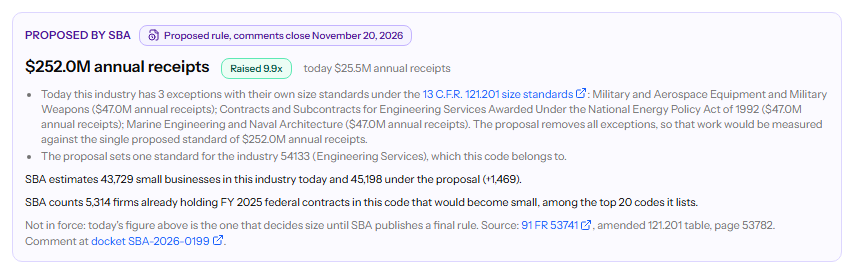
Open a code and its page in the dashboard carries the full proposal block: the proposed standard against today's, what happens to the exceptions, SBA's estimate of small businesses in the industry today and under the proposal, and, for SBA's top codes, how many contractors would become small. The same page shows who buys under the code and who wins it, the firms you would meet in a set-aside if the standard moves.
Documents and data used in this piece
The proposed rule
- Small Business Size Standards, 91 FR 53741 (August 20, 2026)
SBA's notice of proposed rulemaking, FR Doc. 2026-17042, RIN 3245-AI67. Every quotation in this piece is from its text.
- 91 FR 53741, printed edition (PDF)
The printed pages, including the amended 13 C.F.R. 121.201 table, which SBA published only as page images.
- Small Business Size Standards: Revised Size Standards Methodology, 91 FR 54096
The white paper the proposed standards were calculated with, open for comment in its own docket.
- Extension of comment periods, 91 FR 60524
Moved the deadline for both documents from September 21, 2026 to November 20, 2026.
Commenting
- Docket SBA-2026-0199 on Regulations.gov
The proposed rule, its extension and the public comments posted to it (3,159 as of November 12, 2026).
- Comment on SBA-2026-0199
The comment form for the proposed rule, open until November 20, 2026.
- Comment on SBA-2026-0265, the Revised Methodology
The separate comment form for the methodology behind the standards.
The rule in force
- 13 C.F.R. 121.201, Small Business Size Standards by NAICS Industry
The table that decides size today, and will until SBA publishes a final rule.
- 15 U.S.C. 632, Definitions (small business concern)
The Small Business Act section under which SBA sets size standards.
- Size standards, SBA contracting guide
SBA's own page on how size standards work in federal contracting.
On GovConDash
- NAICS codes and size standards
Every code's size standard beside SBA's proposal, and the ten codes with the most FY 2026 contract obligations.
- USAspending.gov
The contract obligations by NAICS code behind the /naics ranking, for fiscal year 2026.
Disclaimer. This piece is commentary on a proposed rule. It is not legal advice, and it is not a size determination for any business. A proposed size standard is not in force; size is determined under the regulations in effect and the facts of each case. Read the proposed rule in full and confirm how it applies to you with counsel.

GovConDash.ai
See what the proposal does to your codes
Start a 14-day free trial of Pro and read every code you register, and every client you advise, against SBA's proposal, beside the agencies that buy under each code and the companies that win it. Checkout takes a card and charges nothing for 14 days. Cancel before then and you pay nothing; keep going and it becomes $99 / month. One trial per account.
Keep reading
SBA Removed 689 Firms From 8(a). GSA Is Now Auditing Their Contracts.Small business status from the other side: GSA's review of the 8(a) firms holding its contracts, and the appeals it produced.